.png?width=375&height=100&name=WebPage%20logo%20with%20curves%202026%20(8).png)
Processes in the Rock Cycle
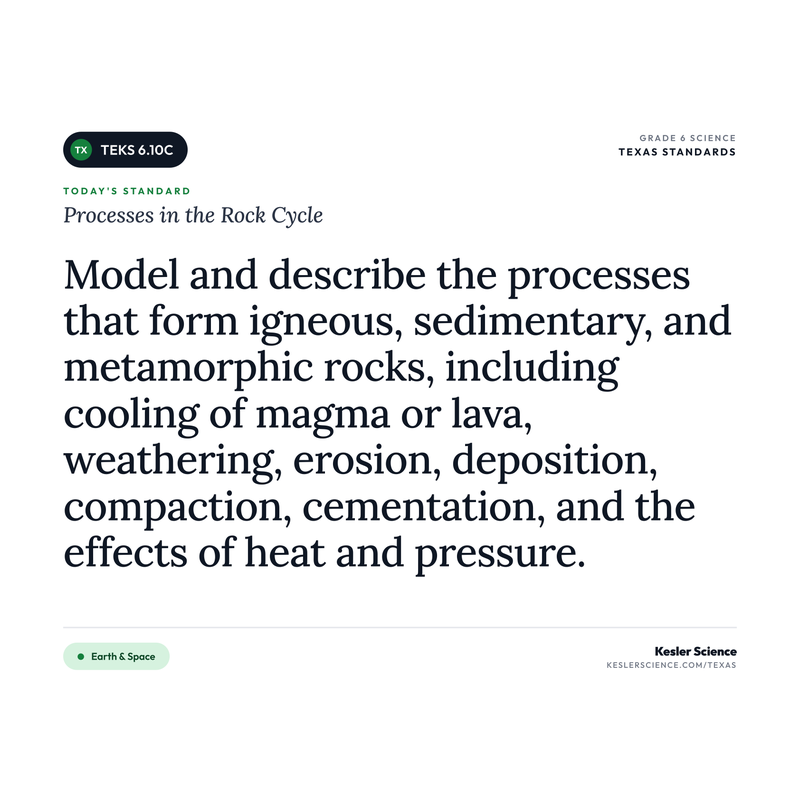
"Describe how metamorphic, igneous, and sedimentary rocks form and change through geologic processes in the rock cycle."
💡 What This Standard Actually Means
"Describe". Students are describing how the three rock types (metamorphic, igneous, and sedimentary) form and how they change into each other through geologic processes in the rock cycle. The new wording leans heavily on the rock cycle as the through-line. Kids need to explain not only how each rock type forms but how rocks move from one form to another over time. Instruction can take many forms, such as crayon-shavings rock cycle labs, real rock sample stations, rock cycle storyboards, and concept-map drawings.
Three rock types and one big cycle. Igneous rocks form when molten rock cools and hardens. Inside the Earth, molten rock is called magma. When it reaches the surface, it's lava. Cool slowly underground and you get larger crystals (granite). Cool quickly on the surface and you get small crystals or glassy rock (basalt, obsidian). Sedimentary rocks form from pieces of older rock or the remains of living things. Weathering breaks rock apart, erosion carries the pieces, deposition drops them in layers, and over time, compaction and cementation glue the layers together into solid rock. Metamorphic rocks form when existing rock is changed by heat, pressure, or both, without fully melting. Limestone becomes marble. Shale becomes slate. The minerals rearrange while the rock stays solid.
The rock cycle is the big idea that ties them all together. Any rock can become any other rock over time. Igneous rock can weather into sediment and become sedimentary. Sedimentary rock can be buried deep and pressure-cooked into metamorphic. Metamorphic rock can melt back into magma and cool into igneous. There's no fixed starting point. The cycle just keeps running.
The geologic processes that drive the cycle are the ones students need to be comfortable naming. Weathering breaks rock down. Erosion moves the pieces. Deposition drops them somewhere new. Compaction and cementation turn loose sediment into solid rock. Heat and pressure change rock without melting it. Melting and cooling turn rock into magma and back into solid rock again. Students should walk away able to start with any rock type and trace at least one path that takes it to another rock type using these processes.
I used to teach this as three separate piles: here are igneous rocks, here are sedimentary, here are metamorphic. Students memorized the piles for the quiz and forgot everything by Friday. The cycle part was the whole point, and I was burying it under vocabulary. What finally worked was starting with a question. I'd hold up a piece of granite from the schoolyard and ask, "What was this rock a million years ago, and what could it turn into next?" Then we'd map every possible path. Igneous to sediment to sedimentary. Sedimentary buried deep to metamorphic. Metamorphic melted to magma and back to igneous. Kids who thought rocks were boring suddenly wanted to argue about where a specific rock had been. Cycle first, categories second.
⚠️ Misconceptions Your Students May Have
These are some of the most common misconceptions. Knowing what to look for can help you get ahead of them.
"A rock is one type forever. Once it's granite, it's always granite."
Rocks change types. A piece of granite (igneous) on a mountainside can weather into sand, get carried downstream, pile up, and harden into sandstone (sedimentary). That sandstone can be buried deep, squeezed and heated, and transform into quartzite (metamorphic). If it's buried deep enough to melt, it becomes magma, cools, and forms a brand-new igneous rock. The rock cycle is real. Any rock can become any other type over a long enough time.
"Magma and lava are the same thing with two names"
They are the same material, but the name depends on location. Molten rock below Earth's surface is called magma. Once it erupts and reaches the surface, it's called lava. This matters because magma cools slowly underground (bigger crystals) and lava cools quickly on the surface (smaller crystals or volcanic glass). Both produce igneous rock, but the speed of cooling changes what the rock looks like.
"Weathering and erosion are the same thing"
These are two separate steps that often get jumbled together. Weathering is the breaking of rock into smaller pieces (wind, water, freeze-thaw, plant roots, chemical reactions). The pieces stay in place. Erosion is the movement of those pieces to a new location, usually by water, wind, ice, or gravity. Break it first, move it second. Students who get this distinction right have a much easier time explaining how sedimentary rocks form.
"Metamorphic rocks form when rocks melt"
Metamorphic rocks form when existing rocks are changed by heat and pressure WITHOUT fully melting. If the rock melts all the way, it becomes magma, and when it cools, it forms an igneous rock instead. The key feature of metamorphism is that the rock stays solid while its minerals rearrange and recrystallize. Marble, slate, gneiss, and schist are all rocks that were transformed, not melted.
📓 Teaching Resources for 6.10C
These resources are aligned to this standard.


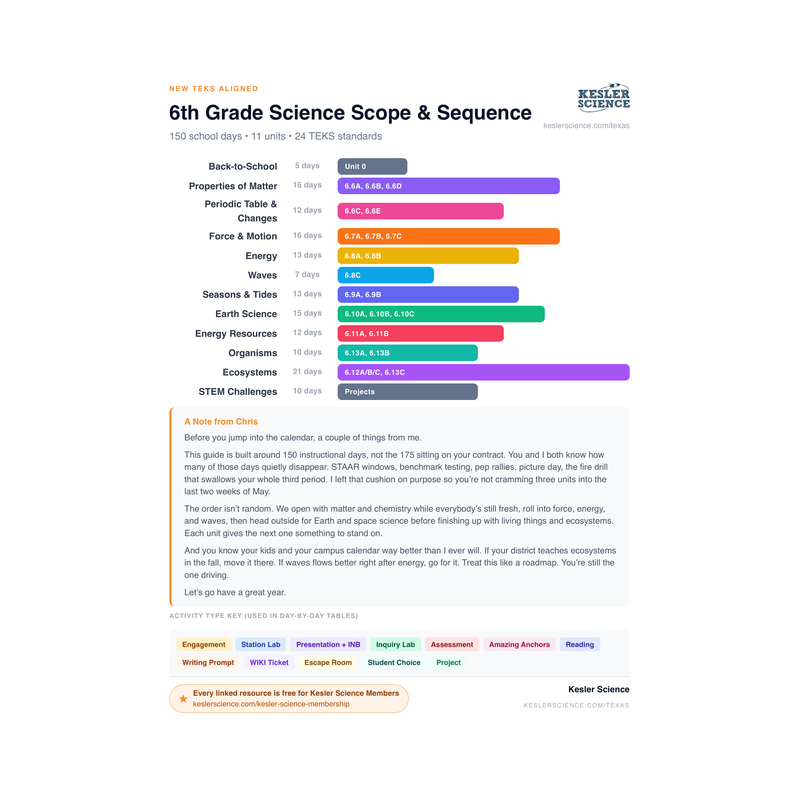
100% Aligned Lessons for Every TEKS You Teach
Kesler Science Plus puts thousands of ready-to-teach lessons and activities in your hands, so you can boost engagement and get your planning time back. Trusted by schools and districts all over the great state of Texas.
🌎 Phenomenon Ideas for 6.10C
Use these real-world phenomena to anchor your lesson. Show students the phenomenon first, let them wonder, then build toward Processes in the Rock Cycle as the explanation.
The Grand Canyon's Colorful Layers
Stand on the rim of the Grand Canyon and you can see stripes of red, tan, gray, and cream stacked on top of each other, going down for about a mile. Each layer is a different rock type, with a different story. The canyon itself was carved by the Colorado River cutting through those layers over millions of years. What used to be covered up is now a giant open textbook.
"How does a river cut a mile deep into solid rock? And why are the rock layers different colors? What does the order of the layers tell us about what happened at the Grand Canyon a long time ago?"
New Land Forming in Hawaii
On the Big Island of Hawaii, Kilauea sends rivers of glowing orange lava into the Pacific Ocean. When that lava hits the water, it hisses, steams, and hardens almost immediately. New land appears where there was ocean the day before. Hawaii is literally still being built, one lava flow at a time.
"Lava that cools quickly in the ocean turns into rock with very tiny crystals. Deep underground, the same molten material cools slowly and makes rocks with large crystals. Why would cooling speed change how big the crystals are?"
Marble Counters and Statues
The marble counter in a kitchen, the floor of a hotel lobby, a famous statue in a museum. All of it started as limestone, a sedimentary rock made from the shells of ancient sea creatures. Buried deep enough, squeezed and heated for long enough, limestone slowly changes into marble. Same atoms. New rock.
"Limestone and marble are made of the same material, but marble is much harder and can take a polish. What do you think happened to the limestone to turn it into marble? If it had been heated even more, what might have happened instead?"
💡 Free Engagement Ideas for 6.10C
Ready-to-run activities you can drop straight into a lesson. Where one of these looks like a phenomenon from the section above, that is on purpose: show it first as the hook, then let students run it themselves.
Crayon Rock Cycle
Use three colors of crayon shavings to model the rock cycle. Layer the shavings in a piece of foil (deposition and compaction = sedimentary). Press hard without melting to squeeze them together. Then apply gentle heat (like holding the foil in warm hands or briefly over a light bulb) to fuse the edges (heat and pressure = metamorphic). Finally, melt the whole thing completely and let it cool (cooling of magma or lava = igneous). Three rock types in one activity.
Weathering and Erosion in a Plastic Bottle
Fill a clear plastic bottle halfway with small pebbles or sugar cubes. Add water and shake hard for 2 minutes (weathering). Let it settle and the cloudy water shows that small pieces broke off. Now carefully tilt and pour the water and sediment into a tray (erosion). Watch the sediment settle in layers (deposition). Three rock cycle processes in 5 minutes.
Rock Cycle Story Wheel
Give each student a paper plate. They divide it into 6 wedges, then draw and label the path a grain of sand could take through the cycle (start as sediment, become sedimentary, get buried and become metamorphic, melt into magma, cool into igneous, weather back to sediment). Arrows connect each wedge. Students present their plate to a partner and explain at least 3 processes by name.
Starburst Metamorphic Squeeze
Give each student one or two pieces of Starburst candy (different colors work best). Unwrap and stack them. Press hard with the heel of a hand for about a minute. The colors flatten and streak but the candy does not melt. Open it up and you have a "metamorphic Starburst" with new layered patterns. It's a tactile stand-in for what pressure does to rock without melting.
🎯 What Approaches, Meets, and Masters Thinking Look Like
Here is what student thinking at each level looks like on this one task, so you know what to look for and how to move a student up.
A piece of granite (an igneous rock) is sitting on the side of a mountain. Describe a path through the rock cycle that could turn that granite into a sedimentary rock. Name the geologic processes that make it happen, in order, and explain what each one does to the rock.
- A starting point (granite, an igneous rock) and a clear ending point (a sedimentary rock).
- The processes named in a sensible order, not just listed at random.
- Weathering described as breaking the rock into smaller pieces.
- Erosion described as moving those pieces to a new place (not the same thing as weathering).
- Deposition described as the pieces dropping and piling up in layers.
- Compaction and cementation described as pressing and gluing the layers into solid rock.
- An explanation showing the granite did not stay granite forever, that a rock can change from one type into another. That is the idea kids most often miss.
The granite gets weathered and broken into little pieces by wind and rain. Then water moves the pieces somewhere else. But it is still granite the whole time. Granite is an igneous rock, so it stays igneous. A rock cannot really turn into a different kind of rock.
First, weathering breaks the granite into smaller pieces, like sand and tiny bits. Next, erosion moves those pieces, usually with water in a river, to a new place. Then deposition drops the pieces and they pile up in layers. After a long time, the weight presses the layers down (compaction) and minerals glue them together (cementation). Now the pieces are stuck into one solid rock. It is a sedimentary rock called sandstone, so the igneous granite turned into a sedimentary rock.
Weathering breaks the granite into pieces, erosion carries them away, deposition drops them in layers, and then compaction and cementation press and glue the layers into solid sandstone. So an igneous rock became a sedimentary rock. The reason it changes type is that the processes take apart the old rock and build a new one out of the pieces, so the rock is not stuck as one type forever.
And it does not have to stop there. If that sandstone gets buried really deep, the heat and pressure can change it without melting it, and it turns into a metamorphic rock like quartzite. If it gets buried even deeper and melts into magma, then cools, it becomes a new igneous rock again. That is why it is called a cycle. Any rock can become any other type if you give it enough time.
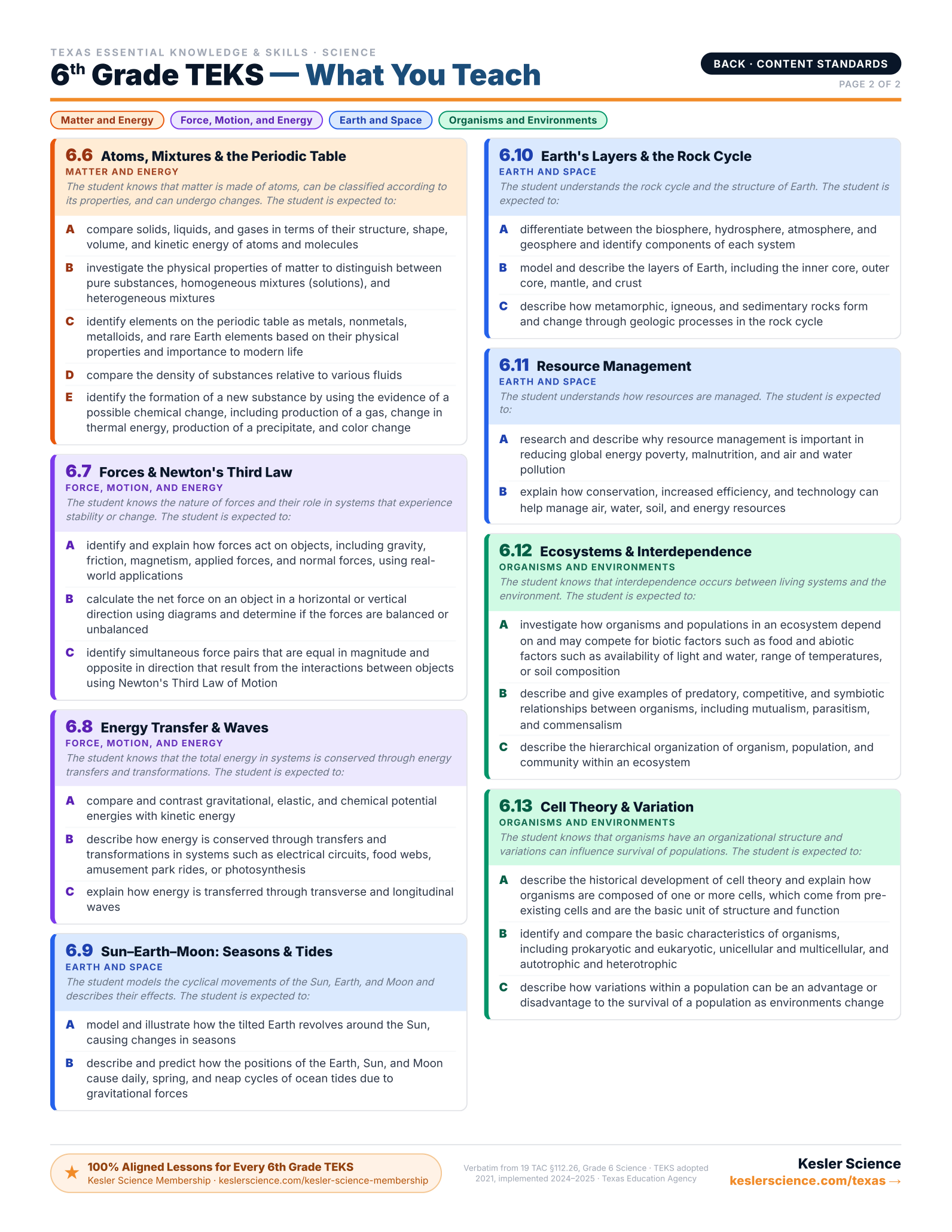
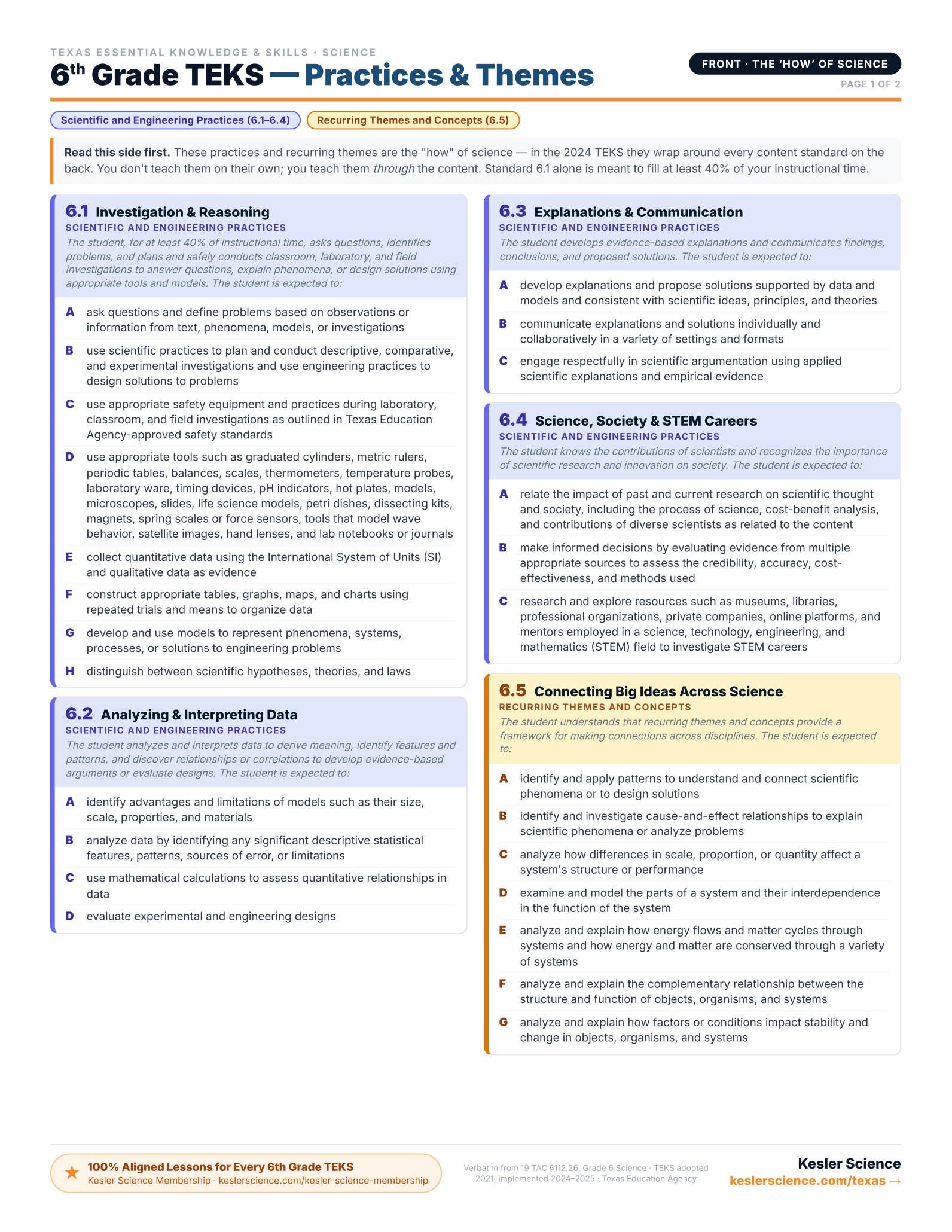
Every 6th-Grade Science TEKS on One Page
The color-coded, front-and-back cheat sheet I wish I'd had — every standard, organized by reporting category. Print it and reference it all year long. This will be your new favorite document!
Trusted Across Texas
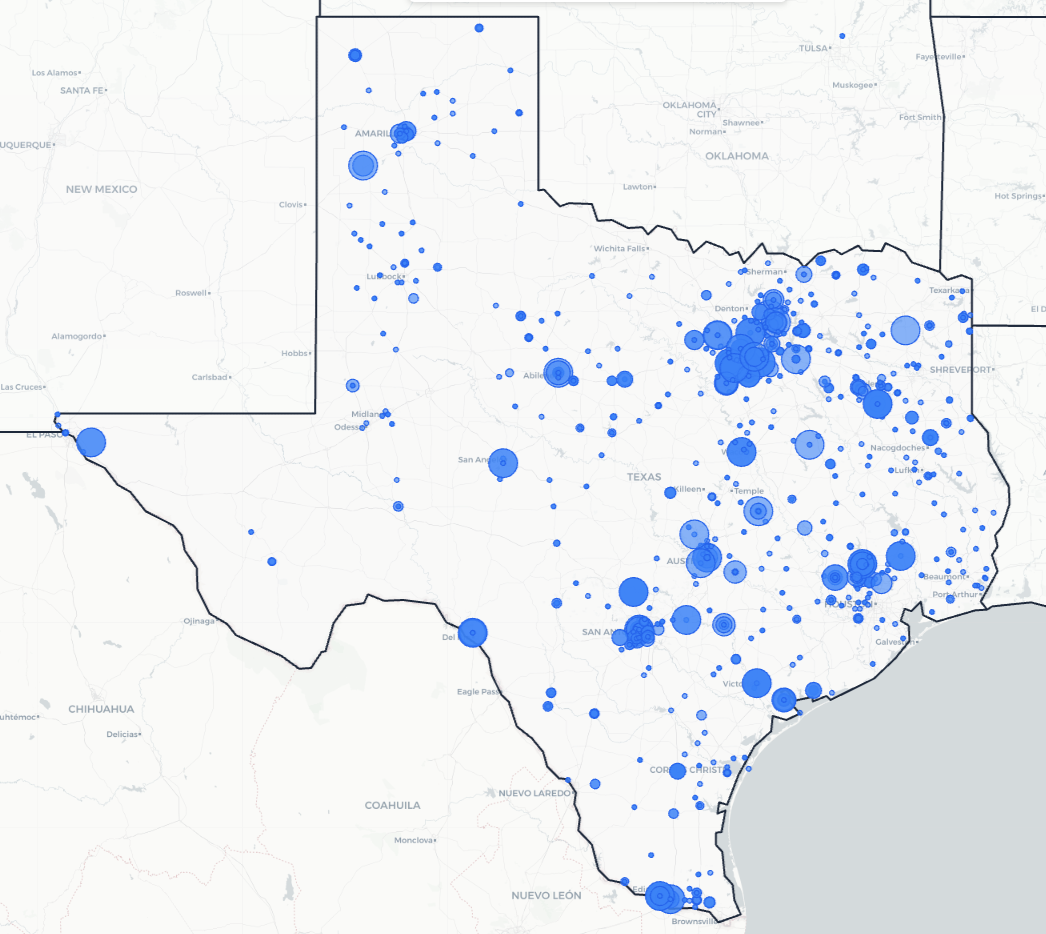
From the Rio Grande Valley to the Panhandle, Texas science teachers are using Kesler Science to save time and engage students.
Texas Schools and Districts
Love Kesler Science
What Teachers Are Saying
Give Your Science Teachers Everything They Need
School and district licenses give your teachers access to every resource they need, including station labs, inquiry labs, anchoring phenomena, presentations, escape rooms, and much more. One purchase covers the grade levels you need.
- PO-friendly. We accept purchase orders
- Volume discounts for 11+ teachers
- Complimentary Kesler Science Plus orientation for 4+ teachers
- Three free implementation PD sessions for departments of 11+
- Aligned to the 2024 TEKS standards
See It in Action
Book a walkthrough and we'll show you how Kesler Science fits your campus.
Book Demo CallNo pressure, no hard sell