.png?width=375&height=100&name=WebPage%20logo%20with%20curves%202026%20(8).png)
Comparing Organisms
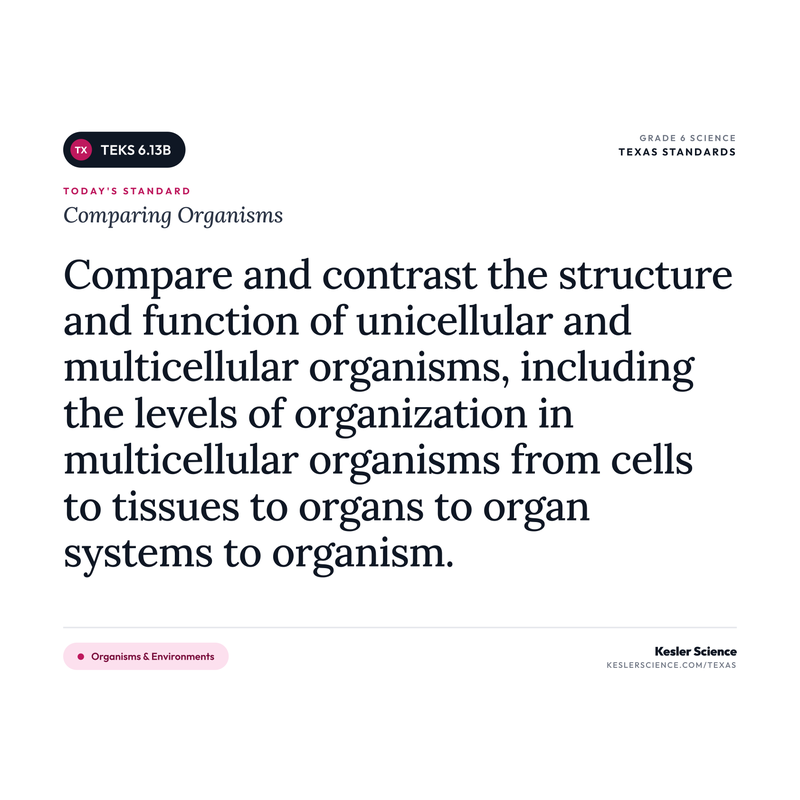
"Identify and compare the basic characteristics of organisms, including prokaryotic and eukaryotic, unicellular and multicellular, and autotrophic and heterotrophic."
💡 What This Standard Actually Means
"Identify and compare". Students are identifying and comparing organisms based on three pairs of basic characteristics: prokaryotic and eukaryotic, unicellular and multicellular, and autotrophic and heterotrophic. The new standard is a major shift from the old version, which focused on levels of organization in multicellular organisms. The new focus is on three different ways scientists categorize all living things. Instruction can take many forms, such as comparison T-charts, organism card sorts, microscope observation stations, and Venn diagrams across the three pairs.
Scientists categorize organisms in several ways, and this standard zeros in on three pairs of characteristics that students need to recognize and compare. Each pair sorts living things into two groups, and most organisms can be described using all three.
Prokaryotic vs. eukaryotic is about cell structure. Prokaryotic cells are simpler. They don't have a nucleus, and their DNA floats freely inside the cell. Bacteria and archaea are prokaryotes. Eukaryotic cells are more complex. They have a true nucleus that holds the DNA, plus other membrane-bound parts called organelles. Plants, animals, fungi, and protists are all eukaryotes. Unicellular vs. multicellular is about how many cells make up the whole organism. Unicellular organisms are made of just one cell that has to do every job (eat, get rid of waste, reproduce, respond). Bacteria, amoebas, paramecia, and yeast are unicellular. Multicellular organisms are made of many cells that specialize and work together. Plants, animals, and most fungi are multicellular.
Autotrophic vs. heterotrophic is about how an organism gets its energy. Autotrophs make their own food, usually through photosynthesis. Plants, algae, and some bacteria are autotrophs. Heterotrophs can't make their own food, so they have to eat or absorb other organisms. Animals, fungi, and most bacteria are heterotrophs. The big idea students should walk away with is that any organism can be described using all three pairs. A grass plant is eukaryotic, multicellular, and autotrophic. A bacterium might be prokaryotic, unicellular, and heterotrophic. Once students can apply the three pairs at once, they can compare any two organisms.
I used to teach this standard with a stadium-at-a-football-game analogy. A fan is a cell, a row doing the wave is a tissue, a section is an organ, the whole crowd is an organ system. It worked beautifully...for the wrong TEKS. That stadium analogy is 7th-grade levels of organization. 6.13B is three pairs of characteristics: prokaryotic or eukaryotic, unicellular or multicellular, autotrophic or heterotrophic. Here's what I'd do instead. Hand each group a mystery organism card (a bacterium, an amoeba, an oak tree, a mushroom, a hawk, a paramecium, blue-green algae) and have them check three boxes for each: prokaryotic or eukaryotic? unicellular or multicellular? autotrophic or heterotrophic? Then make them defend their three boxes out loud. The aha moment is blue-green algae. Unicellular AND autotrophic AND prokaryotic. Three rare combos at once. Sorting one pair at a time before merging is what makes the standard click.
⚠️ Misconceptions Your Students May Have
These are some of the most common misconceptions. Knowing what to look for can help you get ahead of them.
"All single-celled organisms are bacteria"
Bacteria are one type of single-celled organism, but not the only type. Amoebas and paramecia are single-celled eukaryotes called protists. Yeasts are single-celled fungi. When students describe unicellular organisms, they should think beyond bacteria alone. One cell does not automatically mean "germ" or "bacteria."
"A single-celled organism is basically just part of a bigger organism"
A unicellular organism is a complete living thing. That one cell carries out every life function on its own. It's not a piece of something else. Students often picture unicellular organisms as "unfinished," but they are their own living organisms that survive, grow, and reproduce without being attached to anything bigger.
"Bigger organisms just have bigger cells"
An elephant is not made of elephant-sized cells. Elephant cells are roughly the same size as human cells and most other animal cells. Multicellular organisms get bigger by having more cells, not bigger ones. This is a good place to connect back to cell theory: cells are the basic unit, and organisms grow by adding cells through cell division.
"All plants are autotrophs and all animals are heterotrophs"
The plant/animal split lines up most of the time, but not always. Most plants are autotrophs because they make their own food through photosynthesis, but a Venus flytrap also catches and digests insects to supplement nutrients (like nitrogen) that its swampy soil doesn't supply. The flytrap still gets its energy from photosynthesis, so it is technically still an autotroph. Algae are autotrophs even though they aren't plants. Some bacteria are autotrophs (they pull energy from chemicals like sulfur), and others are heterotrophs. Push students to define autotroph (makes its own food) and heterotroph (gets food from other organisms) by what the organism does, not just by which kingdom it sits in.
📓 Teaching Resources for 6.13B
These resources are aligned to this standard.


100% Aligned Lessons for Every TEKS You Teach
Kesler Science Plus puts thousands of ready-to-teach lessons and activities in your hands, so you can boost engagement and get your planning time back. Trusted by schools and districts all over the great state of Texas.
🌎 Phenomenon Ideas for 6.13B
Use these real-world phenomena to anchor your lesson. Show students the phenomenon first, let them wonder, then build toward Comparing Organisms as the explanation.
Bread Dough Rises
A baker mixes flour, water, sugar, and a tiny amount of yeast. After about an hour, the dough has doubled in size. Yeast is a single-celled fungus. Each yeast cell eats the sugar in the dough and releases carbon dioxide gas, which gets trapped in the dough and makes it rise. That entire change is happening because of organisms made of one cell each.
"Yeast is a one-celled organism. How can something so tiny cause a huge amount of dough to rise? What does this tell you about what a single cell is capable of doing on its own?"
The Bacteria That Don't Have a Nucleus
Pull up a comparison image of a bacterial cell and a human cheek cell side by side. They're both alive. They both have a cell membrane. They both reproduce. But the human cell has a nucleus packed with DNA and a bunch of membrane-bound organelles. The bacterial cell has none of that. Its DNA just floats around inside. Bacteria are prokaryotic. Your cells are eukaryotic. Same basic idea (a living cell), built two completely different ways.
"Both cells are alive. So why do scientists put them in two completely different categories? What does the presence or absence of a nucleus actually tell us about the organism?"
A Drop of Pond Water Has Its Own World
Under a classroom microscope, a single drop of pond water can reveal amoebas changing shape, paramecia zipping around, and algae drifting past. Each of those is a complete living organism made of just one cell. They eat, move, respond, and reproduce without ever being part of a bigger body. Compare that to the frog sitting on the edge of the pond, which has billions of cells all working together.
"An amoeba gets everything it needs from one cell. A frog has billions of cells. What can a frog do that an amoeba cannot? What can an amoeba do just as well as a frog?"
💡 Free Engagement Ideas for 6.13B
Ready-to-run activities you can drop straight into a lesson. Where one of these looks like a phenomenon from the section above, that is on purpose: show it first as the hook, then let students run it themselves.
The Three-Pair Bingo
Make bingo cards with sixteen squares, each holding a real organism (paramecium, oak tree, E. coli, mushroom, dolphin, cyanobacteria, amoeba, redwood, yeast, salmon, spinach, you, etc.). Call out one of six categories: prokaryotic, eukaryotic, unicellular, multicellular, autotrophic, heterotrophic. Students mark every organism on their card that fits the call. First to four in a row has to defend each one out loud. The same organism gets marked under multiple categories, which is exactly the point. Every organism is a stack of characteristics, not just one label.
Three-Question Card Sort
Print or write organism names on index cards (amoeba, dog, oak tree, yeast, paramecium, human, E. coli, mushroom, cyanobacteria, redwood, algae, mold). For each card, students answer three quick questions: prokaryotic or eukaryotic, unicellular or multicellular, and autotrophic or heterotrophic. Have them log their answers on a tracker sheet. The big takeaway is that every organism gets three labels, not one. Finish by having students try to find one organism that's prokaryotic AND multicellular (good luck) and discuss why some combinations are common and others aren't.
Make Your Own Food vs. Find Your Food
Set up two stations on opposite sides of the room. Station 1 is the autotroph station: students pretend to be a plant and "make food" using stickers or tokens labeled sunlight, water, and CO2. They combine the inputs into a "glucose" output card. Station 2 is the heterotroph station: students pretend to be a consumer and have to find pre-made glucose cards hidden by the teacher. After both stations, regroup and discuss why both strategies work, why most ecosystems need both, and why a Venus flytrap (still technically an autotroph, since it gets its energy from photosynthesis and only supplements nutrients from insects) trips students up.
Yeast Math: Counting a Unicellular Organism
Mix a packet of dry yeast with warm sugar water in a balloon-topped bottle. Yeast cells will eat the sugar, release CO2, and inflate the balloon. While that's running, ask students: each one of those bubbles in the balloon was produced by living, single-celled, eukaryotic, heterotrophic organisms. Have them write a sentence justifying each of those four labels (single-celled, eukaryotic, heterotrophic, living) using evidence from the bottle. A simple kitchen demo doubles as a multi-category review.
🎯 What Approaches, Meets, and Masters Thinking Look Like
Here is what student thinking at each level looks like on this one task, so you know what to look for and how to move a student up.
A scientist studies two living things: an amoeba (a tiny one-celled organism that lives in pond water and eats smaller organisms) and a maple tree. Compare these two organisms using the three pairs of characteristics: prokaryotic or eukaryotic, unicellular or multicellular, and autotrophic or heterotrophic. For each organism, tell which one fits in each pair, and explain how you know.
- Both organisms described using all three pairs, not just one or two.
- The amoeba labeled unicellular (one cell) and the maple tree labeled multicellular (many cells working together).
- The maple tree labeled autotrophic, with a reason: it makes its own food through photosynthesis.
- The amoeba labeled heterotrophic, with a reason: it cannot make its own food, so it eats other organisms.
- Both organisms correctly labeled eukaryotic, because both have cells with a true nucleus.
- A real comparison, not just two separate lists: the student says where the two organisms are alike and where they are different.
- The amoeba's cell type handled correctly (eukaryotic, not prokaryotic). One cell does not automatically mean bacteria. That is the easiest place to slip.
The amoeba is unicellular because it is just one cell. The maple tree is multicellular because it is big and has lots of cells. The maple tree is autotrophic because it makes its own food. The amoeba is heterotrophic because it eats other things in the pond. The maple tree is eukaryotic. The amoeba is prokaryotic because it is only one cell, so it must be a bacteria.
The amoeba is unicellular because it is just one cell that does every job by itself. The maple tree is multicellular because it has many cells that work together. The maple tree is autotrophic because it makes its own food with photosynthesis. The amoeba is heterotrophic because it cannot make food, so it eats smaller organisms in the pond. They are both eukaryotic because both of their cells have a real nucleus. So the two organisms are the same on one pair (both eukaryotic) but different on the other two pairs.
The amoeba is unicellular, eukaryotic, and heterotrophic. The maple tree is multicellular, eukaryotic, and autotrophic. They match on cell type (both have a nucleus, so both are eukaryotic) but they are different on the other two pairs. The reason the amoeba is heterotrophic is that it cannot make its own food, so it has to eat other organisms, while the tree makes food with photosynthesis.
The three pairs ask three different questions: what is the cell like, how many cells are there, and how does it get food. Each question is separate, so I have to check all three for any living thing. That is how I would describe a mushroom too. A mushroom is multicellular and eukaryotic like the tree, but it cannot make its own food, so it is heterotrophic like the amoeba. A mushroom is not a plant just because it grows in the ground and does not move.
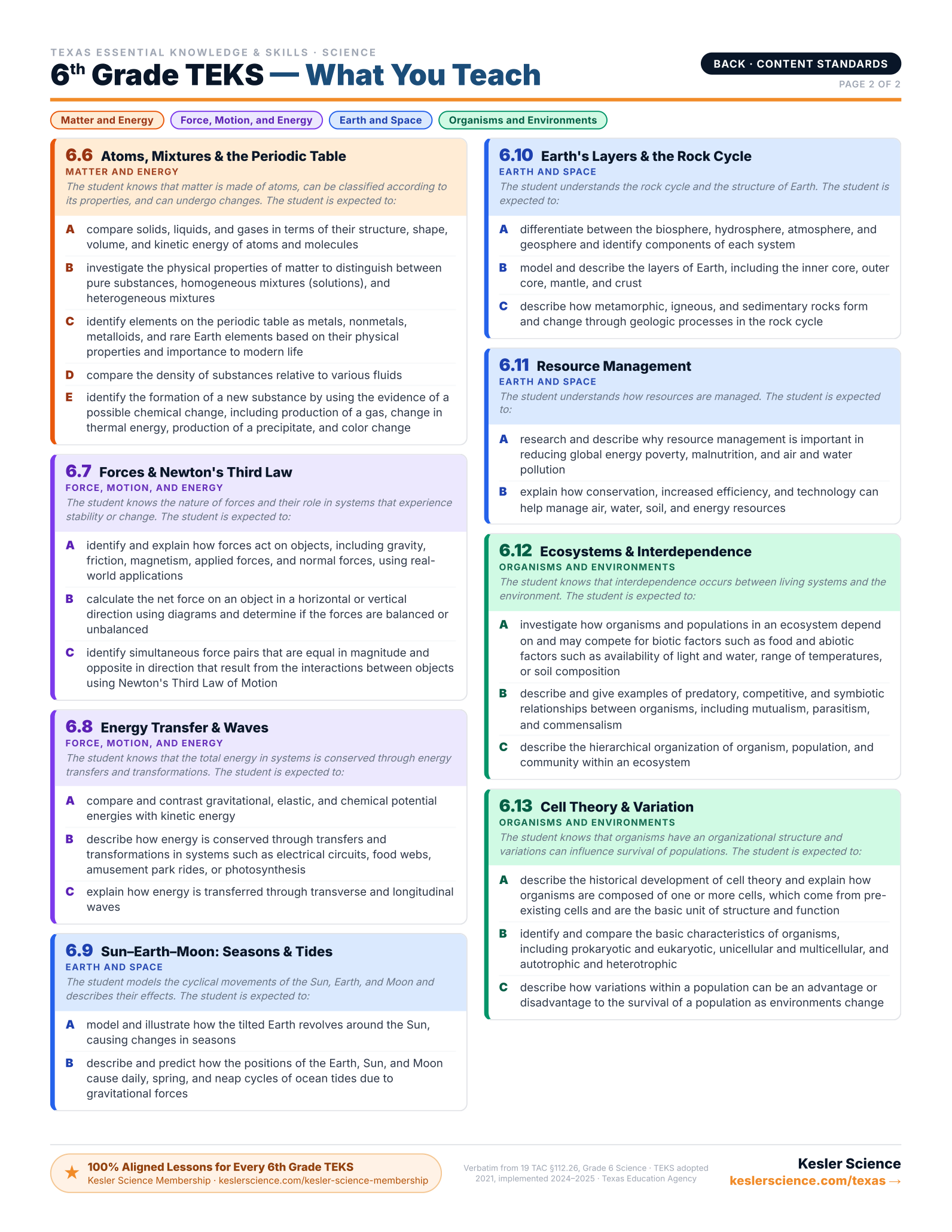
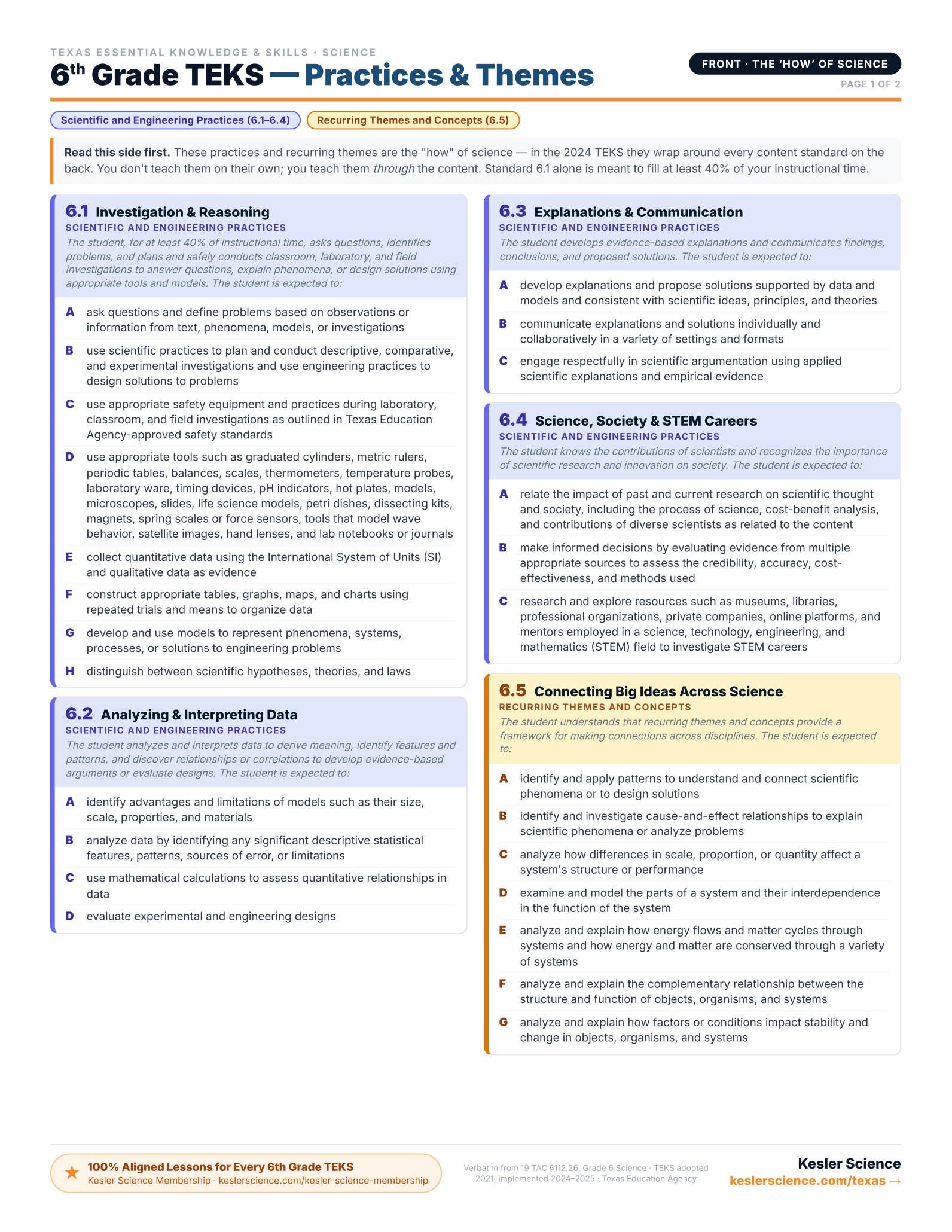
Every 6th-Grade Science TEKS on One Page
The color-coded, front-and-back cheat sheet I wish I'd had — every standard, organized by reporting category. Print it and reference it all year long. This will be your new favorite document!
Trusted Across Texas
From the Rio Grande Valley to the Panhandle, Texas science teachers are using Kesler Science to save time and engage students.
Texas Schools and Districts
Love Kesler Science
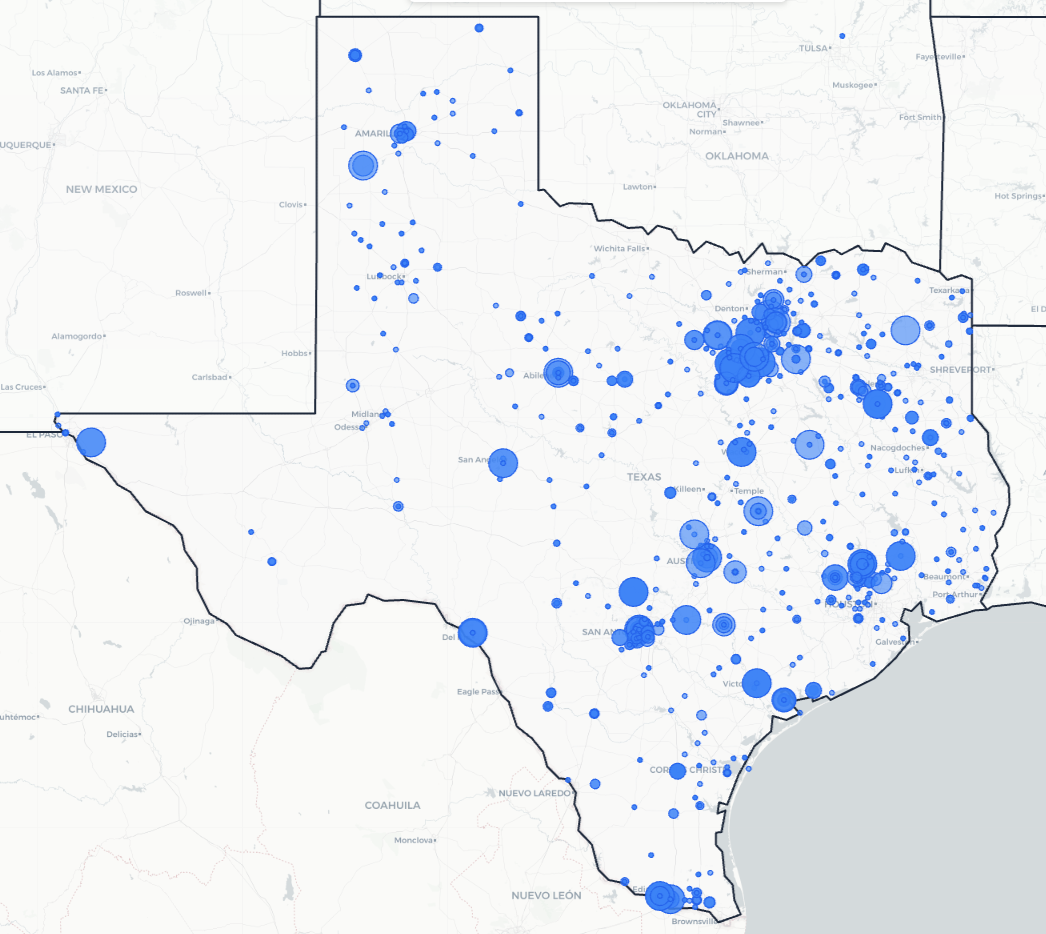
What Teachers Are Saying
Give Your Science Teachers Everything They Need
School and district licenses give your teachers access to every resource they need, including station labs, inquiry labs, anchoring phenomena, presentations, escape rooms, and much more. One purchase covers the grade levels you need.
- PO-friendly. We accept purchase orders
- Volume discounts for 11+ teachers
- Complimentary Kesler Science Plus orientation for 4+ teachers
- Three free implementation PD sessions for departments of 11+
- Aligned to the 2024 TEKS standards
See It in Action
Book a walkthrough and we'll show you how Kesler Science fits your campus.
Book Demo CallNo pressure, no hard sell