.png?width=375&height=100&name=WebPage%20logo%20with%20curves%202026%20(8).png)
Resource Management
"Research and describe why resource management is important in reducing global energy poverty, malnutrition, and air and water pollution."
💡 What This Standard Actually Means
"Research and describe". Students are researching real-world examples of resource management and describing why it matters. The new wording adds specific global problems the standard wants kids to connect resource management to: global energy poverty, malnutrition, and air and water pollution. This is a big shift from the old version, which was about renewable vs nonrenewable. Now it's about the consequences of how humans manage Earth's resources. Instruction can take many forms, such as country-comparison research projects, current event reading activities, infographic creation, and case studies on real conservation success stories.
The reason this standard exists is simple. The way humans manage Earth's resources affects whether people across the world have reliable electricity, enough to eat, and clean air and water. Bad management makes those problems worse. Good management can solve them. The standard names three big global problems for kids to research and describe: global energy poverty, malnutrition, and air and water pollution.
Start with global energy poverty. This is the international term for not having reliable access to modern energy services like electricity and clean cooking fuels. About a billion people still live without dependable electricity, and roughly 2.4 billion cook over open fires or kerosene stoves. Smart resource management (investing in solar, wind, hydro, micro-grids, efficient cookstoves, and grid technology) can spread reliable energy to communities that don't currently have it.
Then look at malnutrition. This is tied to whether people have access to fertile land, clean water, and the resources to grow or buy enough nutritious food. Overuse of cropland, soil erosion, depleted fisheries, and water shortages all push communities toward food insecurity. Resource management practices like crop rotation, sustainable fishing limits, and irrigation efficiency can keep food production going for the long haul.
Air and water pollution are the third global problem on the list. Heavy industries that don't manage their emissions pump pollutants into the air and water. Mining and oil drilling without good management contaminate groundwater. Farms that overuse fertilizer wash nitrogen and phosphorus into rivers, leading to dead zones in lakes and oceans. Better resource management (cleaner industrial processes, reduced fertilizer runoff, recycled water systems, and protected watersheds) keeps the air and water cleaner for everyone. Students should walk away with a clear sense that resource management is a global issue, and the choices humans make today shape what's available tomorrow.
The thing I had to get over on this one was that it isn't the renewable versus nonrenewable lesson anymore. It's a people lesson. What worked for me was opening with one photo and no explanation, a kid doing homework by the light of a kerosene lamp. Two questions. What's hard about this? And what would have to change for it to be different? They get to "she needs electricity" fast, and then we chase it. Where does electricity come from? Who decides who gets it? That's global energy poverty, and now they care about the term before they've heard it.
From there I'd split the room into three research teams, one for each problem the standard names: energy poverty, malnutrition, and air and water pollution. Same three questions for every team. Who does this hurt? Which resource is being managed badly? What's one real fix somebody has already tried? Then they teach it back on one sheet of chart paper. The pattern they find on their own is the whole point. Every one of those three problems traces back to how a resource gets managed, and every one of them has a management fix.
⚠️ Misconceptions Your Students May Have
These are some of the most common misconceptions. Knowing what to look for can help you get ahead of them.
"Renewable resources are unlimited"
Renewable doesn't mean infinite. It means the resource is replenished on a human timescale. Trees are renewable because new ones grow, but a forest clear-cut faster than it regrows can still disappear. Freshwater aquifers can be pumped out faster than rain refills them. The label "renewable" describes how the resource replenishes, not how much we can take.
"Natural resources and energy resources are the same thing"
Energy resources are one type of natural resource. Natural resources also include materials humans use for things other than energy: drinking water, soil for crops, metals and minerals for building, wood for lumber, and land itself. Coal and oil are both natural resources and energy resources. A freshwater lake is a natural resource but isn't really an energy resource unless it's behind a dam.
"Recycling is only about keeping trash out of landfills"
Recycling is a resource management practice. When we recycle aluminum cans, we reduce the amount of new aluminum ore (bauxite) that has to be mined. Recycling paper reduces the number of trees that have to be cut. The point is conserving the natural resource on the front end, not just dealing with garbage on the back end.
"Resource management is just an environment thing"
Resource management isn't only about saving the environment, it's about people. The TEKS specifically calls out global energy poverty, malnutrition, and air and water pollution. When water gets managed well, more communities have safe drinking water. When farmland is managed well, fewer people go hungry. When fuels are managed well, fewer kids breathe polluted air. Show students that "resource management" is really about whether people get what they need to live.
📓 Teaching Resources for 6.11A
These resources are aligned to this standard.


100% Aligned Lessons for Every TEKS You Teach
Kesler Science Plus puts thousands of ready-to-teach lessons and activities in your hands, so you can boost engagement and get your planning time back. Trusted by schools and districts all over the great state of Texas.
🌎 Phenomenon Ideas for 6.11A
Use these real-world phenomena to anchor your lesson. Show students the phenomenon first, let them wonder, then build toward Resource Management as the explanation.
The Ogallala Aquifer Is Dropping
The Ogallala Aquifer sits underneath much of the Texas Panhandle and seven other states. It supplies water for farms and towns across the region. In many parts of the aquifer, the water level has dropped substantially since farmers began heavy irrigation in the mid-1900s. Rain still falls on the plains, but in many areas water is being pumped out much faster than it is being recharged.
"Water is usually called a renewable resource. So why is the Ogallala dropping? What does this tell us about how 'renewable' works in the real world?"
Replanted Forests in East Texas
In East Texas and across the Southeast, commercial timber companies harvest pine trees for lumber and paper. After harvest, many of these companies replant seedlings, and the next generation of trees grows back over the following decades. Some stands are on their third or fourth cycle of being cut and replanted. The same patch of land has produced wood over and over.
"What makes trees a renewable resource, and what resource management practice is happening here? What would happen to these forests if companies only cut and never replanted?"
The Cookstove That Changes a Family's Life
In many parts of the world, families still cook over open wood fires inside their homes. The smoke makes children sick, contributes to early deaths, and uses up a lot of wood. Aid groups have been distributing simple, more efficient cookstoves and small solar setups that use way less fuel and produce way less smoke. The same family, with a better stove, breathes cleaner air, spends less time gathering wood, and saves money. One small change in how a resource is used touches health, time, money, and forests at the same time.
"How does managing one resource (fuel for cooking) connect to other things like air pollution, time, money, and forests? Why is 'resource management' a bigger deal than just saving the environment?"
💡 Free Engagement Ideas for 6.11A
Ready-to-run activities you can drop straight into a lesson. Where one of these looks like a phenomenon from the section above, that is on purpose: show it first as the hook, then let students run it themselves.
The Cookie Mining Challenge
Give each student a chocolate chip cookie, a toothpick, and a paper clip. The chocolate chips are "ore". The cookie is the "land". Students mine out all the chips without breaking the cookie, then try to "reclaim" the land by putting it back together. Kids quickly see how hard it is to undo extraction. Tie it to nonrenewable resource use and the impact of management choices.
Global Problem to Resource Plan
Write four global problems on the board: not enough clean drinking water, hunger, lack of electricity, and dirty air. Assign each group one problem. Their task is to research one real-world resource management practice that helps solve their problem (drip irrigation, no-till farming, solar microgrids, cleaner cookstoves, recycling programs, water-quality monitoring, the list is long). Each group makes a one-page "explainer" with three parts: the problem, the management practice, and why it works. Post them around the room and rotate through.
The Fishing Game
Fill a bowl with dry beans (fish). Each student is a fishing boat. Each round, students scoop a handful and the teacher adds a few beans back (the fish population reproducing). Run it for several rounds. Then add a rule: "only take 3 per round". The first version collapses fast. The second version lasts. Connect it to resource management and fishing limits.
Classroom Recycling Audit
Students look at what ends up in the classroom trash in a single class period. Have them categorize: could this be recycled? Could it be reused? What natural resource did it originally come from (tree, aluminum ore, petroleum)? Students then write three specific management changes the classroom could try for a week.
🎯 What Approaches, Meets, and Masters Thinking Look Like
Here is what student thinking at each level looks like on this one task, so you know what to look for and how to move a student up.
A town gets all of its electricity by burning wood from a nearby forest. People keep cutting trees faster than new ones grow, and the air is getting smoky. In a short paragraph, describe one way the town could manage its resources better, and explain how your idea would help with energy and air pollution.
- A clear resource management idea (such as planting new trees, using solar or wind power, or cutting fewer trees) instead of just saying "stop the pollution."
- A connection between the idea and the town's energy need (the people still get electricity).
- A connection between the idea and air pollution (the smoke gets better).
- An understanding that wood is a renewable resource but can still run out if it is used too fast.
- Reasoning that explains why the idea works, not just what the idea is.
- The renewable-does-not-mean-unlimited idea handled correctly. That is the easiest place to slip.
The town should just keep cutting the trees. Trees are renewable, so they will never run out. New trees grow back, so there is always more wood. They should stop the smoke though.
If the trees grow back slowly but the town cuts them fast, what happens to the forest over time?
The town should put up solar panels to make some of their electricity. That way they do not have to cut as many trees, so the forest can grow back. Burning less wood also means less smoke, so the air gets cleaner. The people still get the power they need, but they are not using up the forest so fast.
The town should use solar power for part of their electricity and only cut a small number of trees each year, about the same amount that grows back. Then the forest does not shrink, because they are taking wood at the rate it can regrow. Burning less wood also means less smoke in the air. The people still get power, the forest stays healthy, and the air gets cleaner.
The big idea is matching how fast you use a resource to how fast it can refill. That is how I know a town pumping water from underground has the same problem. The water can refill from rain, but if they pump it out faster than the rain puts it back, the well still goes dry. Renewable only helps if you do not use it faster than it comes back.
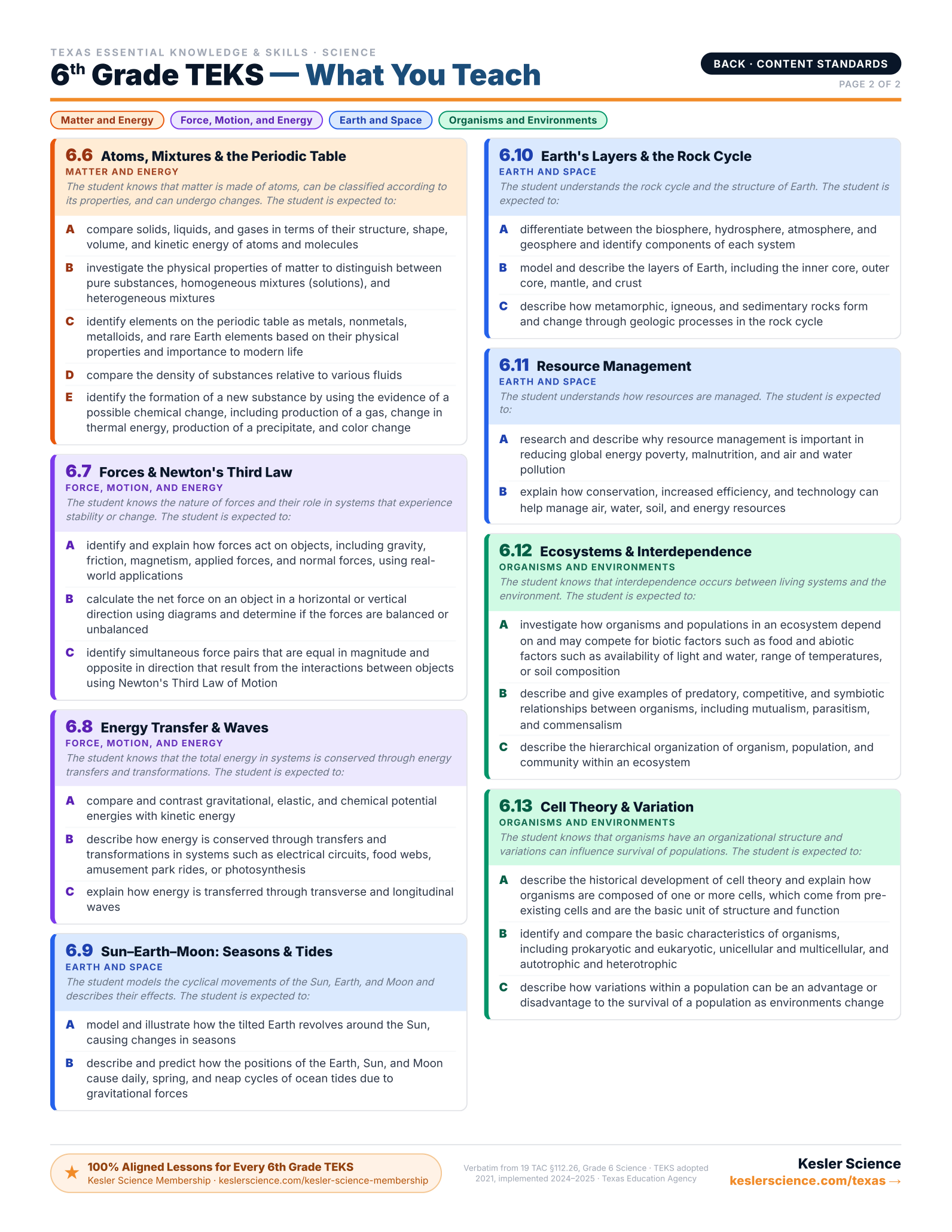
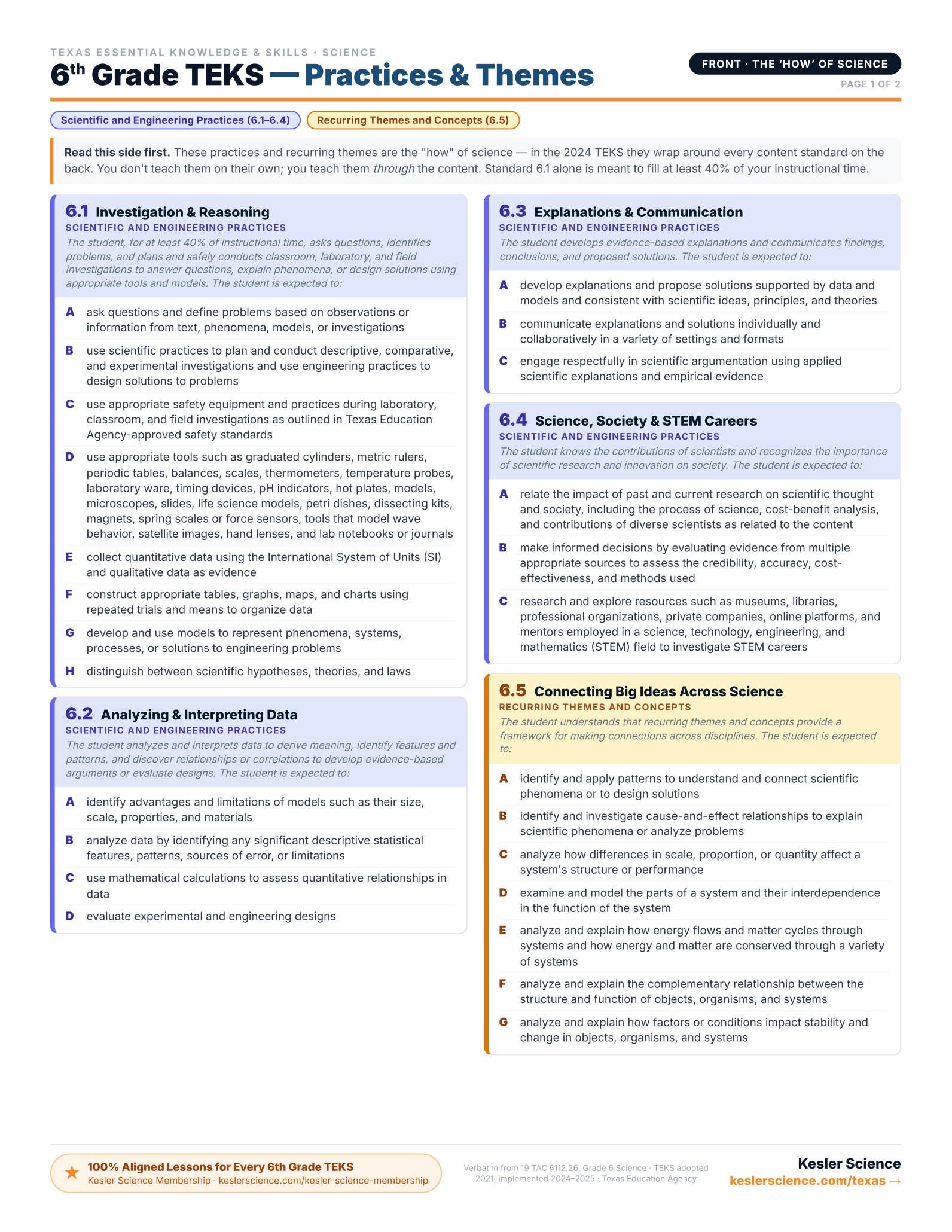
Every 6th-Grade Science TEKS on One Page
The color-coded, front-and-back cheat sheet I wish I'd had — every standard, organized by reporting category. Print it and reference it all year long. This will be your new favorite document!
Trusted Across Texas
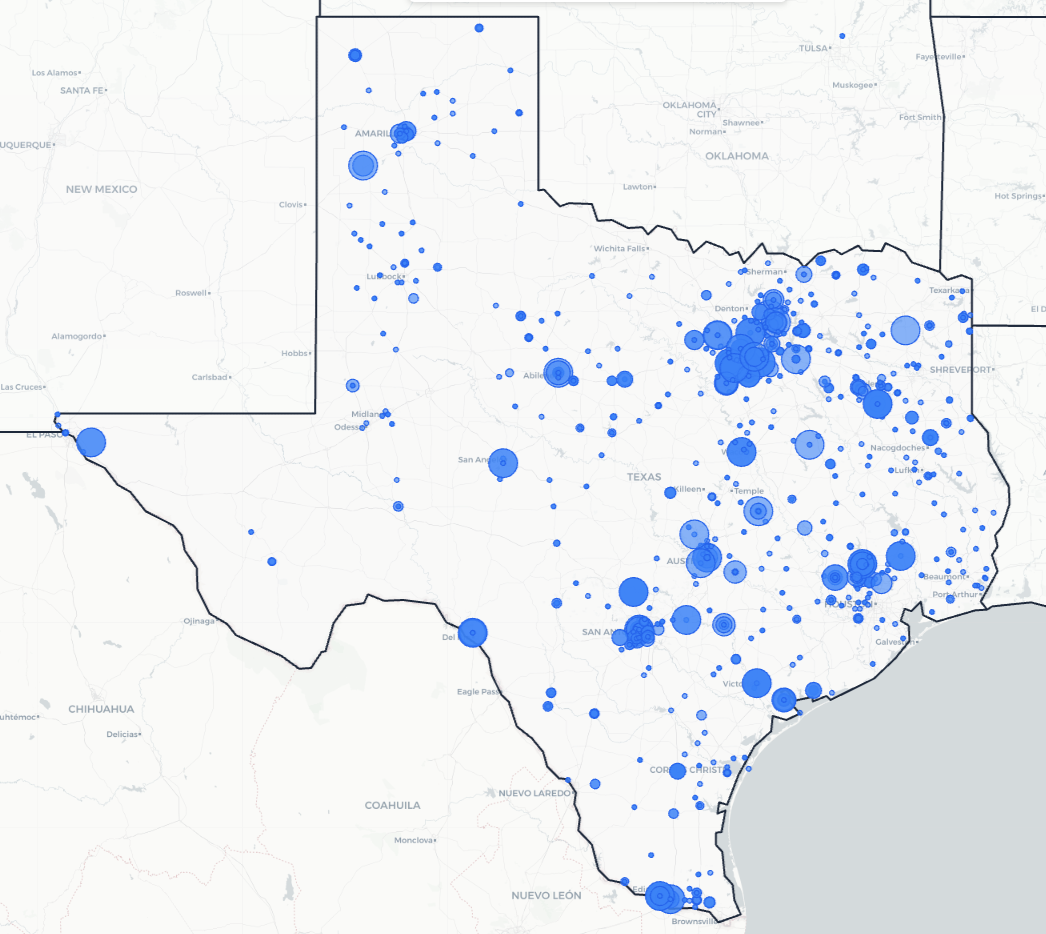
From the Rio Grande Valley to the Panhandle, Texas science teachers are using Kesler Science to save time and engage students.
Texas Schools and Districts
Love Kesler Science
What Teachers Are Saying
Give Your Science Teachers Everything They Need
School and district licenses give your teachers access to every resource they need, including station labs, inquiry labs, anchoring phenomena, presentations, escape rooms, and much more. One purchase covers the grade levels you need.
- PO-friendly. We accept purchase orders
- Volume discounts for 11+ teachers
- Complimentary Kesler Science Plus orientation for 4+ teachers
- Three free implementation PD sessions for departments of 11+
- Aligned to the 2024 TEKS standards
See It in Action
Book a walkthrough and we'll show you how Kesler Science fits your campus.
Book Demo CallNo pressure, no hard sell