.png?width=375&height=100&name=WebPage%20logo%20with%20curves%202026%20(8).png)
Newton's Second Law of Motion
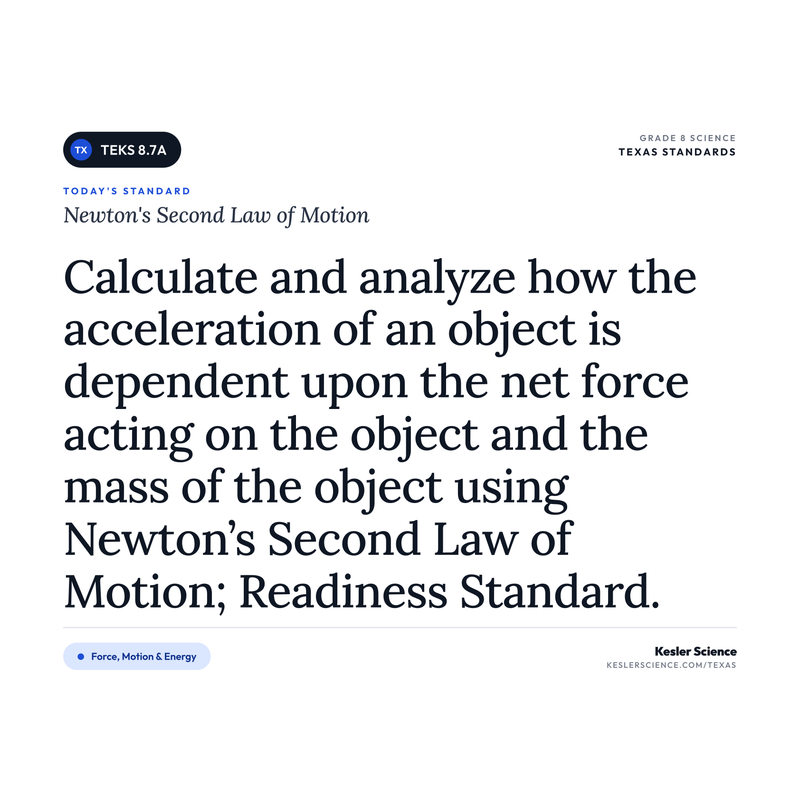
"Calculate and analyze how the acceleration of an object is dependent upon the net force acting on the object and the mass of the object using Newton’s Second Law of Motion."
💡 What This Standard Actually Means
"Calculate and analyze". This standard asks students to do the math, not just talk about it. Using Newton's Second Law of Motion (a = F ÷ m), students calculate how an object's acceleration changes when the net force changes or the mass changes, then analyze what those numbers mean. Students should be able to solve for acceleration, net force, or mass when given the other two, and explain that a larger net force produces a larger acceleration (when mass is held constant) while a larger mass produces a smaller acceleration (when force is held constant). Instruction can take many forms, such as lab investigations, data tables, force-and-acceleration graphs, and worked calculations.
Force is a push or a pull. Mass is the amount of matter in an object. Acceleration is how quickly an object's motion is changing, whether it's speeding up, slowing down, or changing direction. Newton's Second Law ties those three ideas together with a single relationship: F = ma. The net force on an object equals its mass multiplied by its acceleration.
In plain English, this means two things. Push a shopping cart harder and it picks up speed faster. Load that same cart with bricks and the same push barely moves it. Force drives acceleration up. Mass drags it down. Students should be able to predict what happens to acceleration when one variable changes and the other stays the same.
Remind students that mass and weight are not the same thing. Mass measures how much matter is in an object and stays the same anywhere in the universe. Weight is the pull of gravity on that mass and changes depending on where you are. Newton's Second Law uses mass, not weight. Keeping that distinction clear up front saves a lot of cleanup later.
The demo that made this click for my students was borrowed from a physics teacher down the hall. I'd bring two wagons to the front of the room. One had a single textbook in it, the other was loaded with a stack. I'd ask a student to give each wagon the exact same push and predict what would happen. They'd nail the prediction every time. Then we'd talk about why. Same force, different masses, different accelerations. After that, I'd flip it. Same wagon, one gentle push and one big shove. Same mass, different forces, different accelerations. Two quick rounds and the relationship was sitting right in front of them before I ever wrote F = ma on the board.
⚠️ Misconceptions Your Students May Have
These are some of the most common misconceptions. Knowing what to look for can help you get ahead of them.
"Heavier objects fall faster than lighter ones"
In a vacuum, a bowling ball and a feather hit the ground at the same time. On Earth, air resistance usually makes the feather fall slower, but the mass of the object isn't what's slowing it down. Gravity pulls harder on the heavier object, but that heavier object also needs proportionally more force to accelerate. Since acceleration equals force divided by mass, the extra mass cancels out, and both objects end up with the same acceleration. This is one of the most persistent misconceptions in physics and it works against the Second Law if you don't address it.
"If I push something harder, it moves faster"
Pushing harder doesn't instantly mean faster speed. It means more acceleration. A bigger force makes an object change speed more quickly. If the object is already moving, more force makes it speed up faster. If it starts at rest, more force makes it reach higher speeds in less time. The Second Law is about the rate of change of motion, not the final speed.
"Mass and weight are the same thing"
Mass is the amount of matter in an object, measured in kilograms. Weight is the force of gravity pulling on that mass, measured in newtons. An astronaut who weighs 150 pounds on Earth has the same mass on the Moon, but weighs only about 25 pounds there. Newton's Second Law uses mass, not weight. Watch for this when students start plugging numbers into F = ma.
"Acceleration just means speeding up"
Acceleration is any change in velocity. Speeding up counts, slowing down counts, and changing direction counts. A car braking at a red light is accelerating. A ball curving around a track is accelerating. Newton's Second Law covers all of it, because any change in motion means there's a net force acting on the object.
📓 Teaching Resources for 8.7A
These resources are aligned to this standard.


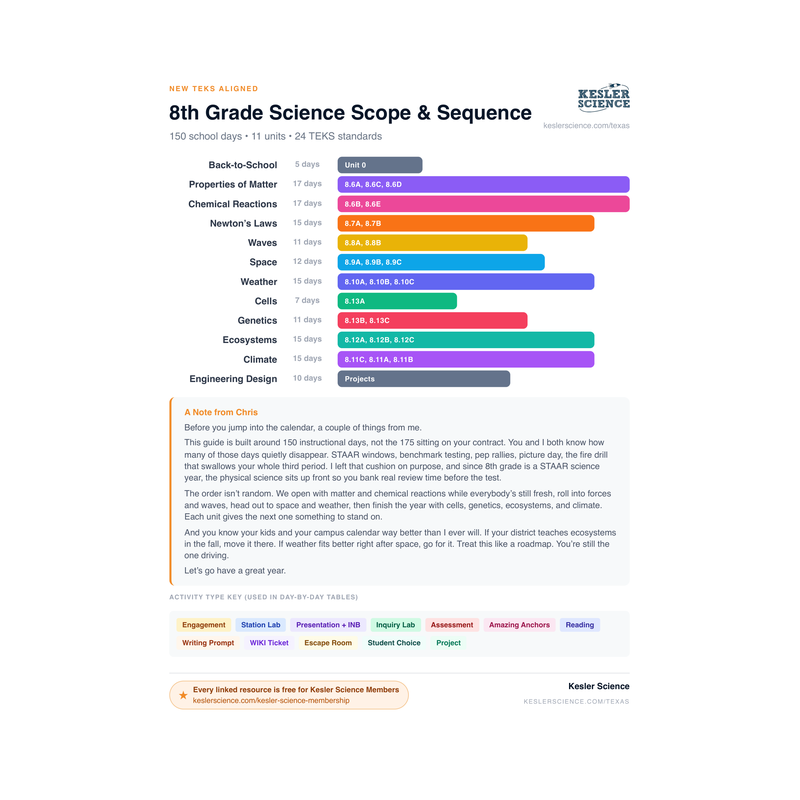
100% Aligned Lessons for Every TEKS You Teach
Kesler Science Plus puts thousands of ready-to-teach lessons and activities in your hands, so you can boost engagement and get your planning time back. Trusted by schools and districts all over the great state of Texas.
🌎 Phenomenon Ideas for 8.7A
Use these real-world phenomena to anchor your lesson. Show students the phenomenon first, let them wonder, then build toward Newton's Second Law of Motion as the explanation.
The Loaded Pickup vs. the Empty Pickup
An empty pickup truck takes off from a stoplight and picks up speed quickly. The same truck hauling a bed full of landscape rock barely creeps forward at first. The engine can produce the same force, and the driver presses the gas pedal the same way. Something about the added mass is slowing the acceleration down.
"If the truck's engine can push with the same force in both cases, why does the loaded truck accelerate so much more slowly? How could you predict the new acceleration if you doubled the mass in the bed?"
The Bowling Ball and the Soccer Ball
A student gives a soccer ball a solid kick and it rockets across the field. The same student kicks a bowling ball with the same amount of effort and the ball barely moves (along with a sore foot). Both got kicked. Both felt a force. So why did they accelerate so differently?
"If the force from the kick was about the same in both cases, what variable explains why the soccer ball accelerated so much more than the bowling ball? What does this tell you about the relationship between mass and acceleration?"
A Grocery Cart Full of Groceries
An empty grocery cart is easy to push and easy to stop. A cart loaded with a full week of groceries needs a harder push to get going, and it keeps rolling even when you try to slow it down. The pusher is the same person. Only the mass of the cart has changed.
"If you push both carts with the exact same force, which one will accelerate faster? Now imagine you want to make the full cart accelerate just as fast as the empty one. What would you need to change about your push?"
💡 Free Engagement Ideas for 8.7A
Ready-to-run activities you can drop straight into a lesson. Where one of these looks like a phenomenon from the section above, that is on purpose: show it first as the hook, then let students run it themselves.
Fan Cart Force Test
Tape a small battery-powered fan to a lightweight toy car that rolls freely. Measure the time it takes to roll across a set distance, then tape on extra mass (a few washers or AA batteries) and run the same test. Because the fan's push stays the same, the heavier car accelerates more slowly. Students chart how acceleration drops as mass goes up (F = ma).
Rubber Band Launch Lab
Tape two pencils upright to the floor a few inches apart and stretch a rubber band between them like a slingshot. Rest a small plastic cup (open end up) against the rubber band, pull it straight back a ruler-measured distance, and release so the band launches the cup forward. Keep the mass the same and try different stretch distances (more stretch = more force); measure how far the cup travels. Then add mass to the cup and compare. Students plot the data and describe the pattern.
Paper Airplane Mass Challenge
Students build identical paper airplanes, then add small paper clips to change the mass. Each group throws the airplane with the same motion for each trial and measures the distance traveled. As mass increases with added clips, acceleration and distance usually drop. Students connect their results back to F = ma.
Textbook Shoebox Sled
Put a shoebox on the floor and attach a string to one end. Have students pull the empty box with a spring scale at a steady slow speed, then pull it again with 1, 2, and 3 textbooks inside. They record the force needed for each trial. The data shows how much more force is needed to accelerate greater masses.
🎯 What Approaches, Meets, and Masters Thinking Look Like
Here is what student thinking at each level looks like on this one task, so you know what to look for and how to move a student up.
A 4 kg cart is pushed with a net force of 8 N. Use Newton's Second Law (a = F ÷ m) to find its acceleration. Then explain what happens to the acceleration if you push twice as hard, and what happens if you use a heavier cart instead.
- The formula used correctly as a = F ÷ m, with units (force in newtons, mass in kilograms, acceleration in m/s²).
- Correct math: 8 N ÷ 4 kg = 2 m/s².
- The "push twice as hard" answer reasoned correctly: more net force means more acceleration.
- The "heavier cart" answer reasoned correctly: more mass means less acceleration for the same push.
- Net force and acceleration treated as moving together, while mass works against acceleration (the two variables pull in opposite directions).
- An explanation that ties each answer back to the formula, not just a guess about what feels right.
- The heavier-cart case handled correctly: that more mass means less acceleration, not more. That is the easiest place to slip.
a = F ÷ m = 8 ÷ 4 = 2 m/s². If you push twice as hard, the force is bigger, so the acceleration gets bigger too. If you use a heavier cart, there is more cart to push, so it gets more acceleration. A bigger, heavier cart has more power behind it once it gets going.
a = F ÷ m = 8 N ÷ 4 kg = 2 m/s². If you push twice as hard, the net force doubles to 16 N, so a = 16 ÷ 4 = 4 m/s². The acceleration doubles too. If you use a heavier cart instead, say you double the mass to 8 kg with the same 8 N push, then a = 8 ÷ 8 = 1 m/s². So the heavier cart gets less acceleration. More force means more acceleration, but more mass means less acceleration.
a = F ÷ m = 8 N ÷ 4 kg = 2 m/s². Push twice as hard and the force is on top of the formula, so doubling it doubles the acceleration to 4 m/s². A heavier cart is different, because mass is on the bottom. With the same 8 N push, a bigger mass on the bottom makes the answer smaller, so the cart accelerates less. Force and acceleration rise together, but mass in the denominator always pulls the acceleration down.
This is the same reason a full shopping cart is so much harder to get moving than an empty one. You give it the same push, but the food adds mass, and that bigger mass on the bottom of a = F ÷ m means less acceleration. If you wanted the full cart to speed up just as fast as the empty one, you would have to push proportionally harder to make up for the extra mass.
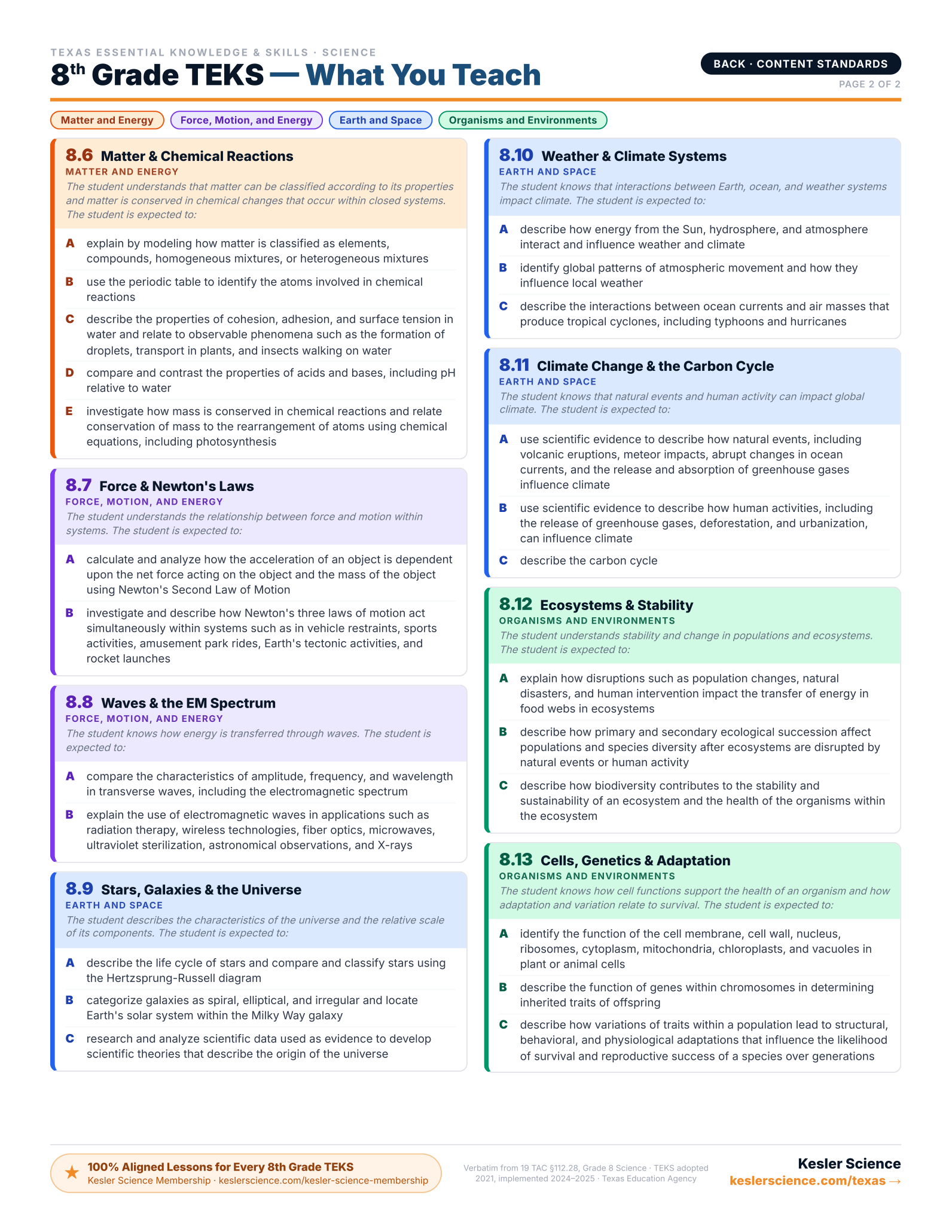
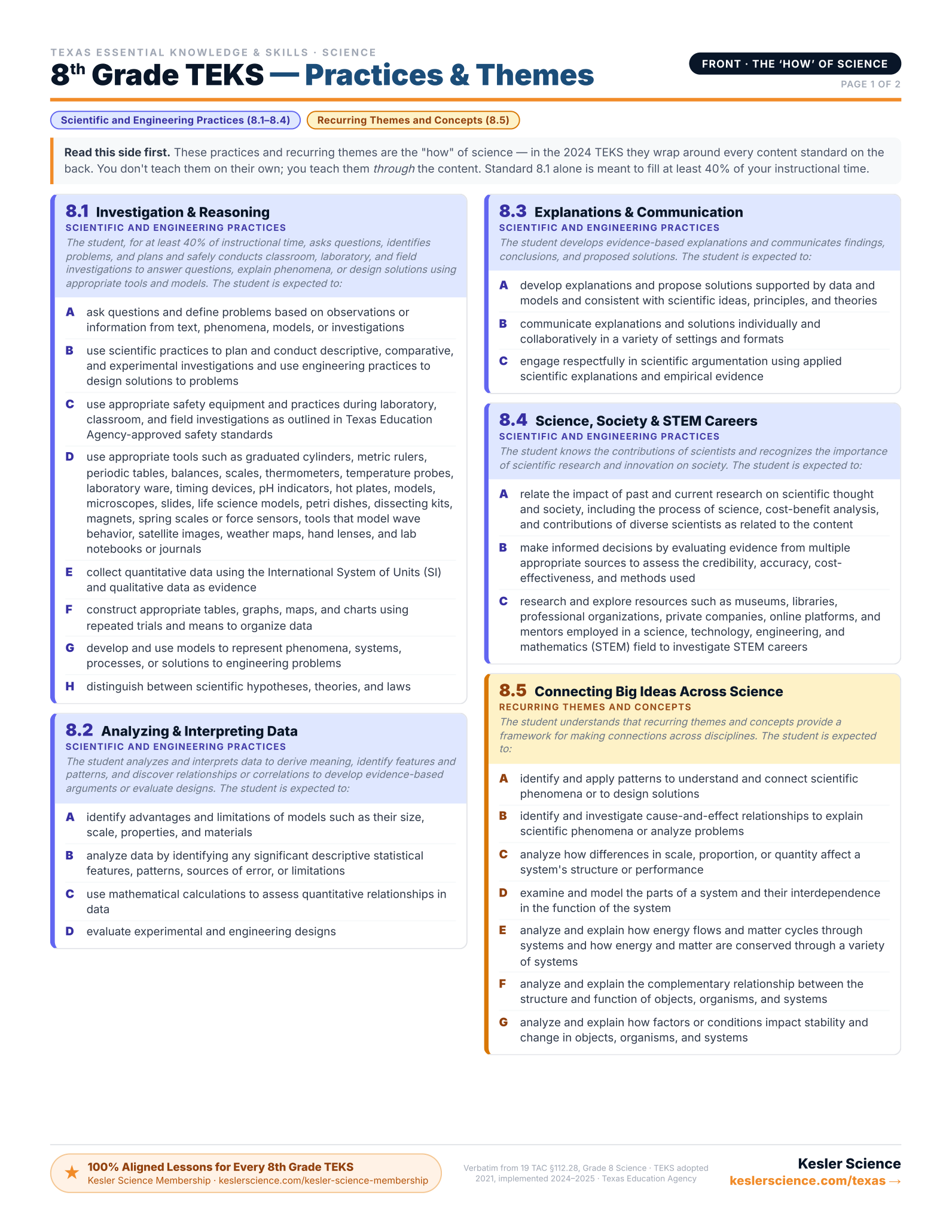
Every 8th-Grade Science TEKS on One Page
The color-coded, front-and-back cheat sheet I wish I'd had — every standard, organized by reporting category. Print it and reference it all year long. This will be your new favorite document!
Trusted Across Texas
From the Rio Grande Valley to the Panhandle, Texas science teachers are using Kesler Science to save time and engage students.
Texas Schools and Districts
Love Kesler Science

What Teachers Are Saying
Give Your Science Teachers Everything They Need
School and district licenses give your teachers access to every resource they need, including station labs, inquiry labs, anchoring phenomena, presentations, escape rooms, and much more. One purchase covers the grade levels you need.
- PO-friendly. We accept purchase orders
- Volume discounts for 11+ teachers
- Complimentary Kesler Science Plus orientation for 4+ teachers
- Three free implementation PD sessions for departments of 11+
- Aligned to the 2024 TEKS standards



See It in Action
Book a walkthrough and we'll show you how Kesler Science fits your campus.
Book Demo CallNo pressure, no hard sell