.png?width=375&height=100&name=WebPage%20logo%20with%20curves%202026%20(8).png)
Properties of Acids & Bases
"Compare and contrast the properties of acids and bases, including pH relative to water."
💡 What This Standard Actually Means
"Compare and contrast". Students describe how acids and bases are alike and how they're different, with a focus on where each falls on the pH scale relative to water. The standard's "including" phrase signals where to focus your students: pH relative to water. Pure water is pH 7. Acids fall below 7. Bases fall above 7. Students should be able to list the properties of acids, list the properties of bases, sort common examples into the two categories, and place them in the right zone on a pH scale. Instruction can take many forms, such as side-by-side comparison charts, pH-scale lineups of household items, and Venn diagrams.
The pH scale runs from 0 to 14, and pure water sits right in the middle at 7. Anything below 7 is an acid, and anything above 7 is a base. The further away from 7, the stronger the acid or base. Battery acid is around pH 1. Lemon juice is around pH 2. Coffee is around pH 5. Pure water is 7. Baking soda solution is around pH 9. Drain cleaner is around pH 13. Comparing where common substances fall on this scale is the heart of this standard.
Acids often taste sour (lemon juice, vinegar, soda), react with many metals, and feel sharp on the tongue. Bases often feel slippery when dissolved in water (soapy water, baking soda solution) and have a bitter taste. Acids and bases are opposites in some ways but they share a common reference point, which is water. The further a substance sits from water on the pH scale, the more strongly acidic or basic it is. Strong acids and strong bases can both cause chemical burns at the extremes, which is why "acid" doesn't automatically mean dangerous and "base" doesn't automatically mean safe. Students should never taste or touch unknown substances to figure out which category they fall into.
The core understanding students should walk away with is a clean compare-and-contrast: acids are below 7, bases are above 7, water is the neutral 7 in the middle, and each side has its own typical properties. Students should be able to put a list of common substances in order on the pH scale and explain why each one belongs where it does.
The trick that worked best for me was the household pH lineup. I'd print a giant pH scale (0 to 14) across the whiteboard and bring in a tray of common stuff: lemon juice, vinegar, soda, milk, water, baking soda water, soap solution, and ammonia (carefully). Before we tested anything, I'd ask students to predict where each item belonged. Then we'd go down the line and stick them in the right zone. The reveal of how acidic soda actually is, or how high up on the scale soap reaches, did more for me than any vocabulary list ever did. Once students can sort and place real items on the scale, they can compare and contrast acids and bases on autopilot.
⚠️ Misconceptions Your Students May Have
These are some of the most common misconceptions. Knowing what to look for can help you get ahead of them.
"pH 3 and pH 4 are basically the same thing"
The pH scale is logarithmic. A substance at pH 3 is ten times more acidic than one at pH 4, and one hundred times more acidic than one at pH 5. Students often read pH as a simple number line where one unit equals "a little bit." On this scale, one unit is a big jump.
"All acids are dangerous and all bases are safe"
Both acids and bases can be harmful at strong concentrations. Battery acid (very low pH) and drain cleaner (very high pH) can both cause chemical burns. Meanwhile, lemon juice and black coffee are acids, and baking soda is a base, and none of those are dangerous in normal household amounts. Strength, not category, determines the hazard.
"Water is an acid because it has hydrogen in it"
Pure water sits right in the middle of the pH scale at 7, which is neutral, not acidic. The pH scale is built around water as the reference point. Acids fall below 7 and bases fall above 7. The fact that water contains hydrogen doesn't make it an acid. What matters on the pH scale is the balance of positive and negative ions in the solution, and in pure water that balance is even.
"You can tell if something is an acid or a base just by tasting or touching it"
Lab safety is non-negotiable. Even though sour is associated with acids and slippery or bitter is associated with bases, students should never taste or handle unknown substances to compare them. The safe way to compare and contrast acids and bases is by placing known examples on the pH scale and looking at the properties of each side. This is a good chance to remind students that scientists rely on tools and reference scales, not their senses.
📓 Teaching Resources for 8.6D
These resources are aligned to this standard.


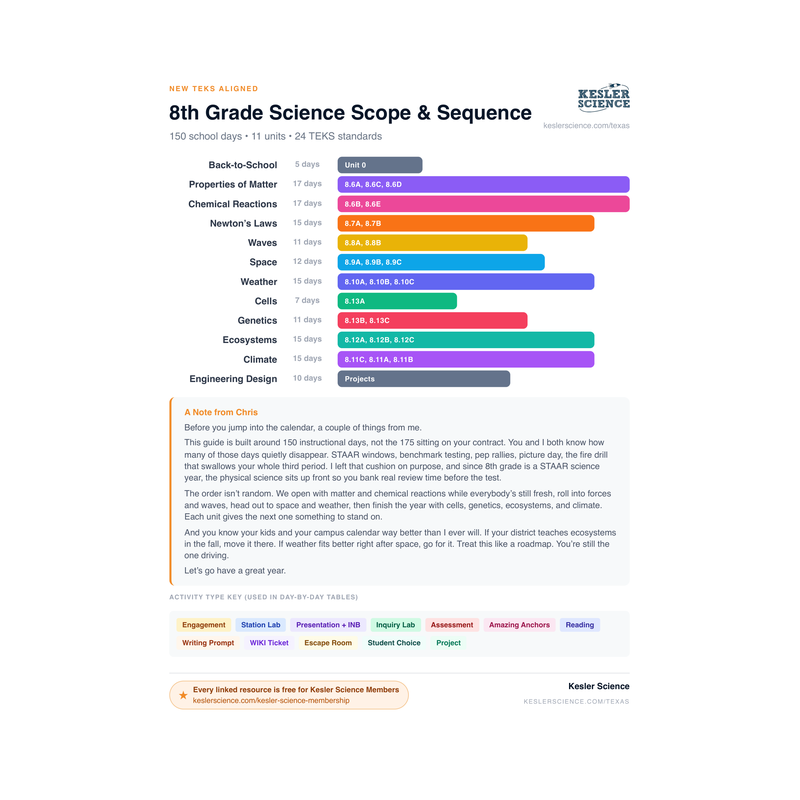
100% Aligned Lessons for Every TEKS You Teach
Kesler Science Plus puts thousands of ready-to-teach lessons and activities in your hands, so you can boost engagement and get your planning time back. Trusted by schools and districts all over the great state of Texas.
🌎 Phenomenon Ideas for 8.6D
Use these real-world phenomena to anchor your lesson. Show students the phenomenon first, let them wonder, then build toward Properties of Acids & Bases as the explanation.
Pool Water vs. Lemon Juice vs. Bleach
A backyard pool is kept at a pH right around 7.4, which is just barely on the basic side of pure water. Lemon juice sits all the way down at about pH 2. Household bleach climbs up to about pH 12. Three liquids you might find in or near a kitchen, all wildly different on the pH scale, even though they're mostly water.
"Why does pure water sit right at 7 on the pH scale? What makes lemon juice sit so far below water and bleach sit so far above it? What does that say about the difference between an acid and a base?"
Hydrangea Flowers That Change Color
Hydrangea plants can produce blue flowers in one yard and pink flowers in the next, even if they're the same variety. Gardeners who want blue blooms add acid to the soil. Those who want pink add a bit of garden lime, which is basic. The color of the flower actually depends on the pH of the soil around the roots.
"How could the same plant produce different flower colors depending on the soil? What does this tell you about the pH scale and how plants interact with their environment?"
Acid Rain and Crumbling Stone Monuments
In some cities, stone statues and building faces that stood for decades have started to look rough, pitted, or blurry in recent years. Air pollution can combine with rainwater to create rain that's more acidic than normal. That mildly acidic rain slowly eats away at limestone and marble. The damage builds up over years, not minutes.
"If rain water is normally around pH 5.6 and polluted rain can drop below pH 4, how much more acidic is the polluted rain? Why might small changes in pH cause noticeable damage to stone over time?"
💡 Free Engagement Ideas for 8.6D
Ready-to-run activities you can drop straight into a lesson. Where one of these looks like a phenomenon from the section above, that is on purpose: show it first as the hook, then let students run it themselves.
Acid vs. Base Venn Diagram
Give each pair of students a list of properties (sour taste, bitter taste, slippery feel, pH below 7, pH above 7, found in lemon juice, found in soap, dissolves some metals, neutral pH, contains water as a reference point). They draw a big Venn diagram with "Acids" on one side and "Bases" on the other, with "Both" in the overlap. Students sort each property card into the correct circle and explain their reasoning out loud. Forces a clean compare-and-contrast.
pH Strip Mystery Mix-Up
Set up a dozen cups with different household liquids (coffee, milk, Sprite, window cleaner, shampoo, etc.), each numbered but unlabeled. Students dip a pH strip in each, record the color and pH, and predict what the liquid might be. Reveal the identities at the end.
pH Number Line Sort
Hand out 10 to 12 cards, each printed with a familiar substance and its approximate pH (battery acid 1, lemon juice 2, soda 3, coffee 5, milk 6, pure water 7, baking soda solution 9, soap 10, ammonia 11, bleach 12). Students physically line up across the front of the room in pH order, holding their card. Once they're in line, ask: "Where is the cutoff between acid and base? Which side is water on? Which substance is closest to water?" Compare-and-contrast in human form.
Household Product pH Lineup
Print a big pH scale (0 to 14) across the whiteboard. Bring in six or seven household items (lemon juice, coffee, water, milk, baking soda, soap, ammonia). Students research or test and tape each item to the correct spot on the scale. The visual sticks for the rest of the unit.
🎯 What Approaches, Meets, and Masters Thinking Look Like
Here is what student thinking at each level looks like on this one task, so you know what to look for and how to move a student up.
A student tests five household substances and records each pH: lemon juice (pH 2), black coffee (pH 5), pure water (pH 7), baking soda solution (pH 9), and drain cleaner (pH 13). Compare and contrast acids and bases: sort these substances into acids and bases using pure water as the reference point, place them in order on a pH scale, and explain how the two groups are alike and how they are different.
- Pure water identified as the neutral reference point at pH 7, with acids placed below 7 and bases placed above 7.
- Lemon juice and black coffee sorted as acids; baking soda solution and drain cleaner sorted as bases.
- Typical properties of each group named: acids often taste sour and react with metals; bases often feel slippery and taste bitter.
- A clear contrast that the two groups sit on opposite sides of water, and a clear similarity that both are measured against water as the common reference.
- The five substances placed in the correct order on the scale, not just sorted into two bins.
- A correct read of strength: the further a substance sits from 7, the more strongly acidic or basic it is (lemon juice is more acidic than coffee; drain cleaner is more basic than baking soda).
- Distance from 7 treated as a real difference in strength, not "basically the same." That is the easiest place to slip.
Lemon juice and coffee are acids because they are under 7. Baking soda and drain cleaner are bases because they are over 7. Water is right in the middle at 7. Acids taste sour and bases feel slippery. Lemon juice is pH 2 and coffee is pH 5, so they are both acids and they are pretty much the same strength. The numbers are just a few apart.
Order on the scale: lemon juice (2), coffee (5), water (7), baking soda (9), drain cleaner (13). Lemon juice and coffee are acids because they are below 7, and baking soda and drain cleaner are bases because they are above 7. Water is neutral at 7 in the middle. Acids and bases are alike because both are compared to water as the reference point, and both can be strong or weak. They are different because acids are below 7 and often taste sour and react with metals, while bases are above 7 and often feel slippery and taste bitter. The further a substance is from 7, the stronger it is, so drain cleaner is a stronger base than baking soda and lemon juice is a stronger acid than coffee.
Order on the scale: lemon juice (2), coffee (5), water (7), baking soda (9), drain cleaner (13). Acids fall below 7 and bases fall above 7, and water at 7 is the neutral middle both are compared to. They are alike because both are measured against that same reference and both get stronger as they move away from it. They are different because acids are sour and react with metals while bases are slippery and bitter. The real idea is that pH measures distance from neutral water, and each step is times ten, so lemon juice at pH 2 is a thousand times more acidic than coffee at pH 5.
This also tells me that "acid" does not mean dangerous and "base" does not mean safe. Coffee is an acid and baking soda is a base, and neither one hurts you in normal amounts, but battery acid near pH 1 and drain cleaner near pH 13 can both burn you. What makes something hazardous is how far it sits from 7, not which side it is on.
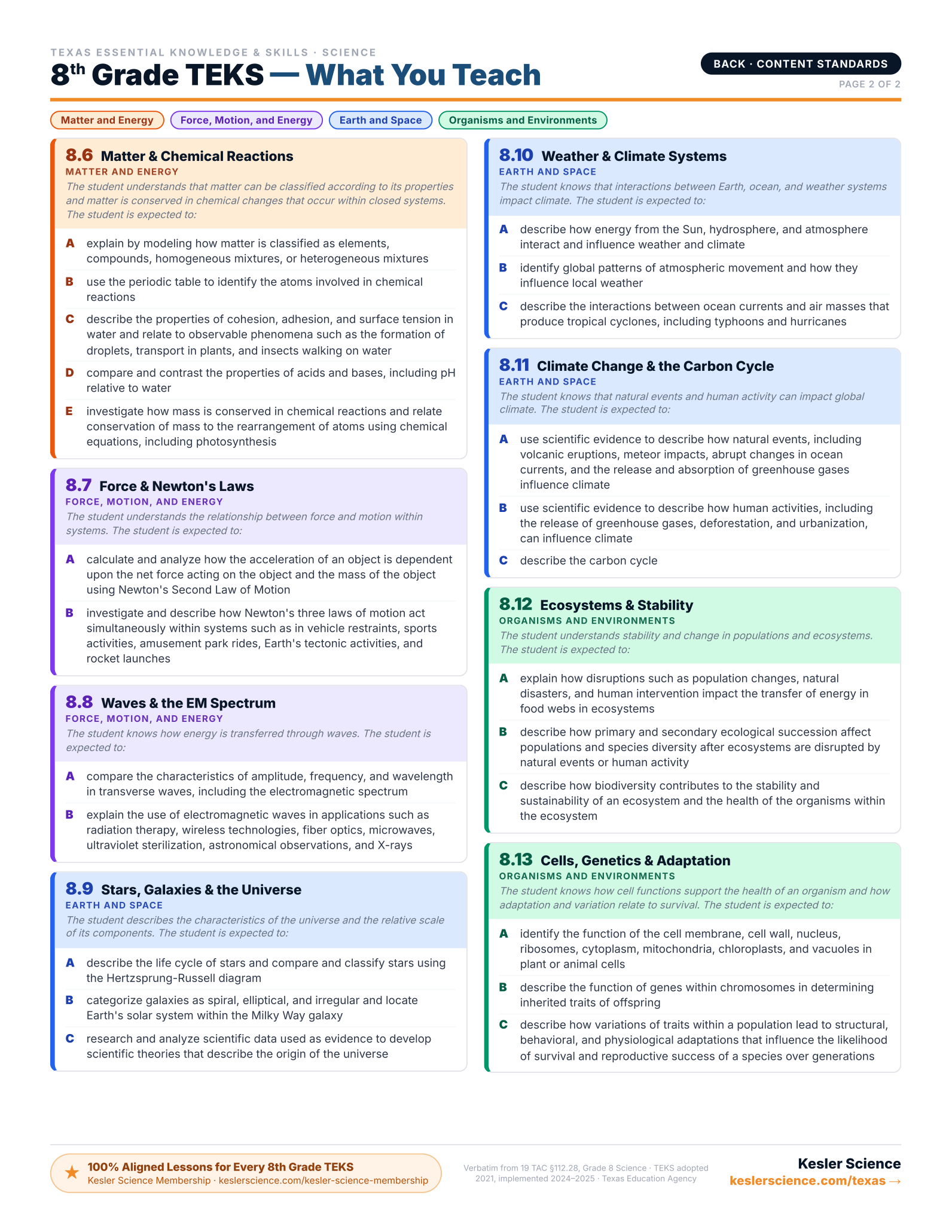
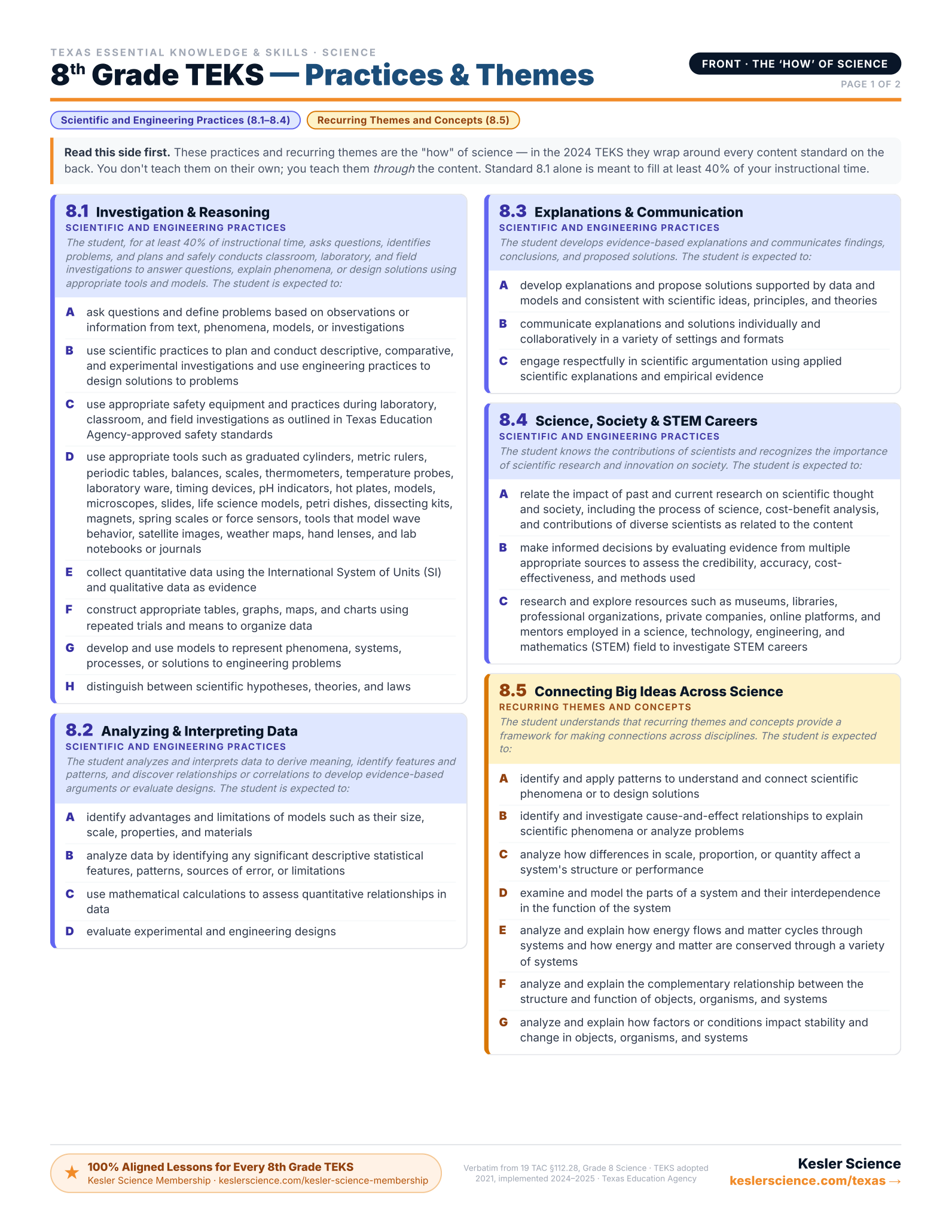
Every 8th-Grade Science TEKS on One Page
The color-coded, front-and-back cheat sheet I wish I'd had — every standard, organized by reporting category. Print it and reference it all year long. This will be your new favorite document!
Trusted Across Texas
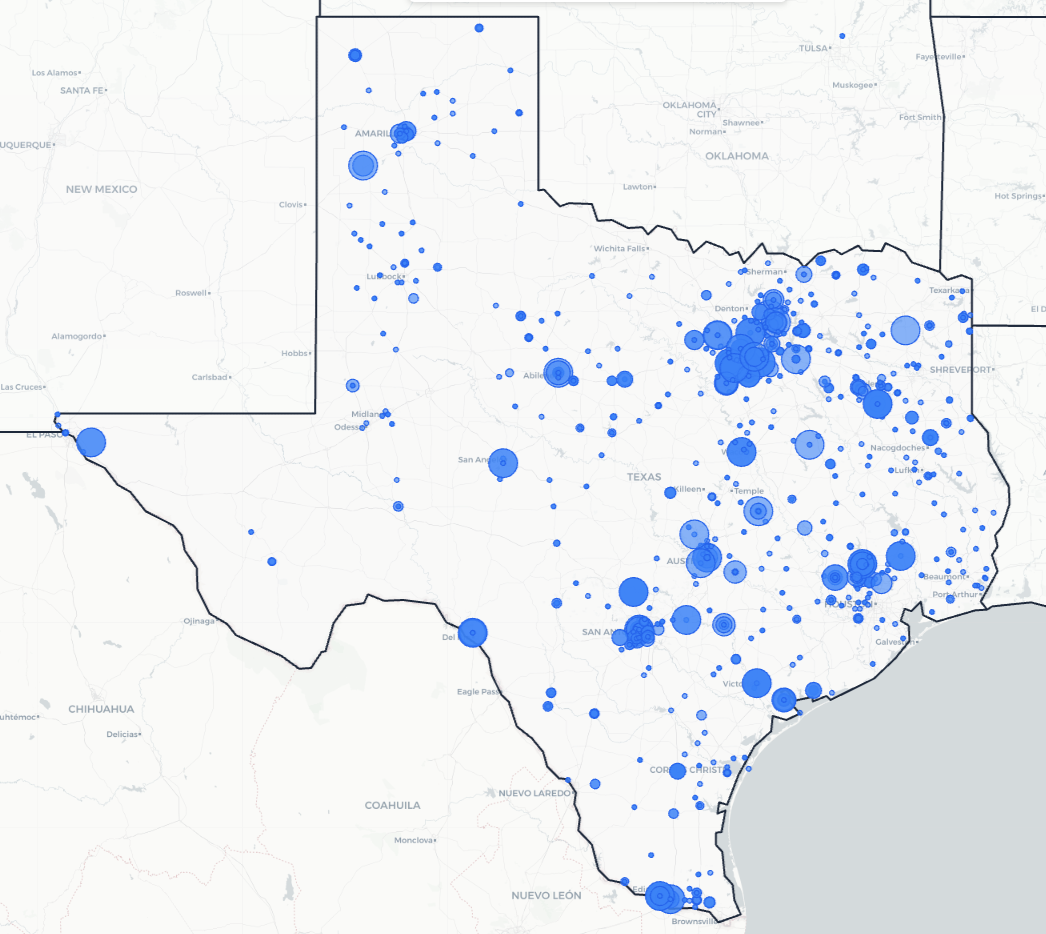
From the Rio Grande Valley to the Panhandle, Texas science teachers are using Kesler Science to save time and engage students.
Texas Schools and Districts
Love Kesler Science
What Teachers Are Saying
Give Your Science Teachers Everything They Need
School and district licenses give your teachers access to every resource they need, including station labs, inquiry labs, anchoring phenomena, presentations, escape rooms, and much more. One purchase covers the grade levels you need.
- PO-friendly. We accept purchase orders
- Volume discounts for 11+ teachers
- Complimentary Kesler Science Plus orientation for 4+ teachers
- Three free implementation PD sessions for departments of 11+
- Aligned to the 2024 TEKS standards
See It in Action
Book a walkthrough and we'll show you how Kesler Science fits your campus.
Book Demo CallNo pressure, no hard sell