.png?width=375&height=100&name=WebPage%20logo%20with%20curves%202026%20(8).png)
Adaptations for Survival
"Describe how variations of traits within a population lead to structural, behavioral, and physiological adaptations that influence the likelihood of survival and reproductive success of a species over generations."
💡 What This Standard Actually Means
"Describe". Students name the type of adaptation, match it to how it helps an organism survive or reproduce, and connect the process to variation within a population over generations. The standard highlights three types: structural, behavioral, and physiological adaptations. Students should be able to identify examples of each type, describe the survival or reproductive advantage, and describe how populations shift over time. Instruction can take many forms, such as sorting activities, labeled organism profiles, and cause-and-effect diagrams.
An adaptation is a trait that helps an organism survive and reproduce in its environment. There are three main types. Structural adaptations are physical body features like thick fur on an Arctic fox, long legs on a heron, a hooked beak on a hawk, or spines on a cactus. Behavioral adaptations are patterns of action like migration, hibernation, nocturnal hunting, or cooperative hunting in wolves. Physiological adaptations are internal or chemical processes like a snake's venom, antifreeze proteins in polar fish, or the ability to produce concentrated urine in desert mammals.
Adaptations do not arise in an individual organism during its lifetime. They arise in populations over many generations through natural selection. Within any population, there is genetic variation. Some variations happen to fit the environment better. Those individuals are more likely to survive, reproduce, and pass those traits to offspring. Over many generations, beneficial traits become more common in the population. An individual does not choose or develop its adaptations. The population changes. Each individual inherits what it inherits.
A common pitfall is students saying things like "the giraffe stretched its neck to reach leaves, so its offspring had longer necks." That is the Lamarckian model, and it is not how evolution works. The correct explanation: giraffes with genetically longer necks happened to survive and reproduce more often in environments where leaves were high, so longer-necked giraffes became more common over generations.
The line I return to every year when teaching this: "Individuals don't adapt. Populations evolve." Students arrive with the Lamarckian version baked in from movies and everyday language, so just telling them once doesn't unstick it. What worked for me was running a quick simulation. Give each group a bag of colored beans representing a population. Remove the ones that "didn't survive" based on a described environment. Return the survivors to the bag, double them (reproduction), and repeat. After three rounds, the color mix has shifted. Students see the population change without any single bean "trying" to adapt. That visual is worth more than a whole chapter of definitions.
⚠️ Misconceptions Your Students May Have
These are some of the most common misconceptions. Knowing what to look for can help you get ahead of them.
"Animals adapt during their lifetime to survive"
This is the Lamarckian misconception, and it is widespread. An individual organism does not develop new heritable traits because of what it does during its life. A bodybuilder's child is not born with bigger muscles. Adaptations show up in populations over generations through natural selection on existing genetic variation. Use this framing: individuals survive. Populations evolve.
"Organisms choose to adapt or want to adapt"
Adaptation is not a conscious choice. A cactus did not decide to have spines. A penguin did not will itself to swim well. Some individuals in past populations happened to have traits that worked in their environments. Those individuals left more offspring. That is the mechanism. It is not a plan or a goal.
"All adaptations are physical body parts"
Structural is only one of three types. Behavioral adaptations (migration, hibernation, group hunting) and physiological adaptations (venom, antifreeze proteins, temperature regulation) are just as important. When students only give body-part answers, press for behavior and internal chemistry examples too.
"Natural selection means the strongest always win"
"Survival of the fittest" does not mean biggest, fastest, or strongest. Fitness in biology is about successfully reproducing and passing traits to the next generation. An organism that hides well, finds food efficiently, or attracts mates can out-reproduce a bigger, stronger competitor. Frame fitness as "fit for this environment," not dominance.
📓 Teaching Resources for 8.13C
These resources are aligned to this standard.


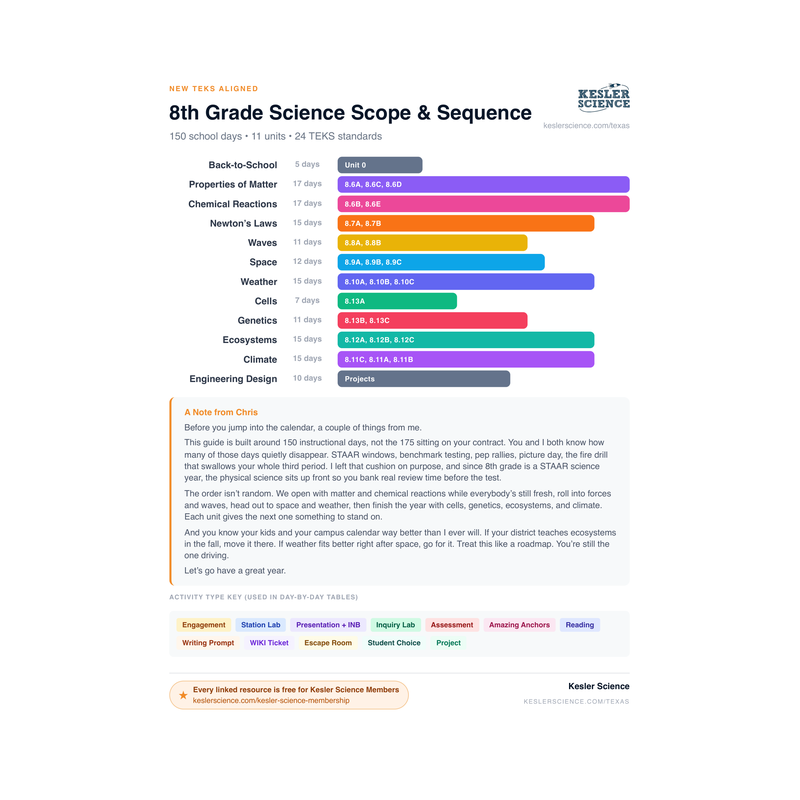
100% Aligned Lessons for Every TEKS You Teach
Kesler Science Plus puts thousands of ready-to-teach lessons and activities in your hands, so you can boost engagement and get your planning time back. Trusted by schools and districts all over the great state of Texas.
🌎 Phenomenon Ideas for 8.13C
Use these real-world phenomena to anchor your lesson. Show students the phenomenon first, let them wonder, then build toward Adaptations for Survival as the explanation.
A Hawk's Eyes, A Hummingbird's Beak
A red-tailed hawk can spot a mouse from hundreds of feet in the air. A hummingbird can hover in place while slipping a beak into a narrow flower. Same class of animal (birds), radically different tools. Neither one chose its features. Both are perfectly suited for how they find food.
"What kind of adaptation is the hawk's vision? The hummingbird's beak? How do those traits help each bird survive and reproduce in its environment?"
Monarch Butterflies Flying 3,000 Miles
Each fall, monarch butterflies from across the eastern United States fly thousands of miles south to specific forests in central Mexico. They've never been there before. Their parents have never been there. Yet they find the same roosting trees generation after generation. The journey can take roughly two months, and one remarkable "super generation" of butterflies lives long enough to make the entire trip. It is the spring and summer journey back north that takes three or four successive generations.
"How would you classify this migration: structural, behavioral, or physiological? How could a trait this specific be passed down if no butterfly has taught it?"
Fish With Antifreeze in Their Blood
Some Antarctic fish species live in water that stays near or just below freezing year-round. Their blood should freeze at those temperatures, but it doesn't. These fish produce special proteins that bind to ice crystals and keep them from growing. They swim in conditions that would kill nearly any other fish.
"What type of adaptation is an antifreeze protein? How might a population of fish have ended up with this ability over many generations in cold waters?"
💡 Free Engagement Ideas for 8.13C
Ready-to-run activities you can drop straight into a lesson. Where one of these looks like a phenomenon from the section above, that is on purpose: show it first as the hook, then let students run it themselves.
Three-Column Adaptation Sort
Print 20 organism traits on cards (thick fur, migration, echolocation, venom, camouflage, hibernation, long tongue, antifreeze blood). Groups sort each card into structural, behavioral, or physiological. Disagreements are the lesson, and some traits will be debated. Discuss the edge cases as a class.
Bird Beak Station
Set up cups with different "foods" (water, small beads, rice, marshmallows, string). Students grab one "beak" tool (tweezers, chopsticks, spoon, straw, clothespin) and try to pick up each food within 30 seconds. Record which beak worked best for which food. Connect results to beak adaptations in real bird species.
Colored Bean Selection Simulation
Spread 50 each of red, green, and brown dried beans across a green tablecloth or piece of construction paper. Students have 10 seconds to pick up as many "prey" beans as they can. Count what's left. Repeat for three generations, doubling survivors each round. Watch the color mix shift toward the best-camouflaged bean.
Design an Organism for an Environment
Assign each group an environment (Texas Hill Country, Arctic tundra, Sahara desert, Amazon rainforest, deep ocean). Groups design an imaginary organism with at least one structural, one behavioral, and one physiological adaptation. They present the design and justify how each trait supports survival and reproduction in the environment.
🎯 What Approaches, Meets, and Masters Thinking Look Like
Here is what student thinking at each level looks like on this one task, so you know what to look for and how to move a student up.
A population of desert rodents lives in an area that is slowly getting hotter and drier over many years. Describe one structural, one behavioral, and one physiological adaptation that could help these rodents survive and reproduce. For each one, explain the advantage it gives. Then describe how variation in these traits within the population leads to the population changing over generations.
- A clear example of each of the three types: one structural (a body feature), one behavioral (a pattern of action), one physiological (an internal or chemical process).
- Each example correctly matched to its type, not all three being body parts.
- A specific survival or reproductive advantage stated for each adaptation, not just "it helps them live."
- The idea that the trait already varies within the population before the environment changes.
- Individuals with the helpful version surviving and reproducing more, so the trait becomes more common over many generations.
- Language that keeps the change in the population, not in a single rodent that "adapts" during its own life.
- The structural vs. physiological line handled correctly (a body part you can see vs. an internal chemical process). That is the easiest place to slip.
Structural: big ears to let off heat. Behavioral: the rodent comes out at night when it's cooler. Physiological: it drinks less water. When it gets hotter, the rodents adapt by growing bigger ears so they can survive, and then their babies are born with the bigger ears too.
Structural: large ears with lots of blood vessels, which release body heat and keep the rodent from overheating. Behavioral: being active only at night and staying in a burrow during the day, which avoids the worst heat. Physiological: making very concentrated urine so the body loses less water. Inside the population, some rodents already have these traits more than others. As it gets hotter and drier, the ones with the helpful traits are more likely to survive and have babies. Their babies inherit those traits, so over many generations more of the population has them.
Structural: large, blood-rich ears to release heat. Behavioral: nighttime activity and burrowing to dodge the heat. Physiological: concentrated urine to hold on to water. None of these are chosen or grown on purpose. The traits already varied in the population, and the hotter, drier environment just meant the rodents that happened to have the helpful versions survived and reproduced more. So the population shifts over generations, even though no single rodent ever changes.
The same logic works for a trait that has nothing to do with strength. Imagine some of these rodents have fur that blends into the pale desert sand. They are not faster or bigger, but hawks spot them less, so they live to reproduce more. "Fittest" here just means fit for this environment, the camouflaged ones out-reproduce the easy-to-see ones, and over generations the pale fur spreads through the population.
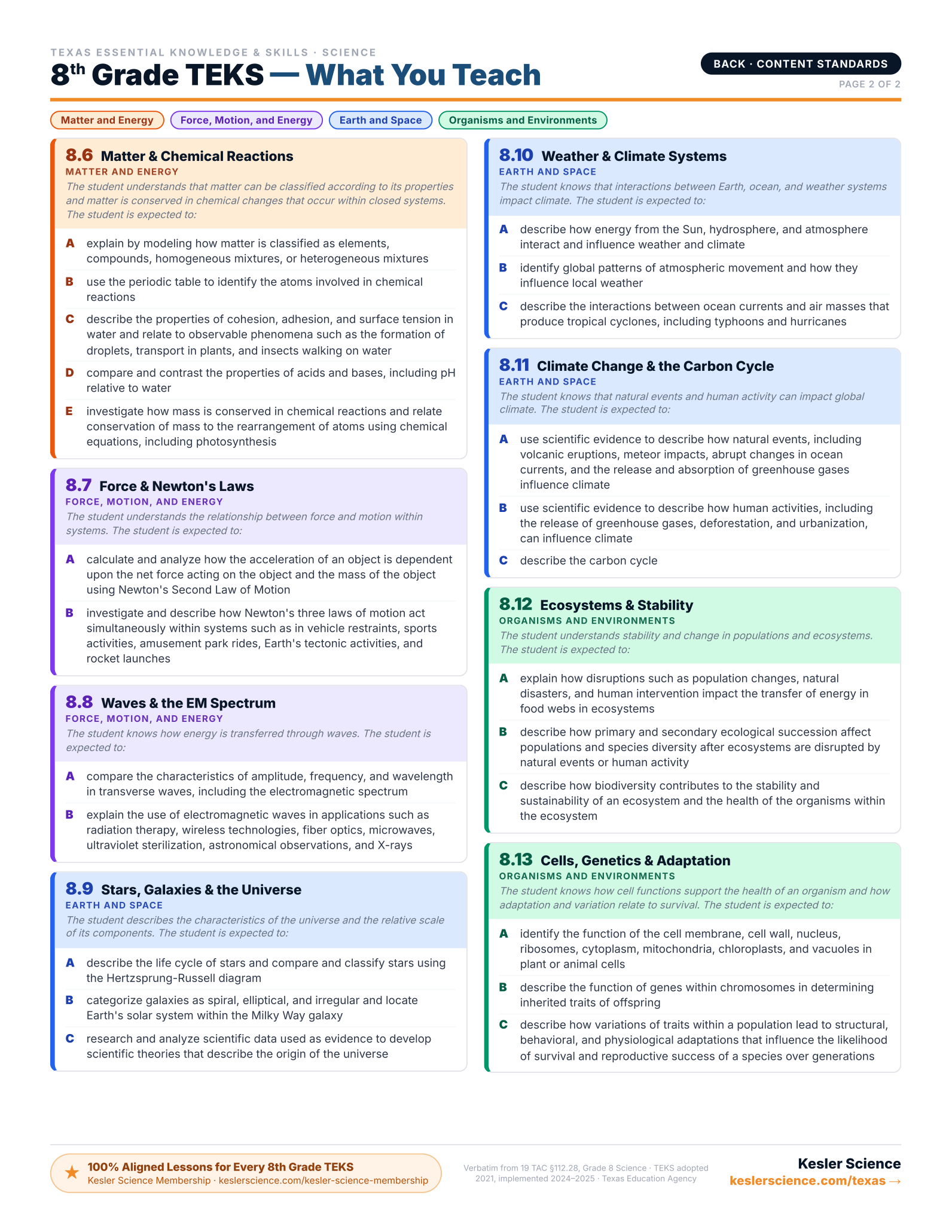
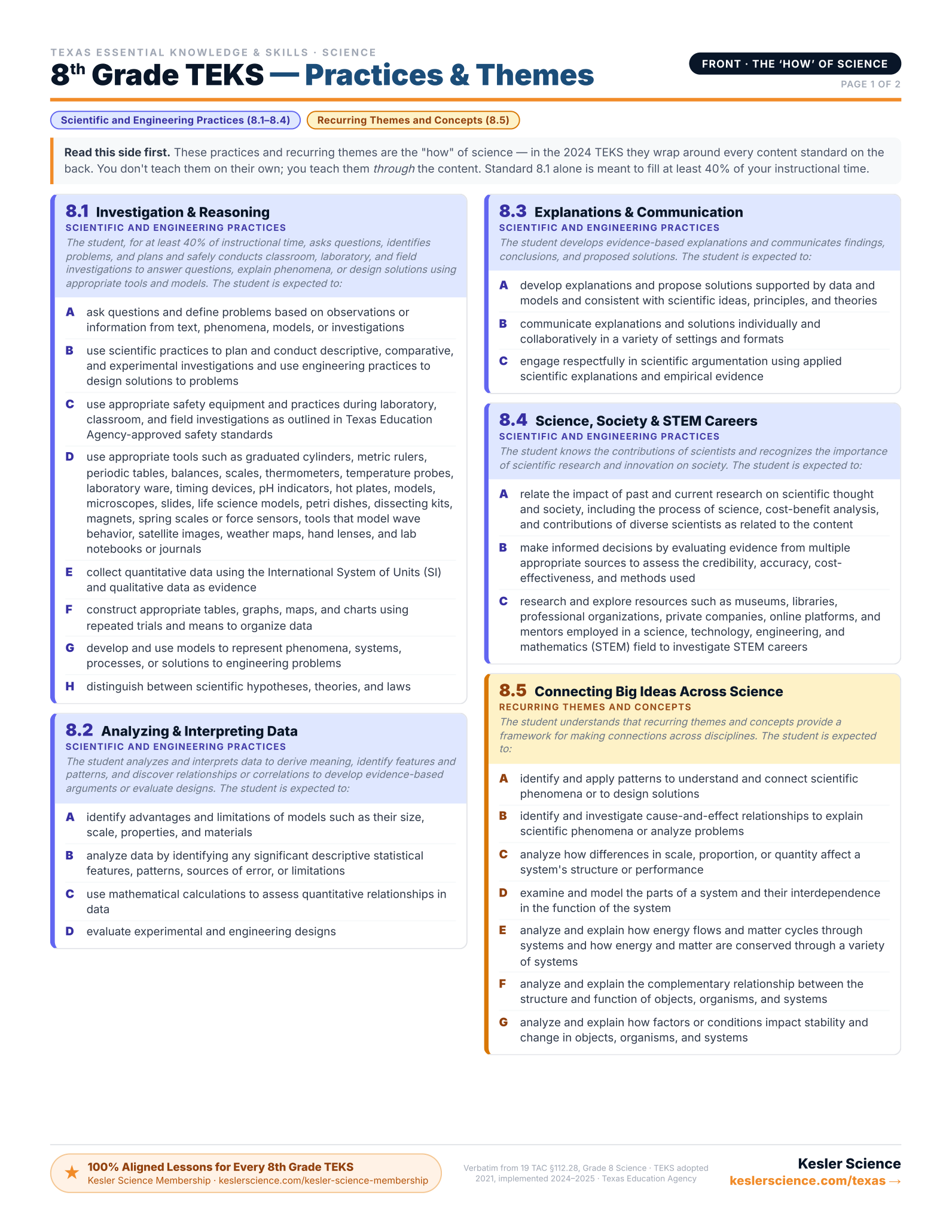
Every 8th-Grade Science TEKS on One Page
The color-coded, front-and-back cheat sheet I wish I'd had — every standard, organized by reporting category. Print it and reference it all year long. This will be your new favorite document!
Trusted Across Texas
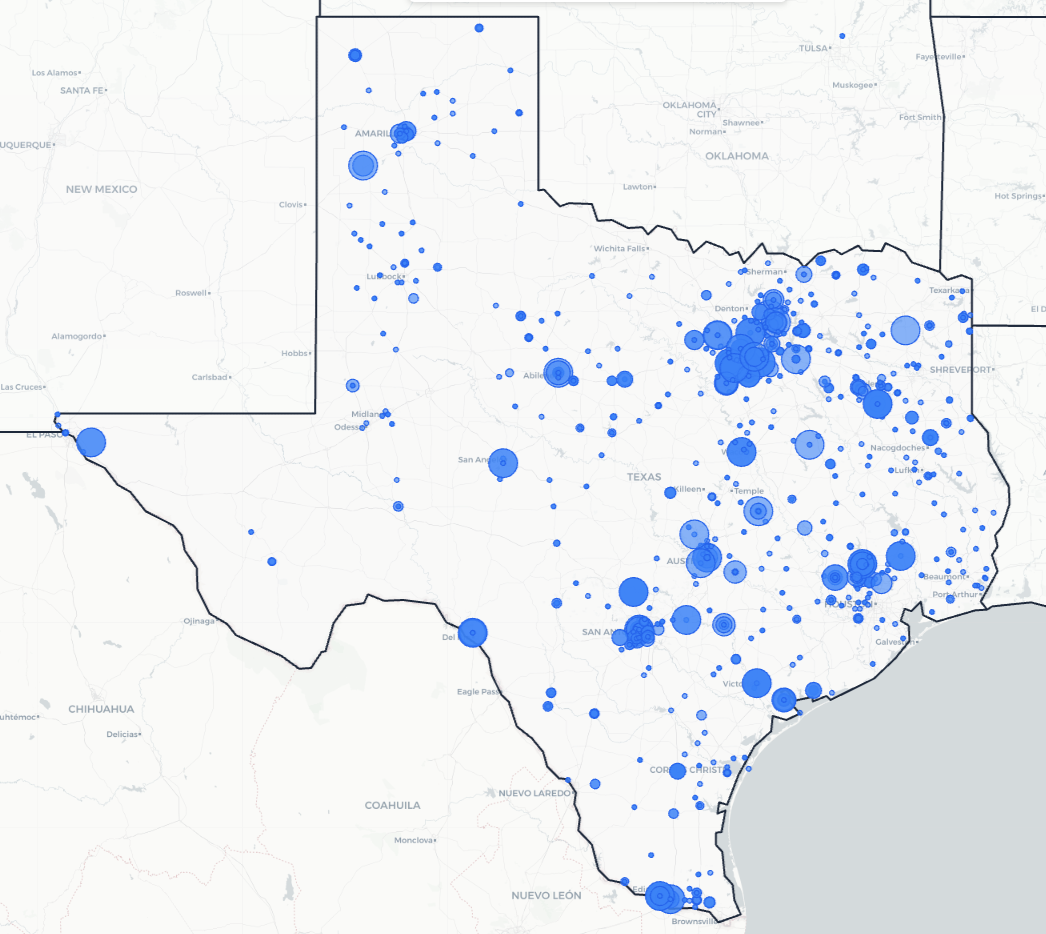
From the Rio Grande Valley to the Panhandle, Texas science teachers are using Kesler Science to save time and engage students.
Texas Schools and Districts
Love Kesler Science
What Teachers Are Saying
Give Your Science Teachers Everything They Need
School and district licenses give your teachers access to every resource they need, including station labs, inquiry labs, anchoring phenomena, presentations, escape rooms, and much more. One purchase covers the grade levels you need.
- PO-friendly. We accept purchase orders
- Volume discounts for 11+ teachers
- Complimentary Kesler Science Plus orientation for 4+ teachers
- Three free implementation PD sessions for departments of 11+
- Aligned to the 2024 TEKS standards
See It in Action
Book a walkthrough and we'll show you how Kesler Science fits your campus.
Book Demo CallNo pressure, no hard sell