.png?width=375&height=100&name=WebPage%20logo%20with%20curves%202026%20(8).png)
Thermal Equilibrium
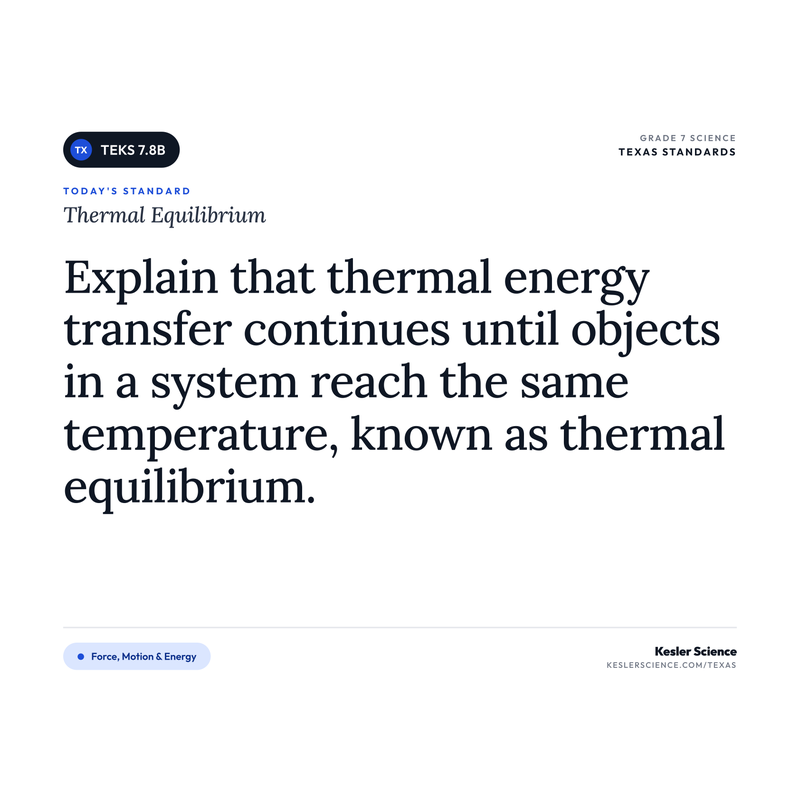
"Investigate how thermal energy moves in a predictable pattern from warmer to cooler until all substances within the system reach thermal equilibrium."
💡 What This Standard Actually Means
"Investigate". Students are investigating how thermal energy moves in a predictable pattern from warmer to cooler until everything in the system reaches thermal equilibrium. The new wording leans on the word "investigate" instead of "explain," so kids should be doing this with measurements and observations, not just reading about it. Instruction can take many forms, such as warm-water-meets-cool-water labs, temperature probe stations, thermal-equilibrium graphing investigations, and ice-cube-in-a-glass observation activities.
When a hot object and a cool object are placed in contact, thermal energy moves from the hotter one to the cooler one. The hotter object cools down, the cooler object warms up, and at some point the two meet in the middle. That point is thermal equilibrium. Once the two objects reach the same temperature, there is no more net transfer of thermal energy between them.
Reaching equilibrium does not mean the particles stop moving. Both objects are still full of particles bouncing and vibrating. The difference is that on average, the particles in both objects now have the same kinetic energy, so the exchange of energy between them balances out. Energy still passes back and forth, but just as much goes one way as the other. That's what "no net transfer" means.
A simple example: drop an ice cube into a glass of warm soda. Thermal energy leaves the warm soda and enters the cold ice. The soda cools, the ice warms (and eventually melts), and after enough time the whole drink sits at one temperature. That final shared temperature is thermal equilibrium. The core understanding students should walk away with is that thermal equilibrium is the stopping point for net energy transfer, not the stopping point for particle motion.
The move that saved me on this standard was sketching two cups with a line graph underneath. One cup starts at 90 degrees, the other at 30 degrees. I'd draw the two lines curving toward each other on the graph until they met in the middle around 60 degrees. Then I'd label that meeting point "thermal equilibrium." Students could see, visually, that it wasn't a stopping point for anything except the net flow of energy. From there I asked them to predict what the graph would look like with different starting temperatures. That one picture did more heavy lifting than any definition I could have written on the board.
⚠️ Misconceptions Your Students May Have
These are some of the most common misconceptions. Knowing what to look for can help you get ahead of them.
"When two objects reach equilibrium, the particles stop moving"
This one trips up a lot of students. Particles never stop moving at normal temperatures. At thermal equilibrium, the particles in both objects have the same average kinetic energy. Energy still transfers in both directions, but it balances out, so there's no net change. Motion continues; net transfer stops.
"Thermal equilibrium means both objects are cold"
Equilibrium just means the two objects reach the same temperature. If you put two hot objects together and they settle at 150 degrees, that's still thermal equilibrium. It's a shared temperature, not a cold temperature. The final temperature depends on the starting temperatures and the amount of matter in each object.
"The final temperature is always exactly halfway between the two starting temperatures"
Not quite. The final temperature depends on how much matter each object contains and what it's made of. A tiny ice cube dropped into a big pot of hot water will barely change the water's temperature. A giant block of ice in the same pot will cool the water way down. The size and type of matter on each side matter just as much as the starting temperatures.
"Once things reach equilibrium, energy stops moving forever"
Energy keeps exchanging between the two objects. It just balances out, so neither object gets hotter or colder. If something changes the system (a heat source is added, the insulation is removed, a cold object is introduced), energy starts flowing in a net direction again until a new equilibrium is reached.
📓 Teaching Resources for 7.8B
These resources are aligned to this standard.


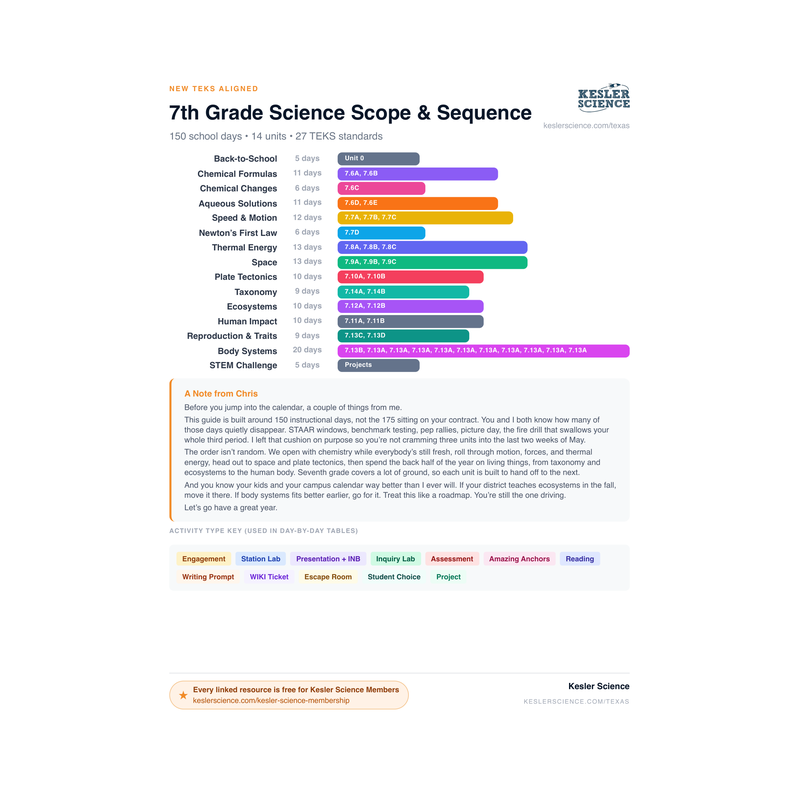
100% Aligned Lessons for Every TEKS You Teach
Kesler Science Plus puts thousands of ready-to-teach lessons and activities in your hands, so you can boost engagement and get your planning time back. Trusted by schools and districts all over the great state of Texas.
🌎 Phenomenon Ideas for 7.8B
Use these real-world phenomena to anchor your lesson. Show students the phenomenon first, let them wonder, then build toward Thermal Equilibrium as the explanation.
A Glass of Iced Water Left on the Counter
Pour a glass of iced water and set it on the kitchen counter. Come back three hours later. The ice is gone, and the water feels roughly the same temperature as the room. Why didn't the water stay cold? And how did it end up matching the room's temperature exactly, without anyone touching it?
"Which way is thermal energy moving during those three hours? When does the transfer stop, and how does the water seem to know when to stop warming up?"
Hot Soup Sitting Out Too Long
You pour a bowl of hot soup and get distracted for half an hour. When you come back, the soup is lukewarm, not piping hot anymore. You didn't put it in the fridge. Nothing "cooled" the soup. So what happened to the energy it had when you first poured it?
"The soup cooled down. The air in the kitchen warmed up, just a tiny bit. What does that tell you about where the thermal energy went, and what would happen if you left it long enough?"
A Cold Metal Chair in a Warm Room
You walk into a warm classroom first thing in the morning and sit in a metal chair. The chair feels ice-cold even though the room is at a comfortable 70 degrees. Fifteen minutes later, the chair feels normal. The room temperature didn't change. What changed about the chair?
"At what point does the chair stop feeling cold to sit on? What does that tell you about the temperature of the chair compared to the temperature of the room?"
💡 Free Engagement Ideas for 7.8B
Ready-to-run activities you can drop straight into a lesson. Where one of these looks like a phenomenon from the section above, that is on purpose: show it first as the hook, then let students run it themselves.
Hot and Cold Cup Challenge
Fill one plastic cup with hot tap water and one with ice water. Place a thermometer in each and record the starting temperatures. Then pour the cold water into the hot water and stir. Record the new temperature every 30 seconds until it stops changing. Students graph the data and identify the thermal equilibrium point.
Penny Drop Temperature Log
Heat 10 pennies in hot tap water for 2 minutes. Drop them into a cup of room-temperature water with a thermometer in it. Record the temperature every 15 seconds until it levels off. Have students annotate the graph: where energy is flowing, where it stops flowing, and where equilibrium is reached.
Cup and Room Match-Up
Give each group a cup of very hot or very cold water and a thermometer. Have them record the temperature every 3 minutes for the rest of class (keep other work going). At the end, compare final temperatures to room temperature. Every cup, no matter the starting point, will be trending toward the room temperature.
Predict-Then-Test
Before any experiment, have students write a prediction: "If I mix 100 mL of 80-degree water with 100 mL of 20-degree water, the final temperature will be ___ degrees." Then run the experiment. Discuss whose predictions came close, what factors they didn't account for, and why equilibrium isn't always the simple average.
🎯 What Approaches, Meets, and Masters Thinking Look Like
Here is what student thinking at each level looks like on this one task, so you know what to look for and how to move a student up.
A student drops a few ice cubes into a glass of warm soda and uses a temperature probe to record the soda's temperature every minute. The soda starts at 30 degrees Celsius, drops fast at first, then levels off and stays at 12 degrees Celsius. Using the idea of thermal energy and particles, explain what happened to the soda and the ice, and explain what is happening at the end when the temperature stops changing.
- A clear statement that thermal energy moved from the warm soda to the cold ice (warmer to cooler), not the other way around.
- The soda cooling down and the ice warming up (and melting) described as two sides of the same energy transfer.
- The leveling-off point named as thermal equilibrium, the point where the soda and the melted ice reach the same temperature.
- An explanation that at 12 degrees there is no more net transfer of thermal energy between the soda and the water.
- The flat part of the data tied back to the science, not just "it stopped" but "they reached the same temperature."
- The trickiest piece: at the end the particles are still moving, energy still passes both ways, it just balances out. Equilibrium stops the net transfer, not the motion.
The ice cube made the soda cold. The soda went from 30 degrees down to 12 degrees because the cold from the ice went into it. At the end the temperature stops changing because the particles stop moving. Everything is done, so nothing is happening anymore and the soda just stays at 12 degrees.
Thermal energy moved from the warm soda to the cold ice, because thermal energy always moves from warmer to cooler. That is why the soda cooled down and the ice warmed up and melted. The temperature dropped fast at first because the soda and ice were very different temperatures. As they got closer, it slowed down. At 12 degrees the soda and the melted ice are the same temperature, so they reached thermal equilibrium. The particles are still moving, but there is no more net transfer of energy, so the temperature stays the same.
Thermal energy moved from the warm soda to the cold ice because thermal energy always moves from warmer to cooler. The soda's particles had more energy, so they passed energy to the slower ice particles when they bumped into each other. That is why the soda cooled and the ice warmed up and melted. The drop was fast at first because the temperature gap was big, and it slowed down as the gap shrank.
At 12 degrees they reached thermal equilibrium. That does not mean the particles stopped. They are still bouncing around. Now the soda particles and the water particles have the same average energy, so energy passes both ways equally and there is no net transfer. The temperature stays put.
I think this is why a cold drink left out on the counter slowly warms up to room temperature. The same rule works in reverse: thermal energy moves from the warmer room air into the cold drink until the drink and the air reach the same temperature. It is the same predictable pattern, just a different system.
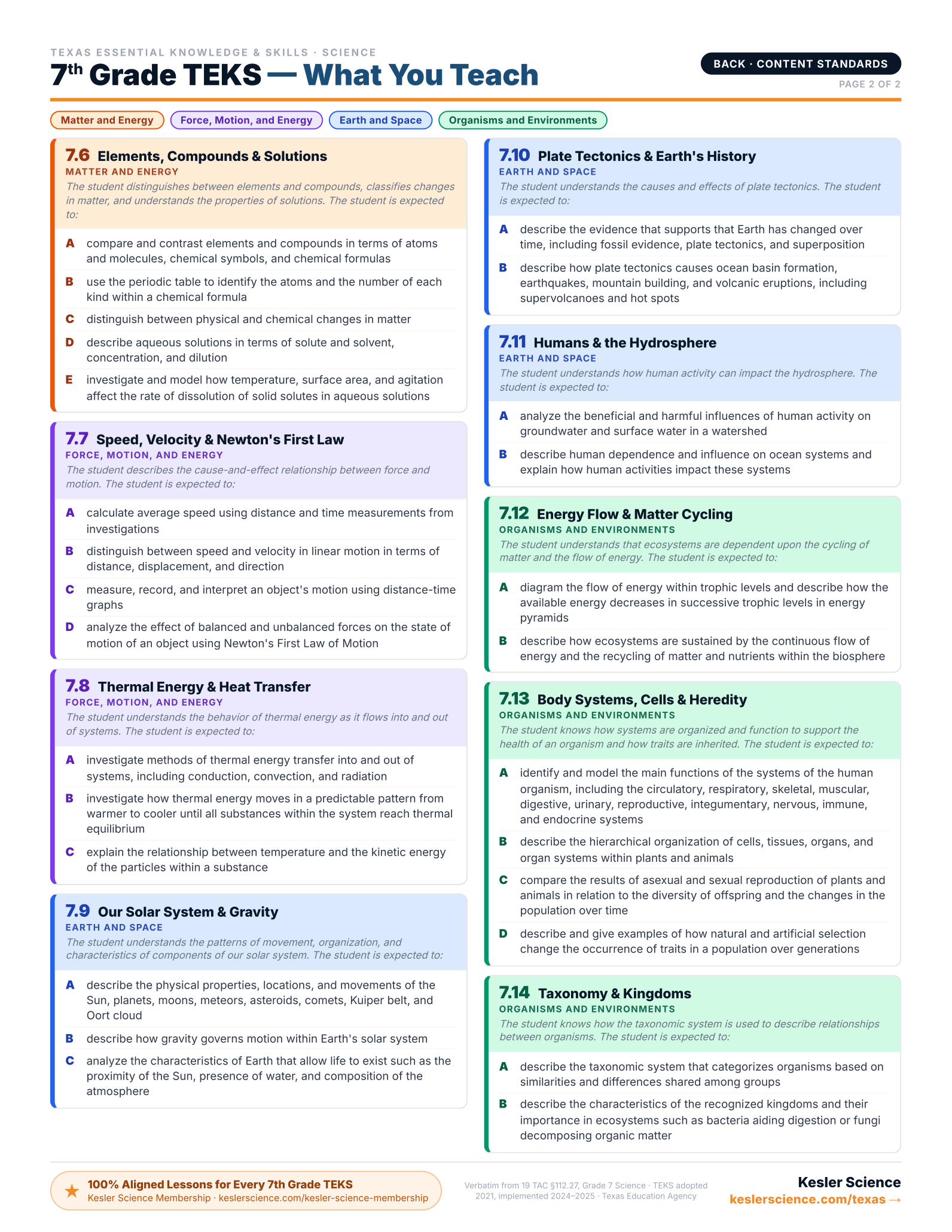
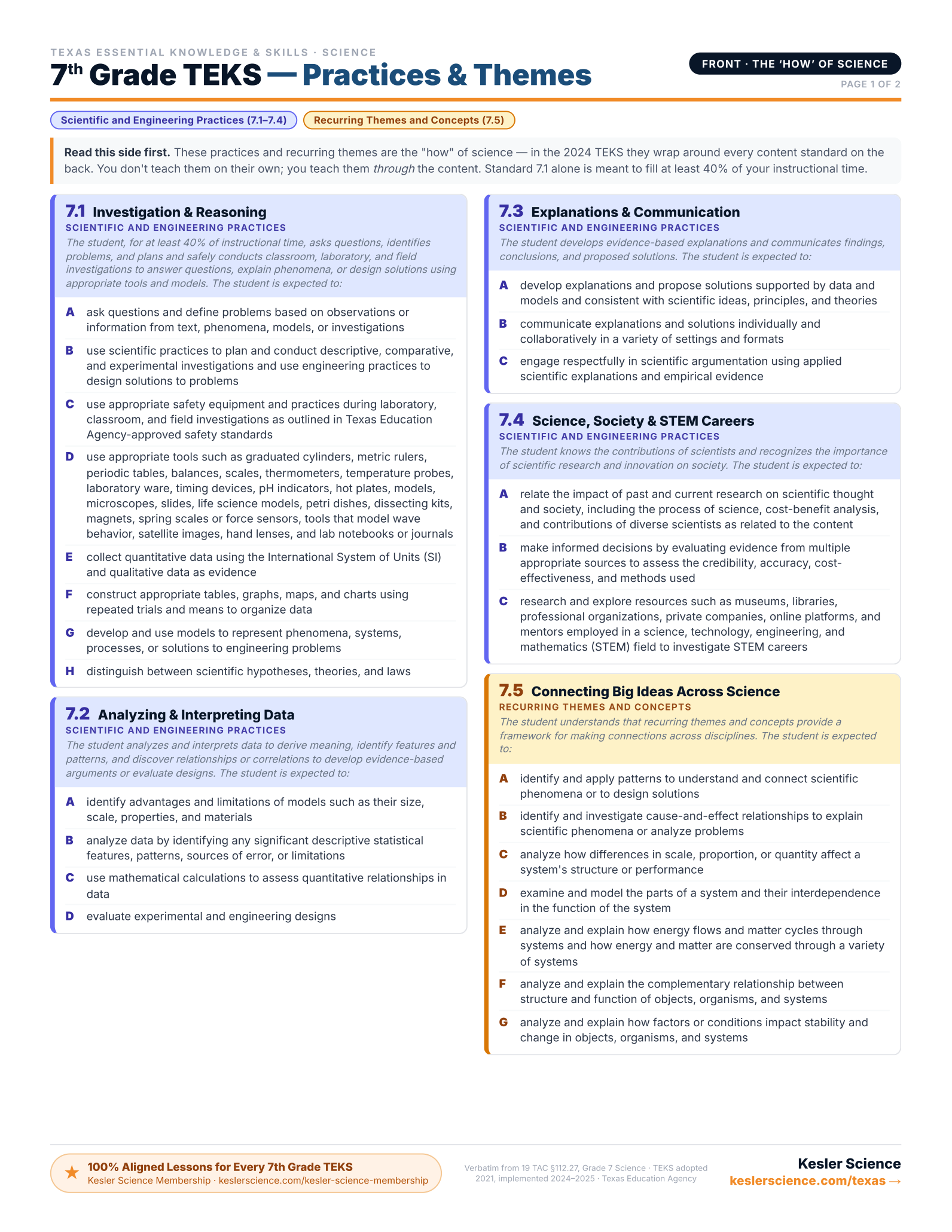
Every 7th-Grade Science TEKS on One Page
The color-coded, front-and-back cheat sheet I wish I'd had — every standard, organized by reporting category. Print it and reference it all year long. This will be your new favorite document!
Trusted Across Texas
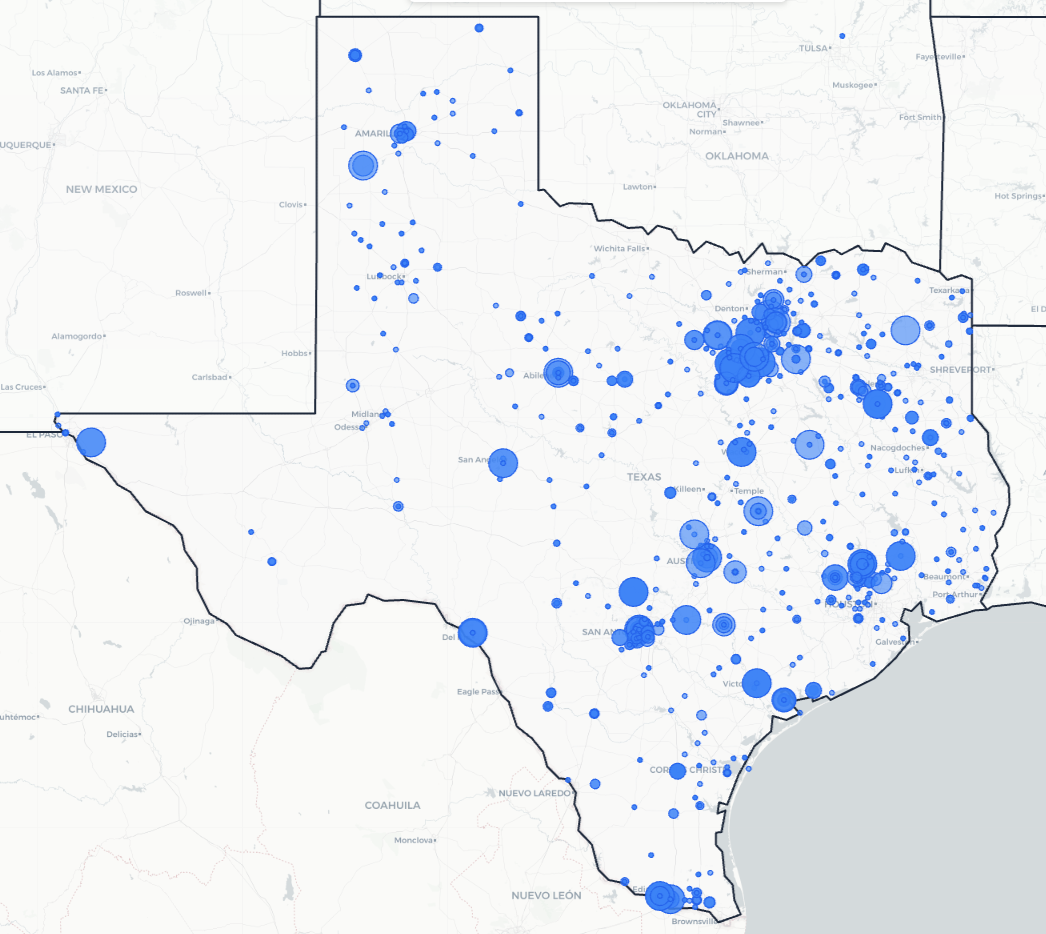
From the Rio Grande Valley to the Panhandle, Texas science teachers are using Kesler Science to save time and engage students.
Texas Schools and Districts
Love Kesler Science
What Teachers Are Saying
Give Your Science Teachers Everything They Need
School and district licenses give your teachers access to every resource they need, including station labs, inquiry labs, anchoring phenomena, presentations, escape rooms, and much more. One purchase covers the grade levels you need.
- PO-friendly. We accept purchase orders
- Volume discounts for 11+ teachers
- Complimentary Kesler Science Plus orientation for 4+ teachers
- Three free implementation PD sessions for departments of 11+
- Aligned to the 2024 TEKS standards
See It in Action
Book a walkthrough and we'll show you how Kesler Science fits your campus.
Book Demo CallNo pressure, no hard sell