.png?width=375&height=100&name=WebPage%20logo%20with%20curves%202026%20(8).png)
Compare Elements & Compounds
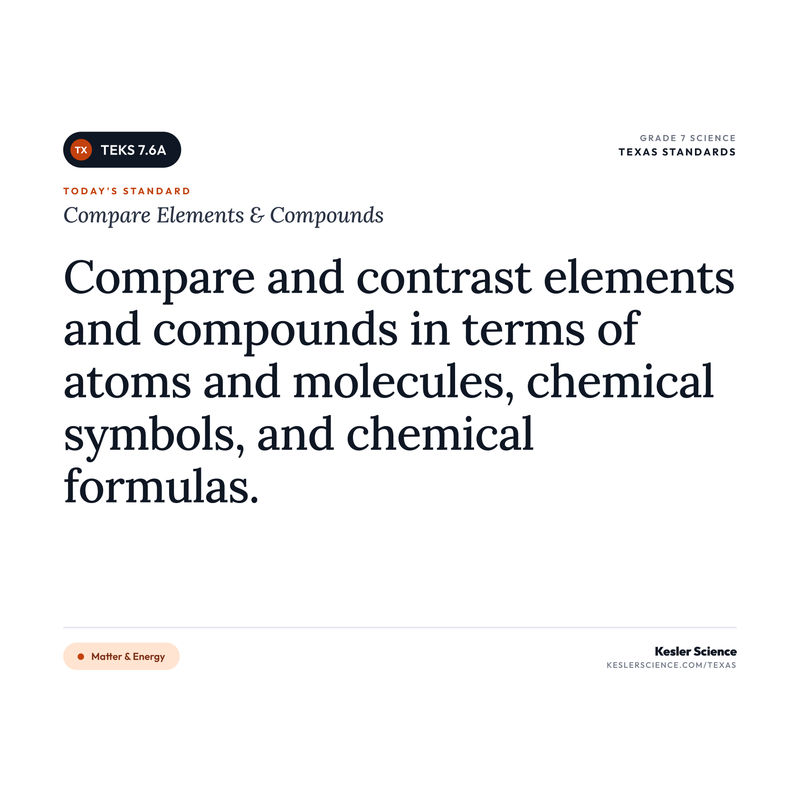
"Compare and contrast elements and compounds in terms of atoms and molecules, chemical symbols, and chemical formulas."
💡 What This Standard Actually Means
"Compare and contrast". Students are finding the similarities and differences between elements and compounds. The standard names exactly what to focus on: atoms and molecules, chemical symbols, and chemical formulas. Kids need to be able to look at a substance and explain how it's organized at the particle level and how it's represented on paper. Instruction can take many forms, such as Venn diagrams, particle model drawings, periodic table sorting activities, and chemical formula card sorts.
An element is a pure substance made of only one kind of atom. Oxygen, iron, carbon, and gold are each elements. Every element has its own spot on the periodic table and its own chemical symbol, like O for oxygen, Fe for iron, and Au for gold. The smallest piece of an element that still has its properties is a single atom (or, in some cases, a molecule made of two atoms of the same element, like O2).
A compound is a pure substance made of two or more different elements that are chemically bonded together in a fixed ratio. Water (H2O), carbon dioxide (CO2), and table salt (NaCl) are compounds. The smallest piece of a compound is a molecule (for compounds held together by covalent bonds) or a formula unit (for compounds held together by ionic bonds). Compounds are represented by chemical formulas, which use the symbols of the elements and small numbers (subscripts) to show how many of each atom are present.
The big idea students should walk away with is the comparison. Elements and compounds are both pure substances, both have a fixed composition, and both can be represented on paper using letters and numbers. They're different because elements are made of one kind of atom, while compounds are made of two or more kinds bonded together. Elements are written with chemical symbols (single elements like H or two-letter codes like Cl). Compounds are written with chemical formulas (combinations like H2O or NaCl). Side-by-side, students should be able to look at any pure substance and explain whether it's an element or a compound and why.
The move I leaned on for this was a quick sort with index cards. I'd write single-atom drawings on some cards (like two oxygen atoms stuck together for O2) and compound drawings on others (like H2O with two hydrogens and one oxygen). Kids sorted them into two piles before I ever said the words "element" and "compound." Once they had piles, I'd ask, "What's different about each pile?" They'd usually land on "same kind of atom vs. different kinds." That's your definition, and the kids just built it themselves. From there, layer in the vocabulary and the symbols vs. formulas piece.
⚠️ Misconceptions Your Students May Have
These are some of the most common misconceptions. Knowing what to look for can help you get ahead of them.
"If it's made of more than one atom, it's a compound"
Oxygen gas (O2) is two oxygen atoms bonded together, but it's still an element because both atoms are the same type. A compound requires two or more DIFFERENT elements. The rule is about the types of atoms, not the number of atoms.
"A compound is just a mixture of elements"
Mixtures can be separated by physical means and the parts keep their original properties. Compounds are chemically bonded in fixed ratios, and their properties are usually very different from the elements that formed them. Hydrogen burns, oxygen supports burning, but together they form water, which puts out fire.
"Compounds have the same properties as the elements inside them"
Sodium is a soft metal that reacts violently with water. Chlorine is a toxic yellow-green gas. Bond them together and you get sodium chloride, which is table salt, safe to sprinkle on dinner. Compound properties are usually very different from the properties of the elements that make them up.
"Every symbol on the periodic table is a compound"
The periodic table lists elements only. Each square represents one type of atom. Compounds are not on the periodic table. They're written as chemical formulas built from element symbols, like H2O or CO2.
📓 Teaching Resources for 7.6A
These resources are aligned to this standard.


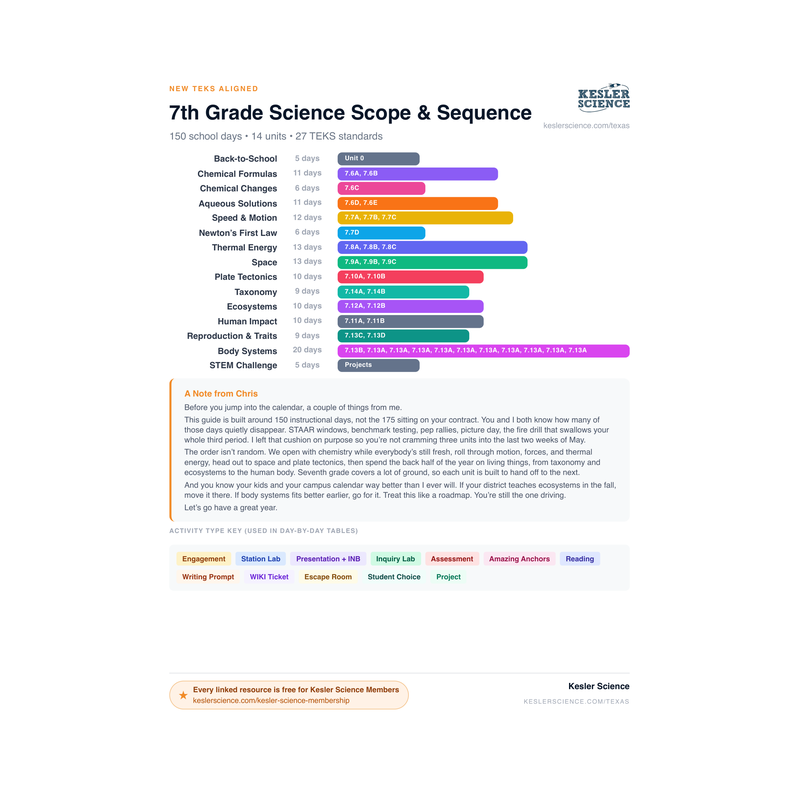
100% Aligned Lessons for Every TEKS You Teach
Kesler Science Plus puts thousands of ready-to-teach lessons and activities in your hands, so you can boost engagement and get your planning time back. Trusted by schools and districts all over the great state of Texas.
🌎 Phenomenon Ideas for 7.6A
Use these real-world phenomena to anchor your lesson. Show students the phenomenon first, let them wonder, then build toward Compare Elements & Compounds as the explanation.
Salt on the Kitchen Table
Sodium is a silvery metal so reactive that it can ignite when it touches water. Chlorine is a yellow-green gas that was used as a chemical weapon in World War I. Yet when sodium and chlorine bond together, the result is sodium chloride, the white crystal we sprinkle on french fries. How does combining two substances that are each dangerous on their own produce something safe to eat?
"Why would a compound have such different properties from the elements that form it? What does that tell us about the difference between an element and a compound?"
Water: Fire Starter or Fire Stopper?
Hydrogen gas is extremely flammable. Oxygen gas is what fire needs to burn. Logically, combining them should create an enormous fireball. Instead, when hydrogen and oxygen bond in the right ratio, they form water, which firefighters use to put fires out. Same atoms, but the arrangement changes everything.
"Hydrogen and oxygen are elements. Water is a compound made of those same two elements. Why does the compound behave so differently from the elements that built it?"
Diamond and Pencil Lead
A diamond is one of the hardest natural substances on Earth. The "lead" in a pencil is soft enough that rubbing it on paper leaves a mark. Both are made of exactly the same element: carbon. The only difference is how the carbon atoms are arranged. Same single element, two very different materials.
"If both diamond and graphite are made of only carbon atoms, what can we learn about elements from looking at them? What does this tell us about why the arrangement of atoms matters?"
💡 Free Engagement Ideas for 7.6A
Ready-to-run activities you can drop straight into a lesson. Where one of these looks like a phenomenon from the section above, that is on purpose: show it first as the hook, then let students run it themselves.
LEGO or Bead Particle Models
Hand out LEGO bricks or colored beads. Tell students each color represents a different element. Have them build an element (all one color), a diatomic element like O2 (two bricks of the same color), and a compound like H2O (two of one color bonded to one of another). Have them trade models with a partner and identify each.
Element vs. Compound Sort
Prepare cards with chemical symbols and formulas (H, O2, Au, NaCl, H2O, Fe, CO2, Cu, CH4, N2). Have students sort them into "Element" and "Compound" piles and justify each placement. Include O2 and N2 to catch the "more than one atom = compound" misconception.
Kitchen Cabinet Element Hunt
Ask students to bring in labels or photos from food and cleaning products at home. In class, have them circle the element names on the Nutrition Facts panel (iron, zinc, calcium, copper - these show up there as minerals, even though they are actually present as compounds in food) and the compounds in the ingredients list (sodium chloride, sodium bicarbonate, carbon dioxide). Discuss how compounds show up on labels versus how elements do.
Build a Periodic Table Mini-Poster
Assign each student two or three elements from the periodic table. They create a mini-poster showing the symbol, the atomic number, and one compound that element forms (for example, sodium + chlorine forms NaCl). Arrange them together on a classroom wall to build a student-made periodic table with compound connections.
🎯 What Approaches, Meets, and Masters Thinking Look Like
Here is what student thinking at each level looks like on this one task, so you know what to look for and how to move a student up.
A student has three substances in front of her: oxygen gas (O2), water (H2O), and carbon dioxide (CO2). For each one, tell whether it is an element or a compound. Then explain how you decided, using what the chemical formula shows you about the atoms inside.
- Each substance labeled as either an element or a compound (oxygen = element, water = compound, carbon dioxide = compound).
- An explanation that uses the kinds of atoms, not just the number of atoms.
- Water (H2O) explained as a compound because it has two different elements bonded together: hydrogen and oxygen.
- Carbon dioxide (CO2) explained as a compound because it has two different elements: carbon and oxygen.
- The subscript numbers read correctly (the 2 in H2O means two hydrogen atoms, not two different elements).
- An answer that connects the formula on paper back to the atoms it stands for.
- Oxygen gas (O2) called an element even though it has two atoms, because both atoms are the same kind. That is the easiest place to slip.
Water is a compound because it has hydrogen and oxygen in it. Carbon dioxide is a compound too because it has carbon and oxygen. Oxygen is a compound also, because the formula O2 has two atoms in it, and if something has more than one atom then it is a compound.
Oxygen (O2) is an element because both atoms are the same kind. There are two atoms, but they are both oxygen, so it is still one type. Water (H2O) is a compound because it has two different elements bonded together, hydrogen and oxygen. Carbon dioxide (CO2) is also a compound because it has two different elements, carbon and oxygen. The little 2 in CO2 just means there are two oxygen atoms, but carbon and oxygen are still two different elements.
Oxygen (O2) is an element because every atom in it is the same single kind of atom, even though there are two of them. Water (H2O) and carbon dioxide (CO2) are both compounds because each one is made of two different elements that are chemically bonded together. The real test is not how many atoms there are, it is how many different elements there are. One kind means an element, two or more kinds bonded together means a compound.
That is also how I can tell that ozone (O3) is still an element, not a compound. It has three atoms, which sounds like a lot, but they are all oxygen, so it is only one kind of atom. And a chemical symbol like just O or Fe stands for an element, while a formula like H2O or NaCl mixes different element symbols together, so it stands for a compound.
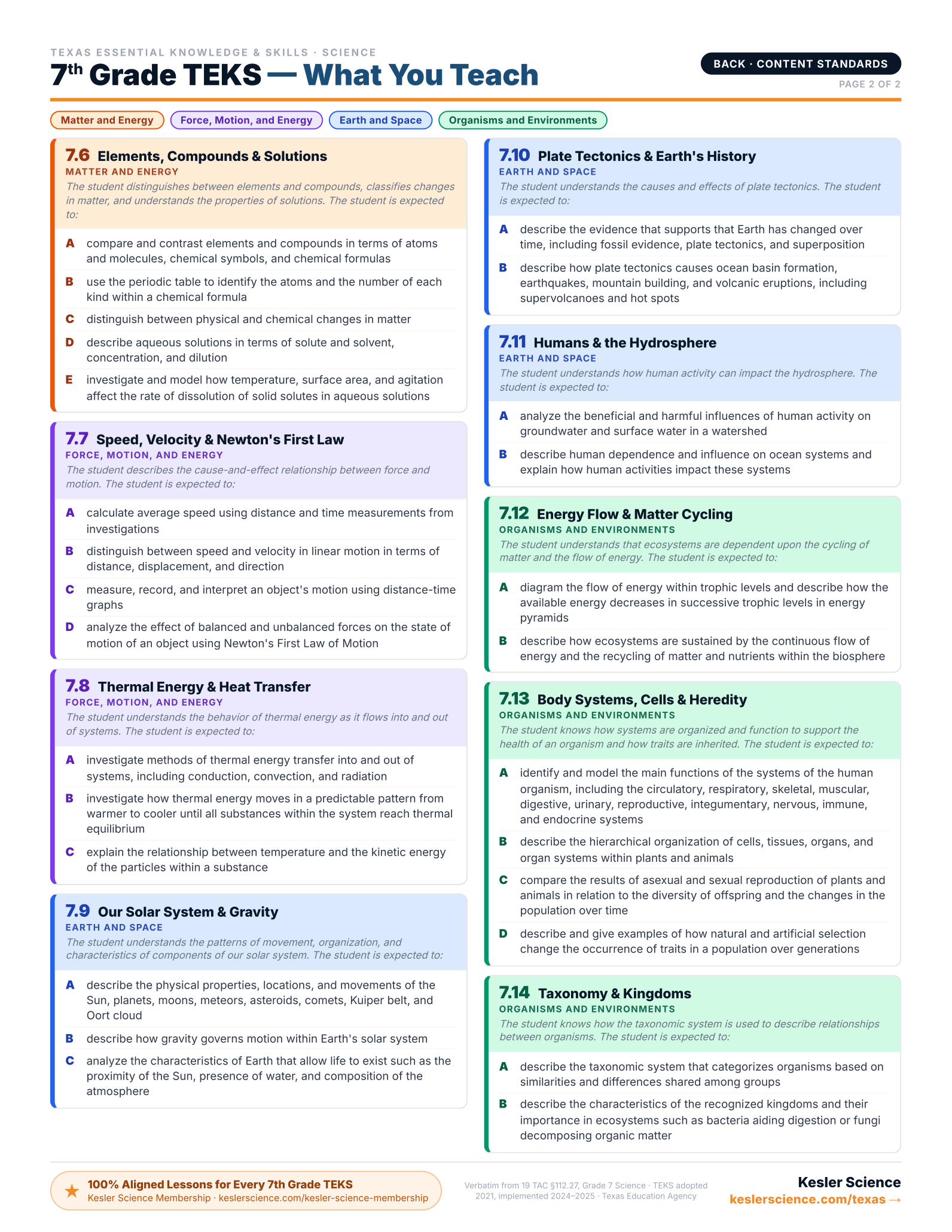
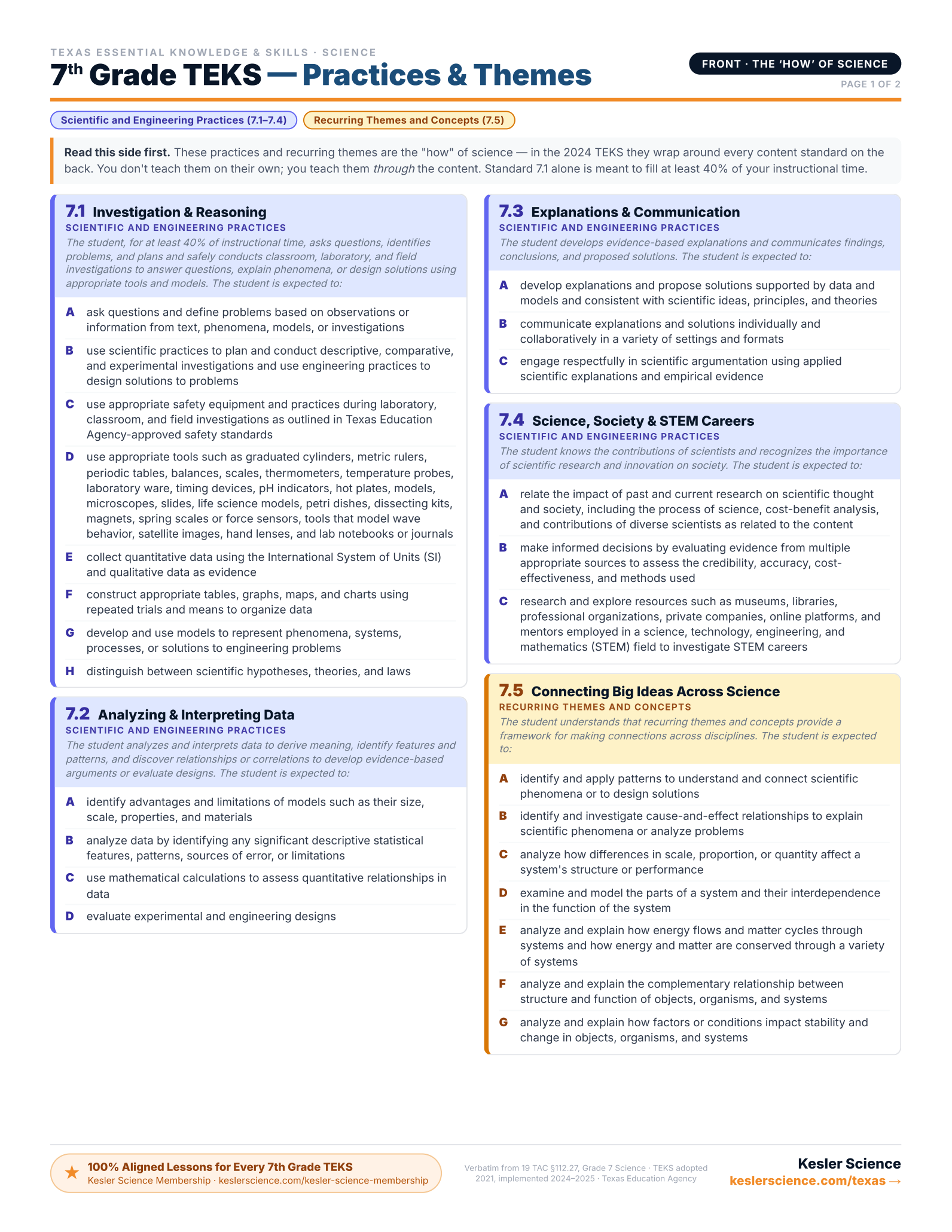
Every 7th-Grade Science TEKS on One Page
The color-coded, front-and-back cheat sheet I wish I'd had — every standard, organized by reporting category. Print it and reference it all year long. This will be your new favorite document!
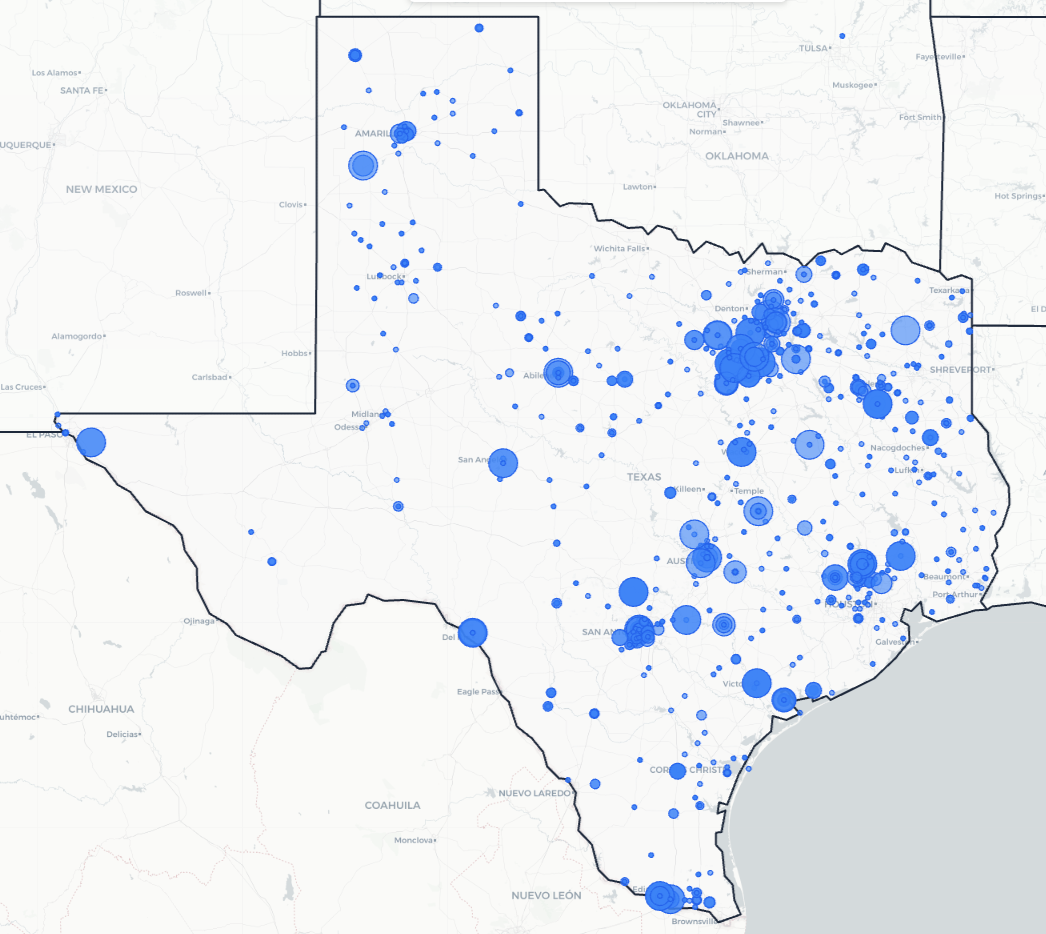
Trusted Across Texas
From the Rio Grande Valley to the Panhandle, Texas science teachers are using Kesler Science to save time and engage students.
Texas Schools and Districts
Love Kesler Science
What Teachers Are Saying
Give Your Science Teachers Everything They Need
School and district licenses give your teachers access to every resource they need, including station labs, inquiry labs, anchoring phenomena, presentations, escape rooms, and much more. One purchase covers the grade levels you need.
- PO-friendly. We accept purchase orders
- Volume discounts for 11+ teachers
- Complimentary Kesler Science Plus orientation for 4+ teachers
- Three free implementation PD sessions for departments of 11+
- Aligned to the 2024 TEKS standards
See It in Action
Book a walkthrough and we'll show you how Kesler Science fits your campus.
Book Demo CallNo pressure, no hard sell