.png?width=375&height=100&name=WebPage%20logo%20with%20curves%202026%20(8).png)
Reproduction & Offspring Diversity
"Compare the results of asexual and sexual reproduction of plants and animals in relation to the diversity of offspring and the changes in the population over time."
💡 What This Standard Actually Means
"Compare". Students are comparing the results of asexual and sexual reproduction in plants and animals, focused on two big outcomes: the diversity of offspring and the changes in the population over time. The shift in the new TEKS is the focus on outcomes (diversity and population change) instead of just defining the two reproduction types. Kids need to think bigger picture about why these reproduction strategies matter. Instruction can take many forms, such as plant runner observations, animal-clone case studies, population modeling activities, and short-term vs long-term advantage debates.
Asexual reproduction involves one parent. The offspring are genetic clones of that parent. Bacteria divide. A strawberry plant sends out runners that grow into new plants. A starfish can regrow from a piece of itself. Some plants reproduce through cuttings, and some animals like certain lizards can clone themselves. The result is offspring with the same DNA as the parent.
Sexual reproduction involves two parents. Genetic material from each parent combines to form offspring with new combinations of traits. In plants, this happens through pollination and the formation of seeds. In animals, it happens through the combining of sperm and egg cells. The offspring are not identical to either parent and not identical to each other. The standard is asking students to compare how these two strategies play out in diversity of offspring and changes in the population over time.
On diversity, asexual reproduction produces almost no genetic variation. The offspring are clones, so the population is genetically uniform. Sexual reproduction creates lots of variation because each offspring gets a unique mix of genes from two parents. On population change over time, that diversity is huge. A genetically uniform population is fast to grow when conditions are stable, but when the environment changes (a new disease, a temperature shift, a new predator), all the clones share the same weaknesses and the population can crash. A diverse population is slower to reproduce but contains a range of traits, so when conditions change, some individuals are likely to have what it takes to survive. Their traits get passed on, and the population shifts. Students should walk away able to compare both reproduction types using diversity of offspring as the bridge to long-term population change.
The moment this clicked for my students was when we talked about the Irish potato famine. In the mid-1800s, one variety of potato was planted over and over across Ireland, all genetically very similar. Then a water mold called late blight arrived. Because the potatoes were so much alike, almost none of them could resist it, and the crop collapsed. My kids went quiet when I showed them the numbers. That was the moment they stopped thinking of variation as a science-class term and started seeing it as the reason a species survives. Then we looked at wild potato species with much more genetic variation and talked about why the same pathogen didn't wipe them out. Real story, real consequences, real concept.
⚠️ Misconceptions Your Students May Have
These are some of the most common misconceptions. Knowing what to look for can help you get ahead of them.
"Asexual offspring are similar to the parent but not identical"
In asexual reproduction, the offspring receive a complete copy of the parent's DNA, so the offspring are essentially genetic clones of the parent. Small mutations can happen each time DNA is copied, but the starting point is "same DNA, copied with high fidelity." Students often picture asexual offspring as "kinda like" the parent when they should be picturing exact copies.
"Sexual reproduction mixes the parents like mixing paint"
Offspring aren't a "blend" of the parents. They receive discrete pieces of genetic information from each parent, and the specific combination of those pieces is what makes each offspring unique. That's where new trait combinations come from, not a smoothie of the parents. The "paint" picture gets in the way of understanding genetic variation.
"One type of reproduction is better than the other"
Each type has clear advantages. Asexual reproduction is fast and doesn't require a mate, which works well in stable environments. Sexual reproduction produces variation, which helps a species adapt when conditions change. Many organisms use both, depending on conditions. It's not a ranking. It's two different strategies for different situations.
"An organism adapts during its lifetime and passes the new trait on"
Variation exists in the population before the environmental pressure shows up. The parents don't change their own DNA by experiencing the environment. The variation is already there, and some individuals just happen to have traits that help them survive. Those individuals are more likely to reproduce, which is what shifts the population over generations.
📓 Teaching Resources for 7.13C
These resources are aligned to this standard.


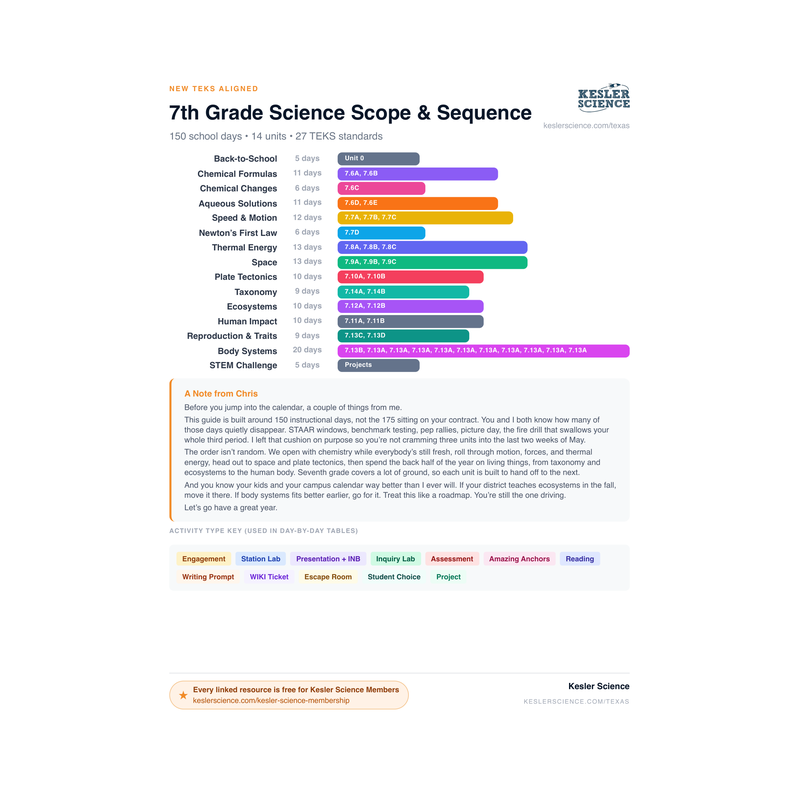
100% Aligned Lessons for Every TEKS You Teach
Kesler Science Plus puts thousands of ready-to-teach lessons and activities in your hands, so you can boost engagement and get your planning time back. Trusted by schools and districts all over the great state of Texas.
🌎 Phenomenon Ideas for 7.13C
Use these real-world phenomena to anchor your lesson. Show students the phenomenon first, let them wonder, then build toward Reproduction & Offspring Diversity as the explanation.
A Strawberry Plant and Its Runners
A single strawberry plant can send out long horizontal stems called runners. Each runner touches the ground and grows into a new plant. That new plant is connected to the parent at first, then breaks off. A whole strawberry patch can come from one original plant, and every plant in it shares the same DNA as that starter plant. Strawberry plants can also reproduce sexually through flowers and seeds, so the same plant can use both strategies.
"If every plant in a strawberry patch came from one original plant through runners, what would happen if a disease showed up that the original plant couldn't resist? Now compare that to a patch of strawberry plants grown from different seeds."
A Litter of Puppies
A mother dog gives birth to a litter of six puppies from the same parents. One is mostly black. One has a white patch on its chest. One is the largest. One has a slightly different coat texture. Same parents, six different mixes of traits, all in the same litter.
"How can two parents produce puppies that aren't identical to each other or to either parent? What does this tell us about how sexual reproduction works?"
Bananas You Buy at the Store
Most grocery-store bananas in the U.S. are a single variety called Cavendish, and they're grown from cuttings rather than seeds. That means the bananas in your kitchen are essentially genetic clones of each other. A fungal disease called Panama disease wiped out the previous dominant banana variety (the Gros Michel) in the mid-1900s, and a newer strain now threatens the Cavendish in several growing regions.
"Why is growing one genetic copy of a plant over and over a risky strategy? What does this tell us about the value of genetic variation for a species or a crop?"
💡 Free Engagement Ideas for 7.13C
Ready-to-run activities you can drop straight into a lesson. Where one of these looks like a phenomenon from the section above, that is on purpose: show it first as the hook, then let students run it themselves.
Bead Baby Cross
Each student gets two "parent" cups with different colors of beads representing trait variants. They pull one bead from each parent cup to create an "offspring" set. Repeat for three offspring. Compare offspring to each other and to parents. Then do the same with one parent only (asexual) and compare the results. Kids see variation show up in the sexual version and clones in the asexual version.
Potato Famine Sort
Give groups a bag of dried beans with one dominant color mixed with a few other colors. That's their "genetically varied" population. Give a second group a bag of all one color ("cloned" population). Announce that a disease destroys all beans of one specific color. Each group removes those beans. Compare survival rates. Kids physically see why variation buffers against environmental change.
T-Chart Speed Sort
Create a deck of 20 index cards. Each card names an organism or a reproduction clue: "bacteria dividing," "oak tree with acorns," "hydra budding," "two lizards mating," "strawberry plant runner," etc. Groups race to sort cards into sexual vs. asexual. Follow with a quick share-out where each group defends two of their sorts.
Species Survival Story
Students write a short "news article" describing a sudden environmental change (a new disease, a temperature spike, a drought). The article has to explain which members of the species survived, why their traits helped, and what the population looks like a few generations later. Drives home why variation matters over time.
🎯 What Approaches, Meets, and Masters Thinking Look Like
Here is what student thinking at each level looks like on this one task, so you know what to look for and how to move a student up.
A strawberry plant makes new plants two ways. It can send out a runner (a stem that grows along the ground and roots into a brand new plant), or it can grow flowers that get pollinated and make seeds. The runner is asexual reproduction (one parent). The seeds are sexual reproduction (two parents). Compare the offspring made each way. How are the offspring different in their variety, and which group would do better if a new plant disease showed up? Explain your answer.
- A clear match between each method and its number of parents: runner = one parent (asexual), seeds = two parents (sexual).
- Runner offspring described as clones, meaning the same DNA as the parent plant, not just "similar to" it.
- Seed offspring described as a new mix of traits from two parents, so they are different from the parents and from each other.
- The word "variety" or "variation" tied to the seeds: the seed plants have more of it, the runner plants have almost none.
- A choice about the disease that follows from the variety: the seed group is more likely to survive because some plants may happen to have a trait that resists the disease.
- An explanation that connects variety to surviving change, not just a guess about which group is "stronger."
- The runner offspring all share the same weakness because they share the same DNA, so a disease that hurts one can hurt them all. That last link is the easiest place to slip.
The runner makes plants with one parent and the seeds make plants with two parents. The runner plants look a lot like the parent but they are not exactly the same. The seed plants have more variety because two parents got mixed together. The seed plants would do better if a disease came because they have more variety.
The runner is asexual, so the new plants get a full copy of the parent's DNA. They are clones, which means they are identical to the parent. The seeds are sexual, so each seed plant gets a new mix of DNA from two parents. That makes the seed plants different from the parents and from each other, so they have lots of variety.
If a new disease showed up, the seed group would do better. Because they all have different traits, some of them might happen to have a trait that fights off the disease. The runner plants are all identical, so if the disease can hurt one of them, it can hurt all of them. They share the same weakness.
The runner is asexual reproduction, so the new plants are clones with the exact same DNA as the parent. There is almost no variety in that group. The seeds are sexual reproduction, so each seed plant gets a different combination of DNA from two parents. That is where the variety comes from, lots of different trait combinations.
If a disease showed up, the seed group would do better over time. The runner plants all share the same DNA, so they all share the same weakness, and the disease could wipe out the whole group. In the seed group, the variety was already there before the disease came, so some plants probably already had a trait that resists it. Those plants survive and pass that trait to their offspring, and over many seasons the population shifts toward disease resistant plants.
This is also why asexual reproduction is not "worse." When nothing in the environment is changing, the runners can fill an area fast with no need for pollination. Variety only becomes the big advantage once conditions change, which is the same reason a farmer who plants one identical crop can lose the whole field to one disease, while a field with many varieties usually keeps some plants standing.
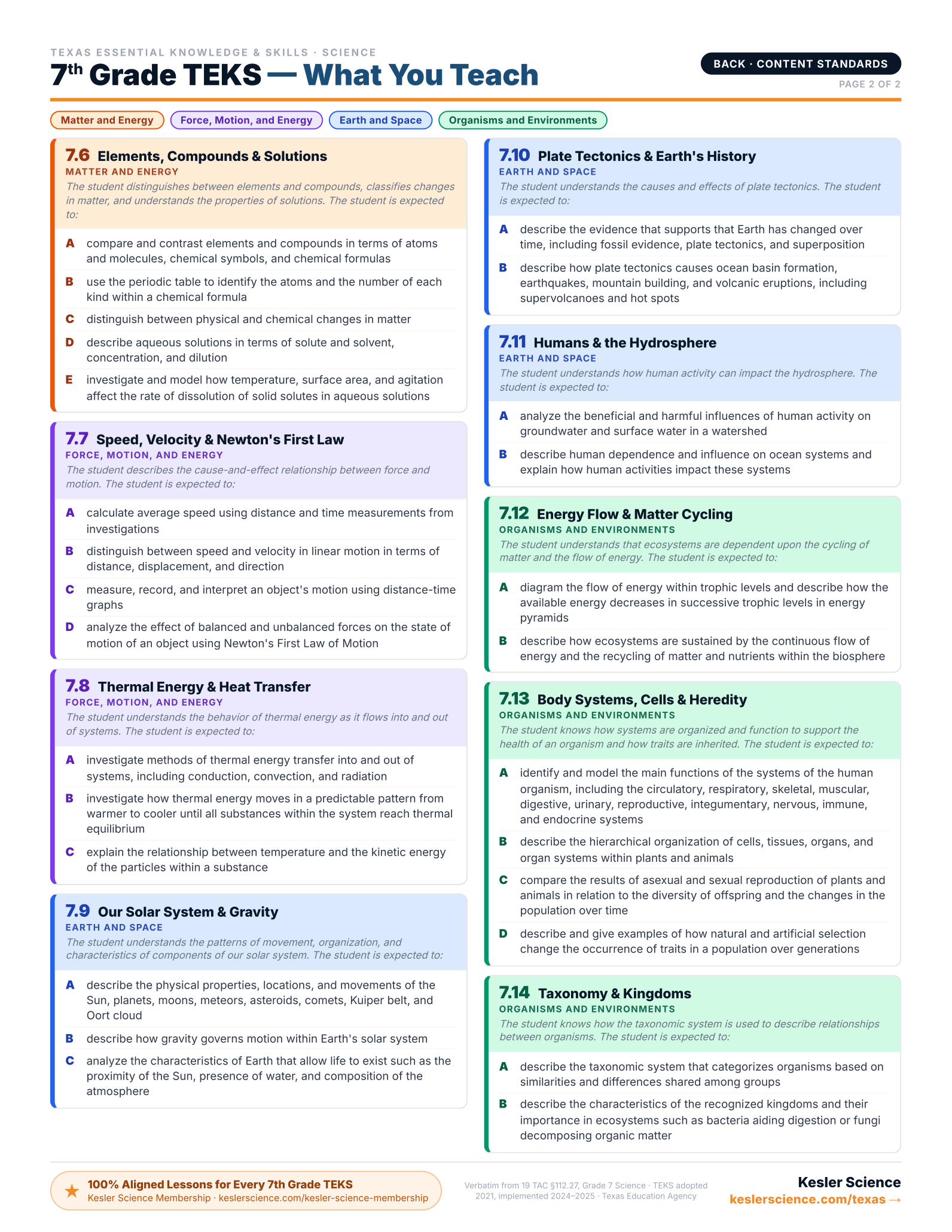
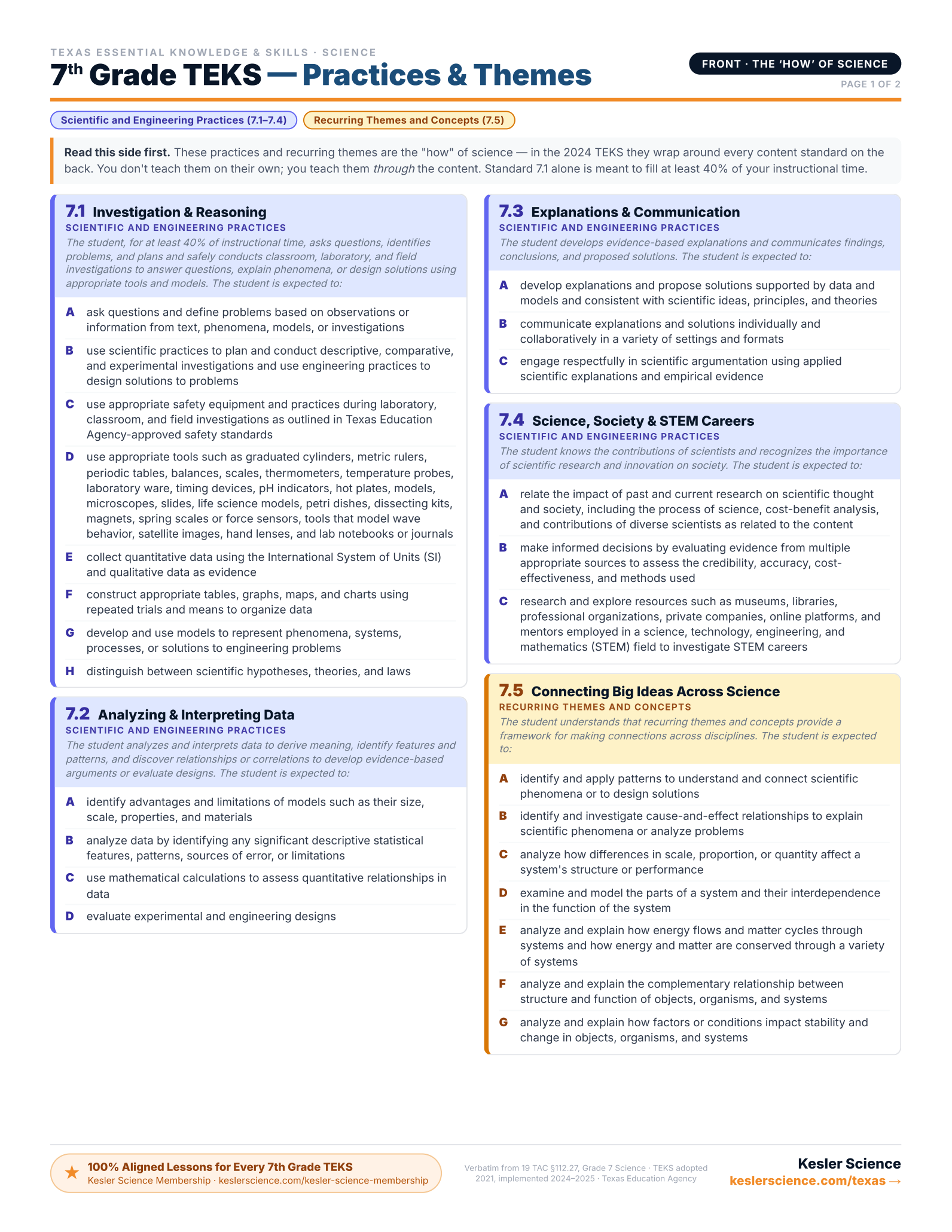
Every 7th-Grade Science TEKS on One Page
The color-coded, front-and-back cheat sheet I wish I'd had — every standard, organized by reporting category. Print it and reference it all year long. This will be your new favorite document!
Trusted Across Texas
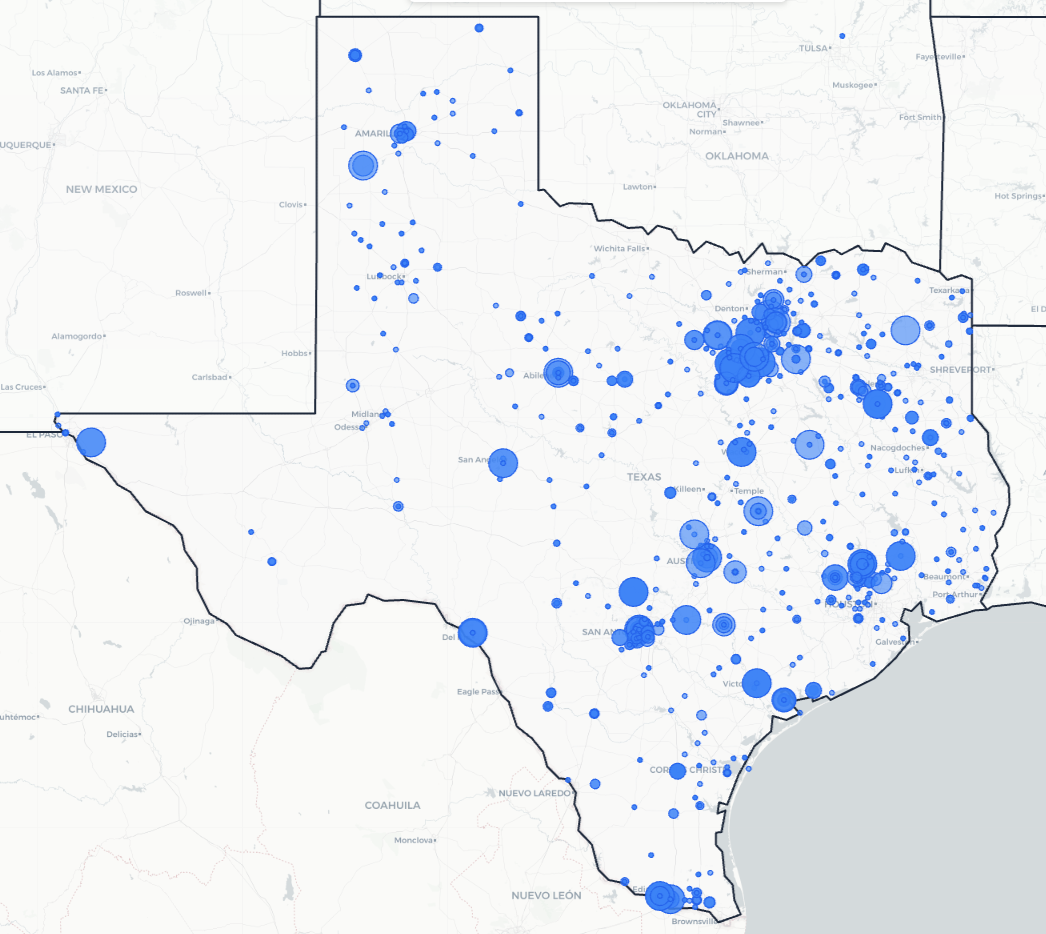
From the Rio Grande Valley to the Panhandle, Texas science teachers are using Kesler Science to save time and engage students.
Texas Schools and Districts
Love Kesler Science
What Teachers Are Saying
Give Your Science Teachers Everything They Need
School and district licenses give your teachers access to every resource they need, including station labs, inquiry labs, anchoring phenomena, presentations, escape rooms, and much more. One purchase covers the grade levels you need.
- PO-friendly. We accept purchase orders
- Volume discounts for 11+ teachers
- Complimentary Kesler Science Plus orientation for 4+ teachers
- Three free implementation PD sessions for departments of 11+
- Aligned to the 2024 TEKS standards
See It in Action
Book a walkthrough and we'll show you how Kesler Science fits your campus.
Book Demo CallNo pressure, no hard sell