.png?width=375&height=100&name=WebPage%20logo%20with%20curves%202026%20(8).png)
Hierarchy of Organisms
"Describe the hierarchical organization of cells, tissues, organs, and organ systems within plants and animals."
💡 What This Standard Actually Means
"Describe". Students are describing the hierarchical organization of cells, tissues, organs, and organ systems within plants and animals. The shift in this standard is the explicit inclusion of plants alongside animals. Kids need to recognize that the same organizational pattern shows up in both kingdoms, not just in humans or other animals. Instruction can take many forms, such as parallel plant-and-animal diagram building, microscope observations of plant and animal tissues, hierarchy ladder drawings, and side-by-side organ comparisons (a leaf is to a plant what skin is to an animal).
The hierarchy of organization runs the same way in both plants and animals. Cells → tissues → organs → organ systems. A cell is the smallest unit that's alive. When a group of similar cells does the same job together, they form a tissue. Different tissues working together form an organ. Several organs cooperating on a shared function form an organ system.
Animal example: muscle cells group together to form muscle tissue. Muscle tissue, plus connective tissue and nervous tissue, builds an organ like the heart. The heart, blood vessels, and blood together make up the circulatory system. Step out one more level and you have the whole organism running its systems together.
The plant version of the hierarchy works exactly the same way, and that's the part students often miss. Plant cells specialize. Palisade cells in a leaf are packed with chloroplasts and do most of the photosynthesis. Xylem cells move water. Phloem cells move sugar. Layers of these specialized cells form different plant tissues. Tissues come together to form plant organs (a leaf is an organ, a stem is an organ, a root is an organ, a flower is an organ). Plant organs work together as plant organ systems. The shoot system (stems, leaves, flowers) handles photosynthesis and reproduction. The root system anchors the plant and absorbs water and nutrients. The big idea students should walk away with is that the cells-to-organ-systems pattern isn't just about people or animals. Every multicellular plant follows the same hierarchical organization. Same pattern, different jobs.
The trick that finally made this stick for my kids was a zoom-in poster. We started with a picture of a whole person on the left, then a picture of just their stomach (organ system and organ), then a microscope shot of stomach lining (tissue), then a single stomach cell. We taped the four images in a line on the wall and labeled each level. Every time we covered a new body part, I'd ask, "Where does this live on the zoom-in chart?" The ladder went from abstract vocab list to something they could see. I'd rebuild it again with a plant, just a tree to a leaf to leaf tissue to a palisade cell, so they saw the pattern wasn't animal-only.
⚠️ Misconceptions Your Students May Have
These are some of the most common misconceptions. Knowing what to look for can help you get ahead of them.
"Every organism has tissues and organs"
The hierarchy from cells to organ systems only applies to multicellular organisms. Bacteria, amoebas, paramecia, and yeast are single-celled organisms. A single cell is the whole organism. There are no tissues or organs because there's nothing to form them out of. That cell still does every life function on its own.
"Tissue means something you blow your nose into"
In biology, a tissue is a group of similar cells doing the same job. Muscle tissue, nervous tissue, epithelial tissue, connective tissue. The everyday meaning of the word gets in the way. It helps to slow down and define the scientific use of the word directly, then give three or four examples students can see or touch.
"Plants don't have organs"
Plants have cells, tissues, organs, and organ systems just like animals. A leaf is an organ. A root is an organ. A stem is an organ. The shoot system (above ground) and root system (below ground) are organ systems. Including plant examples next to animal examples keeps students from thinking the hierarchy is animal-only.
"The order doesn't really matter"
The order matters because each level is built from the one below. Cells build tissues. Tissues build organs. Organs build systems. If students memorize the names without the "built from" relationship, they miss the whole idea. Have them explain the ladder using the phrase "is made up of" at each step.
📓 Teaching Resources for 7.13B
These resources are aligned to this standard.


100% Aligned Lessons for Every TEKS You Teach
Kesler Science Plus puts thousands of ready-to-teach lessons and activities in your hands, so you can boost engagement and get your planning time back. Trusted by schools and districts all over the great state of Texas.
🌎 Phenomenon Ideas for 7.13B
Use these real-world phenomena to anchor your lesson. Show students the phenomenon first, let them wonder, then build toward Hierarchy of Organisms as the explanation.
Zooming In on a Leaf
Show students a photo of a tree. Then a close-up of a single leaf. Then a cross-section of that leaf showing stacked layers of tissue. Then a microscope image of a single palisade cell packed with chloroplasts. Each image is the same plant, just zoomed in further. Every level has a structure and a job.
"We started with a whole tree and ended with one cell. What are all the levels in between? How does each level help the level above it?"
A Single Heartbeat
An adult human heart can beat roughly 100,000 times a day. Each beat is a group of specialized heart muscle cells contracting together. Those cells form tissue, that tissue forms the heart itself, and the heart is part of the circulatory system that keeps the whole person alive. One simple heartbeat reaches through every level of biological organization.
"Start with one muscle cell and work your way up. How does a single cell end up moving blood through the whole body? Which levels of organization have to line up for that to work?"
An Amoeba in Pond Water
Put a drop of pond water under a microscope and you can find single-celled organisms moving, eating, and reproducing. An amoeba is one cell. It has no tissues, no organs, no organ systems. It's still a complete organism, doing every life function on its own.
"If the amoeba is a whole organism with just one cell, does the cells-to-organism ladder apply to it the same way it does to a human? What does this tell us about when the hierarchy does and doesn't apply?"
💡 Free Engagement Ideas for 7.13B
Ready-to-run activities you can drop straight into a lesson. Where one of these looks like a phenomenon from the section above, that is on purpose: show it first as the hook, then let students run it themselves.
Zoom-In Poster Ladder
Give each group five blank index cards. They have to build a zoom-in ladder: cell, tissue, organ, organ system, organism. They can choose an animal, a plant, or do one of each. Under each card, they write "is made up of ___" to show how the levels connect. Post them on the wall when they're done.
Cell to Organism Scramble
Pre-cut strips that name each level (cell, tissue, organ, organ system, organism) plus matching example strips (muscle cell, muscle tissue, heart, circulatory system, human). Groups race to put the levels in order AND match the right example to each level. First group with both correct wins.
Plant vs. Animal Double Ladder
Draw two side-by-side ladders on the board. Assign half the class plants, half animals. Each student comes up and fills in a level on their side with a specific example. When both ladders are complete, compare them. Same structure, different examples. Plants aren't an afterthought.
Microscope & Body Photo Match
Pull images from free resources (cell-level, tissue-level, organ-level, full body). Print them mixed up. Students sort the images by level of organization. Bonus points if they can explain how they decided where each image belonged.
🎯 What Approaches, Meets, and Masters Thinking Look Like
Here is what student thinking at each level looks like on this one task, so you know what to look for and how to move a student up.
A leaf and the human heart are both organs. Pick one of them and build a hierarchy ladder for it. Start at the cell and go up: cell, tissue, organ, organ system. Then write a sentence or two explaining how each level is built from the level below it.
- A ladder with all four levels in the right order: cell, then tissue, then organ, then organ system.
- A correct example at each level for the organ they chose (for the heart: muscle cell, muscle tissue, heart, circulatory system).
- The word tissue used as scientists use it, a group of similar cells doing the same job, not the kind you blow your nose into.
- An explanation that shows each level is made up of the level below it, not just a list of names.
- The organ labeled correctly as an organ (a leaf is an organ, a heart is an organ).
- If they chose the leaf, plant words used correctly: plant cells form plant tissue, tissues form the leaf, and the leaf is part of the shoot system.
- The plant case treated the same way as the animal case. A leaf really does follow the cell-to-system pattern. That is the easiest place to slip.
I picked the heart. The cell is a muscle cell. The tissue is muscle tissue. The organ is the heart. The organ system is the circulatory system. I did not do the leaf because a leaf is just a plant part. Plants do not really have organs like animals do.
I picked the leaf. The cell is a plant cell, like a palisade cell that does photosynthesis. A group of those similar cells doing the same job makes a plant tissue. The tissues together build the leaf, and a leaf is an organ. The leaf is part of the shoot system, which is the organ system with the stems and leaves. Each level is made up of the level below it. Cells make tissue, tissue makes the organ, and organs make the system.
I picked the leaf, but I drew the heart too because they follow the same pattern. In both, cells that do the same job group into a tissue, tissues build an organ, and organs work together as an organ system. The leaf is a plant organ and the heart is an animal organ, but the ladder is the same. The order matters because you cannot have a tissue without cells first.
That is how I know a root is an organ too, even though we did not draw it. A root is made of plant cells that form tissues, and those tissues build the root, so it has to be an organ. The root is part of the root system below the ground. Same pattern, just a different job.
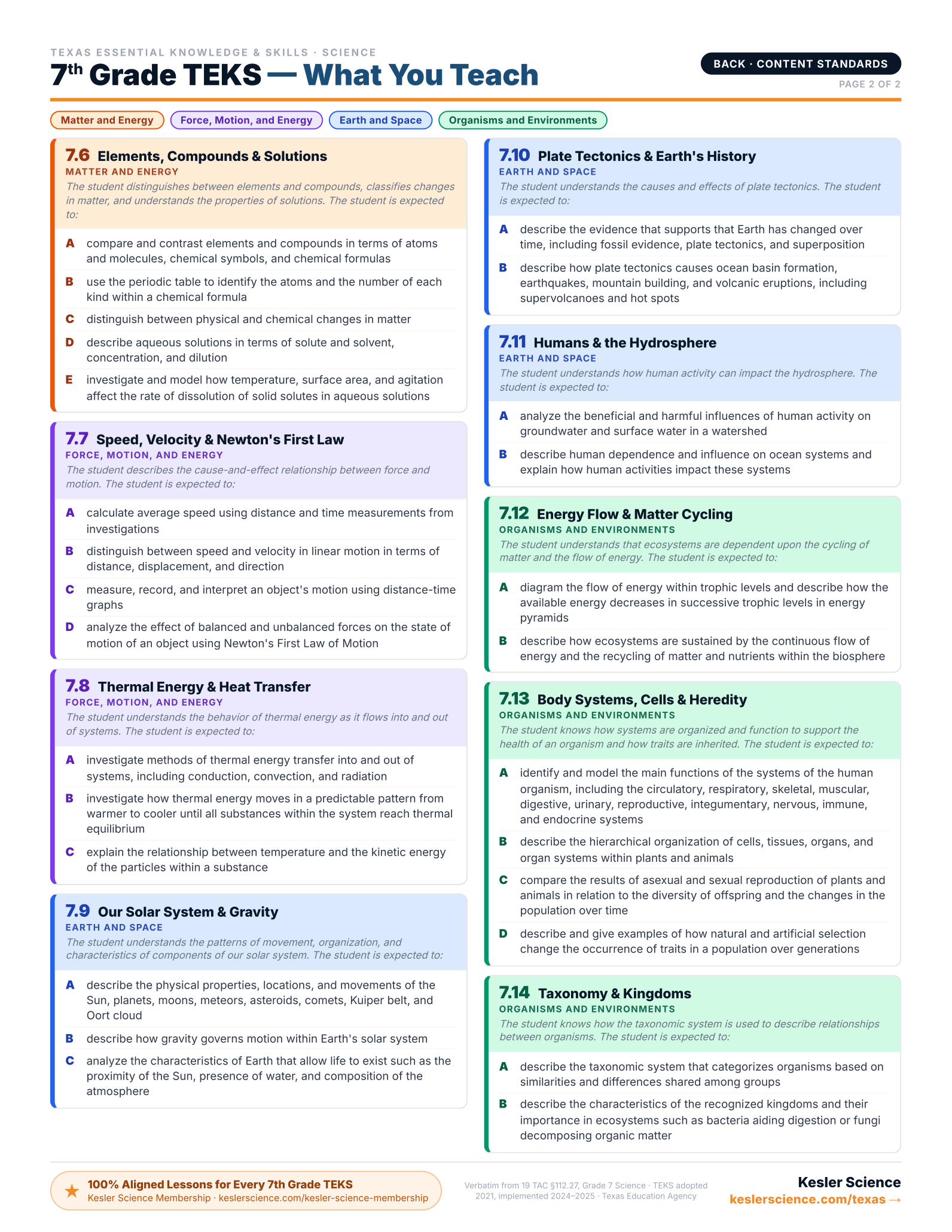
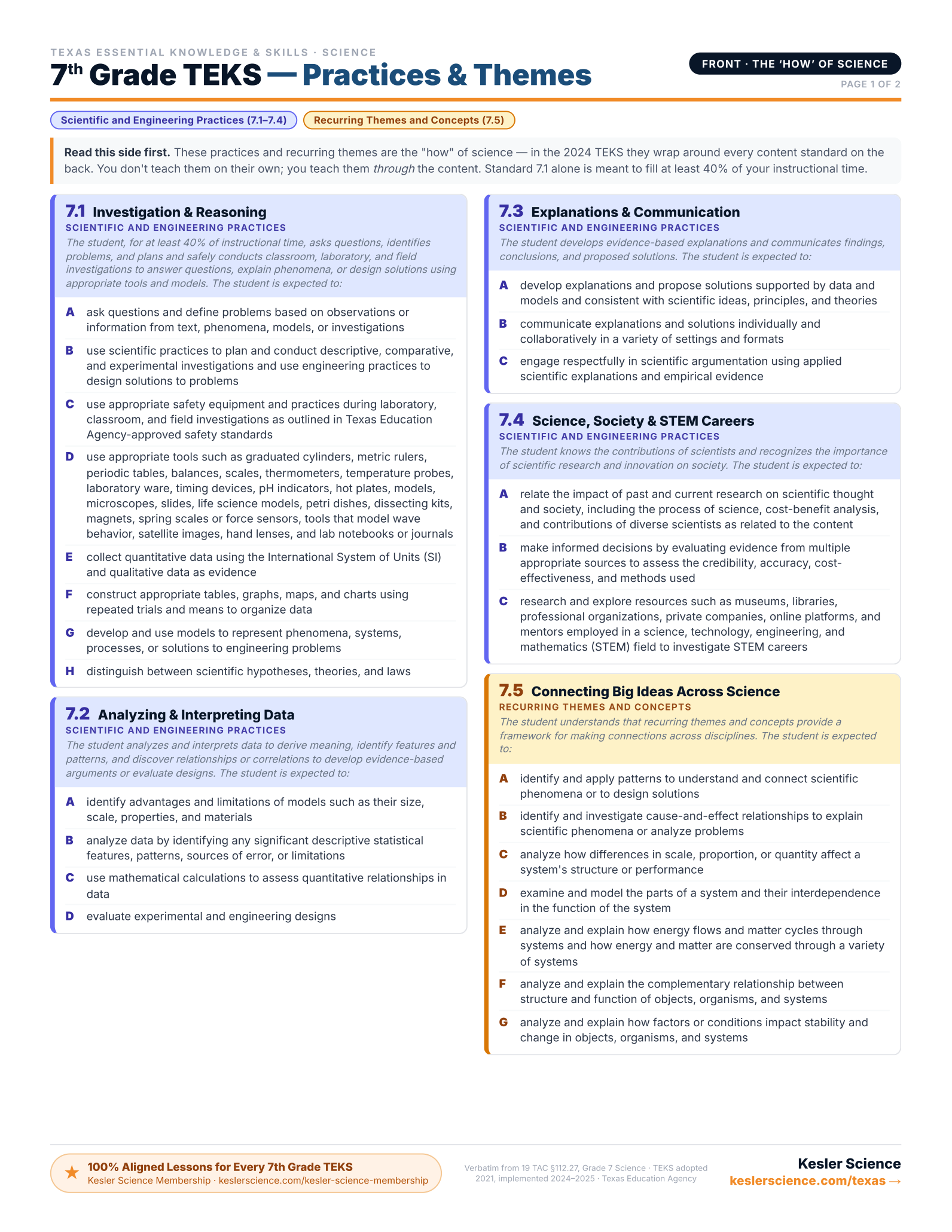
Every 7th-Grade Science TEKS on One Page
The color-coded, front-and-back cheat sheet I wish I'd had — every standard, organized by reporting category. Print it and reference it all year long. This will be your new favorite document!
Trusted Across Texas
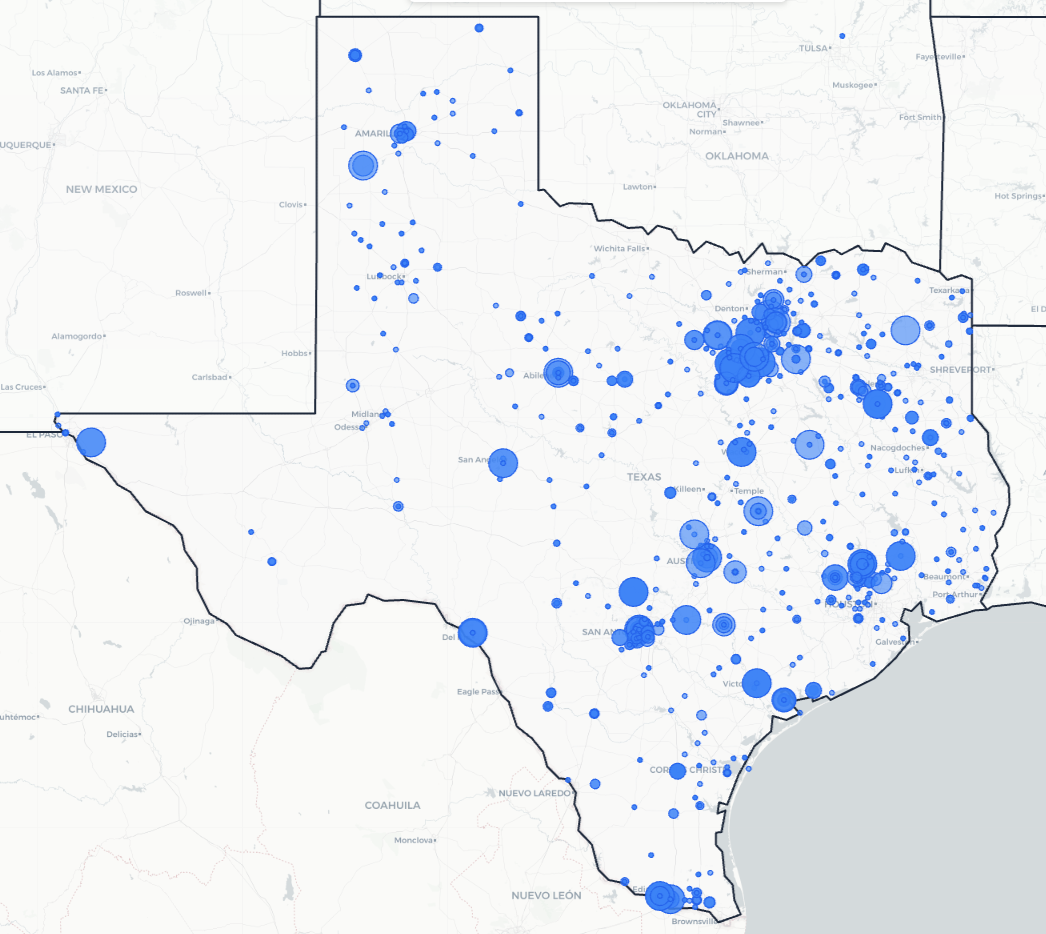
From the Rio Grande Valley to the Panhandle, Texas science teachers are using Kesler Science to save time and engage students.
Texas Schools and Districts
Love Kesler Science
What Teachers Are Saying
Give Your Science Teachers Everything They Need
School and district licenses give your teachers access to every resource they need, including station labs, inquiry labs, anchoring phenomena, presentations, escape rooms, and much more. One purchase covers the grade levels you need.
- PO-friendly. We accept purchase orders
- Volume discounts for 11+ teachers
- Complimentary Kesler Science Plus orientation for 4+ teachers
- Three free implementation PD sessions for departments of 11+
- Aligned to the 2024 TEKS standards
See It in Action
Book a walkthrough and we'll show you how Kesler Science fits your campus.
Book Demo CallNo pressure, no hard sell