.png?width=375&height=100&name=WebPage%20logo%20with%20curves%202026%20(8).png)
NGSS Resource Hub
Three-dimensional breakdowns, phenomena, and classroom-ready activities for every NGSS standard, grades 4-8.

🚀 Jump to Your Discipline
4th Grade NGSS Standards
Pick any standard. Each page is your full lesson-planning workspace for that standard.
Speed & Energy: The Faster It Moves, the More Energy It Has
"Use evidence to construct an explanation relating the speed of an object to the energy of that object."
NGSS Lead States. (2013). Next Generation Science Standards: For states, by states (4-PS3-1). The National Academies Press. https://www.nextgenscience.org/dci-arrangement/4-ps3-energy
Students are not expected to measure changes in an object's speed numerically or to give a precise, quantitative definition of energy.
Summarized in our own words from the 4-PS3-1 assessment boundary (NGSS Lead States, 2013). Not a verbatim quote.
The three dimensions packed into this standard
Every standard bundles a DCI (the content), a SEP (the science practice), and a CCC (the crosscutting lens). They run in the same task, not in sequence.
"The faster a given object is moving, the more energy it possesses."
National Research Council. (2012). A framework for K-12 science education: Practices, crosscutting concepts, and core ideas. The National Academies Press. https://doi.org/10.17226/13165
Energy of motion is simple. The faster something moves, the more energy it has. A marble barely rolling has a little. The same marble flying down a ramp has a lot. No formula needed. Students just connect "it moved faster" to "it had more energy."
"Use evidence (e.g., measurements, observations, patterns) to construct an explanation."
National Research Council. (2012). A framework for K-12 science education. The National Academies Press.
4th graders aren't told the answer and asked to repeat it. They gather evidence, like how far a cup slid or how many blocks fell, and use it to build an explanation. The skill is pointing to what they actually saw and saying what it proves.
"Energy can be transferred in various ways and between objects."
National Research Council. (2012). A framework for K-12 science education. The National Academies Press.
Here's the idea students carry out the door: energy doesn't disappear, it moves. When the fast marble hits the cup, its energy of motion transfers to the cup and the cup slides. More speed means more energy to hand off.
📍 Where This Standard Fits in the K-12 Progression
Use this to plan the year. Knowing what students should already know and what they're heading toward keeps the lesson focused.
Energy is a new idea in 4th grade. Students arrive from 3rd grade knowing that pushes and pulls change how things move, and that motion follows patterns you can predict. They have not yet connected how fast something moves to how much energy it has.
Speed & Energy: The Faster It Moves, the More Energy It Has
In middle school, students connect energy of motion to both speed and mass, and begin using it with data. Kinetic energy goes up as the object gets heavier, and faster as it speeds up.
🌎 Phenomena for 4-PS3-1
Anchor the lesson in one puzzling phenomenon kids keep coming back to. Use the two investigative phenomena to sharpen specific facets.
The Higher Ramp Sends the Cup Flying
A marble rolls down a ramp and slams into a plastic cup at the bottom. Raise the top of the ramp higher and the same marble reaches the bottom moving faster. Each time it's faster, the cup skids farther across the floor. Same marble, same cup, but the distance keeps growing. 4th graders will want to know why.
"Why does letting the marble start from higher up make it push the cup farther?"
- "Is it the height that matters, or is it really how fast the marble is going at the bottom?"
- "If the marble is moving faster, does that mean it has more energy?"
- "Where does the marble's energy go after it hits the cup?"
Same Marble, Different Push
No ramp this time. Flick the same marble across a smooth table, once gently and once hard, into a paper cup. The hard flick sends the cup farther every time. Use this one to sharpen the anchor's big question: it's the speed that changes the energy, not the ramp or the height.
"If we use the very same marble, what makes it move the cup farther some times than others?"
- "Did the marble change, or did only its speed change?"
- "How could we prove the faster marble had more energy?"
- "Would an even harder flick move the cup even farther?"
Fast Marble Down the Domino Line
Stand up a row of dominoes and roll a marble into the front one, first slowly, then quickly. The slow marble knocks down a few. The fast marble runs the energy farther down the line. Same setup as the anchor, but now you can watch the energy travel from object to object.
"How far down the line does the marble's energy travel, and what decides that?"
- "Is the energy passing from one domino to the next?"
- "Why does the faster marble knock down more of them?"
- "Does each domino lose a little of the energy as it falls?"
100% Aligned Lessons for Every NGSS Standard You Teach
The membership gives you access to thousands of lessons and activities designed to boost student engagement and reclaim valuable teaching time. Trusted by schools and districts from every NGSS state.
⚠️ Misconceptions Your Students Will Walk In With
These come up almost every year. Knowing them in advance lets you head them off in the first lesson.
"If something isn't moving, it has no energy at all."
A still object can still hold stored energy, like a stretched rubber band or a ball sitting at the top of a hill. 4-PS3-1 is about energy of motion only. When something is not moving, it has no energy of motion. The moment it speeds up, that motion energy grows.
"The faster ball pushes harder because it is heavier."
Speed and weight are two different things. In this test we use the same marble every time, so the weight never changes. The only thing that changes is the speed. That is how students know the extra energy came from going faster, not from being heavier.
"The energy gets used up and disappears when the ball stops."
The energy doesn't vanish. It transfers to whatever the ball hits. The cup slides, you might hear a tap, and the surfaces warm up a tiny bit. Add those up and the energy is all still there, just moved into other things.
"Energy and force are the same thing."
A force is a push or a pull. Energy is what lets something do work, like move another object. A fast marble has a lot of energy of motion, and it uses that energy to push the cup when they collide. Related ideas, but not the same word.
🙋 Common Student Questions and How to Respond
These come up almost every time this standard gets taught. Plan a response and you'll keep the lesson focused.
Push them to the kind of energy we're studying. "Is it moving? Then it has no energy of motion right now." Then leave the door open: a parked car still has stored energy in its gas tank. For this standard, we only track the energy that comes from moving.
Great question, and a tricky one, because it changes speed AND weight at the same time. Tell them this standard keeps the weight the same and changes only the speed. That's the fair test. Bookmark the weight question for middle school, where they'll add it back in.
Don't hand it to them. Ask, "What moved right when the marble stopped?" Steer them to the cup. The marble's energy of motion transferred into the cup, which is why the cup slid. A little also turned into sound and heat.
In 4th grade we don't put a number on the energy itself. We use evidence instead. A cup that slides farther tells us the marble had more energy. More blocks knocked down tells us the same thing. The effect IS our measurement.
📓 Teaching Resources for 4-PS3-1
These resources are aligned to this standard.
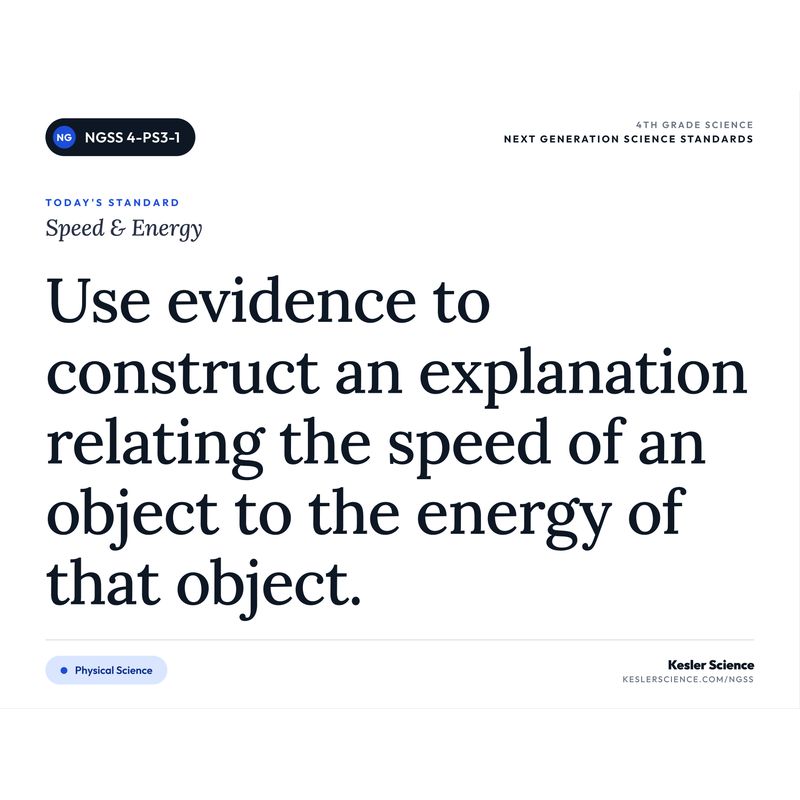
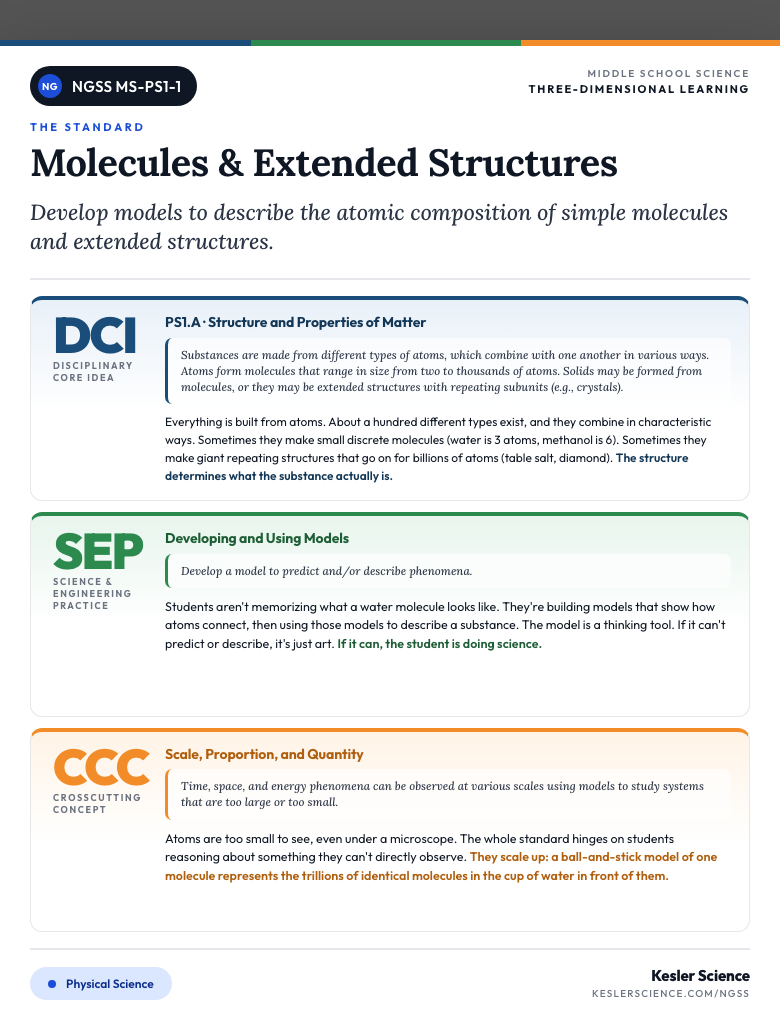
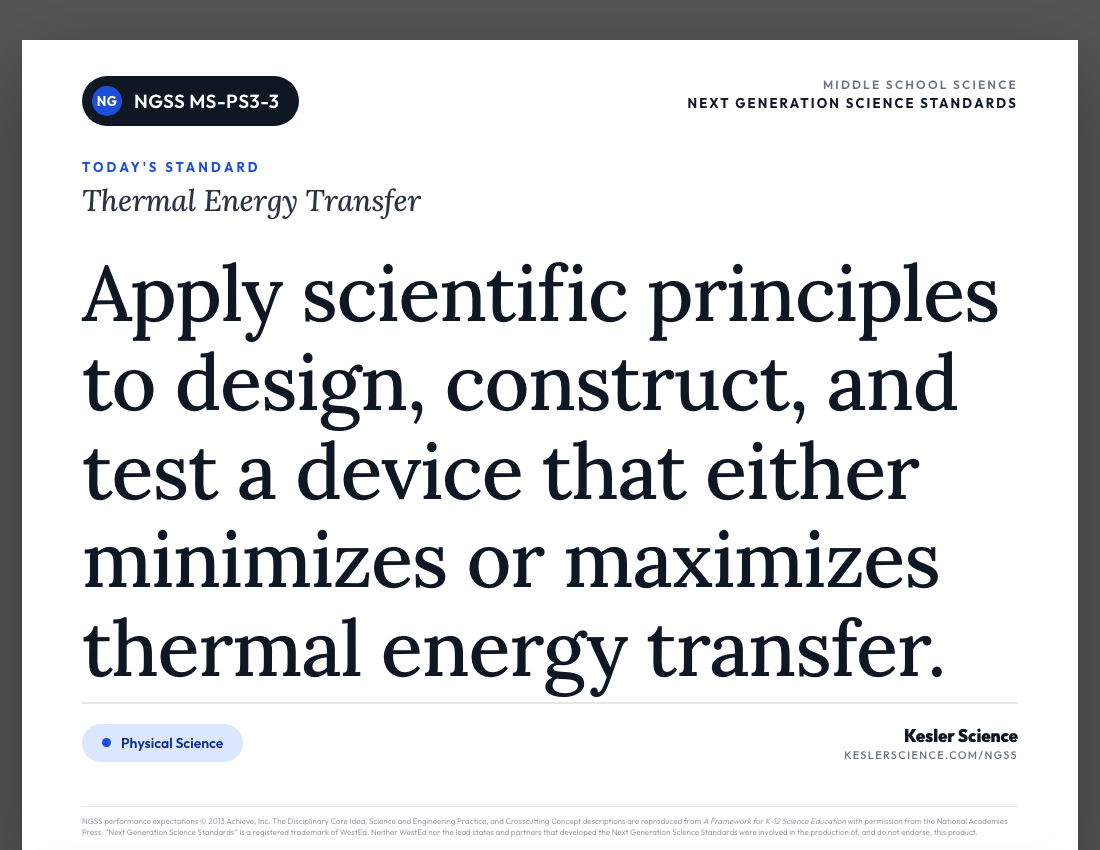
Print-ready classroom poster pack for 4-PS3-1. Includes the verbatim NGSS performance expectation plus student-language "I Can" statements broken into daily learning goals. Landscape orientation, letter size, ready to print and post on your wall.
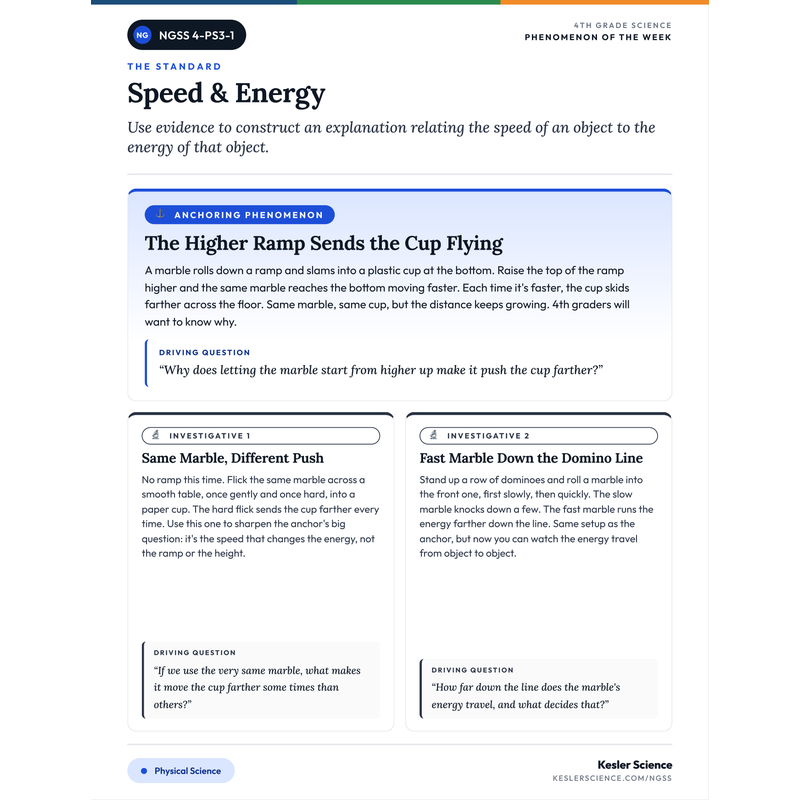
One-page printable with the anchoring phenomenon plus two investigative phenomena for 4-PS3-1. Each one comes with the driving question students will keep asking. Pin it above your desk for the week — one piece of paper, one week of hooks.
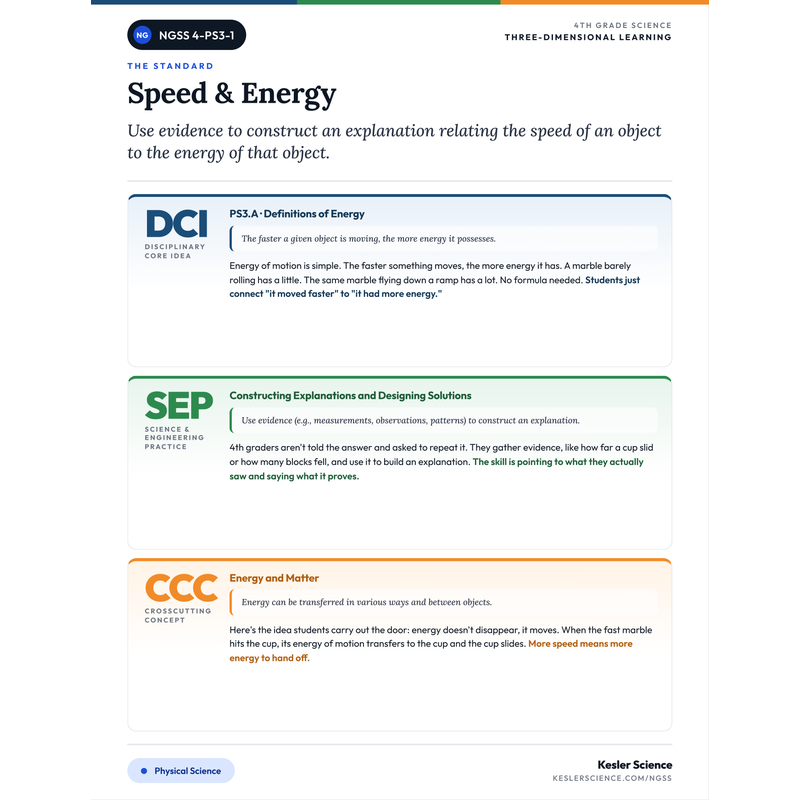
Teacher-facing PDF that breaks down the DCI, SEP, and CCC for 4-PS3-1 in plain English. Color-coded by dimension so you can read the whole standard at a glance. Perfect for lesson planning or a sub folder.

The full unit for 4-PS3-1: differentiated station labs, editable presentations, interactive notebooks (English + Spanish), student-choice projects, and assessments. Built on the 5E model.

9-station hands-on lab covering how the speed of an object relates to the energy it has, with input stations (Explore It!, Watch It!, Read It!, Research It!) and output stations (Organize It!, Illustrate It!, Write It!, Assess It!). Print and digital. English and Spanish.

A print-and-digital science writing activity where students reason and write about speed & energy through an engaging real-world prompt. Includes teacher directions with an answer guide and project ideas. Great for constructed response, bell-ringers, or science journals.
Teaching more than this one standard?
Get every I Can poster, phenomenon hook, and 3-dimension sheet for all 17 4th Grade standards, in one download. The whole year, ready to print.
📚 Vocabulary Students Need for 4-PS3-1
The terms students need to access this standard. Definitions in plain-English, classroom-ready language.
💡 Free Engagement Ideas for 4-PS3-1
Ramp & Cup Distance Test
Groups roll a marble down a ramp set at three heights and measure how far the cup slides each time. They record the distances, find the pattern, and write one sentence linking faster marbles to more energy. This is the anchor turned into a hands-on lab.
Same Marble, Different Push
Students flick one marble across a table at three speeds, gentle, medium, hard, into a cup and mark how far it moves. Because the marble never changes, the only variable is speed. A clean way to isolate the speed-and-energy link.
Domino Knockdown Speed Test
Students set up a long row of dominoes and roll a ball into the front one, slow then fast, counting how many fall each time. They connect 'more fall' to 'the marble had more energy to give away.' Good for seeing energy transfer in action.
Build-an-Evidence Poster
Using the measurements from the tests above, students build a poster that makes a claim ('faster means more energy') and backs it with their own evidence and a labeled drawing of the energy transferring to the cup. Turns their data into an explanation.
📝 Assessment Ideas for 4-PS3-1
Three short tasks that hit all three dimensions. Doable in one class period each.
Give students a finished data table of release heights and cup distances. They write a short explanation (claim plus evidence) that connects the marble's speed to its energy, citing at least one real distance from the table. Mirrors the SEP wording: use evidence to construct an explanation.
Show two pictures: a fast ball and a slow ball about to hit a row of blocks. Students predict which knocks down more blocks, then explain their prediction using the words 'energy of motion.' No new lab needed, just reasoning from the pattern.
Students draw a fast marble hitting a cup and label, with arrows, where the energy starts (the moving marble) and where it goes (the sliding cup). A picture-based check that shows whether they understand energy transferring between objects.
🎯 What Proficient Student Work Looks Like
Same prompt, three student responses at different proficiency levels. Use as anchor papers when scoring.
"Use evidence from the ramp test to explain how the speed of the marble is related to its energy."
- A specific claim backed by data or observation
- Use of standard-specific vocabulary in context
- Connection between the speed and the energy of motion
- A question they're still wondering about (curiosity stays alive)
"The marble pushed the cup. When it went faster it pushed it more. Faster marbles have more power."
Names the right direction (faster pushes more) but uses "power" instead of energy and gives no real measurement. The explanation stops at "it pushed it more." No evidence from the actual test.
"When we let the marble go from the top of the ramp it moved faster and pushed the cup 30 cm. From the lowest spot it was slow and only pushed the cup 10 cm. This shows the faster marble had more energy because it moved the cup farther."
Cites two real distances as evidence. Connects the speed difference to an energy difference in a clear claim. This is exactly what the standard asks a 4th grader to do.
"The faster the marble was going, the more energy it had. My evidence is that the high ramp made the marble fastest and it pushed the cup 30 cm, but the low ramp marble was slow and only moved it 10 cm. When the marble crashed into the cup, its energy of motion transferred to the cup, so more speed meant more energy to give the cup, and that is why it slid farther."
Backs the claim with specific distances AND explains the energy transferring from the marble to the cup. Ties speed, energy, and transfer together in one explanation. Reaches the CCC without being asked.
“Next Generation Science Standards” is a registered trademark of WestEd. Neither WestEd nor the lead states and partners that developed the Next Generation Science Standards were involved in the production of, and do not endorse, this product.
NGSS performance expectations © 2013 Achieve, Inc. The Disciplinary Core Idea, Science and Engineering Practice, and Crosscutting Concept descriptions are reproduced from A Framework for K-12 Science Education with permission from the National Academies Press.
Trusted Across NGSS States
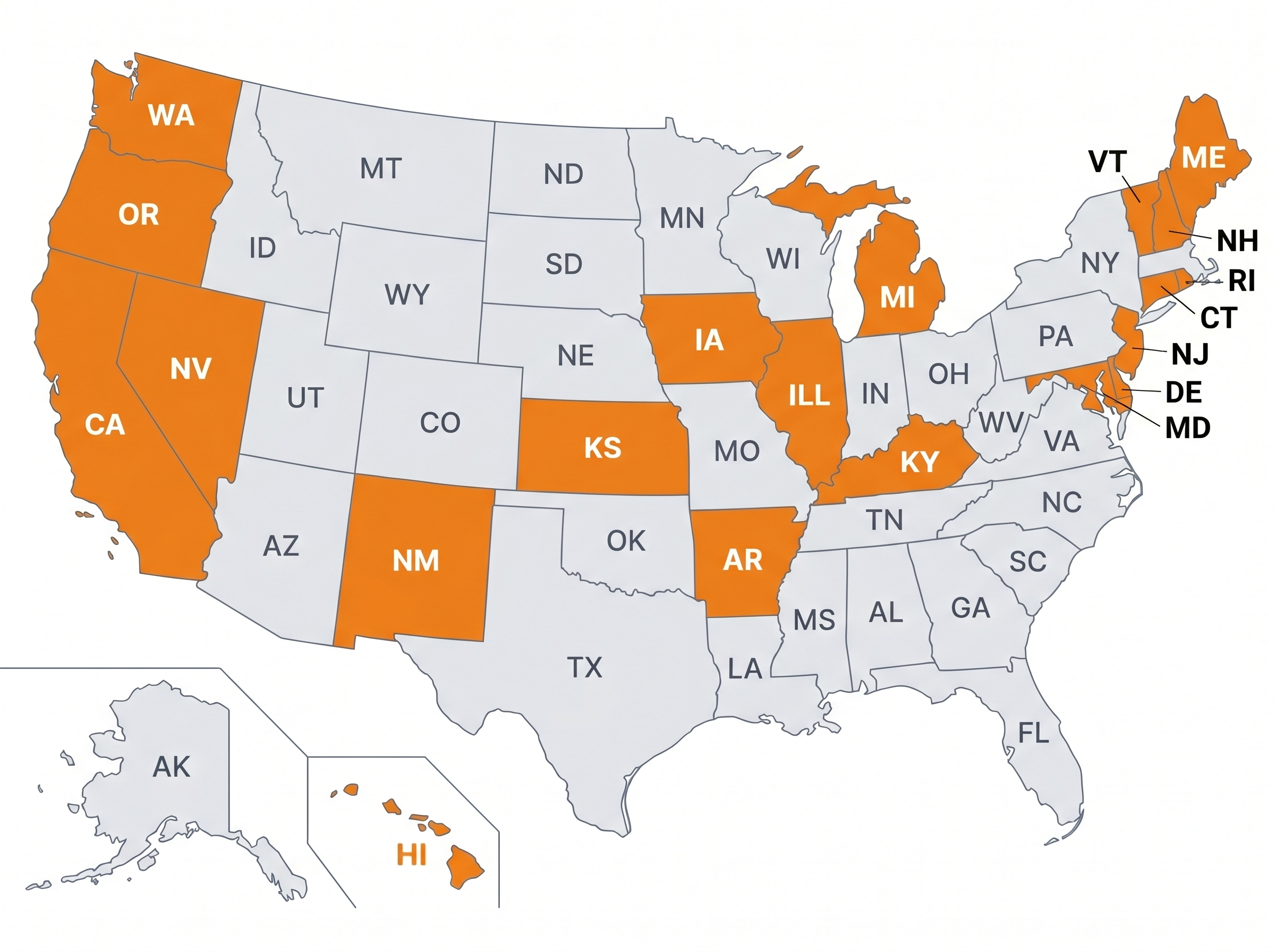
From California to Connecticut, science teachers in the 20 states that adopted NGSS are using Kesler Science to save time and engage students.
Teachers in NGSS States
Love Kesler Science
What Teachers Are Saying
"I'm able to access rigorous NGSS-aligned lessons and labs that are ready to use, so I spend more time helping students directly and less time searching for quality material."
"There's a lesson for each of the NGSS, so I don't have to search for hours to find a good quality lesson. I can spend more time actually teaching."
"The resources help me cover NGSS in a meaningful way, and my students gain a deeper knowledge of the concepts, with learning that's more self-driven."
Give Your Science Teachers Everything They Need
School and district licenses give your teachers access to every resource they need, including station labs, inquiry labs, anchoring phenomena, presentations, escape rooms, and much more. One purchase covers the grade levels you need.
- PO-friendly. We accept purchase orders
- Volume discounts for 11+ teachers
- Complimentary membership orientation for 4+ teachers
- Three free implementation PD sessions for departments of 11+
- Aligned to the NGSS standards
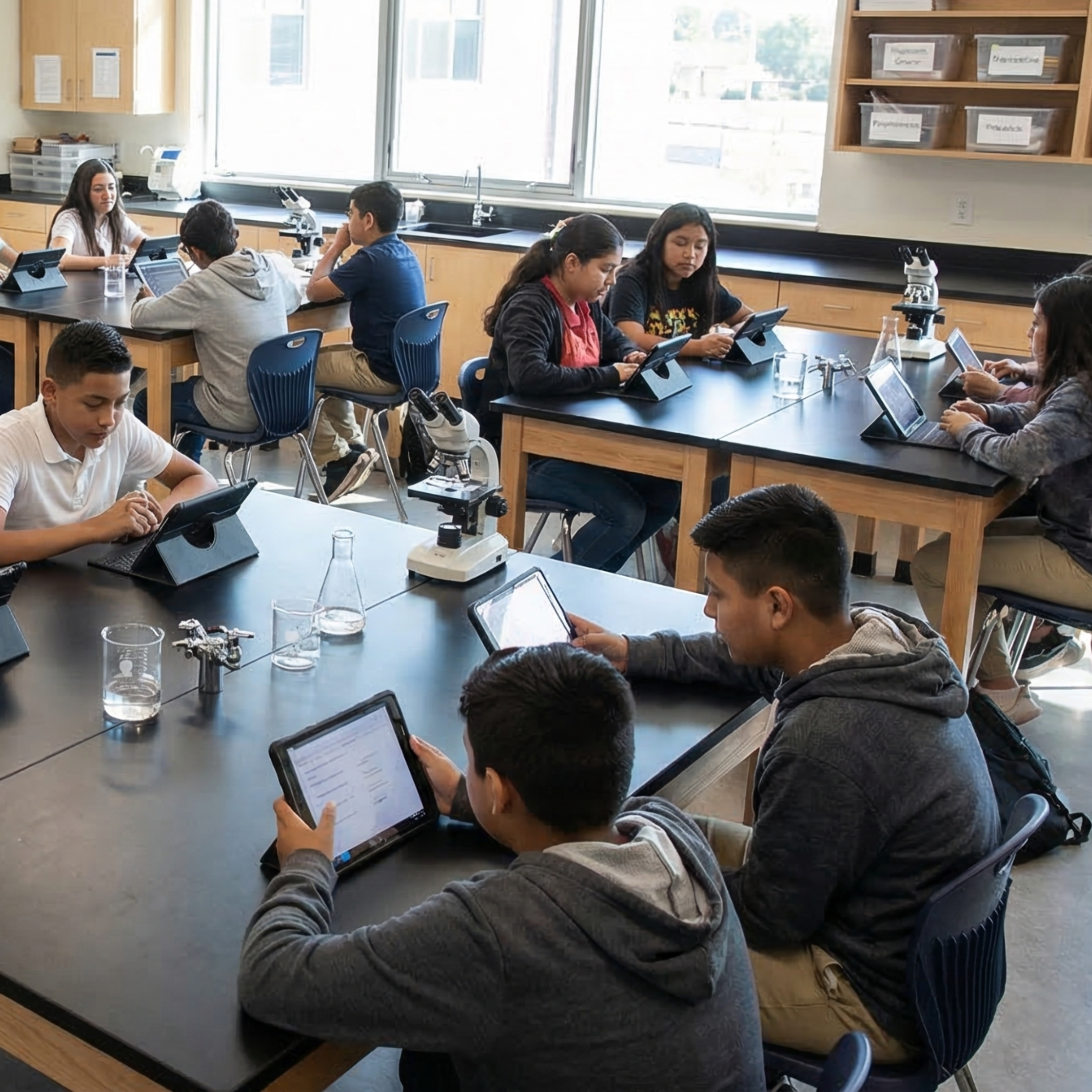
See It in Action
Book a walkthrough and we'll show you how Kesler Science fits your campus.
Book Demo CallNo pressure, no hard sell
"My assistant principal stopped in my room and immediately noticed how the students were engrossed in their centers and how they moved seamlessly from center to center. Also the built-in modifications really impressed!"
"It provides differentiated instruction for all types of learners, allowing them to become more engaged."
"I love it all!! I have become a facilitator in my class and I love the excitement it brings to my class. The kids love all that we do with the Kesler products."