.png?width=375&height=100&name=WebPage%20logo%20with%20curves%202026%20(8).png)
NGSS Resource Hub
Three-dimensional breakdowns, phenomena, and classroom-ready activities for every NGSS standard, grades 4-8.
🚀 Jump to Your Discipline
Elementary NGSS Standards
Pick any standard. Each page is your full lesson-planning workspace for that standard.
Improving Designs: Fair-Test a Prototype, Find What Breaks, Make It Better
"Plan and carry out fair tests in which variables are controlled and failure points are considered to identify aspects of a model or prototype that can be improved."
NGSS Lead States. (2013). Next Generation Science Standards: For states, by states (3-5-ETS1-3). The National Academies Press. https://www.nextgenscience.org/dci-arrangement/3-5-ets1-engineering-design
The three dimensions packed into this standard
This engineering standard runs on two dimensions working in one task: the core ideas (DCI) about testing and improving designs, and the practice (SEP) of planning and carrying out fair tests. NGSS lists no crosscutting concept for this particular standard.
"Tests are often designed to identify failure points or difficulties, which suggest the elements of the design that need to be improved."
National Research Council. (2012). A framework for K-12 science education: Practices, crosscutting concepts, and core ideas. The National Academies Press. https://doi.org/10.17226/13165
"Different solutions need to be tested in order to determine which of them best solves the problem, given the criteria and the constraints."
National Research Council. (2012). A framework for K-12 science education. The National Academies Press.
This standard is the "make it better" step of engineering. Elementary students already built something. Now they test it on purpose to find the weak spot, then change one part to fix it. A test is how you find what to improve next, not a pass-or-fail verdict on the prototype.
"Plan and conduct an investigation collaboratively to produce data to serve as the basis for evidence, using fair tests in which variables are controlled and the number of trials considered."
National Research Council. (2012). A framework for K-12 science education. The National Academies Press.
A fair test is the heart of this standard. If 3rd to 5th graders change the design AND change how hard they test it at the same time, they can't tell what made the difference. They keep everything the same except the one thing they want to compare, and they test more than once.
📍 Where This Standard Fits in the K-12 Progression
Use this to plan the year. Knowing what students should already know and what they're heading toward keeps the lesson focused.
In K-2, students learn that a problem can be solved with a design, and they compare two simple solutions to see which works better. They test their objects and notice when something doesn't work. They arrive in 3-5 ready to learn that a failed test is useful, not just disappointing.
Improving Designs: Fair-Test a Prototype, Find What Breaks, Make It Better
In middle school, several MS-ETS1 standards carry this thread forward. A direct successor is MS-ETS1-4, where students develop a model to generate data for repeated testing and modification of a design, getting closer to the best version each round. The improvement cycle stays the same, but the testing gets more systematic and the data gets more detailed.
🌎 Phenomena for 3-5-ETS1-3
Anchor the lesson in one puzzling phenomenon kids keep coming back to. Use the two investigative phenomena to sharpen specific facets.
The Tower That Keeps Falling on the Third Floor
Each group builds a paper-and-tape tower as tall as they can, then a fan or a gentle table shake tests it. Almost every tower fails the same way: it folds right where the second section meets the third. Same materials, same wobble, same weak spot. Elementary students will want to know why it always breaks in that one place, and how to stop it.
"Why does the tower keep failing in the same spot, and what one change would fix it?"
- "Is it breaking there because that's where the tape is weakest, or because it's the tallest, wobbliest part?"
- "If every tower breaks in the same place, does that tell us exactly what to fix?"
- "Should I change the whole tower, or just the one part that keeps folding?"
One Change at a Time: The Fair-Test Showdown
Two groups both want a stronger tower base, but one widens the base AND adds tape while the other only widens the base. When the wide-and-taped tower wins, nobody can say why. Use this challenge to sharpen the anchor's question: if you change two things at once, you never learn which one actually helped.
"If we want to know what really made the tower stronger, how do we set up a test that gives us a clear answer?"
- "Did the extra tape help, or was it the wider base, or both?"
- "How could we run the test so only one thing is different?"
- "Do we need to test it more than once to be sure?"
Find the Failure Point Before You Fix It
Before changing anything, groups run the same wind test three times and watch closely for exactly where and when the tower gives out. They mark the weak spot with a sticky dot. This challenge zooms in on the anchor: you can't improve a design until you've found the precise place it fails.
"Where exactly does our prototype fail, and how do we pinpoint it before we start changing things?"
- "Does it fail in the same spot every single time, or a different spot?"
- "How many trials do we need before we trust where the weak point is?"
- "Once we know the failure point, what's the smallest change that could fix it?"
100% Aligned Lessons for Every NGSS Standard You Teach
The membership gives you access to thousands of lessons and activities designed to boost student engagement and reclaim valuable teaching time. Trusted by schools and districts from every NGSS state.
⚠️ Misconceptions Your Students Will Walk In With
These come up almost every year. Knowing them in advance lets you head them off in the first lesson.
"If my design fails the test, I did the project wrong."
In engineering, the first build is supposed to fail somewhere. A failed test is not a bad grade. It's information. It shows you the exact part that needs to change. Elementary students who never fail a test never learn what to improve. The failure point IS the lesson.
"To make a design better, you change a bunch of things at once."
If you change five things and the next build is stronger, you have no idea which change helped. A fair test changes one thing at a time. That's the only way 3rd to 5th graders can tell which improvement actually worked and which was just luck.
"One test is enough to know if a design is good."
A single drop or launch can fool you. Maybe it worked once by chance, or failed once because of a fluke. Engineers run several trials under the same conditions. If the result repeats, they can trust it. One try is a guess, not evidence.
"A fair test means everyone is nice and takes turns."
In engineering, "fair" has nothing to do with being polite. A fair test means the conditions stay the same every time: same drop height, same start line, same materials, so the only thing that changes is the part of the design you're testing. That's what makes the comparison honest.
🙋 Common Student Questions and How to Respond
These come up almost every time this standard gets taught. Plan a response and you'll keep the lesson focused.
Don't let "it worked" end the thinking. Push them: "Worked how well? Where's the weakest part?" Ask them to find one spot that would fail first if you pushed harder. Every design has a next version. This standard is about finding it, even when the build looks fine.
Steer them back to evidence. Ask, "What did your test tell you about THIS design first?" Starting over throws away what the failure point taught them. Coach them to change one part, test again, and see if it improved. Save the redesign for when they've actually learned what doesn't work.
Don't hand them a number. Ask, "If it worked once, are you sure, or could that be luck?" Guide them to test until the result repeats. Usually three trials is enough for elementary students to see whether the weak spot shows up every time or just once.
Send them to the test, not their gut. Ask, "Where did it break, leak, or fall, every time?" The spot that fails again and again is the part to fix. If it fails somewhere different each time, they need more trials before they can name the weak point.
📓 Teaching Resources for 3-5-ETS1-3
These resources are aligned to this standard.
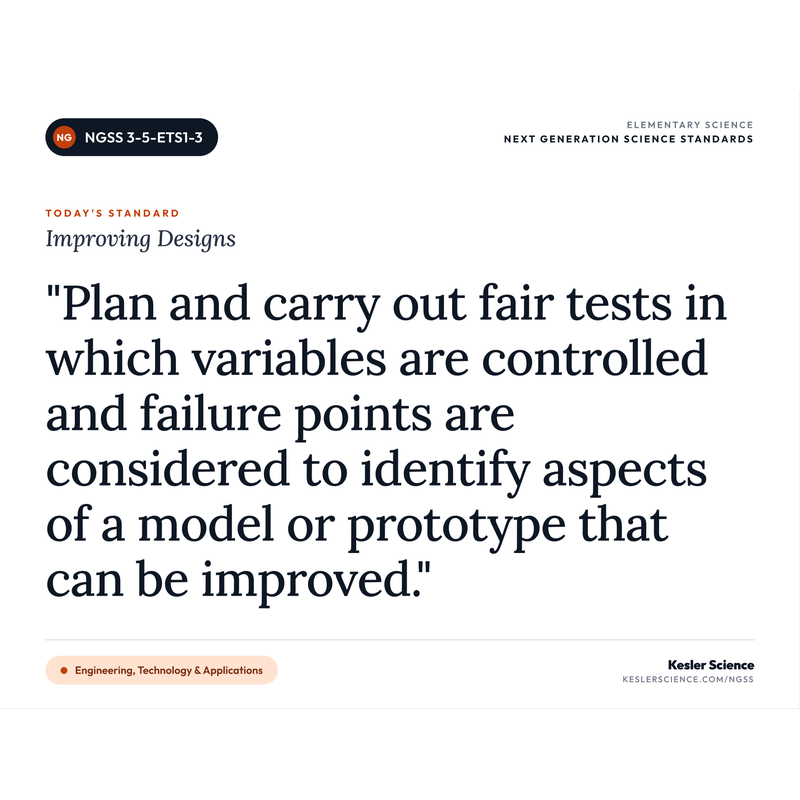
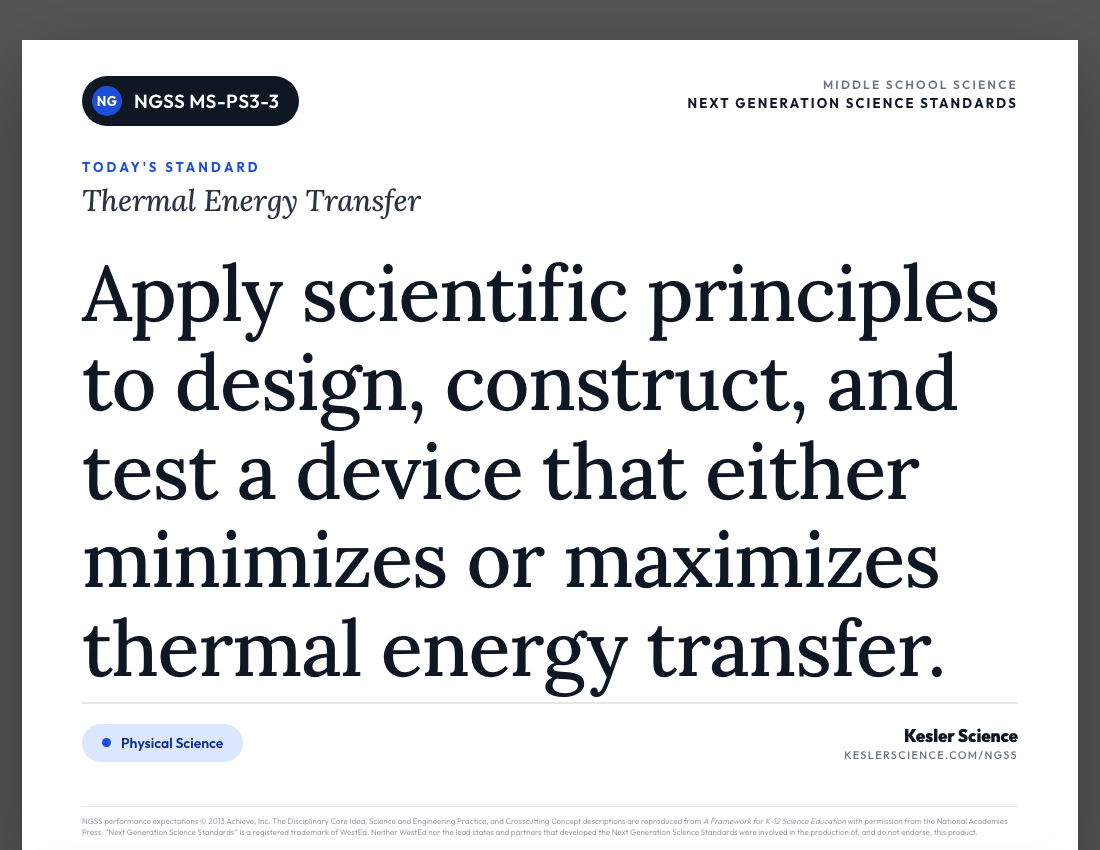
Print-ready classroom poster pack for 3-5-ETS1-3. Includes the verbatim NGSS performance expectation plus student-language "I Can" statements broken into daily learning goals. Landscape orientation, letter size, ready to print and post on your wall.
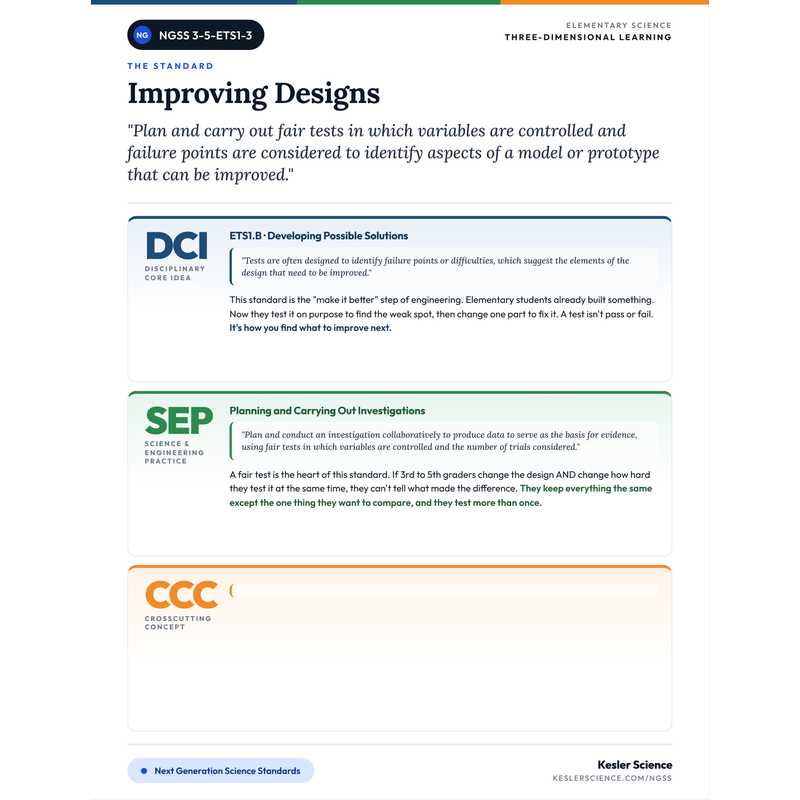
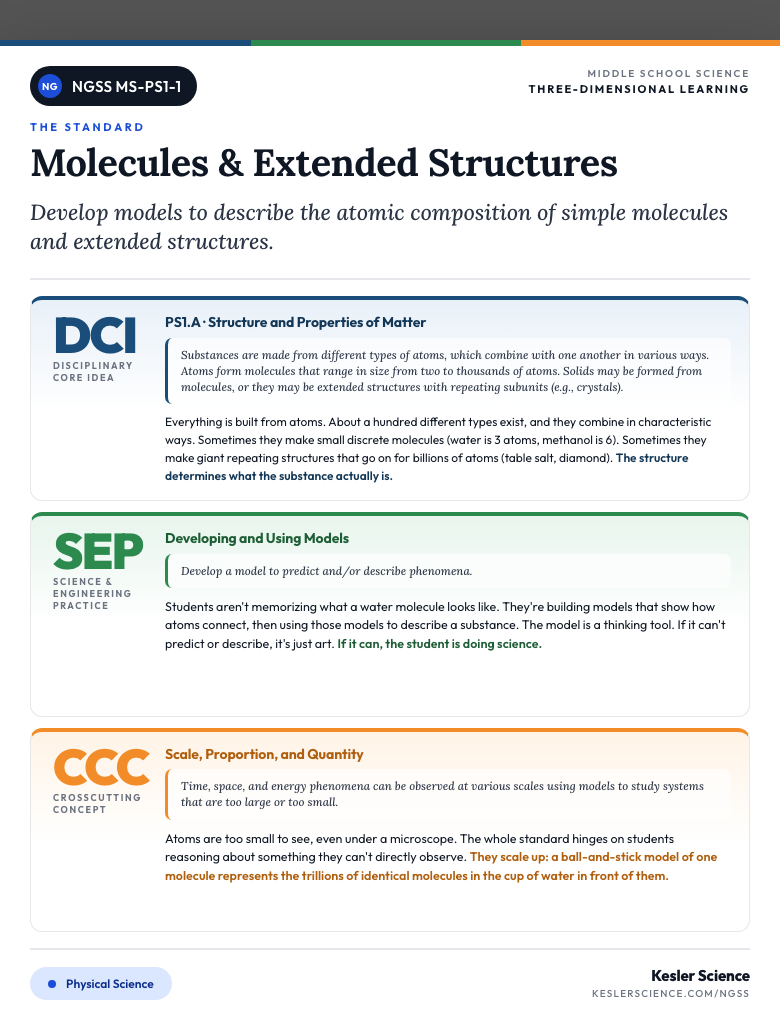
Teacher-facing PDF that breaks down the DCI, SEP, and CCC for 3-5-ETS1-3 in plain English. Color-coded by dimension so you can read the whole standard at a glance. Perfect for lesson planning or a sub folder.
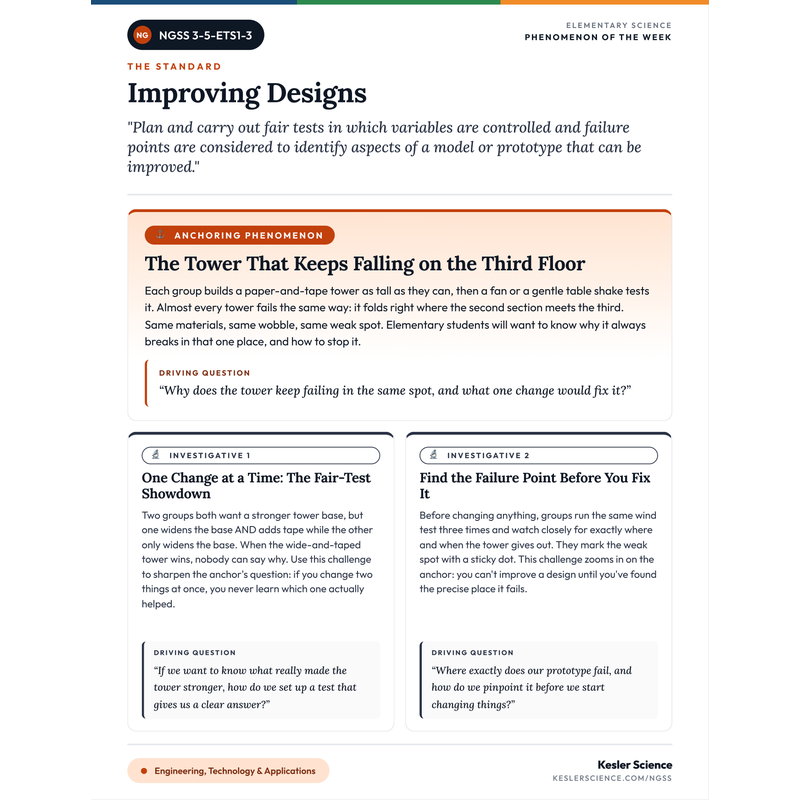
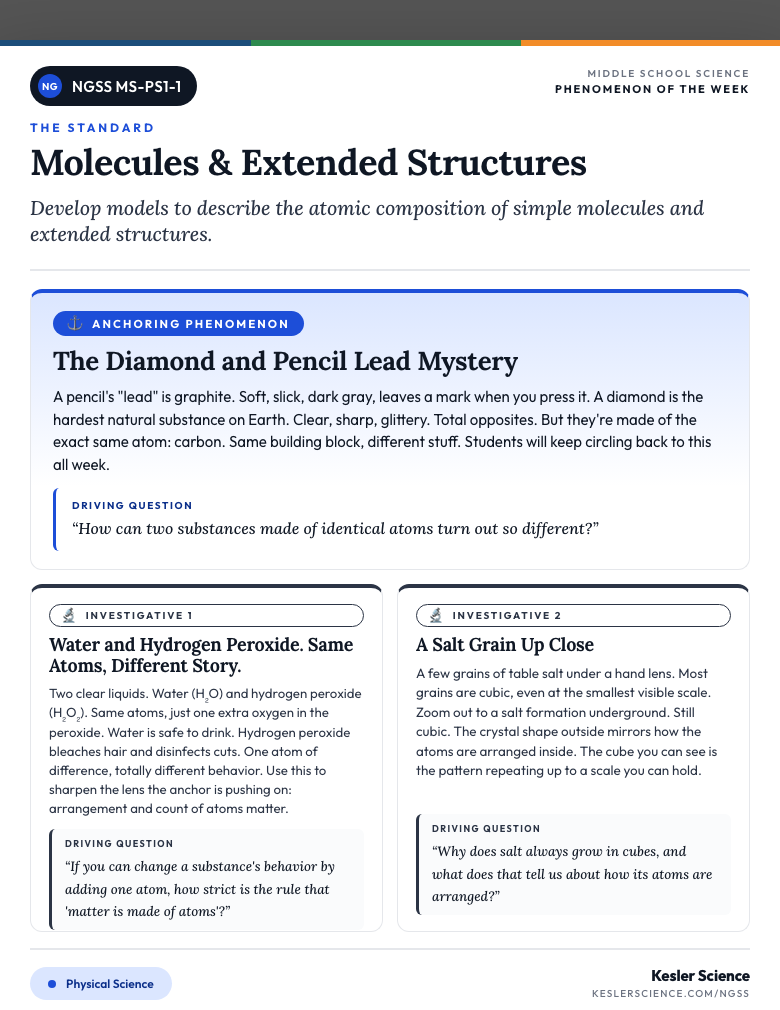
One-page printable with the anchoring phenomenon plus two investigative phenomena for 3-5-ETS1-3. Each one comes with the driving question students will keep asking. Pin it above your desk for the week — one piece of paper, one week of hooks.
Teaching more than this one standard?
Get every I Can poster, phenomenon hook, and 3-dimension sheet for all 17 4th Grade standards, in one download. The whole year, ready to print.
📚 Vocabulary Students Need for 3-5-ETS1-3
The terms students need to access this standard. Definitions in plain-English, classroom-ready language.
💡 Free Engagement Ideas for 3-5-ETS1-3
Tallest Tower Wind-Test Challenge
Groups build the tallest paper-and-tape tower they can, then face the same fan on the same setting. Everyone watches for where the tower folds. They mark the failure point, change one part, and test again to see if the second version stands longer. This is the anchor turned into a build-test-improve lab.
One-Change Cup Tower Showdown
Each group stacks plastic cups into a tower to hold a textbook, then improves it by changing exactly ONE thing (wider base, more cups, or a cardboard platform) and retesting. Because only one thing changes, they can finally say which change helped. A clean, hands-on lesson in controlling variables.
Leak-Proof Boat Trial Run
Groups design a small boat from foil and tape to hold the most pennies before water leaks in. They run three trials, watch where the water gets in, and improve that exact seam. Finding the failure point (the leak) and fixing only that spot is the whole game.
Improve-It Engineering Notebook Page
After any of the build labs, students fill a notebook page: draw version 1, circle the failure point, write the one change they made, and draw version 2. Then they write one sentence of evidence ('it held 4 more pennies'). Turns the build into a record of real improvement.
📝 Assessment Ideas for 3-5-ETS1-3
Three short tasks that hit all three dimensions. Doable in one class period each.
Give students two prototype towers and the goal of finding out which is stronger. They write a test plan that names what they'll keep the same (drop, push, or weight), what they'll change, and how many trials they'll run. Mirrors the SEP: a fair test with variables controlled and trials considered.
Show students a short video or photo set of a prototype being tested three times and failing in the same place each time. They identify the failure point and name the one part of the design that should be improved. Hits the ETS1.B idea: tests reveal what needs to be improved.
Students get their own first-build test data and write what they changed, why, and what evidence shows it improved (held more, stood longer, leaked less). One change, backed by results from the test. This is the full build-test-improve loop the standard asks for.
🎯 What Proficient Student Work Looks Like
Same prompt, three student responses at different proficiency levels. Use as anchor papers when scoring.
"Use your test results to explain where your tower failed and what one change you made to improve it. How do you know your change worked?"
- A specific claim backed by data or observation
- Use of standard-specific vocabulary in context
- Connection between what students observe and the underlying science idea
- A question they're still wondering about (curiosity stays alive)
"My tower fell so I fixed it. I added more tape and made it better. The new one is good."
Knows the goal is to improve, but never names where it failed and never gives evidence. "Better" and "good" aren't results. No fair test, no specific failure point, no proof the change worked.
"My tower folded right in the middle every time the fan hit it, all three trials. So I made the middle wider with an extra strip of paper and left everything else the same. I tested it the same way three more times and it stayed up longer, so my change worked."
Names the exact failure point, ran multiple trials, changed one thing, and kept the test fair. Backs the improvement with a repeatable result. This is exactly what the standard asks elementary students to do.
"My tower failed at the middle joint on all three trials, so that was the weak spot. I changed only one thing, a wider middle, and kept the same fan setting and the same height so the test stayed fair. It held up through all three new trials instead of folding. My evidence is it never fell at the middle again. I know my next version could be even better if I widen the base too, but I'd test that one change by itself."
Pinpoints the failure point with trial evidence, controls variables, proves the improvement, AND already plans the next single-change test. Reaches the engineering mindset that a design is a version you keep improving, without being asked.
“Next Generation Science Standards” is a registered trademark of WestEd. Neither WestEd nor the lead states and partners that developed the Next Generation Science Standards were involved in the production of, and do not endorse, this product.
NGSS performance expectations © 2013 Achieve, Inc. The Disciplinary Core Idea, Science and Engineering Practice, and Crosscutting Concept descriptions are reproduced from A Framework for K-12 Science Education with permission from the National Academies Press.
Trusted Across NGSS States
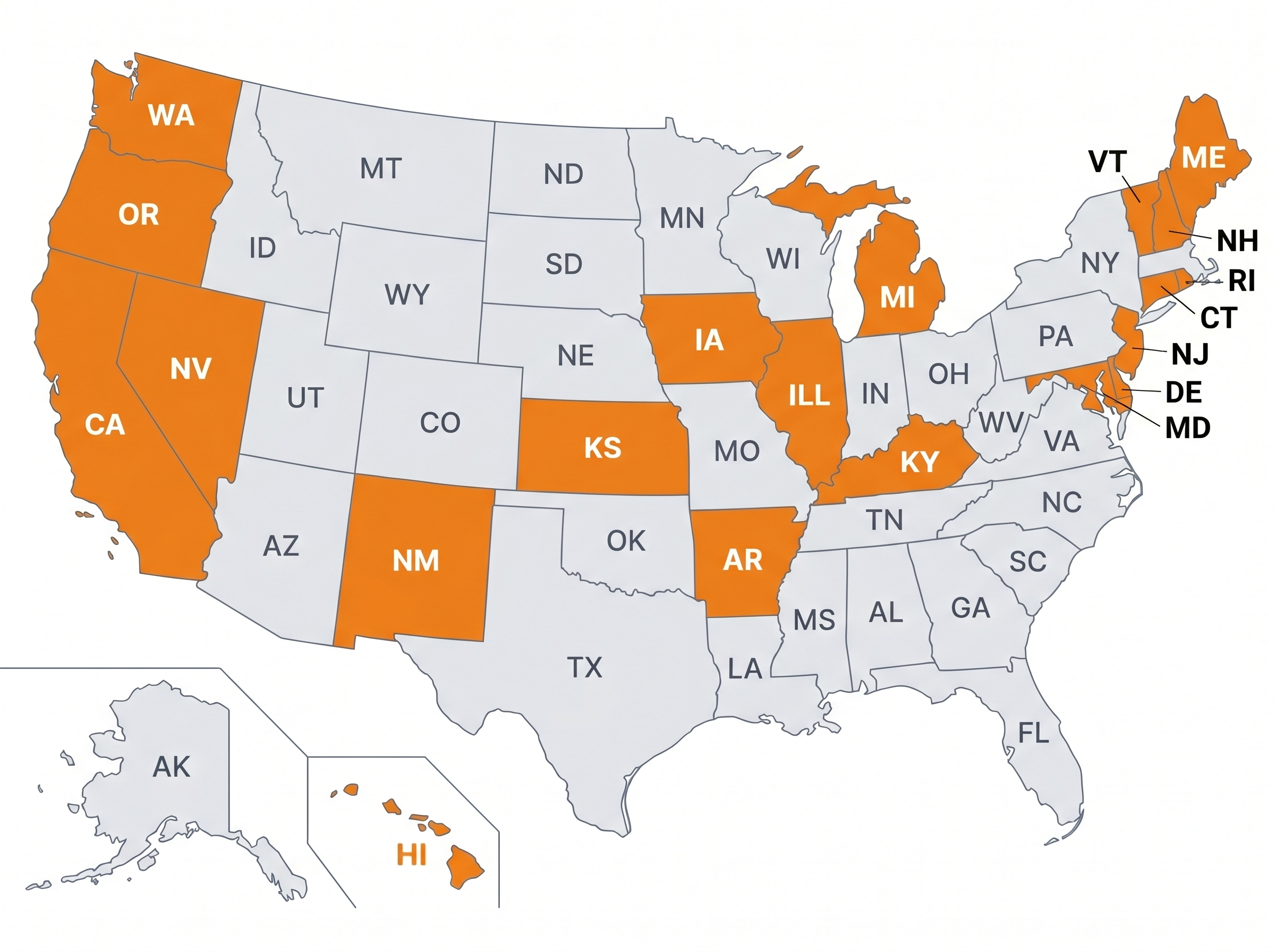
From California to Connecticut, science teachers in the 20 states that adopted NGSS are using Kesler Science to save time and engage students.
Teachers in NGSS States
Love Kesler Science
What Teachers Are Saying
"I'm able to access rigorous NGSS-aligned lessons and labs that are ready to use, so I spend more time helping students directly and less time searching for quality material."
"There's a lesson for each of the NGSS, so I don't have to search for hours to find a good quality lesson. I can spend more time actually teaching."
"The resources help me cover NGSS in a meaningful way, and my students gain a deeper knowledge of the concepts, with learning that's more self-driven."
Give Your Science Teachers Everything They Need
School and district licenses give your teachers access to every resource they need, including station labs, inquiry labs, anchoring phenomena, presentations, escape rooms, and much more. One purchase covers the grade levels you need.
- PO-friendly. We accept purchase orders
- Volume discounts for 11+ teachers
- Complimentary membership orientation for 4+ teachers
- Three free implementation PD sessions for departments of 11+
- Aligned to the NGSS standards
See It in Action
Book a walkthrough and we'll show you how Kesler Science fits your campus.
Book Demo CallNo pressure, no hard sell
"My assistant principal stopped in my room and immediately noticed how the students were engrossed in their centers and how they moved seamlessly from center to center. Also the built-in modifications really impressed!"
"It provides differentiated instruction for all types of learners, allowing them to become more engaged."
"I love it all!! I have become a facilitator in my class and I love the excitement it brings to my class. The kids love all that we do with the Kesler products."