
Inside the Properties of Water 5E Lesson
The 5E instructional model walks students through five phases: Engage, Explore, Explain, Elaborate, and Evaluate. It flips the traditional lecture-first sequence on its head. Students explore a concept hands-on before you ever explain it, which means by the time you do explain it, they have something to hook the vocabulary onto.
I switched to the 5E model years ago and stopped going back. Kids retain more, ask better questions, and stop staring at me waiting to be told the answer. The Properties of Water 5E Lesson is built on this framework from start to finish. Here's how it plays out across the five phases.
🎯 Engage
Day one is a three-station demo rotation. Each station shows one of the three water properties in action with stuff you can grab from a kitchen or grocery store. Station one is the penny drop (cohesion plus surface tension). Station two is a stalk of celery sitting in food coloring overnight, or a strip of paper towel dipped in water (adhesion plus capillary action). Station three is a sewing needle balanced on the surface of a glass of water (surface tension).
Students cycle through, sketch what they observe, and write a one-sentence guess for what's making each one happen. Nobody has heard a vocabulary lecture yet. That's the point. They're walking into the rest of the unit with three vivid mental images and a working sense that water does some weird things, ready to attach vocabulary to.
What's included in the Engage:
- Teacher directions for the three demo stations
- Printable student observation sheet
- Answer key for the discussion questions
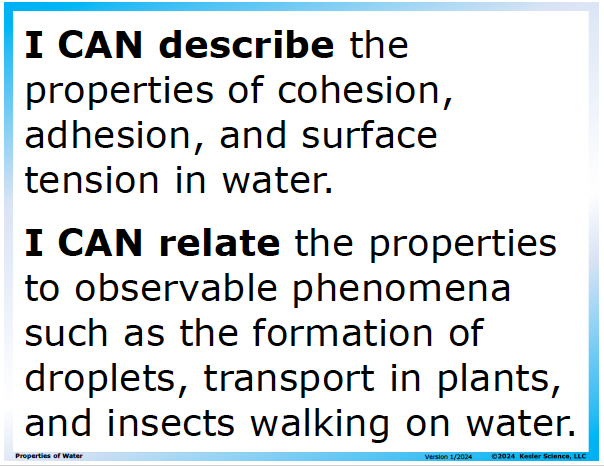
- Four learning objective slides (standard verbatim, "Describe and relate to observable phenomena" highlighted, "I CAN...", and "WE WILL...")
- An illustrated Chemistry Word Wall in English and Spanish covering the full unit vocabulary
🔬 Explore
The Properties of Water Station Lab is the heart of the Explore phase. Students rotate through 8 stations (plus a 9th challenge station for early finishers) over one class period. The Station Lab is split into four input stations (where kids take in new information) and four output stations (where they show what they learned).
The four input stations:
- 🎬 Watch It! — Students watch a short video on cohesion, adhesion, and surface tension and answer guided questions.
- 📖 Read It! — A one-page reading passage at two differentiated levels on how water's properties show up in droplets, plants, and water striders, with a Spanish version included.
- 🔬 Explore It! — The hands-on activity (the heart of the Station Lab) where students test cohesion with the penny drop, adhesion with a paper towel dipped in colored water, and surface tension with a floating needle or paper clip.
- 💻 Research It! — Reference cards with definitions and diagrams of cohesion, adhesion, surface tension, capillary action, and the polar nature of the water molecule.
The four output stations:
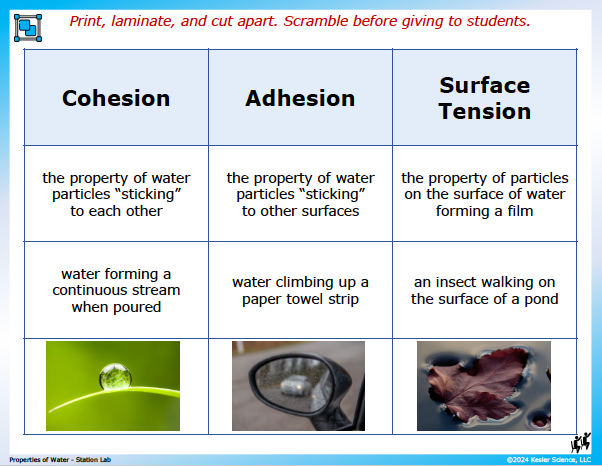
- 📋 Organize It! — A card sort where students physically place real-world examples (dew on a leaf, water rising in celery, raindrop shape, water strider, paper towel absorbing a spill) under the property doing the work.
- 🎨 Illustrate It! — Students draw a graphic organizer of all three properties with a picture and a real-world example for each.
- ✍️ Write It! — Three open-ended questions in complete sentences (this is where you see who really gets it).
- 📝 Assess It! — A short formative check with multiple choice and a fill-in-the-blank vocabulary paragraph.
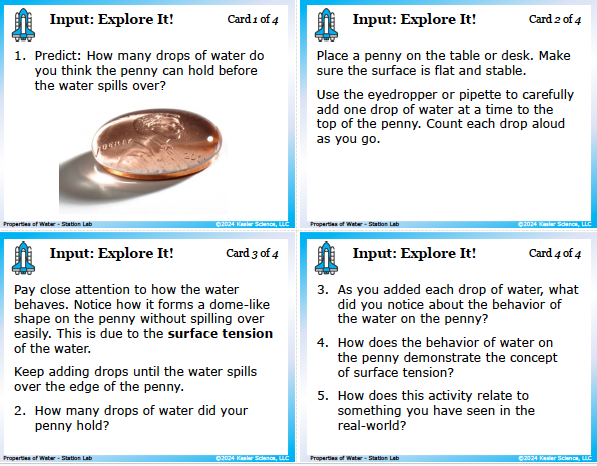
Print and digital versions are both included. If you want the full breakdown of what happens at every single station, what students produce, and how to set it up, that's in our dedicated Station Lab post.
→ Read the full Properties of Water Station Lab walkthrough 8 stations, materials list, teacher tipsThe Station Lab is included in the full 5E lesson. You don't need to buy it separately if you're getting the whole unit.
📚 Explain
Here's the real payoff of doing the Engage and Explore before the Explain: by the time kids hit this phase, they've already watched water bead up on a penny, climb a paper towel, and hold up a needle. They have a working understanding before you ever start naming things. The discussions get deeper, the questions get sharper, and you spend less time defining and more time pushing their thinking.
The Properties of Water Presentation walks 8th graders through the full scope of TEKS 8.6C, one concept at a time, with photo and diagram examples on nearly every slide. The deck opens by reminding students that water (H2O) has unique and interesting properties that are essential to the existence of life on Earth, and that water molecules behave the way they do because they like to stick to each other and to other surfaces. From there it builds out the three properties in order: cohesion, adhesion, and surface tension.
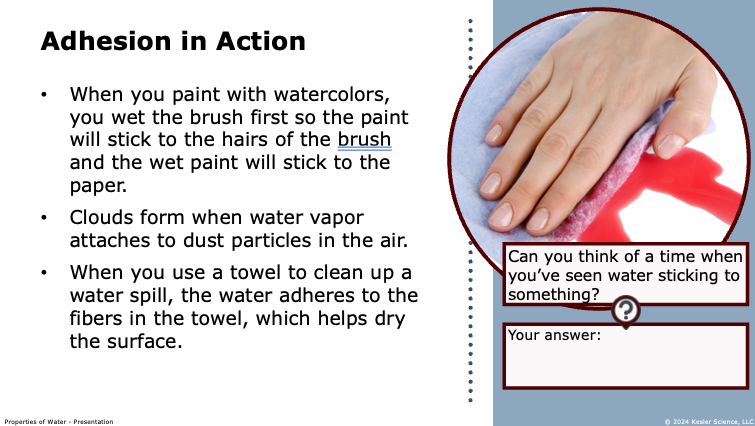
Students learn that cohesion is the property that makes molecules of the same substance stick together. In water, that means water molecules pulling on other water molecules, which is why a drop of water clumps into a rounded bead instead of spreading out into a thin film, why dew forms on a leaf, and why a meniscus curves in a glass. Adhesion is the property that makes molecules of different substances stick together. In water, that's water molecules being attracted to other surfaces, which is why water sticks to a paintbrush, why a paper towel cleans up a spill, and why water vapor attaches to dust particles to form clouds.
The deck then drills into surface tension, which is the result of cohesion at the surface of a body of water. Since the molecules at the very top have nothing above them to stick to, they're pulled extra tightly inward and downward by the molecules around and below them, which creates an elastic "skin" on the surface. That skin is strong enough to hold a water strider, let raindrops form a small crater shape before merging with a pond, and let kids fit 25 to 30 drops on a penny. The Presentation then ties all three properties together in real-world phenomena: capillary action in plant vessels (water climbing from roots to leaves against gravity), cloud formation (adhesion to dust, cohesion holds droplets together, condensation), and even how a tear forms on your skin (cohesion holds the liquid together, adhesion sticks it to your skin, surface tension lets it grow until it overflows).
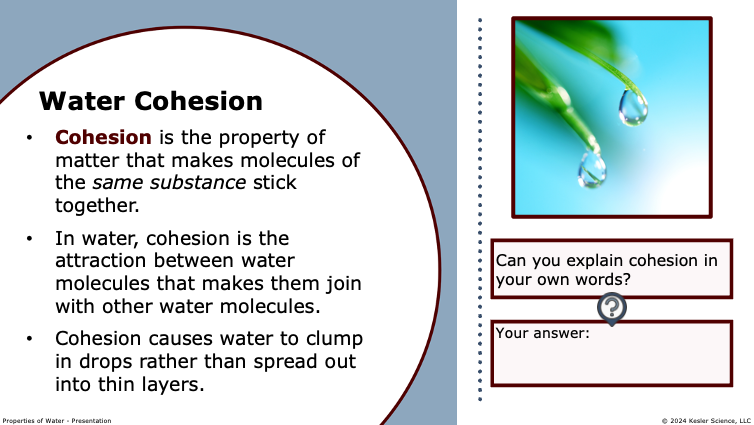
For every property, students see the same pattern: definition, real-world photo, classroom example. That repetition (different properties, same explanation framework) bakes the "describe and relate to observable phenomena" verb of TEKS 8.6C into long-term memory.
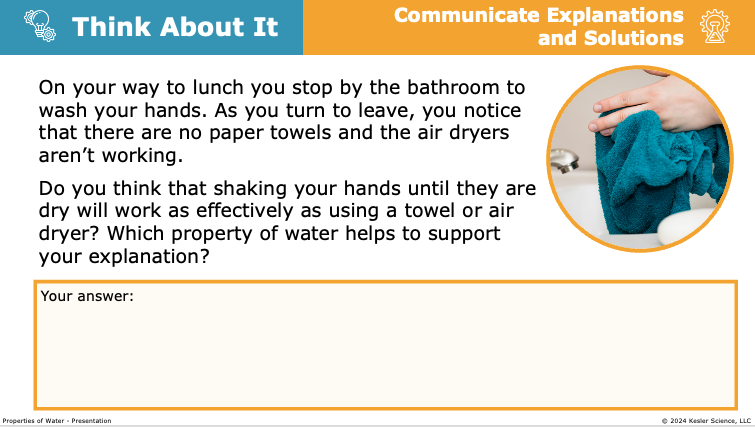
What makes the Properties of Water Presentation different from a typical chemistry slideshow is that kids are doing something on almost every single slide. It's not a lecture deck. It's a participation deck. "Your answer:" prompts appear on most slides, Brain Breaks reset attention every few slides (drops on fingertips, role-play where students physically demonstrate cohesion and adhesion with a partner), Quick Action INB tasks (drag and drop tiles into the correct word web, sequence water transport in a tree) show up throughout, and Think About It prompts push deeper into bigger ideas like why raindrops have a rounded shape, why paper towels are designed the way they are, and whether shaking your hands dry actually works. The deck closes with a Check for Understanding tied back to the two Essential Questions: What are the properties of cohesion, adhesion, and surface tension in water? and How do these properties relate to the formation of water droplets, transport in plants, and insects walking on water?
The Explain materials in this product include:
- An editable 24-slide Presentation at two differentiated levels (Dependent and Modified), works in PowerPoint or Google Slides
- A guided fill-in-the-blank student notes handout that mirrors the Presentation, with answer key
- A Paper Interactive Notebook (English and Spanish) students cut, fold, and glue into their notebooks
- A Digital Interactive Notebook at both levels with answer keys, for 1:1 classrooms or Google Classroom
The Explain runs across two class periods. The built-in Think About It prompts are where the real discussion happens, so let those breathe.
🛠️ Elaborate
The Elaborate phase is where students stretch what they learned about cohesion, adhesion, and surface tension and put it into a project of their choosing. In this 8th grade chemistry lesson, that's a Student Choice Project board with six different project options plus a "design your own" pathway.
Students might design a children's picture book that follows a water molecule from a tree's roots to a single leaf using capillary action, or build a paper towel "absorbency tournament" experiment that scores three brands of paper towels on how well adhesion pulls water in, or write and film a one-minute newscast where they interview a water strider about how it stays on top of the pond. There are options for kids who love to write, kids who love to draw, kids who love to build, and kids who love to perform. Whatever the project, the point is the same: students apply cohesion, adhesion, and surface tension to a real-world artifact instead of a worksheet.
Choice is the whole point. By letting students pick how they show their thinking, you get more authentic work for TEKS 8.6C and you actually get to see what they understand about water's properties.
The rubric (the part teachers actually want)
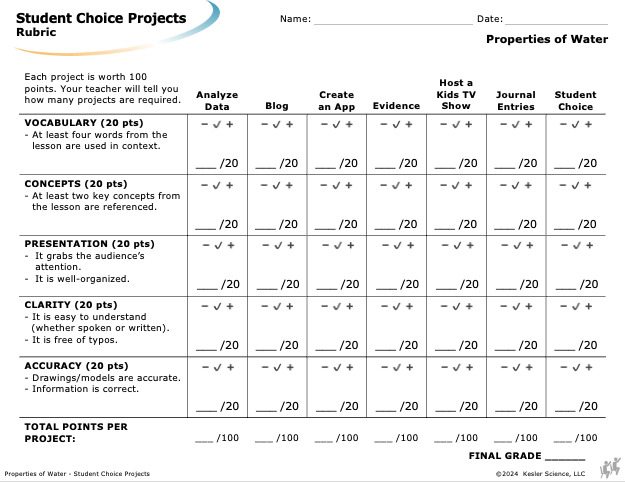
Every project, no matter which option a student picks, is graded on the same 100-point rubric. Five categories at 20 points each:
- Vocabulary (20 pts) — At least four words from the lesson are used in context.
- Concepts (20 pts) — At least two key concepts from the lesson are referenced.
- Presentation (20 pts) — The project grabs attention and is well-organized.
- Clarity (20 pts) — Easy to understand. Free of typos.
- Accuracy (20 pts) — Drawings and models are accurate. The science is right.
Two differentiated versions in one file
The standard version is for students ready for independent application. The Reinforcement version is for students who need additional vocabulary or concept support. Three of the six options are swapped for projects with a tighter vocabulary tie-in, and "design your own" is replaced with "collaborate with the teacher" so kids aren't pitching cold.
✅ Evaluate
The Evaluate phase wraps the unit with a formal assessment. It's not all bubble-in. Several questions hand students a photograph of a real-world phenomenon (a drop of water on a leaf, a water strider, water climbing a paper towel) and ask them to identify the property and justify the choice.
The full assessment has 12 questions across five formats:
- Multiple choice (4 questions) covering definitions of cohesion, adhesion, and surface tension, plus the real-world examples from the standard
- Hotspot / visual (2 questions) where students circle the image showing a target property and describe the difference between cohesion and adhesion in two side-by-side photos
- Multiselect (2 questions) where students pick all the everyday situations that involve a given water property
- Short answer (2 questions) on why droplets form into rounded beads and how a tall tree moves water from roots to leaves
- Multipart scenario (2 questions) with a 3-student classroom debate where kids identify which student's reasoning correctly explains why a water strider doesn't sink
A modified version is included for students who need additional support, with fewer multiple-choice distractors and sentence-starter scaffolds on the short-answer items.
If you've taught all five phases, this assessment shouldn't surprise anyone. It's a chance for kids to show you they get it.
How everything fits together
If you want the whole experience (Engage hook, the Station Lab as the Explore, the Explain day with Presentation and interactive notebook, the Student Choice Elaborate, and the Evaluate assessment all in one download), that's the Properties of Water Complete 5E Science Lesson.
If you only need the one-day hands-on activity, the Station Lab works as a standalone. Most teachers buy the full 5E because the Station Lab works harder when it's bookended by a strong Engage and a follow-up Explain. But both are honest options.

Get the Properties of Water 5E Lesson

Or if you only need the one-day hands-on Station Lab:
(The Station Lab is included in the full 5E Lesson)
Frequently asked questions
Does this cover all of TEKS 8.6C?
Yes. All three properties (cohesion, adhesion, surface tension) and all three observable phenomena (droplets, transport in plants, insects walking on water) are addressed across the five phases.
What do my students need to know before this lesson?
A basic understanding of atoms, molecules, and the states of matter from earlier grade-level standards. If your kids can describe what a water molecule is, they're ready.
How long does it take to teach?
Done with fidelity, about 10 class periods of 45 minutes each: one day for the demo Engage, two days for the Station Lab, two days for the Presentation and Interactive Notebook, three days for the Student Choice Project, and one to two days for review and the assessment. The product also ships with a compressed 8-day sample unit plan if you need to move faster.
Do I need special supplies?
Just kitchen-grade stuff. Pennies, eyedroppers, paper towels, food coloring, and sewing needles or paper clips. Most teachers already have all of this on hand or can pick it up at a grocery store for a few dollars.
Does this work for digital classrooms?
Yes. Every component has a digital version. The Station Lab is fully digital-ready (Google Slides), the Presentation works in Google Slides, and the Student Choice Projects can be submitted as videos, slide decks, or written work.
Is this 5E lesson aligned to NGSS too?
It connects with MS-LS1-6 (the role of water and capillary transport in plants) and supports MS-PS1-4 on how molecular attractions explain observable properties. Built TEKS-first, but the standards overlap heavily.