8 hands-on stations for teaching the properties of water
A station lab is a student-led activity where small groups rotate through 8 stations (plus a 9th challenge station for early finishers) at their own pace during one to two class periods. You become a facilitator instead of a lecturer. You're walking around, spot-checking, breaking misconceptions, and watching for the moment things click.
The Properties of Water Station Lab has four input stations (where students take in new info on cohesion, adhesion, and surface tension) and four output stations (where they show what they learned). Here's what's at each one.
4 input stations: how students learn the properties of water
A short YouTube video walks students through how a water strider walks on water without breaking the surface. Students answer three questions: why surface molecules act elastic, how the bug's micro setae (waxy hairs) keep its feet from sinking, and what role hydrophobicity plays. The water strider is a perfect anchor phenomenon — every kid has either seen one or seen the videos. Visual learners come alive at this station.
A one-page passage called "Invisible Forces: How Water Climbs Trees" walks students through the three properties using a tug-of-war analogy. Cohesion is the team holding hands. Adhesion is the gloves giving grip on the rope. Surface tension is the strength of each team's grip. Capillary action is what gets water from a tree's roots to its leaves. Three multiple-choice questions follow. Comes in two reading levels (Dependent and Modified) plus a Spanish version.
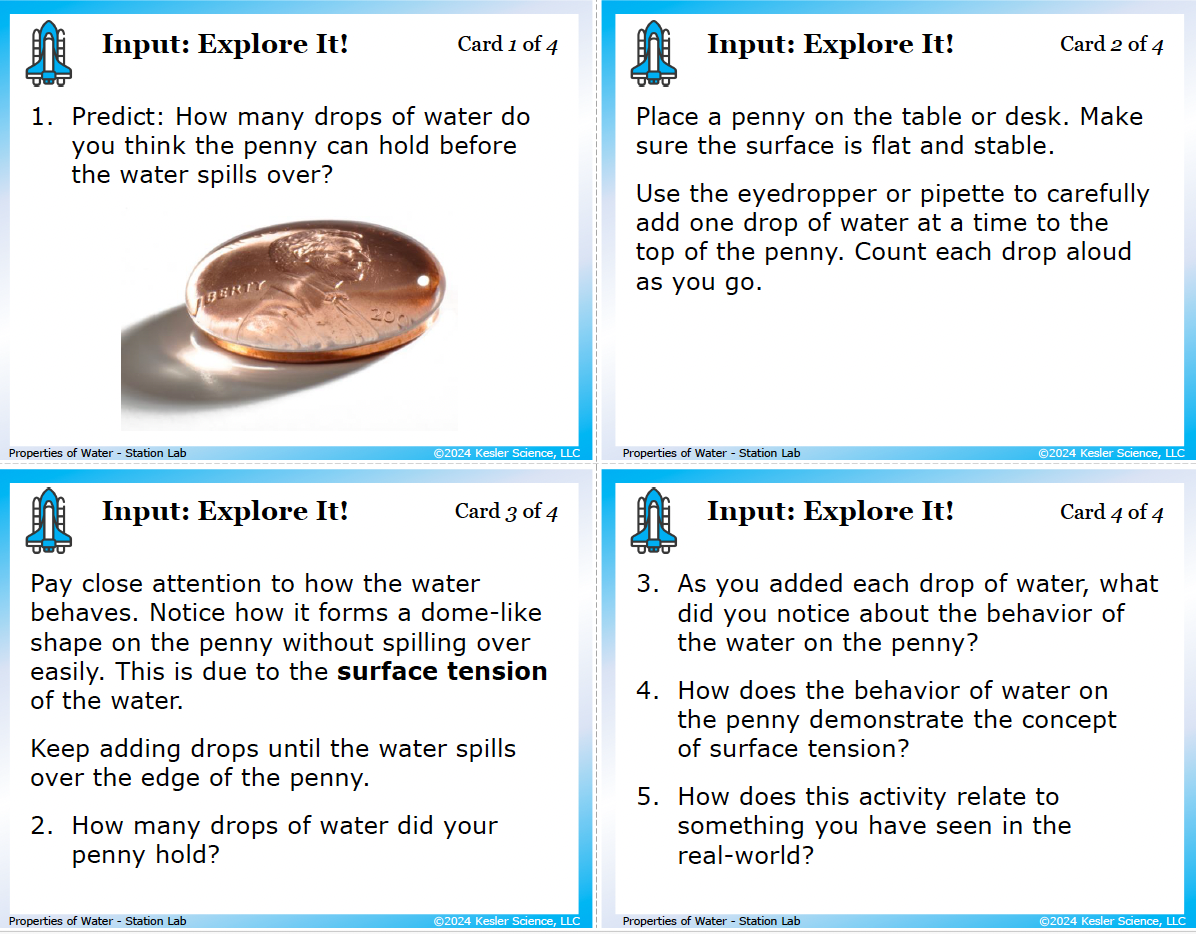
This is the heart of the lab. Students get a penny, an eyedropper, and a cup of water. They predict how many drops the penny will hold before water spills over, then start counting. The water domes up on the penny, refusing to spill. Most kids guess 5–10 drops. Most pennies hold 30–50. The why is surface tension — the molecules at the surface grip each other so hard they hold a giant bubble in place. Five questions wrap it up: the prediction, the actual count, what they observed, how it demonstrates surface tension, and a real-world connection.
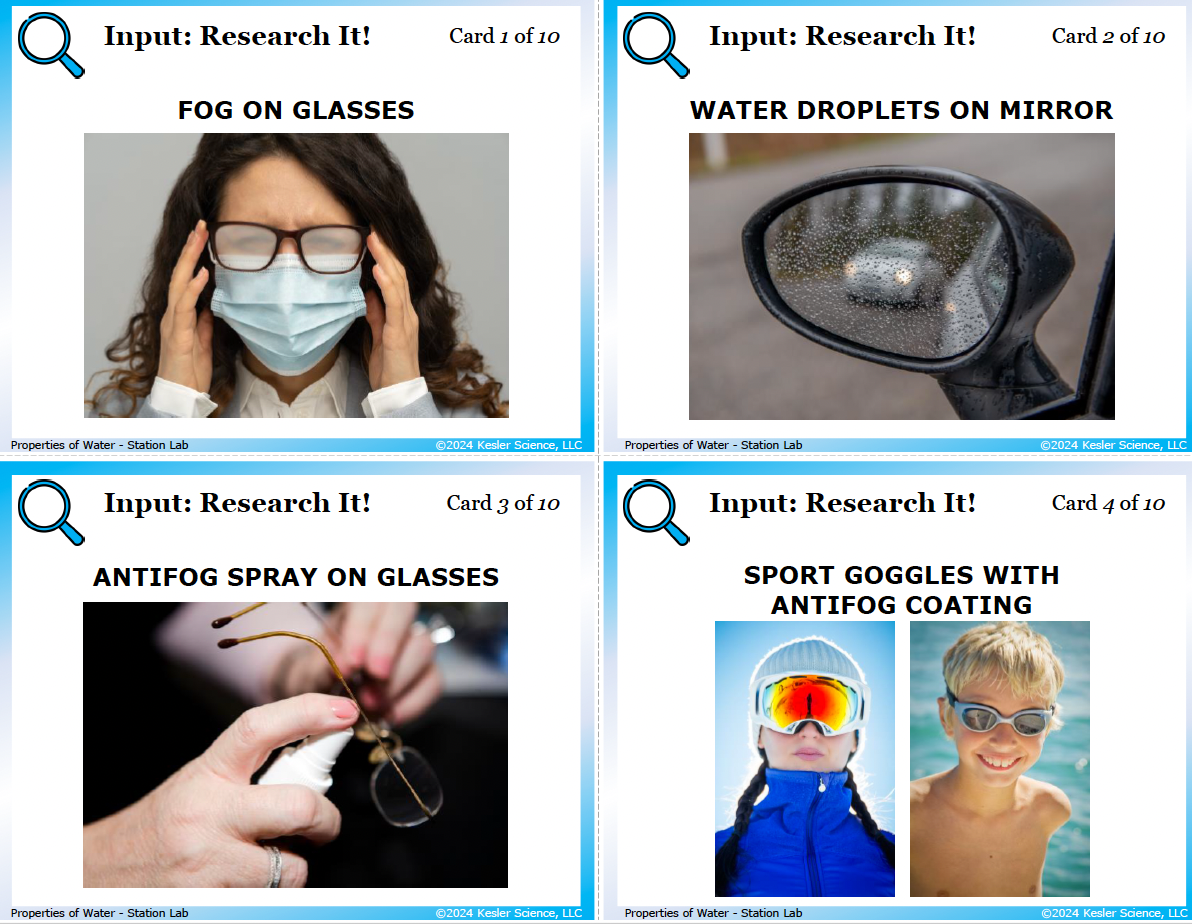
Students examine 10 reference cards on antifog technology — how fog forms on glasses, mirrors, and goggles when warm moist air hits a cold surface, and how antifog coatings spread water into a thin invisible film instead of letting it bead up. The cards include surgical mask fog, antifog spray, sport goggles, firefighter helmets, and medical applications. Five questions check whether they can identify two common applications, explain temperature-driven fog formation, describe how antifog interferes with surface tension, compare two coating types, and discuss an innovative application. The connection between surface tension and antifog is the moment students realize this is real-world engineering, not just nature trivia.
4 output stations: how students show what they learned
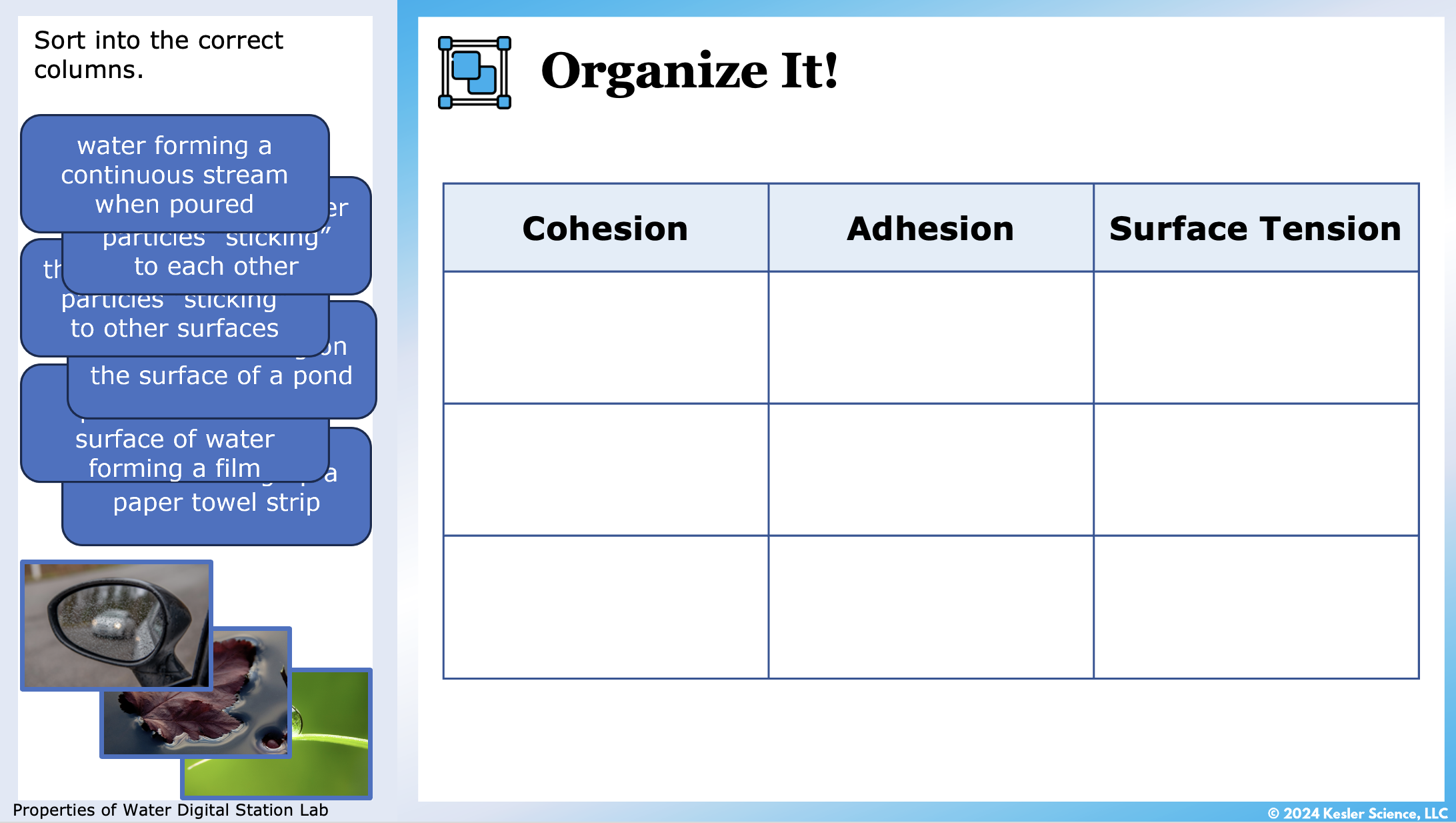
A card sort. Kids match definitions and real-world examples with three categories: Cohesion, Adhesion, and Surface Tension. Cards include "water particles sticking to each other" → cohesion, "water climbing up a paper towel strip" → adhesion, "an insect walking on the surface of a pond" → surface tension, plus images of water domes on leaves, droplets on mirrors, and leaves floating on water. Easy to spot-check at a glance, and the fastest way to see who's actually internalized the differences.
Students draw a real-world example that shows all three properties working together. Examples might be a tree pulling water up its trunk, a flower drinking from a glass of dyed water, or a paper towel soaking up a spill. They add arrows and labels showing where cohesion, adhesion, and surface tension each happen. This catches kids who can define the three properties but can't pick them out of one scene. Watch what they label.
Three open-ended questions tied to everyday phenomena: why a cold soda can has separate water droplets on it instead of an even film (cohesion forming droplets), how to explain a bug walking on water to a younger sibling (surface tension), and how understanding these properties helps engineers develop antifog technology. This is the writing practice middle schoolers need and rarely get in science class.
Eight multiple-choice and fill-in-the-paragraph questions tied to TEKS 8.6C vocabulary (surface tension, cohesion, adhesion, capillary action, condense). Includes the floating-needle question (surface tension), the plants-transport-water question (cohesion + adhesion), and a definition question on cohesion. The fill-in paragraph weaves all five vocabulary words together into one passage about water on leaves and through plants. If you're grading the lab, this is the easiest station to grade.
Bonus Challenge It! station for early finishers
Four optional extensions: design a four-panel comic strip illustrating the water cycle with cohesion and adhesion roles called out, build a 10-word crossword puzzle, write a storybook from the perspective of a water molecule traveling up a plant, or retell water's journey through a plant using only icons and pictures (hieroglyphics style). Requires teacher approval before they start.
How this fits into a complete properties of water unit
This Station Lab is the Explore day of our full Properties of Water Complete 5E Lesson for TEKS 8.6C. The complete two-week unit follows the 5E method of instruction and includes an Engage hook, the Properties of Water Station Lab for Explore, PowerPoint slides and interactive notebook pages for Explain, student choice projects to Elaborate, and an Evaluate assessment.
Most teachers grab the full 5E because the Station Lab lands hardest with the days around it. But if you just need a strong hands-on day on cohesion, adhesion, and surface tension, the Station Lab on its own does the job.

Get this properties of water activity

Or if you want the full two-week experience with the Engage hook, Explain day, Elaborate extension, and Evaluate assessment all included:
(Station Lab is included)
Frequently asked questions
What does TEKS 8.6C cover?
Texas TEKS 8.6C asks 8th grade students to describe the properties of cohesion, adhesion, and surface tension in water and relate them to observable phenomena such as the formation of droplets, transport in plants, and insects walking on water. Students should be able to identify which property is at work in a given scenario and explain the molecular reason behind it.
What's the difference between cohesion and adhesion?
Cohesion is water molecules sticking to each other (water-to-water). Adhesion is water molecules sticking to other surfaces (water-to-something-else). Both work together in capillary action — adhesion pulls water up the inside walls of a thin tube like xylem, and cohesion pulls the rest of the water column along behind it.
How long does this properties of water activity take?
One to two class periods (45 to 110 minutes total). The Explore It! penny experiment is fast (about 10 minutes per group), and the Research It! antifog reference cards are dense, so plan for two periods the first time you run a station lab. Once your class has the routine down, most groups can finish all 8 stations in one period.
Do I need to provide my own materials?
Yes, but everything is cheap and easy. You'll need pennies, eyedroppers (cheap plastic transfer pipettes), cups of water, paper towels, and colored pencils. Total cost for a class of 30: under $10. The Watch It! station also needs a device with internet.
Can I use this for 7th grade or in a 1:1 digital classroom?
Yes to both. The Modified version of every station works as a stretch lesson for advanced 7th graders. The full digital version (PowerPoint or Google Slides) works in 1:1 classrooms and Google Classroom. The Explore It! penny experiment still needs the physical penny and dropper for the full hands-on experience, but the digital version replaces it with a video walkthrough for fully remote settings.