
8 hands-on stations for teaching the origins of the universe
A station lab is a student-led activity where small groups rotate through 8 stations (plus a 9th challenge station for early finishers) at their own pace during one to two class periods. You become a facilitator instead of a lecturer. You walk around, spot-check, and break misconceptions while kids work through the rotation.
The Origins of the Universe Station Lab has four input stations (where students take in new info on the Big Bang and the evidence supporting it) and four output stations (where they show what they learned). Here's what's at each one.
4 input stations: how students learn the origins of the universe
A short YouTube video walks students through what the universe was like 13.7 billion years ago and the timeline that followed. Three questions follow: describe what the universe was like 13.7 billion years ago, what changes had to happen after the Big Bang for the first atoms to form, and how the formation of stars impacted the universe. Visual learners come alive at this station.
A one-page passage called "Origins of the Universe" walks students through Georges LeMaitre's original 1949 idea, the first seconds after the Big Bang, the 300,000-year cool-down before atoms could form, and the three big pieces of evidence (redshift, cosmic microwave background, and the 99% hydrogen-helium ratio). Three multiple-choice questions follow plus a vocabulary task. Comes in two reading levels (Dependent and Modified) plus a Spanish version.
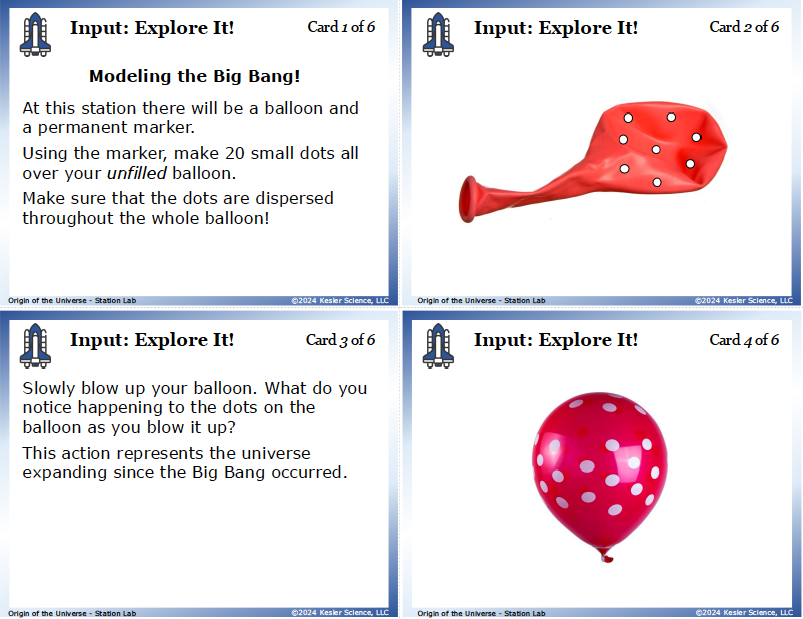
This is the heart of the lab. Students model the Big Bang with a balloon and a permanent marker. They put 20 small dots all over an unfilled balloon (the dots are galaxies), then slowly blow it up. Three questions follow: describe the dots' motion as the balloon expands, do the dots move closer together or further apart, and explain how scientists use this model to show the universe has been expanding since the Big Bang. By the end, kids have built a working model of an expanding universe with their own hands.
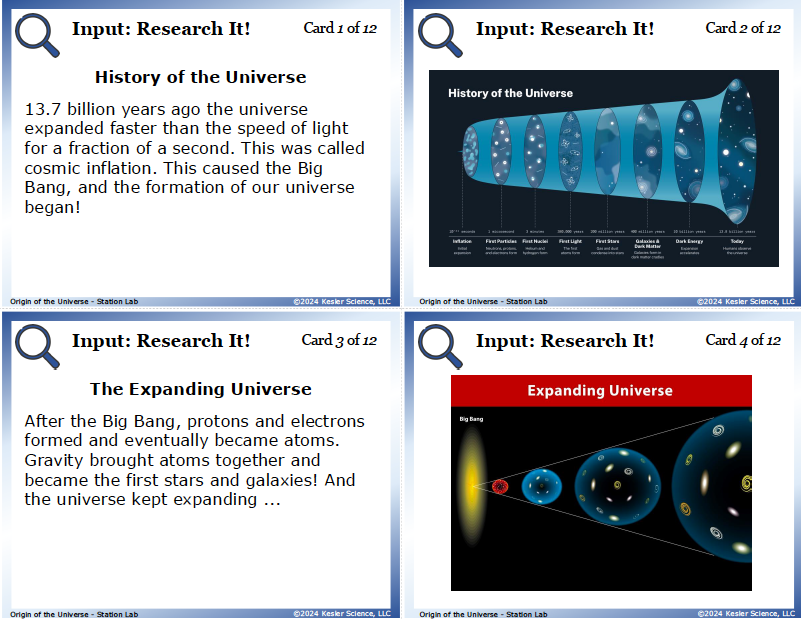
Students examine 12 reference cards covering cosmic inflation, the formation of the first atoms and galaxies, redshift (with a clear visual of stretched wavelengths over time), and the WMAP all-sky image of cosmic microwave background radiation. Five questions ask them what triggered the Big Bang, what force pulled atoms together to form stars, what evidence supports an expanding universe, how redshift shows galaxies moving apart, and what evidence we have for cosmic background radiation.
4 output stations: how students show what they learned
A card sort. Kids organize 12 statements into three columns: Before the Big Bang, First Seconds of the Big Bang, and Billions of Years After the Big Bang. Examples include "all matter was one hot point," "electrons and quarks formed," "hydrogen and helium atoms collapse to form stars," and "galaxies move away from each other, creating redshift." Easy to spot-check at a glance, and it forces kids to commit to a timeline.
Students draw an illustrated timeline of key events in the universe since the Big Bang. They have to include the cooling of the universe so atoms could form and show how stars created heavy elements and exploded to spread those elements through space. The drawing locks the sequence in. Even kids who say "I can't draw" surprise themselves here.
Three open-ended questions: what evidence scientists have to prove the Big Bang took place, what important events happened in the first billion years after the Big Bang, and where the heavy elements came from that formed Earth and everything living on it. This is the writing practice middle schoolers need and rarely get in science class.
Eight multiple-choice and fill-in-the-paragraph questions tied to TEKS 8.9C vocabulary (Big Bang, cosmic microwave background radiation, electrons, protons, redshift). Includes a first-elements question, a when-did-it-happen question, and a why-did-it-take-a-billion-years question. The fill-in paragraph weaves all five vocabulary words into the Big Bang story. If you're grading the lab, this is the easiest station to grade.
Bonus Challenge It! station for early finishers
Four optional extensions: write a first-person creative story from the perspective of a quark watching the universe form, design an animated flipbook of the universe expanding and cooling, conduct an imaginary interview with Georges LeMaitre, or give a simplified explanation of redshift, cosmic microwave background, or the hydrogen-helium ratio that a young student could understand. Requires teacher approval before they start.
How this fits into a complete origins of the universe unit
This Station Lab is the Explore day of our full Origins of the Universe Complete 5E Lesson for TEKS 8.9C. The complete two-week unit follows the 5E method of instruction and includes an Engage hook, the Origins of the Universe Station Lab for Explore, PowerPoint slides and interactive notebook pages for Explain, student choice projects to Elaborate, and an Evaluate assessment.
Most teachers grab the full 5E because the Station Lab lands hardest with the days around it. But if you just need a strong hands-on day on the Big Bang and the evidence behind it, the Station Lab on its own does the job.

Get this origins of the universe activity

Or if you want the full two-week experience with the Engage hook, Explain day, Elaborate extension, and Evaluate assessment all included:
(Station Lab is included)
Frequently asked questions
What does TEKS 8.9C cover?
Texas TEKS 8.9C asks 8th grade students to research and analyze scientific data used as evidence to develop scientific theories that describe the origin of the universe. In practice, students should be able to name the three big pieces of evidence supporting the Big Bang theory (galaxy redshift, cosmic microwave background radiation, and the 99% hydrogen-helium element ratio) and explain what each one shows.
What's the deal with redshift?
When light from a galaxy travels toward us, the wavelengths of that light get stretched out (toward the red end of the spectrum) if the galaxy is moving away. Edwin Hubble noticed in 1929 that almost every galaxy in the sky shows redshift, which means almost every galaxy is moving away from us. That's the first big piece of evidence that the universe is expanding. The Research It! station has a clear visual of stretched wavelengths over time.
How long does this origins of the universe activity take?
One to two class periods (45 to 110 minutes total). Plan for two periods the first time you run a station lab. Once your class has the routine down, most groups can finish all 8 stations in one period.
Do I need to provide my own materials?
Just balloons, permanent markers, and colored pencils. Total cost for a class of 30: under $10. The Watch It! station also needs a device with internet.
Can I use this in a 1:1 digital classroom?
Yes. The full digital version (PowerPoint or Google Slides) works in 1:1 classrooms and Google Classroom. The balloon Explore It! demo can be replaced with a video of an inflating balloon or a digital simulation of the expanding universe. The reference cards and sort cards live inside the digital slides.