
8 hands-on stations for teaching star classification and the H-R diagram
A station lab is a student-led activity where small groups rotate through 8 stations (plus a 9th challenge station for early finishers) at their own pace during one to two class periods. You become a facilitator instead of a lecturer. You walk around, spot-check, and break misconceptions while kids work through the rotation.
The Classifying Stars Station Lab has four input stations (where students take in new info on the star life cycle and the H-R diagram) and four output stations (where they show what they learned). Here's what's at each one.
4 input stations: how students learn star classification
A short YouTube video walks students through how stars form, classify, and die. Three questions follow: which element fuses to make helium during thermonuclear fusion, what system scientists use to classify stars, and what can happen when a star runs out of fuel. Visual learners come alive at this station.
A one-page passage called "A Star is Born!" walks students through the full star life cycle: nebula → protostar → main sequence → red giant or supergiant → white dwarf, neutron star, or black hole. Three multiple-choice questions follow. Comes in two reading levels (Dependent and Modified) plus a Spanish version.
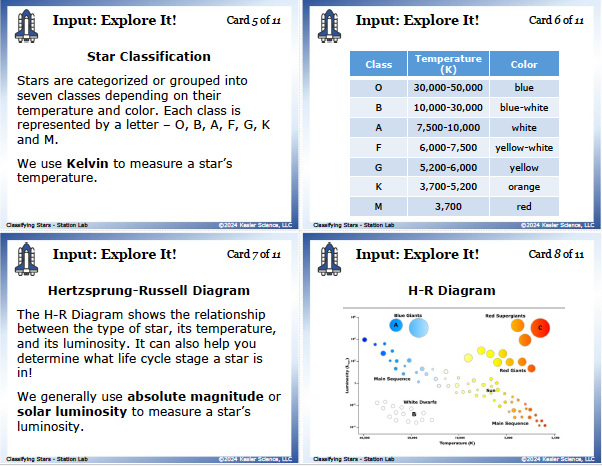
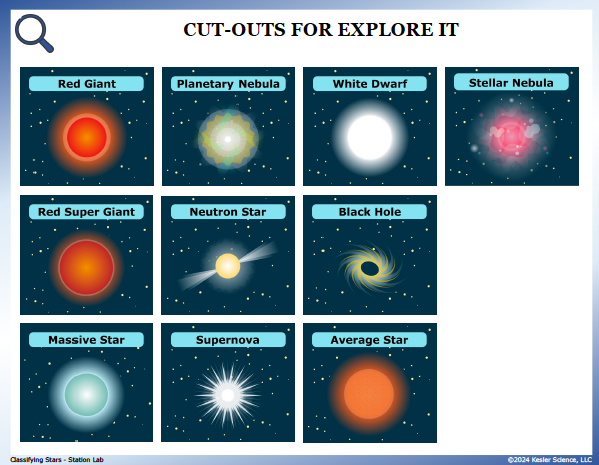
This is the heart of the lab. Students get pre-printed cut-outs of stellar nebula, average star, red giant, planetary nebula, white dwarf, massive star, red supergiant, supernova, neutron star, and black hole. They physically arrange them in order for both the low-mass and high-mass star life cycles. Then they look at the star classification table (O, B, A, F, G, K, M with temperature ranges and colors) and an H-R diagram, and answer seven questions about color, temperature, the Sun's location, and the differences between life cycles. By the end, they've built two life cycles by hand and read information off the H-R diagram.
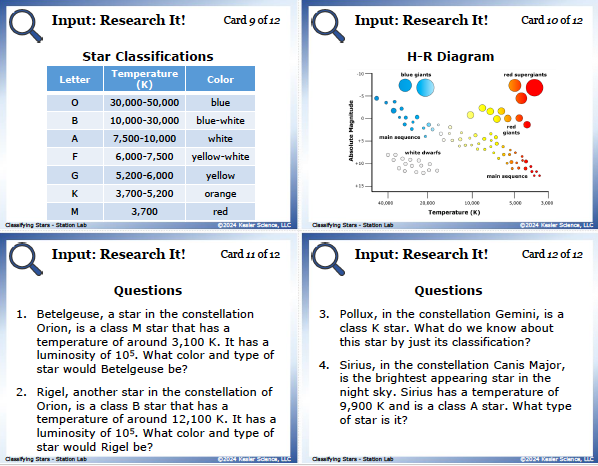
Students examine 12 reference cards on constellations (Orion, Gemini, Canis Major), specific named stars (Betelgeuse, Rigel, Castor, Pollux, Sirius), the star classification table, and the H-R diagram. Four questions ask them to use temperature and luminosity to classify each named star. Betelgeuse at 3,100 K and Rigel at 12,100 K both live in Orion but classify completely differently — that's the point.
4 output stations: how students show what they learned
A card sort. Kids match the seven star classifications (O, B, A, F, G, K, M) with their correct temperature range (in Kelvin) and color. Easy to spot-check at a glance, and the fastest way to see who's actually got the OBAFGKM sequence down vs. who's still mixing up classifications.
Students draw the full life cycle of either a low-mass or high-mass star, label every stage, and use color to show what each stage looks like. Even kids who say "I can't draw" surprise themselves here. The drawing locks the sequence in.
Three open-ended questions: why scientists compare a star's life to a living thing, why blue means hot and red means cool on stars (the opposite of how Earth uses color), and why humans care about the life cycle of a star (especially the Sun's). This is the writing practice middle schoolers need and rarely get in science class.
Eight multiple-choice and fill-in-the-paragraph questions tied to TEKS 8.9A vocabulary (high-mass star, life cycle, low-mass star, luminosity, temperature). Includes the two-classification-criteria question, a low-mass-vs-high-mass question, and the Kelvin-vs-Celsius temperature scale question. The fill-in paragraph weaves all five vocabulary words together. If you're grading the lab, this is the easiest station to grade.
Bonus Challenge It! station for early finishers
Four optional extensions: build seven star-classification flashcards, research a specific named star and write a paragraph about it, create a Venn diagram comparing low-mass and high-mass stars, or write a first-person story as a star going through its life cycle. Requires teacher approval before they start.
How this fits into a complete classifying stars unit
This Station Lab is the Explore day of our full Classifying Stars Complete 5E Lesson for TEKS 8.9A. The complete two-week unit follows the 5E method of instruction and includes an Engage hook, the Classifying Stars Station Lab for Explore, PowerPoint slides and interactive notebook pages for Explain, student choice projects to Elaborate, and an Evaluate assessment.
Most teachers grab the full 5E because the Station Lab lands hardest with the days around it. But if you just need a strong hands-on day on the star life cycle and the H-R diagram, the Station Lab on its own does the job.

Get this classifying stars activity

Or if you want the full two-week experience with the Engage hook, Explain day, Elaborate extension, and Evaluate assessment all included:
(Station Lab is included)
Frequently asked questions
What does TEKS 8.9A cover?
Texas TEKS 8.9A asks 8th grade students to describe the life cycle of stars and compare and classify stars using the Hertzsprung-Russell diagram. Students should be able to put the stages of a low-mass or high-mass star's life in order, identify a star's classification (O, B, A, F, G, K, or M) by its temperature and color, and use the H-R diagram to describe a star's stage of life.
What's the OBAFGKM mnemonic?
OBAFGKM is the order of star classifications from hottest (O, blue, 30,000–50,000 K) to coolest (M, red, under 3,700 K). The classic mnemonic is "Oh Be A Fine Girl/Guy, Kiss Me." The Sun is a class G star (yellow, around 5,800 K).
How long does this classifying stars activity take?
One to two class periods (45 to 110 minutes total). The Explore It! station has a lot of moving parts (10 cut-outs, two life cycles, classification table, H-R diagram), so plan for two periods the first time you run a station lab. Once your class has the routine down, most groups can finish all 8 stations in one period.
Do I need to provide my own materials?
Almost nothing. The 10 star life cycle cut-outs are included in the download. You just need to print, cut, and (optionally) laminate them. The Watch It! station also needs a device with internet, and the Illustrate It! station needs colored pencils.
Can I use this in a 1:1 digital classroom?
Yes. The full digital version (PowerPoint or Google Slides) works in 1:1 classrooms and Google Classroom. Students drag the digital cut-outs into the right order on the slides instead of physically arranging them. The H-R diagram and classification table are embedded in the digital slides.