
8 hands-on stations for comparing and contrasting forms of energy
A station lab is a student-led activity where small groups rotate through 8 stations (plus a 9th challenge station for early finishers) at their own pace during one to two class periods. You become a facilitator instead of a lecturer. You walk around, spot-check, and break misconceptions while kids work through the rotation.
The Compare and Contrast Energies Station Lab has four input stations (where students take in new info on potential energy, gravitational energy, elastic energy, chemical energy, and kinetic energy) and four output stations (where they show what they learned). Here's what's at each one.
4 input stations: how students learn potential and kinetic energy
A short YouTube video shows astronauts playing with a basketball, a slingshot, and a ball on a ramp inside the International Space Station. Kids answer three questions: how a basketball's gravitational potential energy relates to kinetic energy on Earth, how elastic potential energy is used to move an astronaut across the space station, and why a ball doesn't roll down a ramp inside the space station (no gravity = no gravitational potential energy). The microgravity examples are the perfect setup because they isolate gravitational potential energy by removing it.
A one-page passage called "The Hidden Power of Everyday Objects" frames the lesson as a detective hunt with three clues: a soccer ball on a high shelf (gravitational), a stretched rubber band (elastic), and a battery in a toy car (chemical). The passage walks through each form of potential energy and how it transforms into kinetic energy. Vocabulary is bolded throughout. Three multiple-choice questions follow, plus the vocab notes section. Comes in two reading levels (Dependent and Modified) plus a Spanish version.
This is the heart of the lab. Three hands-on activities. Activity 1 (Gravitational): drop two same-size bouncy balls from different heights and compare bounce heights. Activity 2 (Elastic): use a ruler to stretch two different-thickness rubber bands the same length, release them at a plastic cup 50 cm away, and measure how far the cup slides. Activity 3 (Chemical): crack two glow sticks and put one in hot water and one in cold water, then compare brightness after a couple minutes. Each activity ends with a question about what variable affected the energy (height for Activity 1, mass/thickness for Activity 2, temperature for Activity 3).
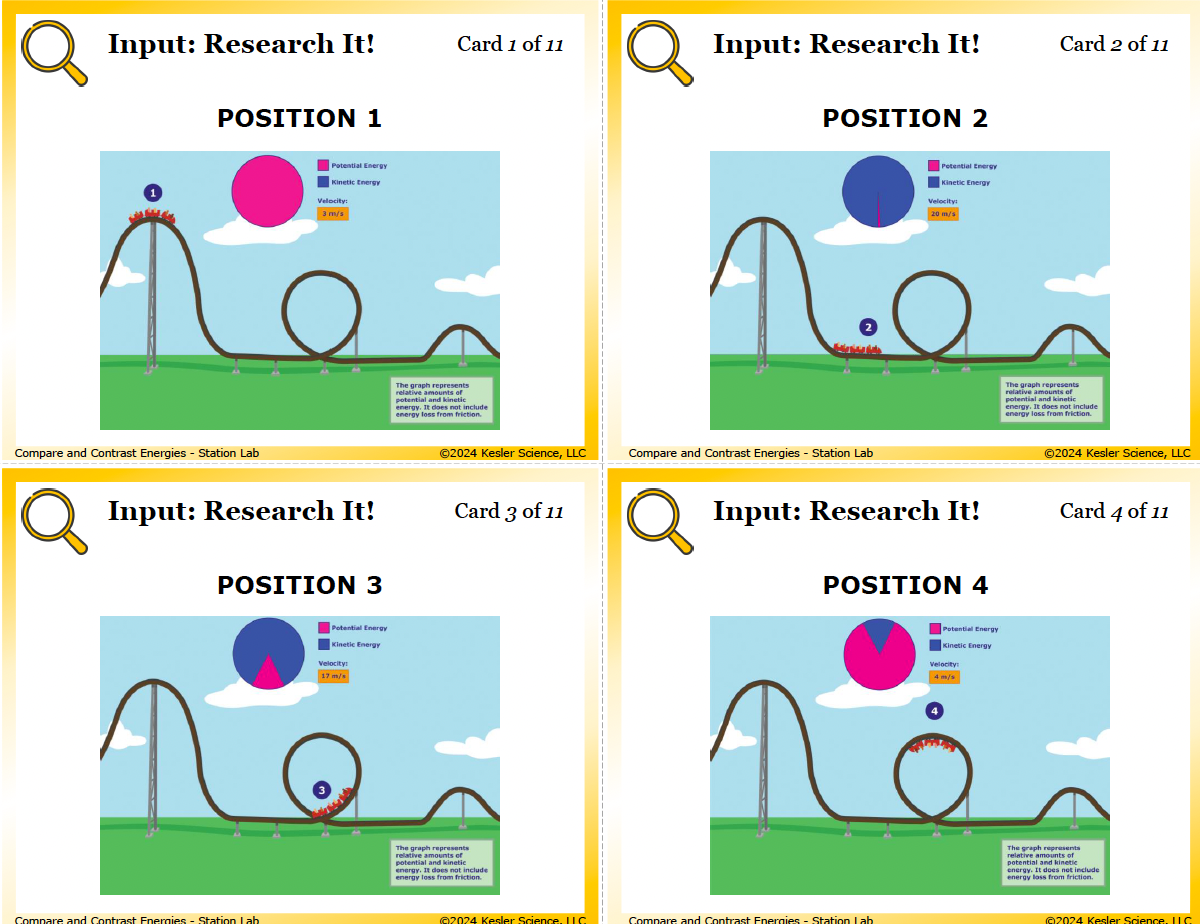
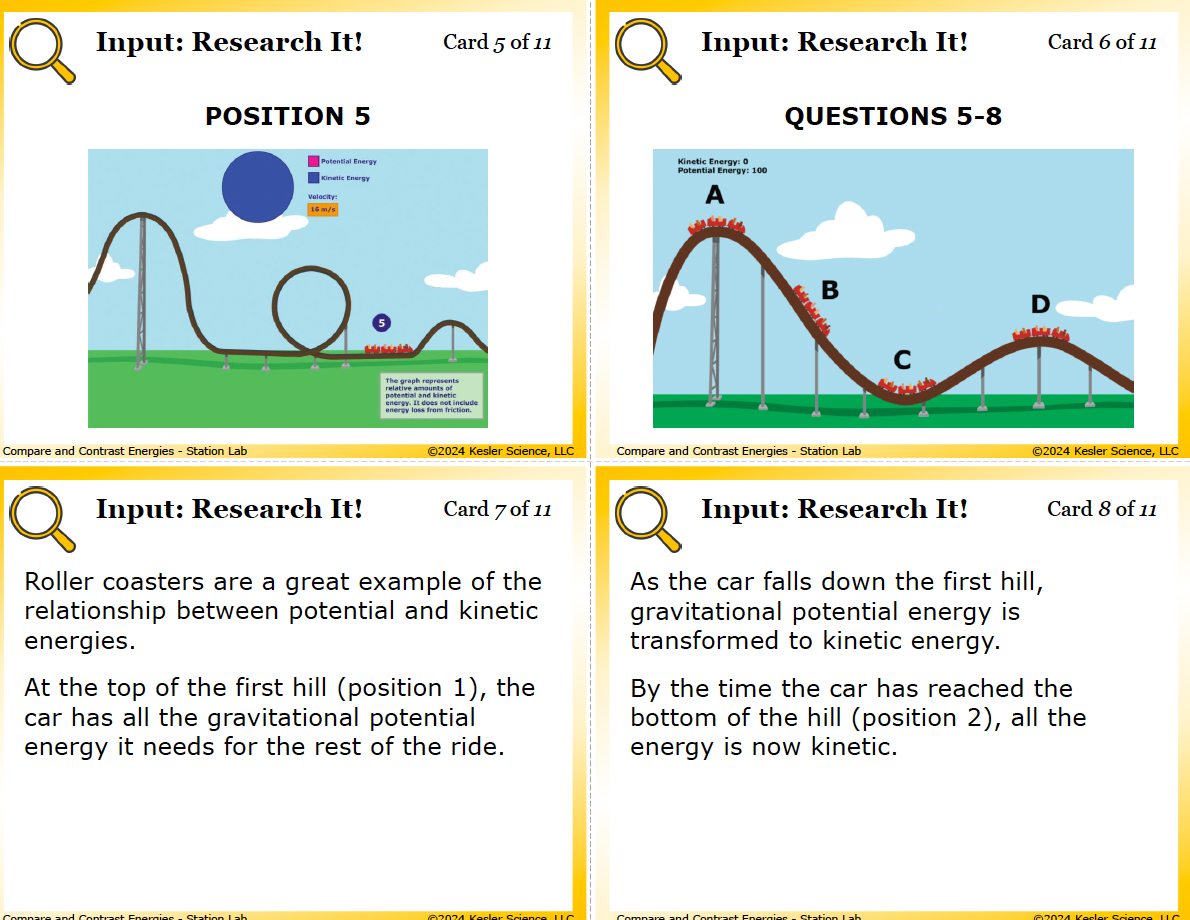
Students examine 11 reference cards: a roller coaster shown at 5 positions with a pie chart of potential vs. kinetic energy at each (100% PE at the top, 0% PE at the bottom, 25% PE on the loop, etc.), an explanation of how gravitational potential energy converts to kinetic energy on the way down, and a labeled diagram for matching. Eight questions follow, including identifying the form of potential energy at the top of the first hill and matching positions A-D on a final coaster diagram with their PE/KE percentages (50/50, 25/75, 0/100, 100/0). The roller-coaster sequence is the standout reference for this lab.
4 output stations: how students show what they learned
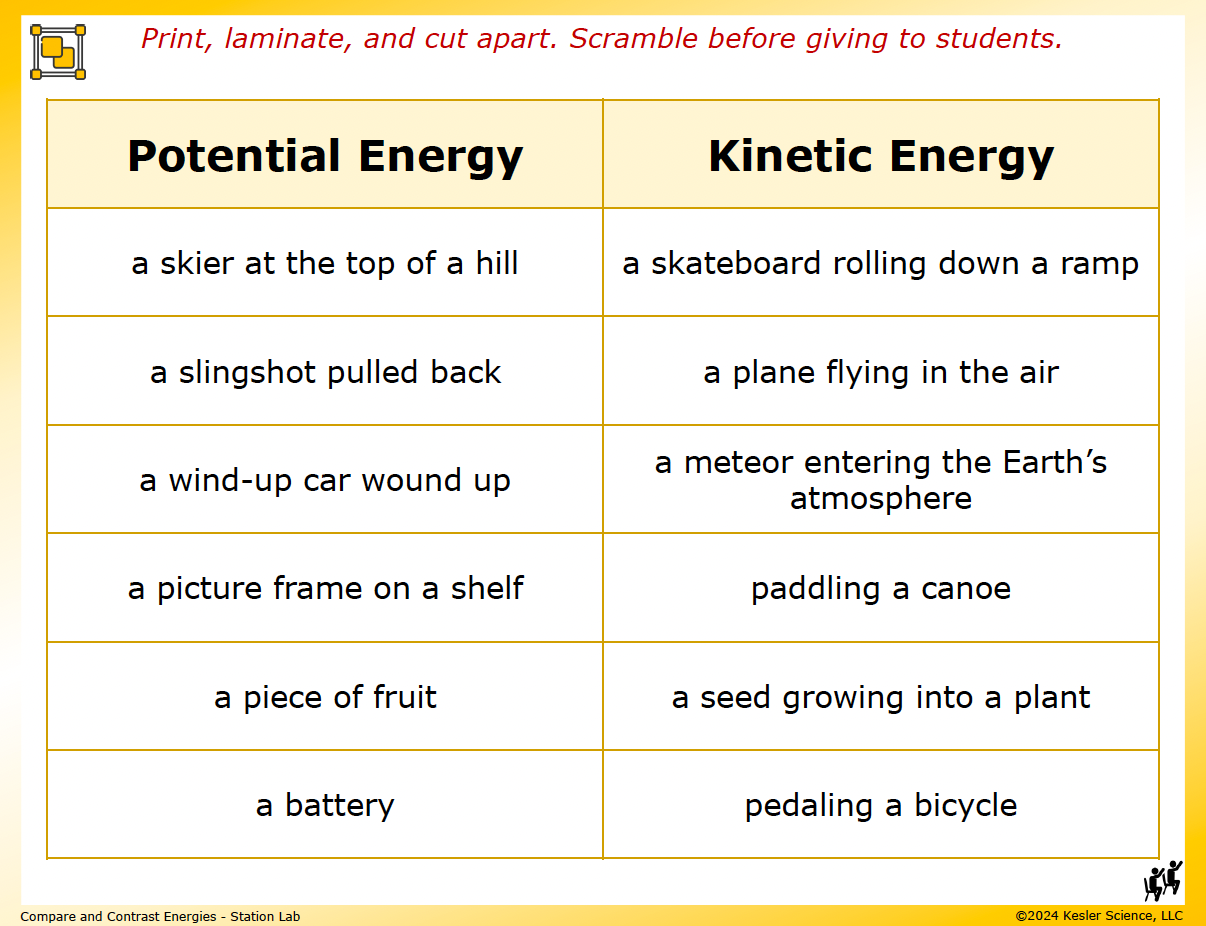
A two-column card sort. Kids sort 12 example cards into POTENTIAL ENERGY and KINETIC ENERGY columns. Potential examples: skier at top of hill, slingshot pulled back, wound-up wind-up car, picture frame on a shelf, a piece of fruit (food = chemical PE), a battery. Kinetic examples: skateboard rolling down a ramp, plane flying, meteor entering atmosphere, paddling a canoe, a seed growing into a plant (chemical PE becoming kinetic), pedaling a bicycle. The seed card is a great misconception catcher because the actual growth is the kinetic part. Easy to spot-check at a glance.
Students draw a real-world or natural scene where potential energy transforms into kinetic energy. They label where each type of energy is present, use arrows to show the direction of the transformation, and add creative elements (characters, energy rays, motion lines). The free-form prompt encourages kids to pick something from their own life (a swing set, a ramp at the skate park, a bow and arrow) which makes the concept stickier than a generic example. Even kids who say "I can't draw" surprise themselves here.
Three open-ended questions: the difference between potential and kinetic energy, how to increase the potential energy of an object (raise it higher, stretch it more, store more chemicals), and a fresh scenario kids invent themselves where potential transforms to kinetic (with the form of PE specified). Forces kids to commit definitions to paper and produce an original example. This is the writing practice middle schoolers need and rarely get in science class.
Eight multiple-choice and fill-in-the-paragraph questions tied to TEKS 6.8A vocabulary (potential energy, gravitational energy, elastic energy, chemical energy, kinetic energy). Includes which option is NOT potential energy (a boat moving across the water), what type of transformation a bow and arrow shows (elastic potential to kinetic), and where gravitational potential energy is greatest in a dropped object (at the start of the fall). The fill-in paragraph weaves all five vocabulary words together. If you're grading the lab, this is the easiest station to grade.
Bonus Challenge It! station for early finishers
Four optional extensions: build a Venn diagram comparing potential and kinetic energies (with at least three details for each), interpret a graph showing total energy with kinetic and potential curves crossing (write a paragraph describing a scenario the graph fits), diagram a chosen scenario showing PE transferred or transformed into KE with pictures and labels, or create a five-page flipbook telling a story of potential energy transforming to kinetic energy. Requires teacher approval before they start.
How this fits into a complete compare and contrast energies unit
This Station Lab is the Explore day of our full Compare and Contrast Energies Complete 5E Lesson for TEKS 6.8A. The complete two-week unit follows the 5E method of instruction and includes an Engage hook, the Compare and Contrast Energies Station Lab for Explore, PowerPoint slides and interactive notebook pages for Explain, student choice projects to Elaborate, and an Evaluate assessment.
Most teachers grab the full 5E because the Station Lab lands hardest with the days around it. But if you just need a strong hands-on day on potential and kinetic energy, the Station Lab on its own does the job.

Get this compare and contrast energies activity

Or if you want the full two-week experience with the Engage hook, Explain day, Elaborate extension, and Evaluate assessment all included:
(Station Lab is included)
Frequently asked questions
What does TEKS 6.8A cover?
Texas TEKS 6.8A asks 6th grade students to compare and contrast gravitational, elastic, chemical, and kinetic energies. Students should be able to identify the form of energy in any given object or scenario, explain whether the energy is stored (potential) or in motion (kinetic), and describe the relationship between potential and kinetic energy in real-world systems. The standard pairs naturally with 6.8B (energy transformations and conservation) and 6.8C (energy of waves).
Is this kids' first time meeting potential vs. kinetic energy?
Yes for most 6th graders. They've heard the word "energy" since elementary school, but the formal split between stored (potential) and moving (kinetic) is brand new. The Watch It! astronaut video introduces it through microgravity examples, the Read It! detective passage uses three concrete clues (soccer ball, rubber band, battery), and the Explore It! station gives three hands-on tests where kids feel the difference. By the end, they can categorize any example.
How long does this compare and contrast energies activity take?
One to two class periods (45 to 110 minutes total). The Explore It! station's three activities (bouncy balls, rubber bands, glow sticks) are the longest piece, so plan for two periods the first time you run a station lab. Once your class has the rotation routine down, most groups can finish all 8 stations in one period.
Do I need a lot of supplies for this?
Pretty light. A pair of bouncy balls, two rubber bands of different thickness, a ruler, a plastic cup, two glow sticks, and two cups (one for hot water, one for cold) per station rotation. Total cost for a class of 30: under $20 if you're starting from nothing. The hot water can come from a tap or a kettle.
Can I use this in a 1:1 digital classroom?
Yes. The full digital version (PowerPoint or Google Slides) works in 1:1 classrooms and Google Classroom. Students drag digital cards for the Organize It! sort and complete the Illustrate It! drawing on a digital canvas. The Explore It! hands-on activities are harder to digitize, but you can substitute simulation videos or PhET energy simulations if you don't have the supplies. The hands-on version is still the strongest.