
8 hands-on stations for teaching Newton's third law of motion
A station lab is a student-led activity where small groups rotate through 8 stations (plus a 9th challenge station for early finishers) at their own pace during one to two class periods. You become a facilitator instead of a lecturer. You walk around, spot-check, and break misconceptions while kids work through the rotation.
The Newton's Third Law Station Lab has four input stations (where students take in new info on action, reaction, force, Newton's third law, and thrusters) and four output stations (where they show what they learned). Here's what's at each one.
4 input stations: how students learn Newton's third law
A short YouTube video introduces Newton's third law with a basketball throw and an astronaut-pushing-astronaut demonstration. Kids answer three questions: what Newton's third law states, what happened when the basketball was thrown, and what happened when one astronaut pushed the other (both moved in opposite directions). The astronaut clip is the perfect setup because it removes the friction and gravity confusion that hides the reaction in everyday examples. Visual learners hook in fast at this station.
A one-page passage called "How Does a Rocket Get to Space?" frames the lesson around a rocket launch. The passage walks through Newton's third law (object A applies a force on B, B applies an equal and opposite force on A), action and reaction with a thrown ball, walking (foot pushes the ground, ground pushes the foot back to propel you forward), and rocket thrusters (push down so the rocket can launch up). Vocabulary is bolded throughout. Three multiple-choice questions follow, plus the vocab notes section. Comes in two reading levels (Dependent and Modified) plus a Spanish version.
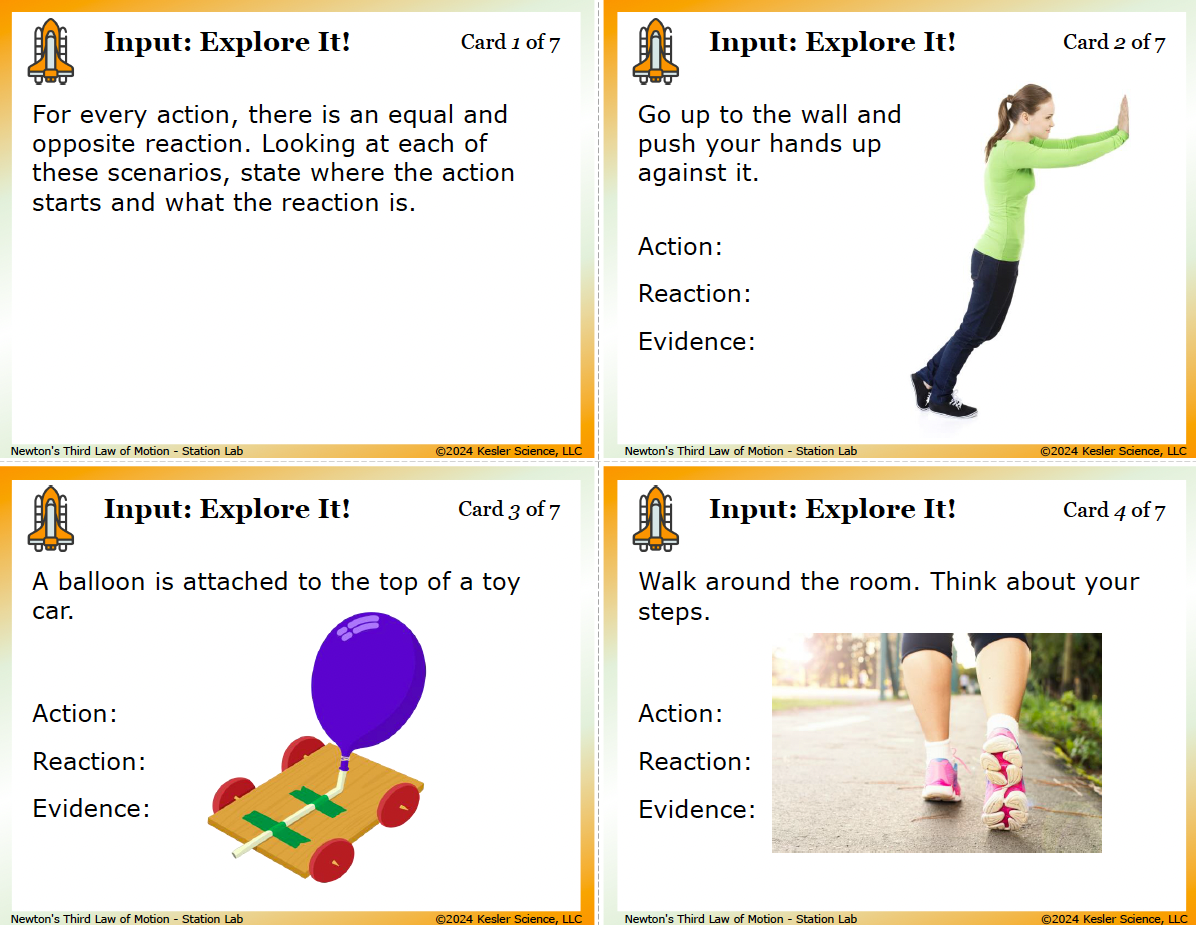
This is the heart of the lab. Six real-world scenarios where kids identify the action, the reaction, and the evidence. They physically push against a wall (action: hands push wall; reaction: wall pushes hands; evidence: their arms feel resistance). They watch a balloon attached to a toy car shoot forward as the air rushes out backward. They walk around the room and identify each step's action-reaction pair. They analyze a shopping cart push, a bowling ball hitting pins, and a baseball thrown to a catcher. Each scenario forces kids to commit to two paired forces, not one, which is the hardest part of the standard.
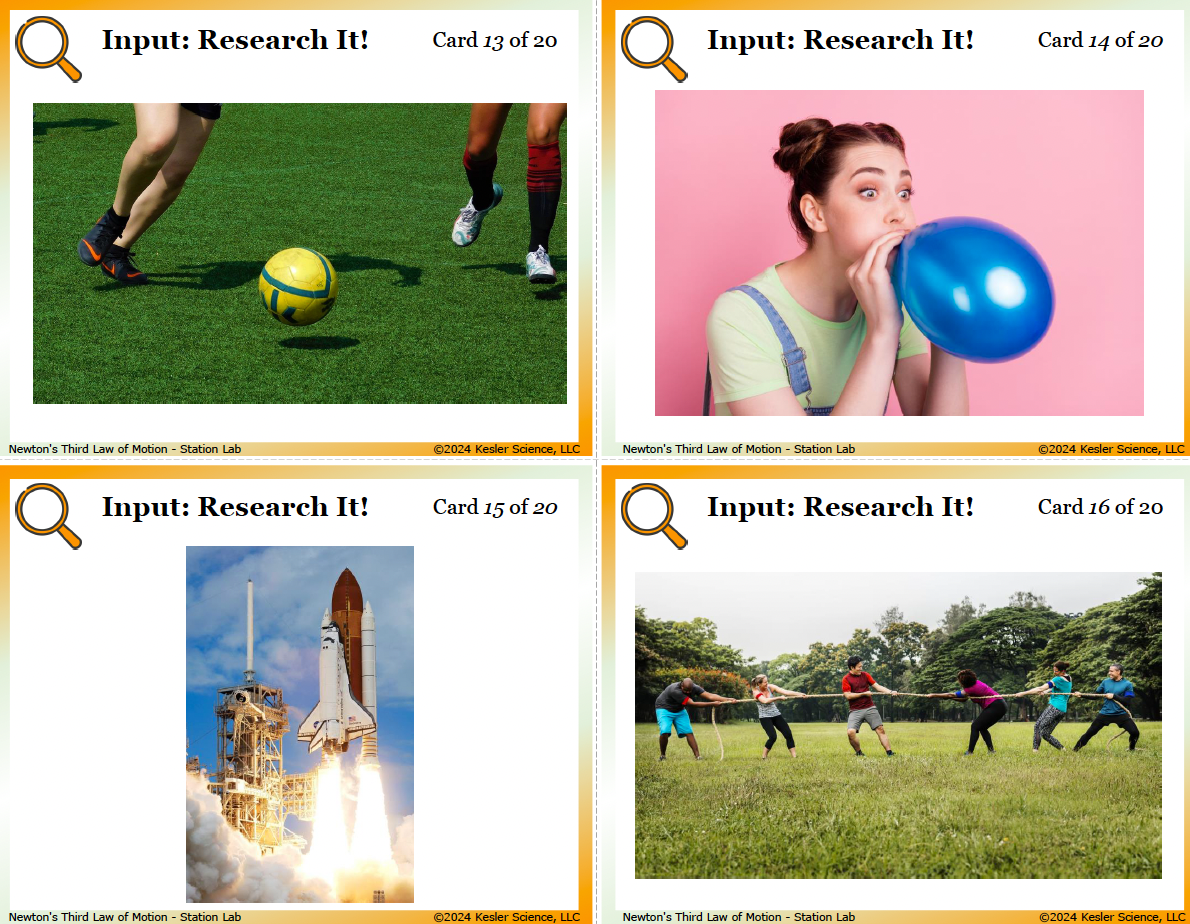
Students examine 16 reference cards: vocabulary definitions (action, reaction, force, Newton's third law, push, thrust), a worked tennis example (racket hits ball, ball hits racket with equal opposite force), 8 photo scenarios (soccer kick, blowing up a balloon, rocket launch, tug of war, race car, baseball pitcher, pushing a stack of boxes, two kayakers), and 8 questions where kids identify action and reaction in each scenario. The kayak question is especially good for 6th graders: paddles push water backward, water pushes the kayak forward.
4 output stations: how students show what they learned
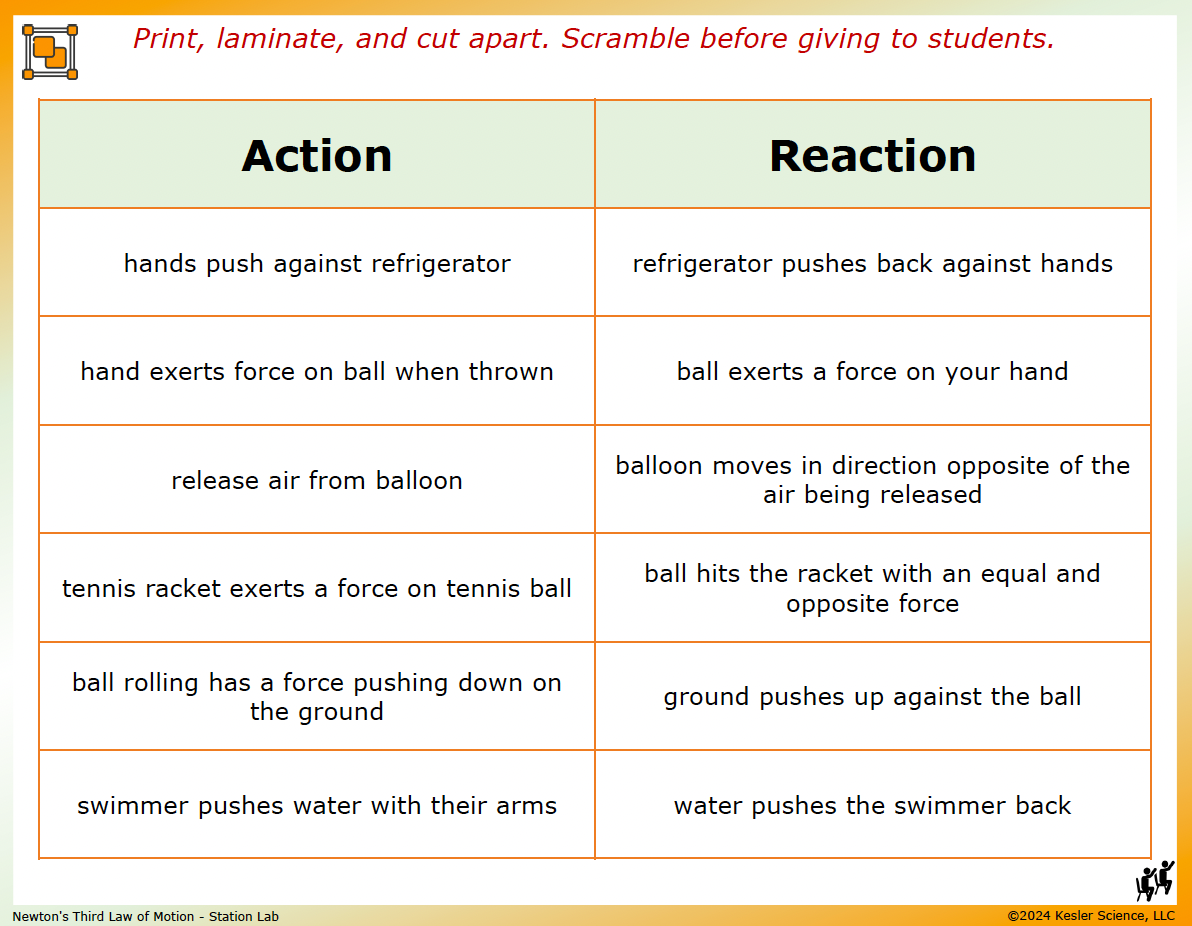
A two-column matching card sort. Kids match 6 ACTION cards to 6 REACTION cards. Pairs include hands push refrigerator/refrigerator pushes hands, hand throws ball/ball pushes back on hand, release air from balloon/balloon flies opposite direction, tennis racket hits ball/ball hits racket equal and opposite, ball pushes ground/ground pushes ball, swimmer pushes water/water pushes swimmer back. Sorting forces kids to recognize that action and reaction are paired forces on two different objects, not one force on one object. Easy to spot-check at a glance.
Students draw a three-stage scene: an action, the reaction, and a later response to the reaction (a chain of consequences). They use arrows to show the direction of every force at every stage. The three-stage drawing forces kids to think past the immediate pair and see how Newton's third law plays out across time. Even kids who say "I can't draw" surprise themselves here because the arrows do most of the work.
Three open-ended questions: explain how Newton's third law applies to a tug-of-war where the rope doesn't move (both sides push with equal opposite force, action-reaction pair), explain a skateboard push-off (foot pushes ground backward, ground pushes you forward), and describe the action and reaction during a rocket launch (thrusters push gases down, gases push rocket up). Forces kids to apply the law to brand-new scenarios. This is the writing practice middle schoolers need and rarely get in science class.
Eight multiple-choice and fill-in-the-paragraph questions tied to TEKS 6.7C vocabulary (Newton's third law of motion, action, reaction, force, thrusters). Includes the basic statement of the law (equal and opposite reaction), what happens when a bat hits a ball (the ball pushes against the bat with equal force), and what happens when a ball is thrown against a wall (it bounces back with the same force). The fill-in paragraph weaves all five vocabulary words into a single rocket-launch explanation. If you're grading the lab, this is the easiest station to grade.
Bonus Challenge It! station for early finishers
Four optional extensions: write a sports-journalism article summarizing how Newton's third law shows up during a game, build a four-panel comic strip illustrating the law (using all five vocabulary words and at least one drawing per panel), design a Wanted Poster about reactions (with pictures and explanations of how reactions follow actions in everyday life), or write an acrostic poem using the word REACTION. Requires teacher approval before they start.
How this fits into a complete Newton's third law unit
This Station Lab is the Explore day of our full Newton's Third Law of Motion Complete 5E Lesson for TEKS 6.7C. The complete two-week unit follows the 5E method of instruction and includes an Engage hook, the Newton's Third Law Station Lab for Explore, PowerPoint slides and interactive notebook pages for Explain, student choice projects to Elaborate, and an Evaluate assessment.
Most teachers grab the full 5E because the Station Lab lands hardest with the days around it. But if you just need a strong hands-on day on action and reaction forces, the Station Lab on its own does the job.

Get this Newton's third law activity

Or if you want the full two-week experience with the Engage hook, Explain day, Elaborate extension, and Evaluate assessment all included:
(Station Lab is included)
Frequently asked questions
What does TEKS 6.7C cover?
Texas TEKS 6.7C asks 6th grade students to investigate how Newton's third law of motion is observed when two objects interact. Students should be able to look at any push or pull and identify both halves of the action-reaction pair, recognize that the two forces act on different objects, and explain real-world examples like walking, swimming, throwing, and rocket launches in terms of paired forces. The standard pairs naturally with 6.7A (forces in the real world) and 6.7B (calculating net force).
Is this kids' first time with Newton's third law?
Yes for most 6th graders. They've heard about gravity, friction, and pushes/pulls in earlier grades, but "for every action there is an equal and opposite reaction" as a formal law is brand new. The Watch It! astronaut clip is the visual anchor, the Read It! rocket passage is the conceptual anchor, and the Explore It! balloon-on-car activity is the kinesthetic anchor. By the end, kids can name action and reaction in any scenario.
How long does this Newton's third law activity take?
One to two class periods (45 to 110 minutes total). The Explore It! station's six-scenario investigation is the longest piece, so plan for two periods the first time you run a station lab. Once your class has the rotation routine down, most groups can finish all 8 stations in one period.
Do I need a lot of supplies for this?
Pretty light. A toy car, a balloon, a straw, and a roll of tape per station rotation. Total cost for a class of 30: under $10 if you're starting from nothing. The Watch It! station also needs a device with internet. The wall-push and walking-around scenarios need only existing classroom space.
Can I use this in a 1:1 digital classroom?
Yes. The full digital version (PowerPoint or Google Slides) works in 1:1 classrooms and Google Classroom. Students drag digital cards for the Organize It! sort and complete the Illustrate It! drawings on a digital canvas. The Explore It! balloon-on-car activity is harder to digitize, but you can substitute simulation videos or PhET physics simulations if you don't have the supplies. The hands-on version is still the strongest.