
SEPs and Recurring Themes for 7th Grade Science
The 2024 science TEKS expect students to learn content through the scientific and engineering practices and the recurring themes and concepts. The real question is which ones fit which units, and how to teach them without rebuilding the curriculum you already have.
How the Practices, Themes, and Content Fit Together
In the 2024 science TEKS, you teach the content through the scientific and engineering practices and the recurring themes and concepts, all at the same time.
Scientific and Engineering Practices
The thinking and doing of science: asking questions, planning investigations, analyzing data, communicating evidence. The verbs students do.
Recurring Themes and Concepts
Big ideas that show up across every science domain: patterns; cause and effect; scale, proportion, and quantity; parts of a system; energy flows and matter cycles; structure and function; and stability and change.
Content
The science itself, in four strands: matter and energy; force, motion, and energy; Earth and space; and organisms and environments. The nouns of your year.
SEPsScientific and Engineering Practices
Four standards (7.1 to 7.4) broken into 18 student expectations. What students do as scientists, woven through every unit. Click any tile to jump to that student expectation.
Asking questions and conducting investigations
"The student, for at least 40% of instructional time, asks questions, identifies problems, and plans and safely conducts classroom, laboratory, and field investigations to answer questions, explain phenomena, or design solutions using appropriate tools and models."
Ask Questions & Define Problems
Generate testable questions from observations and phenomena.
Plan & Conduct Investigations
Descriptive, comparative, experimental, plus engineering design.
Lab Safety
Use appropriate safety equipment per TEA-approved standards.
Use Scientific Tools
The right tool for the right measurement, used correctly.
Collect Quantitative & Qualitative Data
Numbers in SI units plus careful observations as evidence.
Tables, Graphs, Maps & Charts
Organize repeated trials and means into the right visual.
Develop & Use Models
Build models to represent phenomena and predict behavior.
Hypotheses, Theories & Laws
Tell these three apart and use the right word.
Ask questions and define problems
"Ask questions and define problems based on observations or information from text, phenomena, models, or investigations."
What this looks like in your classroom
Students start every unit by asking questions sparked by what they observe or read. The questions are specific and testable, and they come from what students saw.
- Generate questions from a phenomenon, demo, or reading
- Distinguish testable from untestable questions
- Define an engineering problem with clear needs and constraints
- Refine vague questions into specific, investigable ones
Pairs naturally with…
Sentence stems for kids
"I noticed… so I'm wondering…"
"The problem I want to solve is…"
"This question is testable because…"
Plan and conduct investigations
"Use scientific practices to plan and conduct descriptive, comparative, and experimental investigations and use engineering practices to design solutions to problems."
What this looks like in your classroom
Students design and run their own investigations. They pick the right type for the question: descriptive (observe and record, no hypothesis), comparative (change a variable and compare results to test a predicted relationship), or experimental (test a hypothesis by comparing a treatment with a control).
- Choose the right investigation type for the question
- Identify independent, dependent, and controlled variables
- Plan the data they'll collect before starting
- Use engineering design steps (define, design, test, improve)
Pairs naturally with…
Sentence stems for kids
"This is a [descriptive / comparative / experimental] investigation because…"
"My independent variable is… My dependent variable is…"
"I'm controlling… so the only thing that changes is…"
Use safety equipment and practices
"Use appropriate safety equipment and practices during laboratory, classroom, and field investigations as outlined in Texas Education Agency-approved safety standards."
What this looks like in your classroom
Students know which safety gear and procedures apply before starting any investigation. Goggles, gloves, ventilation, and Safety Data Sheets (SDS) aren't afterthoughts.
- Identify safety risks before the investigation starts
- Select and properly use safety equipment (goggles, gloves, aprons)
- Follow TEA-approved standards for chemicals, heat, biological materials
- Know the emergency procedures for the classroom
Pairs naturally with…
Sentence stems for kids
"Before I start, the safety risks are…"
"The safety equipment I need is… because…"
"If something goes wrong, I will…"
Use appropriate scientific tools
"Use appropriate tools such as graduated cylinders, metric rulers, periodic tables, balances, scales, thermometers, temperature probes, laboratory ware, timing devices, pH indicators, hot plates, models, microscopes, slides, life science models, petri dishes, dissecting kits, magnets, spring scales or force sensors, tools that model wave behavior, satellite images, hand lenses, and lab notebooks or journals."
What this looks like in your classroom
Students know the right tool for each measurement and use it correctly. Wrong tool means wrong data.
- Match the tool to the measurement (mass to balance, volume to graduated cylinder)
- Read tools carefully, to the smallest marked line, and record the unit
- Calibrate when needed
- Maintain a lab notebook with date, procedure, observations
Pairs naturally with…
Sentence stems for kids
"I'm using a [tool] because I'm measuring…"
"The unit I'll record this in is…"
"My reading is… and the unit is…"
Collect quantitative and qualitative data
"Collect quantitative data using the International System of Units (SI) and qualitative data as evidence."
What this looks like in your classroom
Students collect BOTH kinds of data. Numbers and observations. Both count as evidence.
- Use metric units that work with SI, like meters, grams, milliliters, and degrees Celsius
- Record qualitative observations in detail (color, texture, sound, and odor only when the teacher says it's safe and shows how to waft)
- Distinguish between observation and inference
- Treat both data types as evidence for claims
Pairs naturally with…
Sentence stems for kids
"My quantitative data is… My qualitative data is…"
"I observed… so I infer…"
"The SI unit for this measurement is…"
Construct tables, graphs, maps and charts
"Construct appropriate tables, graphs, maps, and charts using repeated trials and means to organize data."
What this looks like in your classroom
Students organize raw data into formats that reveal patterns. Repeated trials and a mean give a more reliable result than a single trial.
- Set up a data table before the investigation starts
- Run repeated trials and calculate the mean
- Choose the right graph type (bar, line, scatter, pie)
- Label every axis with units; title every graph
Pairs naturally with…
Sentence stems for kids
"I ran [number] trials and the mean is…"
"The best graph type for this data is… because…"
"My table shows… my graph shows…"
Develop and use models
"Develop and use models to represent phenomena, systems, processes, or solutions to engineering problems."
What this looks like in your classroom
Students build models that capture what they're trying to understand. Models can be drawings, diagrams, physical builds, or computer simulations.
- Choose the model type that fits the phenomenon (physical, conceptual, mathematical)
- Show how parts of a system interact via the model
- Use the model to predict what happens when something changes
- Acknowledge what the model shows and what it doesn't
Pairs naturally with…
Sentence stems for kids
"My model represents… by…"
"This part of the model stands for…"
"If we changed [X] in the model, then [Y] would…"
Distinguish hypotheses, theories and laws
"Distinguish between scientific hypotheses, theories, and laws."
What this looks like in your classroom
Students stop using these three words interchangeably. They know a theory isn't "just a guess" and a law doesn't explain why.
- Define hypothesis (a testable, tentative explanation that leads to a prediction and can be supported or not supported by evidence)
- Define theory (well-established explanation supported by many lines of evidence)
- Define law (descriptive statement of pattern, often mathematical)
- Identify which is which in real examples
Pairs naturally with…
Sentence stems for kids
"This is a [hypothesis / theory / law] because…"
"It can't just be 'a guess' because…"
"The difference between a theory and a law is…"
Analyzing and interpreting data
"The student analyzes and interprets data to derive meaning, identify features and patterns, and discover relationships or correlations to develop evidence-based arguments or evaluate designs."
Limits of Models
Identify what models show well and what they leave out.
Patterns in Data
Find trends, outliers, and sources of error in data sets.
Mathematical Calculations
Use math to find quantitative relationships in data.
Evaluate Designs
Judge experimental and engineering designs for quality.
Identify advantages and limitations of models
"Identify advantages and limitations of models such as their size, scale, properties, and materials."
What this looks like in your classroom
Students don't treat models as truth. They ask: what does this model show well, and what does it miss?
- List what the model captures (the advantage)
- List what the model leaves out (the limitation)
- Identify when the model would mislead
- Compare two different models of the same phenomenon
Pairs naturally with…
Sentence stems for kids
"This model shows… but it doesn't show…"
"An advantage of this model is…"
"A limitation of this model is…"
Analyze data for patterns and limitations
"Analyze data by identifying any significant descriptive statistical features, patterns, sources of error, or limitations."
What this looks like in your classroom
Students read data and look for the story. Mean, range, outliers, error sources, patterns.
- Calculate the mean, median, and range
- Identify trends, patterns, and outliers in the data
- Recognize possible sources of error
- Acknowledge limitations of the data set
Pairs naturally with…
Sentence stems for kids
"The pattern I see is…"
"A possible source of error here is…"
"The outlier might be… because…"
Use mathematical calculations
"Use mathematical calculations to assess quantitative relationships in data."
What this looks like in your classroom
Students do the math. Ratios, averages, totals. Math is how science answers "how much" and "how related."
- Calculate average speed (distance ÷ time), the concentration of a solution, and the mean of repeated trials
- Compare two quantities with a ratio
- Calculate the percent of energy passed from one trophic level to the next
- Show work with units throughout
Pairs naturally with…
Sentence stems for kids
"My calculation is… with units of…"
"The math shows that…"
"These two quantities are related because…"
Evaluate experimental and engineering designs
"Evaluate experimental and engineering designs."
What this looks like in your classroom
Students judge the quality of an investigation or engineering solution. Was the design sound? Could it be improved?
- Identify flaws in someone else's experimental design
- Suggest improvements to make a design more controlled or efficient
- Distinguish strong evidence from weak evidence
- Compare two competing designs for the same problem
Pairs naturally with…
Sentence stems for kids
"One thing this design does well is…"
"This design could be improved by…"
"If we change [X], the design will work better because…"
Developing evidence-based explanations and communicating findings
"The student develops evidence-based explanations and communicates findings, conclusions, and proposed solutions."
Develop Explanations
Build CER explanations tied to scientific principles.
Communicate Findings
Share findings in writing, talks, posters, and models.
Engage in Argument
Defend claims and critique others using evidence, not opinion.
Develop explanations and propose solutions
"Develop explanations and propose solutions supported by data and models and consistent with scientific ideas, principles, and theories."
What this looks like in your classroom
Students explain WHY something happened and back it up with evidence from their own data.
- Construct claim, evidence, reasoning (CER) explanations
- Tie explanations back to scientific principles (conservation, cause-and-effect, etc.)
- Propose solutions to engineering problems based on data
- Distinguish observation from explanation
Pairs naturally with…
Sentence stems for kids
"My claim is…"
"My evidence is…"
"My reasoning connects to the principle that…"
Communicate explanations and solutions
"Communicate explanations and solutions individually and collaboratively in a variety of settings and formats."
What this looks like in your classroom
Students share their work in many ways. Lab report, poster, talk, model, infographic. Pick the format that fits.
- Write clear lab reports with all required sections
- Present findings orally (individually and in groups)
- Build visual products like posters, diagrams, or infographics
- Collaborate respectfully on shared deliverables
Pairs naturally with…
Sentence stems for kids
"Our findings are…"
"The key takeaway is…"
"We chose this format because…"
Engage in scientific argumentation
"Engage respectfully in scientific argumentation using applied scientific explanations and empirical evidence."
What this looks like in your classroom
Students defend their claim AND critique others' claims using evidence. Every point has to come back to data or observations.
- Critique a claim based on evidence quality
- Defend a claim against counterarguments
- Acknowledge weaknesses in their own argument
- Revise their position when new evidence appears
Pairs naturally with…
Sentence stems for kids
"I agree with… because the evidence shows…"
"I disagree because… What about…"
"Can you tell me more about your evidence for…"
Contributions of scientists and the role of science in society
"The student knows the contributions of scientists and recognizes the importance of scientific research and innovation on society."
Scientists & Society
Impact of past and current research, plus diverse contributors.
Evaluate Sources
Check credibility, accuracy, and methods of any source.
Explore STEM Careers
Investigate real STEM jobs through people and resources.
Impact of research on thought and society
"Relate the impact of past and current research on scientific thought and society, including the process of science, cost-benefit analysis, and contributions of diverse scientists as related to the content."
What this looks like in your classroom
Science is a story told by many people. Students meet the scientists behind past discoveries and the ones doing the work today.
- Profile diverse scientists tied to each unit's content
- Examine how a discovery changed society
- Apply cost-benefit thinking to scientific decisions
- Recognize that science is iterative, built on prior work
Pairs naturally with…
Sentence stems for kids
"This scientist's work mattered because…"
"Today's research on this topic is being done by…"
"The cost of [X] versus the benefit of [Y] makes me think…"
Evaluate evidence from multiple sources
"Make informed decisions by evaluating evidence from multiple appropriate sources to assess the credibility, accuracy, cost-effectiveness, and methods used."
What this looks like in your classroom
Students don't trust the first thing they read. They check the source, the method, and the possible bias.
- Identify the author, publication, and purpose of a source
- Check methods and sample size before trusting a claim
- Compare multiple sources on the same topic
- Spot bias, advertisement, or pseudoscience
Pairs naturally with…
Sentence stems for kids
"I trust this source because…"
"I question this source because…"
"The methods used here are… so the data is…"
Investigate STEM careers
"Research and explore resources such as museums, libraries, professional organizations, private companies, online platforms, and mentors employed in a science, technology, engineering, and mathematics (STEM) field to investigate STEM careers."
What this looks like in your classroom
Students start picturing themselves in STEM jobs. They explore what scientists, engineers, technicians, and mathematicians actually do.
- Research a STEM career tied to the current unit
- Read profiles of working scientists and engineers
- Visit a museum or local STEM workplace (in person or virtually)
- Talk to a STEM professional or mentor
Pairs naturally with…
Sentence stems for kids
"A career that uses this kind of science is…"
"A [career] uses [skill from class] in their work by…"
"I'd want to learn more about [career] because…"
ThemesRecurring Themes and Concepts
One standard (7.5) with seven big ideas that show up everywhere. Point them out, name them, and students will start seeing them on their own.
Patterns
Repeating relationships in data and nature. Students notice them, then ask why.
Cause & Effect
One thing produces another. Mechanisms can be tested, and predictions follow from them.
Scale, Proportion & Quantity
Size, ratios, and amounts change how a system behaves. Bigger often works differently.
Parts of a System
A system has parts that interact. Models let us study what's too small, too big, or too slow.
Energy Flows & Matter Cycles
Energy flows, matter cycles. Neither appears nor disappears. It just changes form or location.
Structure & Function
The way something is built shapes what it can do, from atoms to organisms to bridges.
Stability & Change
Systems stay stable through feedback and balance, or they shift when something tips them.
Patterns
"Identify and apply patterns to understand and connect scientific phenomena or to design solutions."
What this looks like in your classroom
Students start seeing repeating relationships across totally different topics. Once they spot a pattern, they ask why it happens.
- Identify repeating data trends in graphs and tables
- Predict the next event in a sequence based on what's come before
- Connect a pattern in one science domain to a similar pattern in another
- Look for periodicity (cycles that repeat in time or space)
Pairs naturally with…
Prompts and sentence stems
"I notice that every time…"
"I predict the next one will be… because…"
"This pattern looks like the one we saw in…"
Cause and Effect
"Identify and investigate cause-and-effect relationships to explain scientific phenomena or analyze problems."
What this looks like in your classroom
Students stop accepting "it just happens" and start asking what caused it, and what evidence supports that cause.
- Identify the cause behind an observed effect
- Distinguish correlation from causation
- Predict an effect when a known cause is changed
- Test a cause-and-effect relationship with a controlled investigation
Pairs naturally with…
Prompts and sentence stems
"The cause of this was…"
"If I change…, then… will happen because…"
"My evidence the cause is… is…"
Scale, Proportion & Quantity
"Analyze how differences in scale, proportion, or quantity affect a system's structure or performance."
What this looks like in your classroom
Students recognize that size, ratios, and amounts change how a system behaves. Make something bigger and it often works differently.
- Recognize when scale matters (what works small may not work big)
- Use ratios and proportions to compare quantities across systems
- Convert between SI units to keep quantities consistent
- Predict how a change in quantity affects a system's behavior
Pairs naturally with…
Prompts and sentence stems
"If we made this 10 times bigger, the ___ would…"
"The ratio of ___ to ___ matters because…"
"This works at a small scale, but at a large scale…"
Parts of a System
"Examine and model the parts of a system and their interdependence in the function of the system."
What this looks like in your classroom
Students stop thinking of things as isolated parts and start asking: what are the parts of this system, and how does each part depend on the others to make the whole thing work?
- Identify the parts of a system and how each one depends on the others
- Build a model (diagram, physical, or digital) to represent the system
- Predict what happens when one part of the system changes
- Critique a model. What does it show? What does it miss?
Pairs naturally with…
Prompts and sentence stems
"What are the parts of this system?"
"What flows in? What flows out? What stays inside?"
"If we changed [X], what would happen to the rest of the system?"
Energy Flows & Matter Cycles
"Analyze and explain how energy flows and matter cycles through systems and how energy and matter are conserved through a variety of systems."
What this looks like in your classroom
Students track where stuff goes. When something seems to disappear, ask: where did the matter go? Where did the energy go?
- Trace matter through a cycle (nutrients moving through an ecosystem, or water moving through a watershed)
- Trace energy through a transfer (thermal energy moving from warmer to cooler, or energy passing up a food chain)
- Identify where conservation holds and where it appears not to
- Use arrows in models to show direction of flow
Pairs naturally with…
Prompts and sentence stems
"If matter looks like it disappeared, where did it actually go?"
"What form did the energy start as? What form did it end as?"
"Draw an arrow showing the flow."
Structure & Function
"Analyze and explain the complementary relationship between structure and function of objects, organisms, and systems."
What this looks like in your classroom
Students stop looking at what something is and start asking how it's built, and why that shape matters for what it does.
- Connect the shape or structure of something to its job
- Predict how a structural change would affect function
- Compare structures across organisms or materials and explain why they differ
- Identify the structural feature that makes something work
Pairs naturally with…
Prompts and sentence stems
"The structure of this is… and that lets it…"
"If we changed the structure to…, then…"
"Two things that look different actually do the same job because…"
Stability & Change
"Analyze and explain how factors or conditions impact stability and change in objects, organisms, and systems."
What this looks like in your classroom
Students recognize that systems usually stay balanced through feedback, but they can also tip into a new state. They ask: what keeps it stable, and what would make it change?
- Identify what keeps a system stable (feedback, balance, equilibrium)
- Predict what conditions would cause a system to change
- Distinguish slow change from sudden change
- Identify both natural and human causes of change
Pairs naturally with…
Prompts and sentence stems
"What keeps this stable?"
"What would have to change for the system to shift?"
"Is this change happening slowly or all at once?"
Where each practice and theme fits best
One row per unit, in no particular order. Teach your units in whatever order works for your campus. These are suggestions, not requirements. Just make sure every practice and theme shows up several times across the year.
| Unit | Practices to feature | Themes to feature |
|---|---|---|
| Matter & Solutions 7.6A to 7.6E | 7.1AAsk Questions & Define Problems 7.1BPlan & Conduct Investigations 7.1CLab Safety 7.1DUse Scientific Tools 7.1ECollect Quantitative & Qualitative Data 7.1FTables, Graphs, Maps & Charts 7.1GDevelop & Use Models 7.1HHypotheses, Theories & Laws 7.2CMathematical Calculations 7.3ADevelop Explanations | 7.5BCause & Effect 7.5CScale, Proportion & Quantity 7.5EEnergy Flows & Matter Cycles 7.5FStructure & Function |
| Force & Motion 7.7A to 7.7D | 7.1BPlan & Conduct Investigations 7.1DUse Scientific Tools 7.1FTables, Graphs, Maps & Charts 7.1GDevelop & Use Models 7.1HHypotheses, Theories & Laws 7.2CMathematical Calculations 7.3ADevelop Explanations | 7.5APatterns 7.5BCause & Effect |
| Thermal Energy 7.8A to 7.8C | 7.1BPlan & Conduct Investigations 7.1CLab Safety 7.1DUse Scientific Tools 7.2DEvaluate Designs | 7.5BCause & Effect 7.5DParts of a System 7.5EEnergy Flows & Matter Cycles 7.5GStability & Change |
| Solar System 7.9A to 7.9C | 7.1AAsk Questions & Define Problems 7.1ECollect Quantitative & Qualitative Data 7.2ALimits of Models 7.3ADevelop Explanations 7.4AScientists & Society 7.4BEvaluate Sources | 7.5APatterns 7.5CScale, Proportion & Quantity |
| Earth's History & Plate Tectonics 7.10A to 7.10B | 7.1FTables, Graphs, Maps & Charts 7.1GDevelop & Use Models 7.1HHypotheses, Theories & Laws 7.2BPatterns in Data 7.4AScientists & Society 7.4CExplore STEM Careers | 7.5APatterns 7.5GStability & Change |
| Water & Human Impact 7.11A to 7.11B | 7.1AAsk Questions & Define Problems 7.2DEvaluate Designs 7.3BCommunicate Findings 7.3CEngage in Argument 7.4BEvaluate Sources | 7.5BCause & Effect 7.5DParts of a System 7.5GStability & Change |
| Ecosystems & Classification 7.12A to 7.12B · 7.14A to 7.14B | 7.1DUse Scientific Tools 7.1GDevelop & Use Models 7.2ALimits of Models 7.2CMathematical Calculations 7.3BCommunicate Findings 7.4CExplore STEM Careers | 7.5APatterns 7.5CScale, Proportion & Quantity 7.5EEnergy Flows & Matter Cycles 7.5FStructure & Function |
| Human Body, Reproduction & Selection 7.13A to 7.13D | 7.1CLab Safety 7.1GDevelop & Use Models 7.2ALimits of Models 7.2BPatterns in Data 7.3BCommunicate Findings 7.3CEngage in Argument 7.4AScientists & Society 7.4BEvaluate Sources | 7.5APatterns 7.5CScale, Proportion & Quantity 7.5DParts of a System 7.5FStructure & Function 7.5GStability & Change |
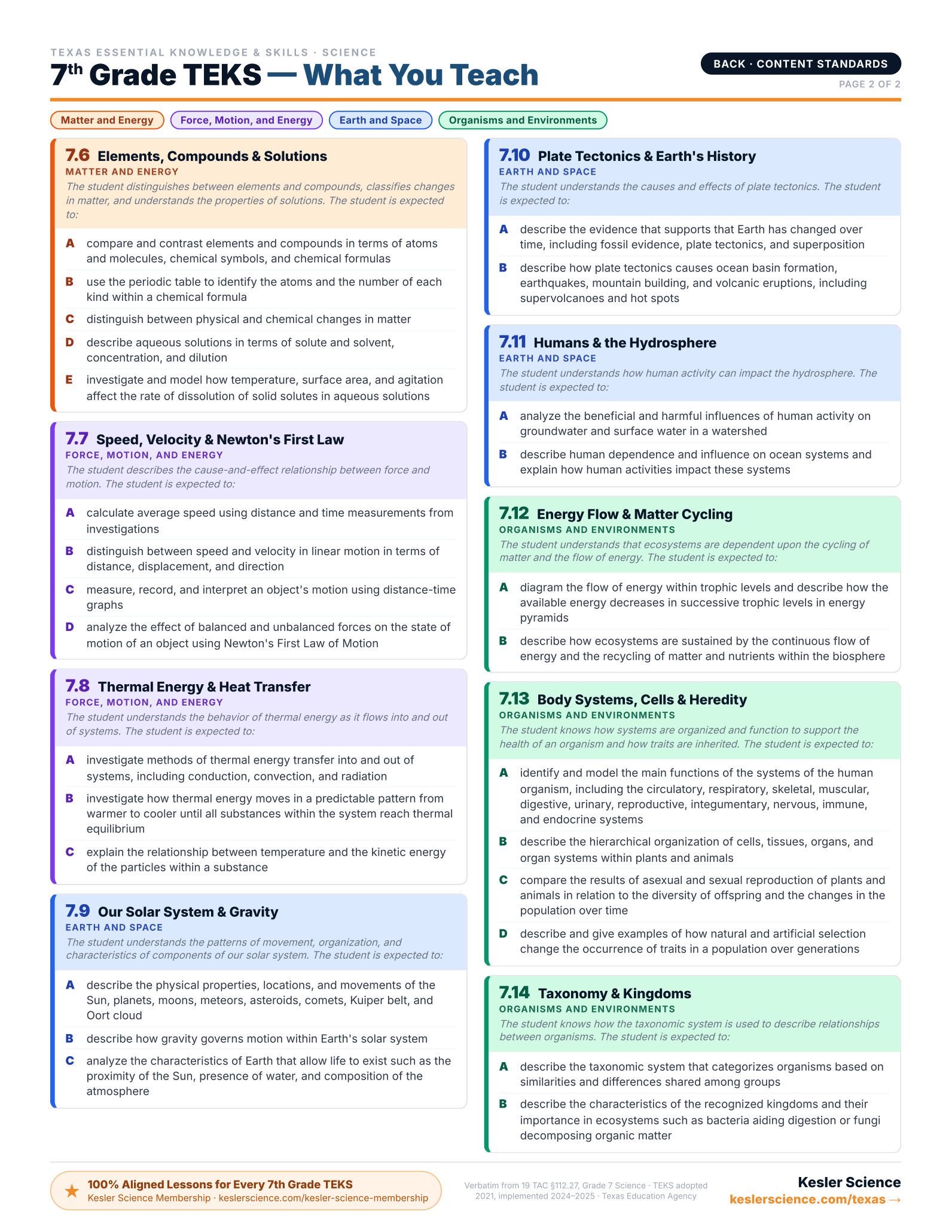
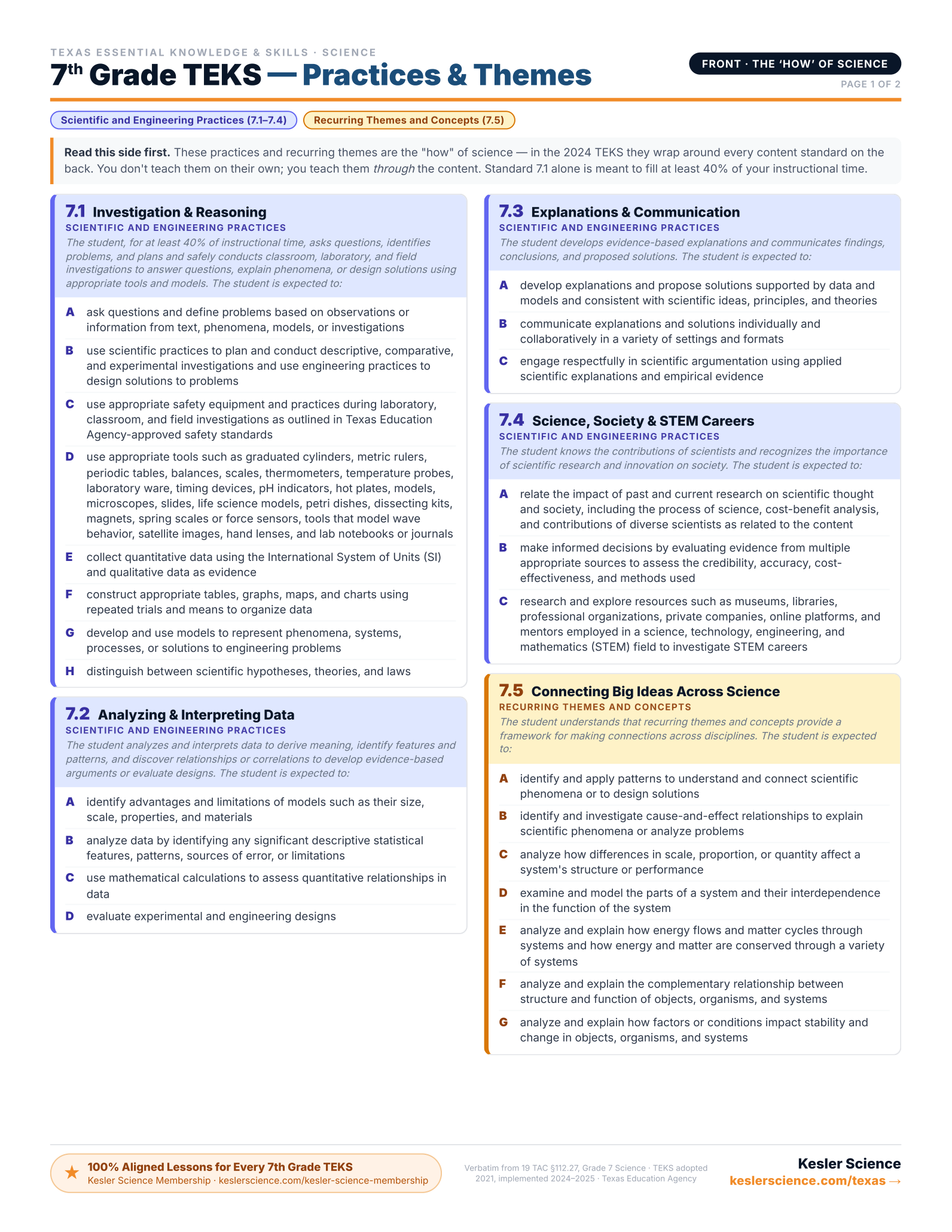
Every 7th-Grade Science TEKS on One Page
The color-coded, front-and-back cheat sheet I wish I'd had — every standard, organized by reporting category. Print it and reference it all year long. This will be your new favorite document!