
8 hands-on stations for teaching variations and survival
A station lab is a student-led activity where small groups rotate through 8 stations (plus a 9th challenge station for early finishers) at their own pace during one to two class periods. You become a facilitator instead of a lecturer. You walk around, spot-check, and break misconceptions while kids work through the rotation.
The Variations and Survival Station Lab has four input stations (where students take in new info on variation, advantage, disadvantage, DNA, and mutation) and four output stations (where they show what they learned). Here's what's at each one.
4 input stations: how students learn variations and survival
A short YouTube video covers desert plant variations. Three task-card questions tie it back to which environment the plants in the video are adapted to (desert), why many desert plants have no leaves (to reduce water loss), and what a sphere-shaped stem helps the plant do (store water and reduce surface area exposure to sun). Visual learners come alive at this station because they see real plant adaptations on screen before they read about the broader idea.
A one-page passage called "Variations in Populations" walks students through how variations show up (combining DNA from two parents, plus mutations) and what makes one a survival advantage versus a disadvantage. The vocabulary is bolded throughout (population, variations, mutations, DNA, advantage). The passage uses concrete examples kids can picture: a predator with unusual fur that camouflages it, male birds with bright feathers attracting mates, and a plant with broad leaves that thrives in the rainforest but dies in the desert. Three multiple-choice questions plus the vocabulary section follow. Comes in two reading levels (Dependent and Modified) plus a Spanish version.
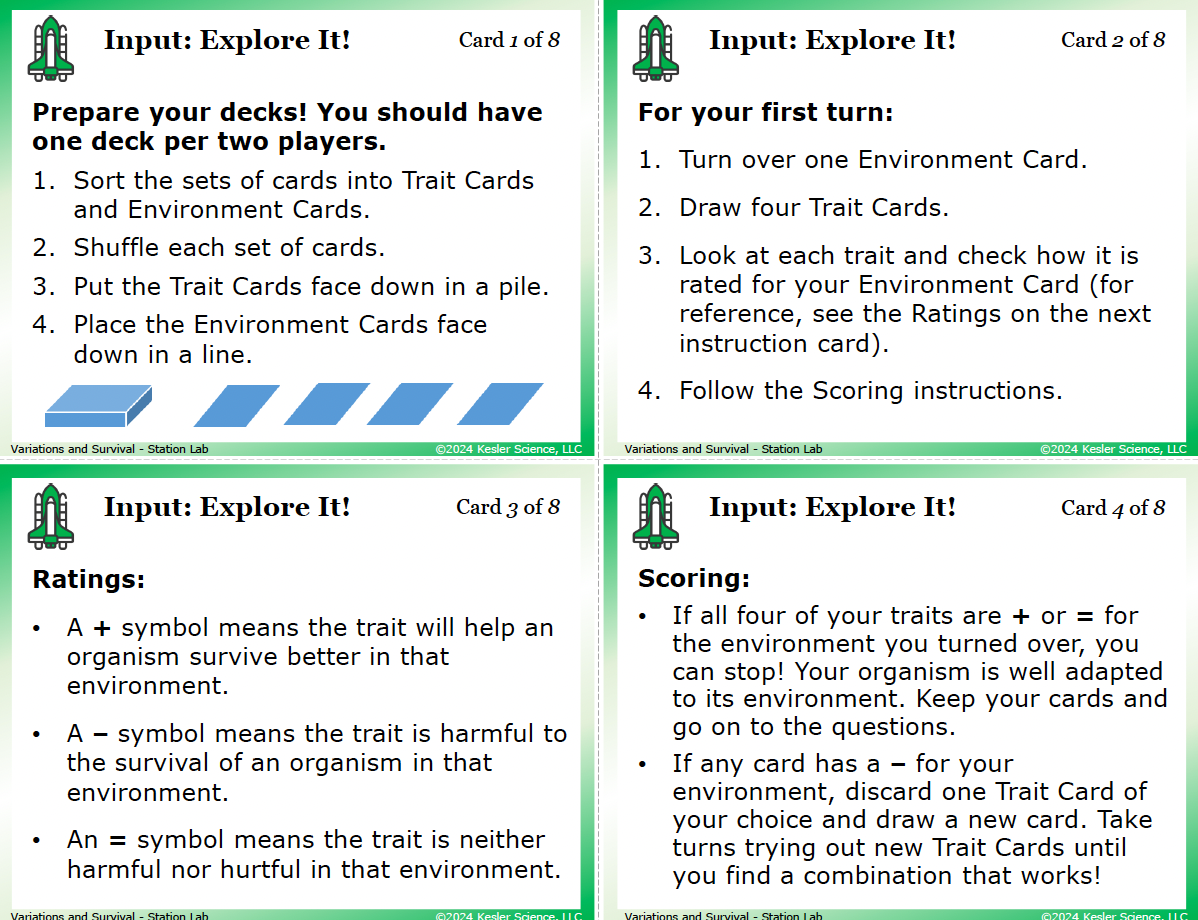
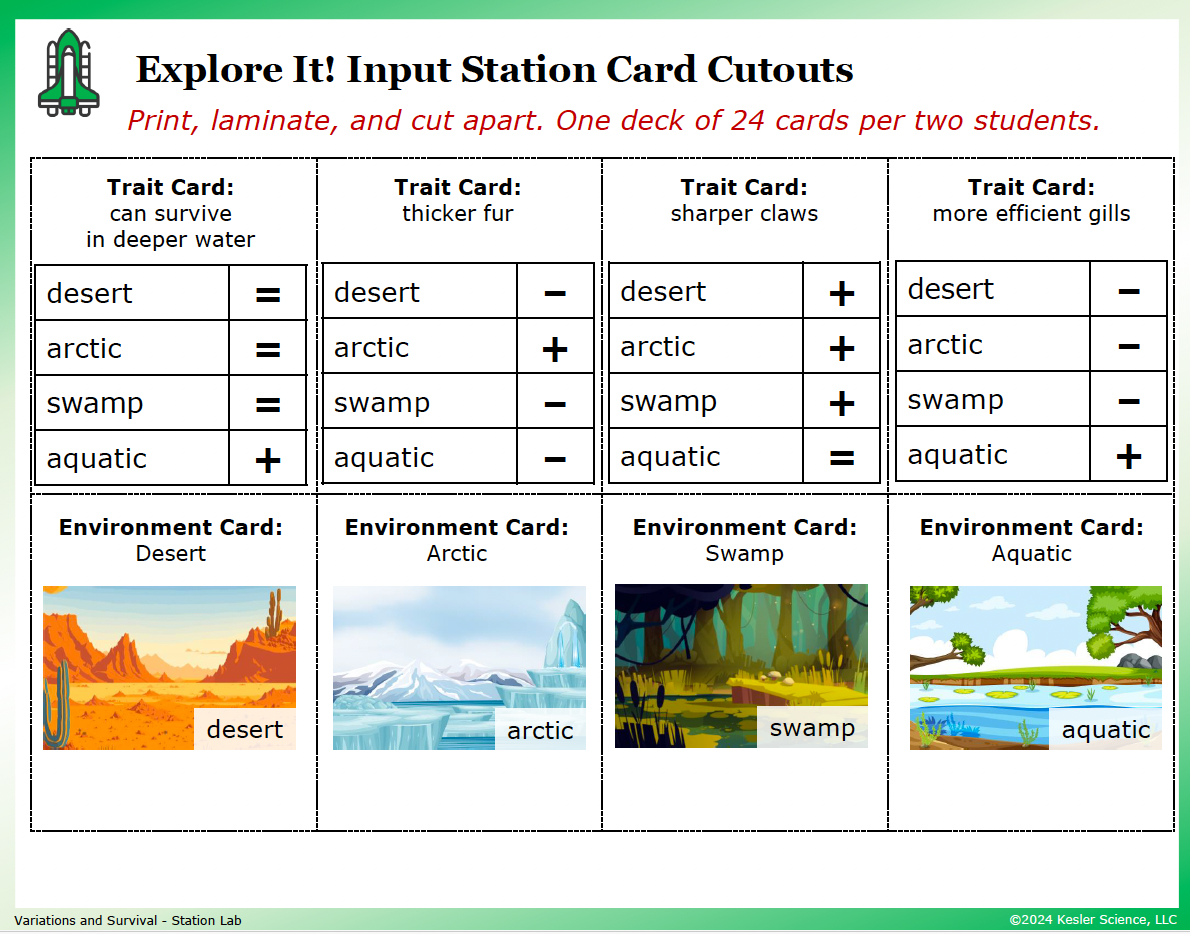
This is the heart of the lab. Each pair of students gets a deck of 24 cards (16 trait cards plus 4 environment cards: desert, arctic, swamp, aquatic). They flip an environment card, draw four trait cards, and check each trait against the environment using the +, -, or = ratings on the trait card itself. If any card has a minus, they discard it and draw again until they have four traits that all work for that environment. Trait cards include thicker fur, more efficient gills, sharper claws, heavier scales that conserve water, white fur, fur that changes color in winter, and slow walking speed. Four reflection questions push them past the game: which environment they chose, what four traits worked, why one would be a good variation in that environment, and how the same trait would affect an organism in a different environment.
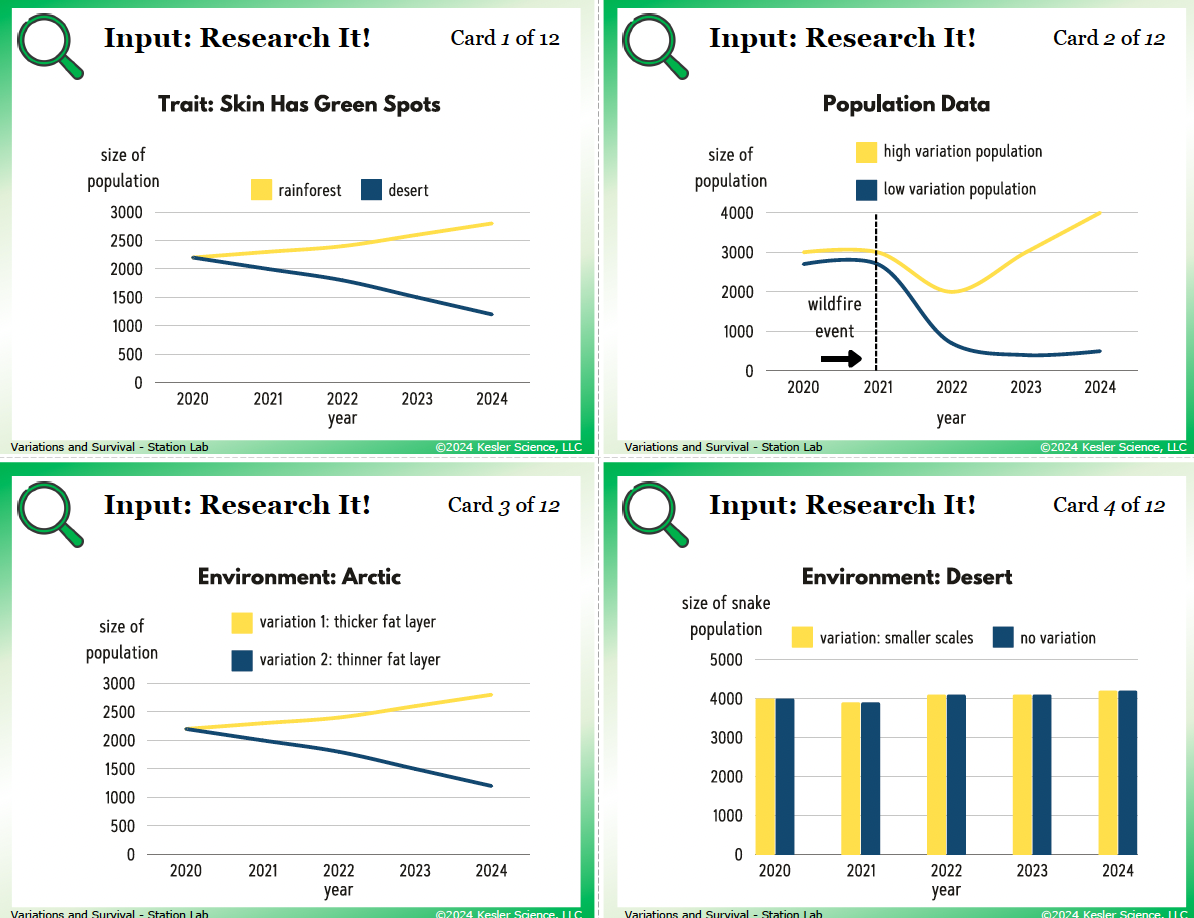
Students examine 12 reference cards: four real-looking population graphs (Trait Skin Has Green Spots in rainforest vs. desert, Population Data with a wildfire event in 2021, Environment Arctic with thicker vs. thinner fat layer, and Environment Desert smaller scales vs. no variation), plus four FACT cards spelling out the rules (high-variation populations survive challenges better, traits must interact with the environment to matter, advantages help survival and reproduction, and environmental conditions can change). Four questions check whether they can read the graphs, match each one to the correct fact card, and apply the brown anole lizard example (thrives in Florida, struggles in Maine).
4 output stations: how students show what they learned
A two-column card sort. Kids sort 8 scenario cards into Advantage and Disadvantage columns. Advantage examples: rodents needing less water during a drought, sea snails with thicker shells in acidifying ocean, faster cheetahs catching prey, moths with predator-warning wing colors. Disadvantage examples: a plant blooming after the pollinators have left, chipmunks digging shallow holes when flooding is increasing, anti-social chimps missing the safety of the group, an entire snow rabbit species with white fur as the snow melts. Easy to spot-check at a glance.
Students sketch a desert ecosystem with hot, dry daytime conditions and very little green ground cover, then draw a species of snake that would live there. They show the variations (skin color, behavior of diurnal vs. nocturnal, size, preferred food). Then they draw a red X on the variety of desert snake that would be at a disadvantage. The red X is the giveaway: a green snake in a desert sticks out, a snake that hunts in midday heat overheats, a small snake gets eaten by hawks. The students who get it use the X correctly. The students who don't draw a green snake in a sandy desert and call it a day.
Three open-ended questions in complete sentences: explain why the environment plays a critical role in determining whether a trait is an advantage or disadvantage, give examples of traits that would be an advantage in a lush rainforest but not in a windy polar environment, and describe how variations actually appear within a population (DNA combinations from two parents plus mutations). This is the writing practice middle schoolers need and rarely get in science class.
Eight multiple-choice and fill-in-the-paragraph questions tied to TEKS 6.13C vocabulary (advantage, variations, DNA, population, mutation). Includes which option does NOT describe how variations appear in a population (an organism cannot change its own traits to survive better), which option best describes a disadvantage (it lowers the chance of reproduction), and what happens when a trait is well suited for the environment (organisms with that variation are more likely to pass their genes to the next generation). The fill-in paragraph weaves all five vocabulary words together. If you're grading the lab, this is the easiest station to grade.
Bonus Challenge It! station for early finishers
Four optional extensions: write a story about a variety of organisms with traits that no longer fit their environment (and how they might find a new place to live), make a poster titled "Having Trouble Fitting In?" that pitches a new destination to mismatched organisms, build a line graph from the provided fish population data table tracking what happens after fertilizer leaches into a water body, or write journal entries as a research scientist in Alaska watching permafrost thaw and which species are surviving. Requires teacher approval before they start.
How this fits into a complete variations and survival unit
This Station Lab is the Explore day of our full Variations and Survival Complete 5E Lesson for TEKS 6.13C. The complete two-week unit follows the 5E method of instruction and includes an Engage hook, the Variations and Survival Station Lab for Explore, PowerPoint slides and interactive notebook pages for Explain, student choice projects to Elaborate, and an Evaluate assessment.
Most teachers grab the full 5E because the Station Lab lands hardest with the days around it. But if you just need a strong hands-on day on variations and survival, the Station Lab on its own does the job.

Get this variations and survival activity

Or if you want the full two-week experience with the Engage hook, Explain day, Elaborate extension, and Evaluate assessment all included:
(Station Lab is included)
Frequently asked questions
What does TEKS 6.13C cover?
Texas TEKS 6.13C asks 6th grade students to investigate how variations among individuals in a population can lead to survival or reproductive advantages. Students should be able to explain where variation comes from (combining DNA from two parents plus mutations), define what makes a variation an advantage versus a disadvantage, and explain why the environment determines which traits help or hurt.
Is this kids' first time meeting variation and natural selection?
Yes for most 6th graders. Some have heard of "adaptations" in earlier grades, but the formal vocabulary (variation, advantage, mutation, DNA, population) and the idea that the environment decides whether a trait is good or bad is brand new this year. The Read It! passage introduces all five vocabulary words in bold, and the Explore It! card game makes the environment-decides-everything idea immediately physical.
How long does this variations and survival activity take?
One to two class periods (45 to 110 minutes total). The Explore It! card game takes the longest because students play multiple rounds across different environments, so plan for two periods the first time you run a station lab. Once your class has the rotation routine down, most groups can finish all 8 stations in one period.
Do I need a lot of supplies for this?
Almost nothing. Just colored pencils or markers (especially red, for the X on the Illustrate It! station) and a device with internet for the Watch It! station. Everything else is in the download. Total cost beyond the download is essentially zero if your classroom already has colored pencils.
Can I use this in a 1:1 digital classroom?
Yes. The full digital version (PowerPoint or Google Slides) works in 1:1 classrooms and Google Classroom. The Explore It! card game is digitized so students drag virtual environment and trait cards. The Organize It! card sort works especially well digitally because students drag scenario cards into the Advantage and Disadvantage columns. The Research It! population graphs are clickable and zoomable.