
Inside the Rocks & Natural Resources 5E Lesson
The 5E instructional model walks students through five phases: Engage (hook them), Explore (let them mess with it), Explain (give them the words), Elaborate (push them to apply it), and Evaluate (find out what stuck). Each phase has a specific job. When you follow them in order, you let students do science first, then learn the vocabulary instead of the other way around. Here's how each phase plays out for 4.11C.
🎯 Engage
Day one opens with the move that anchors the whole standard: the sponge demo. Bring a dry kitchen sponge and a block of clay (or a smooth granite rock) to class. Pour an ounce of water on the sponge — it disappears inside. Pour an ounce on the clay — it puddles on top and runs off. Same water, same amount, two completely different rocks. Then ask: "If you were a drop of oil deep underground millions of years ago, which one would you rather end up inside?"
Kids get it instantly. The sponge is what an oil reservoir actually looks like at a microscopic level: millions of connected holes between grains of sand cemented together. Texas has more of those underground sponges than almost anywhere on Earth, which is why the state's been pumping oil for over a hundred years.
The Engage materials in the 5E lesson hand you the Objective & Word Wall slide (the I CAN statement plus key vocabulary like porosity, permeability, aquifer, deposit), a digital and printable Engagement activity that has students sort photos of different rocks by where they'd expect to find resources, and the Bell Ringer question that gets the sponge demo conversation going. Hook + vocabulary + objective — all in 15 minutes.
🔬 Explore
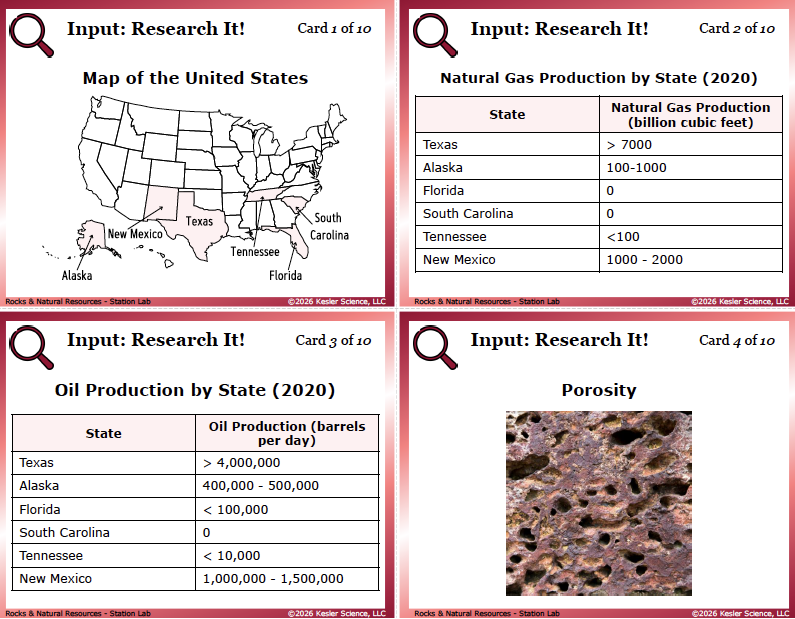
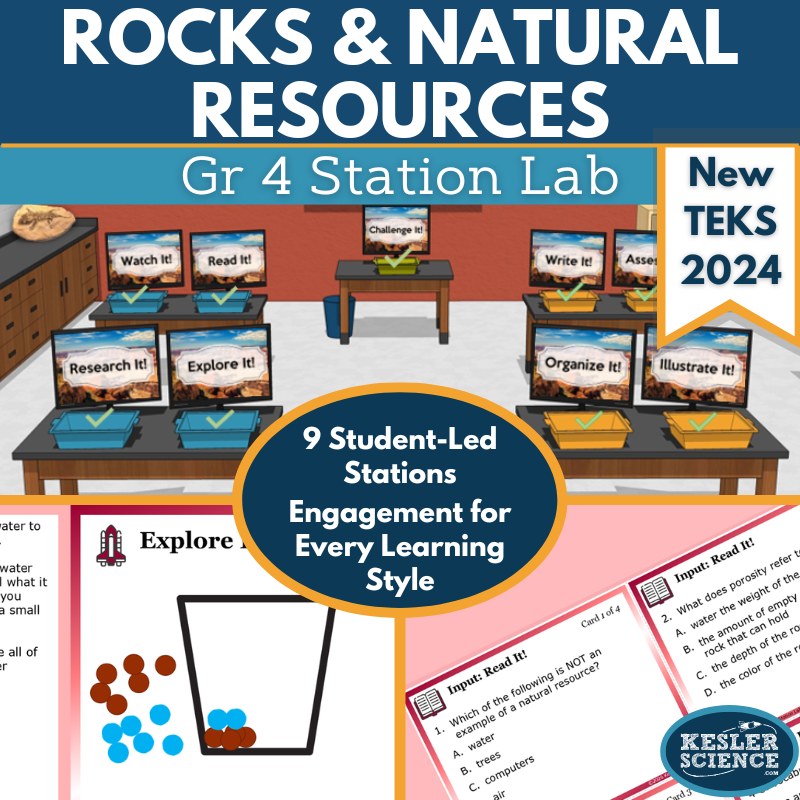
The Rocks & Natural Resources Station Lab is the heart of the Explore phase. Nine stations let students rotate through hands-on investigations of porosity, permeability, and what those properties mean for storage. The four input stations (Watch It!, Read It!, Explore It!, Research It!) give students multiple ways to take in the content: they watch a short video on how aquifers work, read an article about the Edwards Aquifer, run a hands-on test on sand versus clay versus sponge, and research how mineral deposits form when hot fluids cool inside rock.
The four output stations (Organize It!, Illustrate It!, Write It!, Assess It!) push them to produce something: a labeled diagram of an aquifer, an illustration of fossil fuel formation, a short explanation of why granite makes a terrible storage rock, and a quick check-for-understanding on key vocabulary. The bonus Challenge It! station asks them to design an underground storage solution given a list of physical property constraints.
Print and digital versions are both included. If you want the full breakdown of how the Station Lab runs day-by-day, I wrote a separate walkthrough of just that piece.
→ Read the full Rocks & Natural Resources Station Lab walkthrough 9 stations, materials list, teacher tipsThe Station Lab is included in the full 5E lesson. You don't need to buy it separately.
📚 Explain
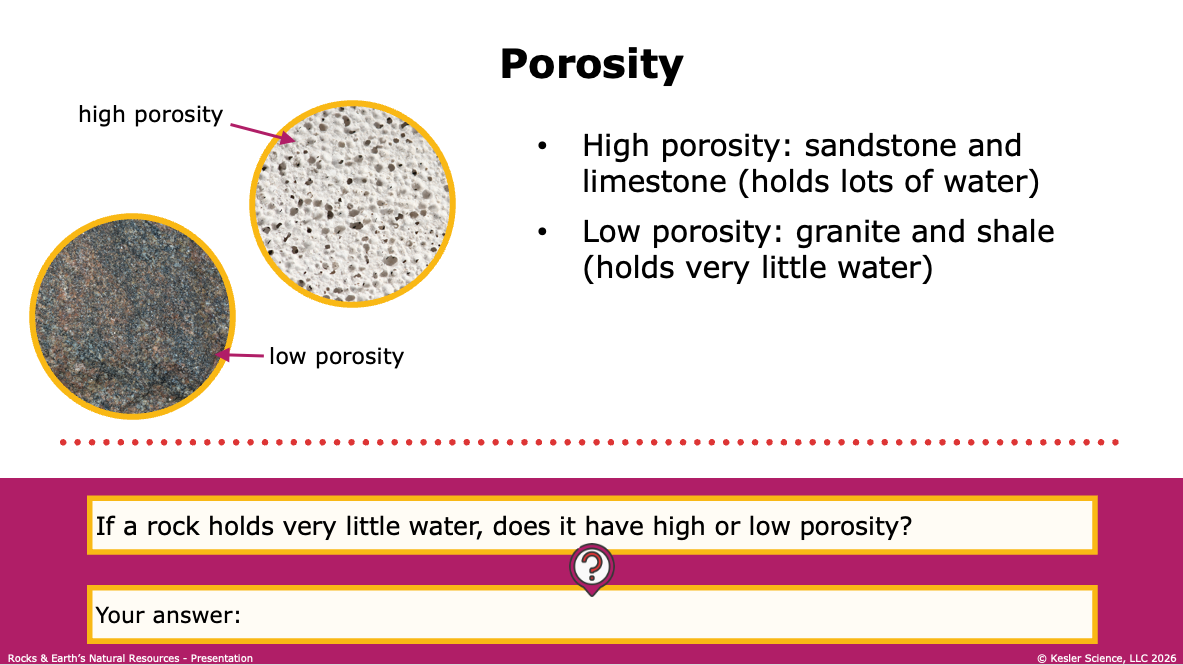
Here's the real payoff of doing the Engage and Explore before the Explain: by the time students sit down with the presentation, they've already experienced porosity and permeability. They've felt water disappear into a sponge and run off granite. They've watched sand let oil through and clay block it. So when the Presentation slide says "porosity is the measure of empty space inside a rock," they're not memorizing — they're naming something they already saw.
The Explain phase uses the Rocks & Natural Resources Presentation, which comes in both digital and print versions plus an answer key. It opens with the Essential Question ("What physical properties of rocks allow Earth's natural resources to be stored in them?") and runs through ~20 content slides covering porosity, permeability, weathering's role in making rocks more porous, how heat and cooling form fossil fuels and mineral deposits, and real-world applications like water wells and oil extraction.
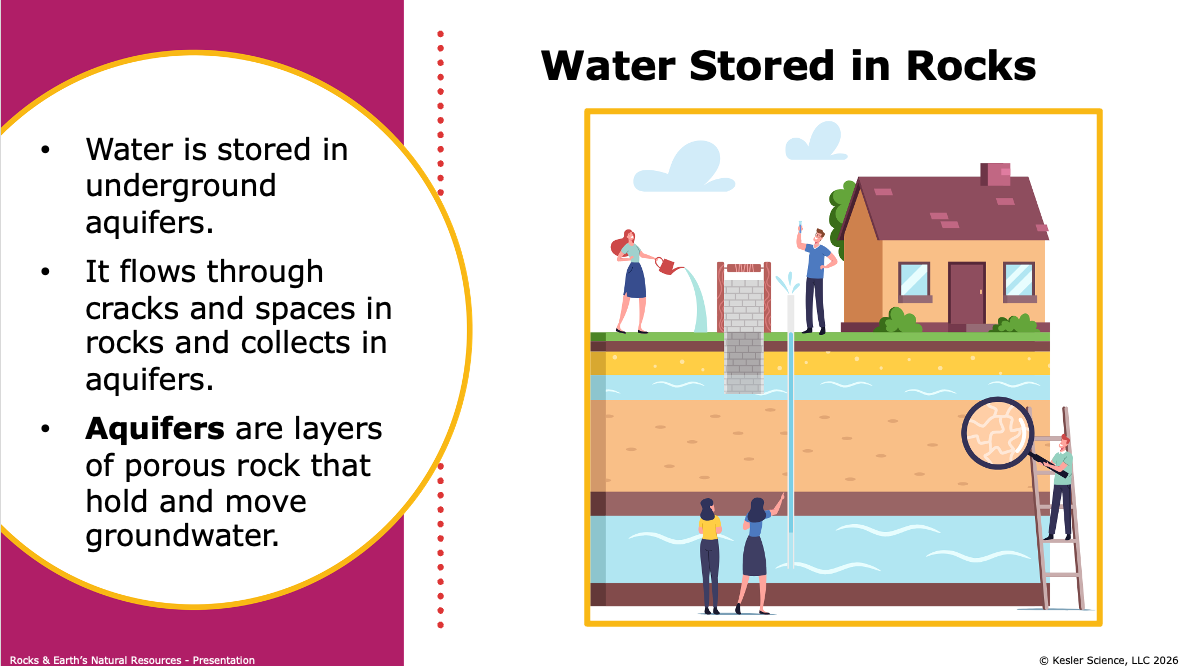
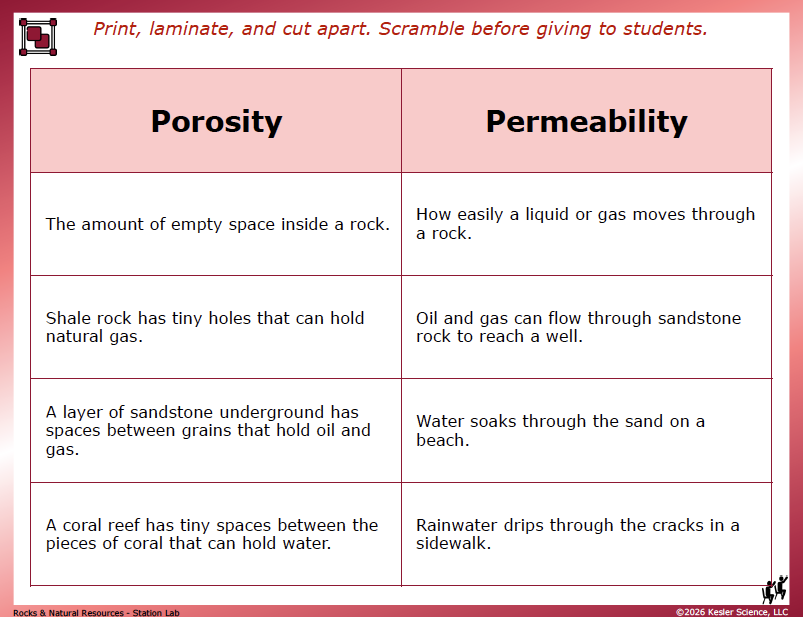
The two big ideas the presentation makes stick: porosity is how much empty space exists, permeability is whether those spaces connect. A rock can have lots of pores but if they're sealed off from each other, nothing can get in or out — that's high porosity but low permeability. The classic example is a piece of pumice with isolated air bubbles versus a piece of sandstone where the spaces between grains all link up. Both look "holey," but only sandstone makes a great storage rock because water, oil, or gas can actually flow through it.
The presentation also pulls in the connection to weathering (4.10B territory) — as rocks break down at the surface, they often develop new cracks and pore spaces, making them more porous over time. And it covers how heat and cooling underground are part of the story: heat and pressure turned ancient plants and ocean life into oil and natural gas, and those resources collected in the pore spaces of sandstone and limestone. When magma cools deep underground, it leaves valuable mineral deposits behind in the rock spaces.
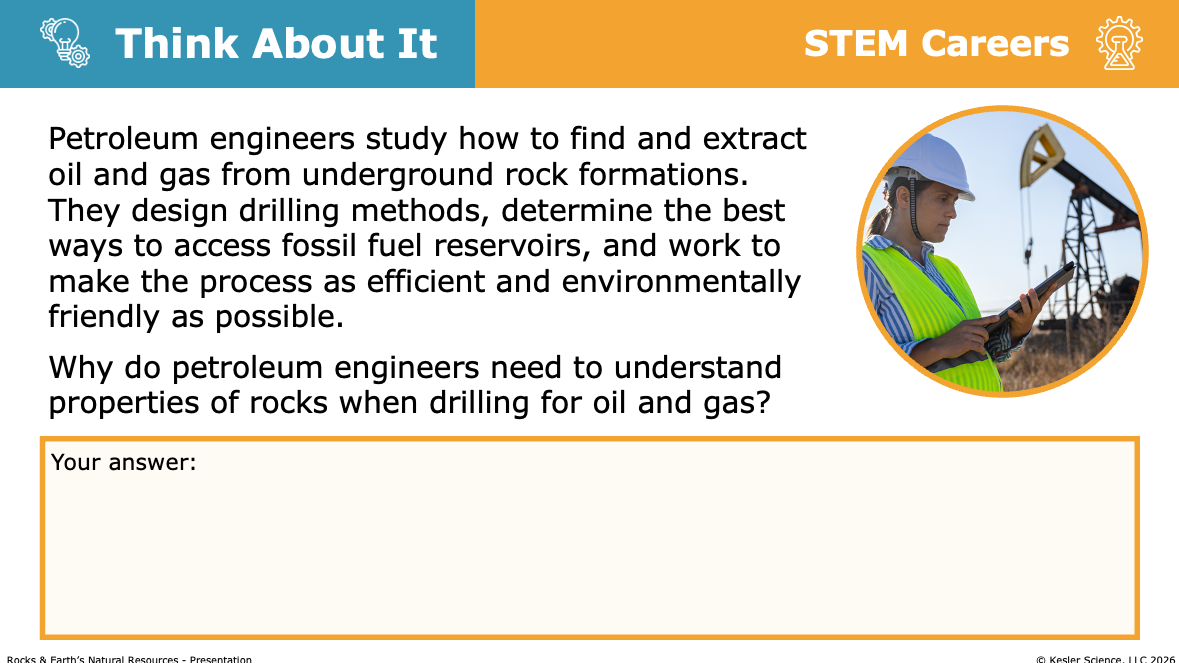
What makes the Rocks & Natural Resources Presentation different from a typical lecture deck: it has built-in "Quick Action" INB activities sprinkled through it — students stop, rank rock layers from most to least permeable, predict how groundwater would move through different layers, and trace where fossil fuels form. By the time you get to the end of the deck, students have done three or four short hands-on tasks, not just watched slides.
The presentation closes with Texas-specific examples: the Edwards Aquifer providing drinking water for San Antonio (limestone, high porosity and permeability), the Permian Basin pumping oil and natural gas (sandstone reservoirs), and East Texas mineral deposits. By tying the big concepts to places kids have heard of, the standard stops feeling abstract.
🛠️ Elaborate
The Elaborate phase is where students stretch what they learned about porosity, permeability, and how rocks store natural resources into a real-world project. The Rocks & Natural Resources Complete 5E Lesson includes a Student Choice Project Board with nine project options plus a "design your own" pathway, so every kid finds something that matches how they like to learn.
The options range from build an aquifer model (cup, sand, clay, water — show how it works) to create an infographic on why Texas is full of underground oil and gas, to write a short story from the perspective of a water droplet traveling through limestone underground for a thousand years, to record a video tour of the Edwards Aquifer using photos and a script. Students who want to push themselves can design their own project — as long as it shows they understand porosity, permeability, and how those properties let rocks store natural resources.
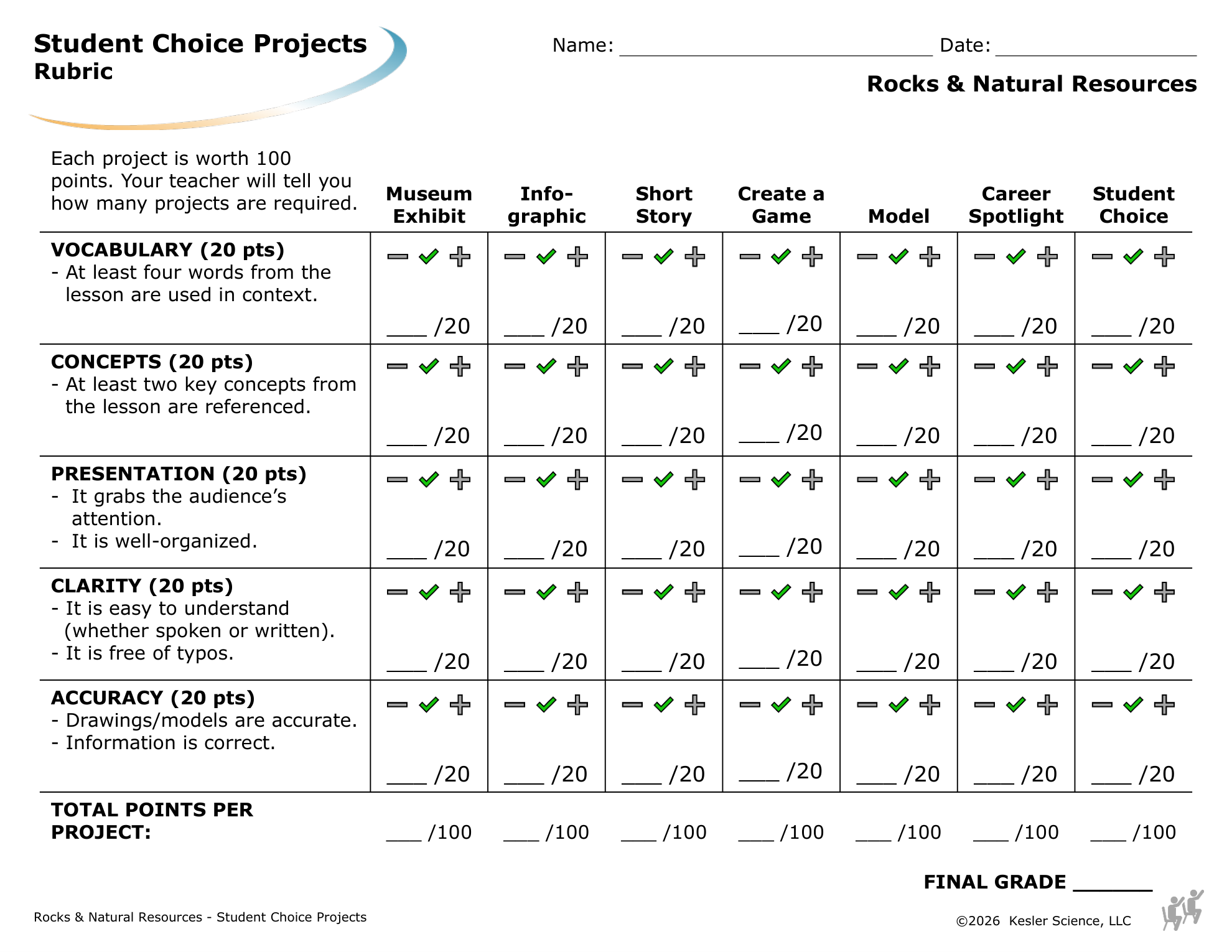
The included Rubric (page 3 of the Student Choice with Rubric PDF) keeps grading simple and consistent across whatever projects students choose. It scores content accuracy, use of vocabulary, creativity, and effort on a 1–4 scale. Every project gets evaluated the same way regardless of format.
✅ Evaluate
The Evaluate phase wraps the unit with a formal assessment. It's not all bubble sheets, though — the assessment combines a short multiple-choice section (checking core vocabulary and concept identification) with constructed-response questions where students have to explain why a given rock would or wouldn't make a good aquifer, or trace what happens to a drop of water once it reaches limestone underground.
What I like about this assessment: there are no gotchas. Every question maps back to something students did or saw earlier in the 5E lesson. A kid who paid attention during the sponge demo, ran the Station Lab, and worked through the Presentation should be able to answer every item. The point of the Evaluate phase isn't to surprise anyone — it's to confirm that the learning stuck and surface anything we need to reteach.
The full assessment is included in the 5E download as both a PDF and an editable Google Docs version, so you can swap or rewrite questions to match your specific classroom needs.
How everything fits together
If you want the whole experience (Engage hook, the Station Lab as the Explore phase, the editable Presentation, Student Choice projects, and the assessment), grab the Complete 5E Lesson. If you only have time for the one-day hands-on activity, just the Station Lab will fit in a single 45-minute period.
What's included in the Rocks & Natural Resources 5E Lesson download
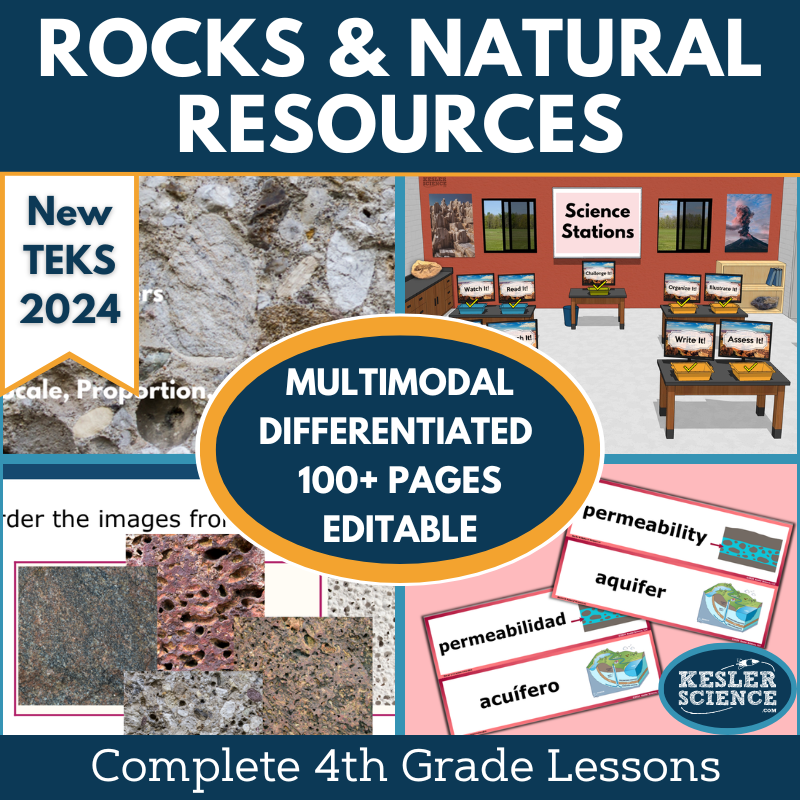
When you buy the Rocks & Natural Resources Complete 5E Lesson, you get a single PDF download with everything you need to teach TEKS 4.11C end-to-end, plus editable digital versions.
- ✅ Engage materials — teacher directions, Objective & Word Wall slide, Bell Ringer, hook activity (English & Spanish word walls)
- ✅ Station Lab — print and digital versions, 9 stations, full teacher directions and answer key (English & Spanish Read It! stations)
- ✅ Interactive Notebook (INB) — paper INB with foldables tied to porosity, permeability, aquifers, and resource formation (English & Spanish)
- ✅ Presentation — digital and print versions plus answer key, with built-in Quick Action INB stops
- ✅ Student Choice Project Board with rubric — 9 options + "design your own" pathway
- ✅ Assessment with answer key — multiple choice plus constructed response, editable PDF and Google Docs versions
- ✅ Editable presentation — swap your own photos, add your own examples, retitle anything you need to fit your classroom
A couple of real-talk tips from running this lesson
Do the sponge demo on day one — don't skip it
It's easy for 4th graders to land on "renewable good, fossil fuels bad" and stay there. Force them to name one advantage of coal and one disadvantage of solar. Once they can argue both sides of every resource, they actually understand the TEKS.
Bring real rocks if you can
If kids spend the first 15 minutes cutting out cards, you lose the energy of the sorting activity. Cut them once and use them across all your sections. Sandwich bags work great for storage between classes.
Tie it to the Edwards Aquifer if you teach in Texas
Put a giant T-chart on the board labeled RENEWABLE and NONRENEWABLE. Have one kid from each group come up and add an advantage and a disadvantage from their notes. By the end you have a wall of trade-offs that becomes your reference for the rest of the unit.
Get the Rocks & Natural Resources 5E Lesson
Or if you only need the one-day hands-on Station Lab:
(The Station Lab is included in the full 5E Lesson)
Frequently asked questions
Does this cover all of TEKS 4.11A?
Yes. All eight resources named in the standard (wind, water, sunlight, plants, animals, coal, oil, and natural gas) are covered, and both the "identify" and "explain advantages and disadvantages" verbs are addressed across the five phases.
What do my students need to know before this lesson?
A basic understanding that we use energy to power things in our daily lives. That's about it. The lesson builds the rest of the vocabulary from scratch.
How long does it take to teach?
Done with fidelity, about 10 class periods of 45 minutes each. One day for the Engage sorting activity, two days for the Station Lab, two days for the Presentation and Interactive Notebook, three days for the Student Choice Project, and one to two days for review and the assessment.
Do I need special supplies?
Just pinwheels (or paper to fold them), a small flashlight for the solar demo, and printed copies of the picture cards. Most teachers already have everything on hand.
Does this work for digital classrooms?
Yes. Every component has a digital version. The Station Lab is fully digital-ready (Google Slides), the Presentation works in Google Slides, and the Student Choice Projects can be submitted as videos, slide decks, or written work.
Is this 5E lesson aligned to NGSS too?
It aligns most directly with 4-ESS3-1 (obtain and combine information to describe that energy and fuels are derived from natural resources and their uses affect the environment). Built TEKS-first, but the standards overlap heavily.