8 hands-on stations for teaching how rocks store natural resources
A station lab is a student-led activity where small groups rotate through 8 stations (plus a 9th challenge station for early finishers) at their own pace during one to two class periods. You become a facilitator instead of a lecturer. You walk around, spot-check, and break misconceptions while the kids work through the rotation.
The Rocks & Natural Resources Station Lab has four input stations (where students take in new information on porosity, permeability, and natural resources) and four output stations (where they show what they learned). Here's what's at each one.
4 input stations: how students learn porosity and permeability
A short YouTube video introduces the two big properties (porosity and permeability) and how they affect rocks and sediments. Students stop the video at 2:02 and answer three questions: name two important properties of rocks and sediments, explain what porosity measures, and explain what permeability measures. The video gives kids the vocabulary before they touch the cups of clay, sand, and gravel at Explore It!, which makes the connection click faster.
A one-page passage called "Water Wells" opens with the question every 4th grader thinks they know: where does the water from your faucet come from? The passage walks through groundwater (water filling tiny spaces between rocks and soil), porosity (the empty space inside a rock that can hold water), permeability (how easily water flows through), and aquifers (layers of rock with both high porosity and high permeability that store and move groundwater). It closes with the conservation message: aquifers can run dry if too much water is taken out, so we have to use water wisely. Three multiple-choice questions follow, plus the vocabulary section (natural resources, groundwater, porosity, permeability, aquifer). Comes in two reading levels (Dependent and Modified) plus a Spanish version.
This is the station kids will remember. Each group labels three cups (clay, sand, gravel) and adds about ¼ cup of each material to the matching cup. They hold the gravel cup at eye level and look for empty spaces. Then they measure 50 mL of water with a graduated cylinder and pour it into each cup. They record which cups let the water sink through and which cups left the water sitting on top. The reflection question asks them to rank the three substances from least permeable to most permeable. Clay traps water, gravel lets it pour straight through, sand sits in the middle. The hands-on data is the structure-function lesson on permeability in disguise.
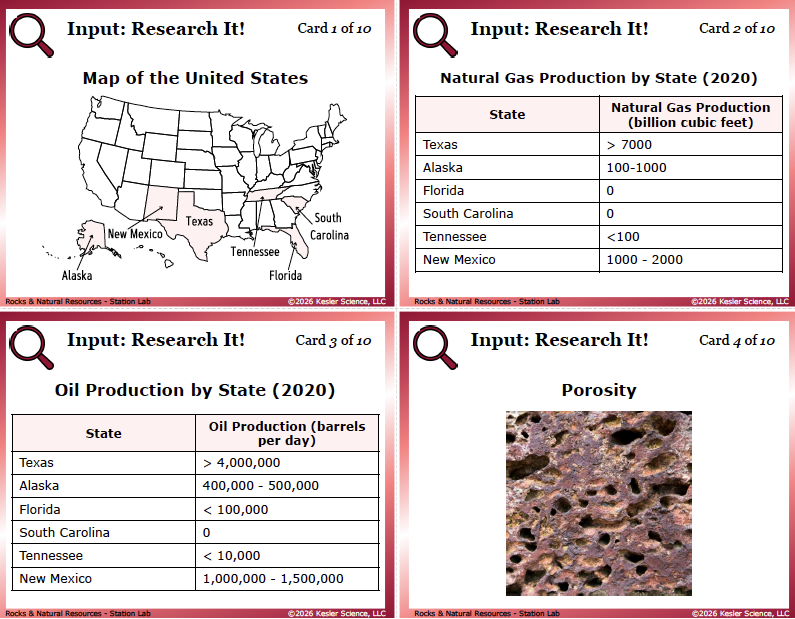
Ten reference cards bring real US oil and gas production data into the lab. A map of the United States highlights Texas, Alaska, Florida, South Carolina, Tennessee, and New Mexico. Two data tables show 2020 Natural Gas Production (Texas over 7,000 billion cubic feet; South Carolina at 0) and Oil Production (Texas over 4 million barrels per day; South Carolina at 0). A porosity image card shows a real rock with visible pores. Definition cards explain that rocks with higher porosity hold more oil and natural gas, and that not all rocks underground are the same. Five questions tie the cards together: which state produces the most, which states produce none, describe the porosity of rocks in New Mexico, describe the porosity in South Carolina, and how porosity differs between Texas and Tennessee.
4 output stations: how students show what they learned
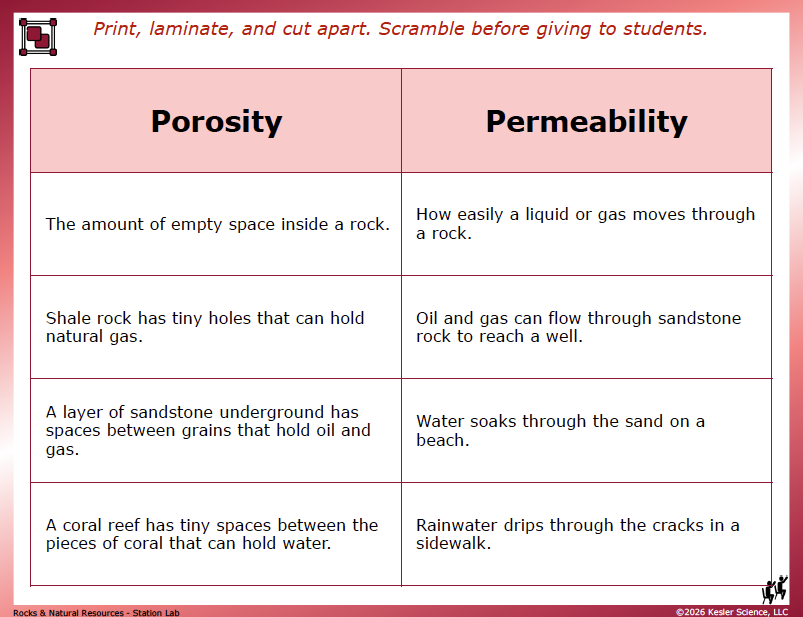
A two-column card sort. Kids match eight cards to either "Porosity" or "Permeability": the amount of empty space inside a rock (porosity); how easily a liquid or gas moves through a rock (permeability); shale rock has tiny holes that can hold natural gas (porosity); oil and gas can flow through sandstone rock to reach a well (permeability); a layer of sandstone has spaces between grains that hold oil and gas (porosity); water soaks through the sand on a beach (permeability); a coral reef has tiny spaces between pieces of coral that hold water (porosity); and rainwater drips through cracks in a sidewalk (permeability). Sorting these forces kids to separate the two ideas that they keep blurring together.
Students sketch four rock layers in their notebooks, each with a different combination of porosity and permeability: high porosity and high permeability (an aquifer-style rock), low porosity and high permeability (rare in nature but possible in cracked rock), high porosity and low permeability (clay, which holds water but won't release it), and low porosity and low permeability (solid granite or shale). This is the station where you find out who really gets that the two properties are independent. Kids who can draw all four combinations have it. Kids who draw the same picture four times are still treating porosity and permeability as the same thing.
Three open-ended questions in complete sentences. First, what physical properties of rocks allow natural resources to be stored in them. Second, how porosity and permeability impact how rocks store natural resources. Third, what would happen if all rocks had low permeability, and how would that affect natural resource storage. The third question is the one to watch. It's the lab's whole story in one prompt: a world where every rock had low permeability would be a world where you couldn't drill a well for water, oil, or natural gas. The resources would still be there, but stuck.
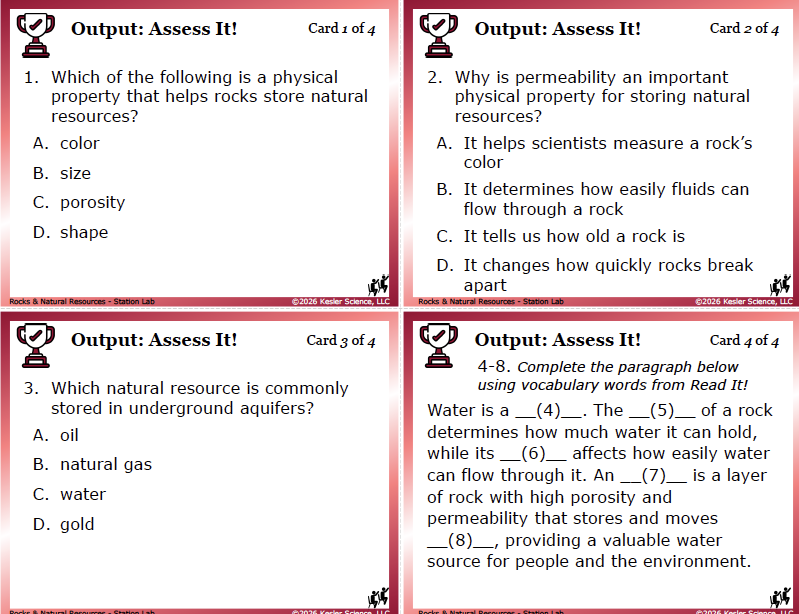
Three multiple-choice questions plus a fill-in-the-paragraph that uses the five Read It! vocabulary words (natural resources, porosity, permeability, aquifer, groundwater). The multiple choice asks them to pick the physical property that helps rocks store natural resources (porosity, not color or shape), explain why permeability matters (it determines how easily fluids flow through a rock), and name the natural resource commonly stored in underground aquifers (water). The fill-in paragraph weaves the vocabulary together in a story about an aquifer that stores and moves groundwater for people and the environment.
Bonus Challenge It! station for early finishers
Four optional extensions: design a bookmark with different rock layers showing each combination of porosity and permeability; research petroleum engineers and create a poster, slide, or video explaining how they use porosity and permeability in their job; write a creative short story from the perspective of a water droplet or oil droplet traveling through different rock layers; or research the natural resources stored in rocks in your local area (water, oil, minerals) and present a slideshow to the class. Requires teacher approval before they start.
How this fits into a complete Rocks & Natural Resources unit
This Station Lab is the Explore day of our full Rocks & Natural Resources Complete 5E Lesson for TEKS 4.11C. The complete two-week unit follows the 5E method of instruction and includes an Engage hook, the Rocks & Natural Resources Station Lab for Explore, PowerPoint slides and interactive notebook pages for Explain, student choice projects to Elaborate, and an Evaluate assessment.
Most 4th-grade teachers I work with grab the full 5E because the Station Lab lands hardest when the days around it support it. But if you just need a strong hands-on day on porosity, permeability, and how rocks store natural resources, the Station Lab on its own does the job.

What you get with this Rocks & Natural Resources activity

When you buy the Station Lab, you get a single download with everything you need:
- Print version at two reading levels (Dependent for on-grade, Modified for additional support) plus a Spanish Read It! passage
- Digital version as PowerPoint files (works in Google Slides too) at both levels — for 1:1 classrooms or Google Classroom
- Teacher Directions and Answer Key for both versions, all keys included
- Station task cards ready to print, laminate, and drop in baskets at each station
- Reference cards for the Research It! station (10 cards covering the US map, 2020 oil and natural gas production by state, porosity images and definitions, and the analysis questions)
- Sort cards for the Organize It! station (8 cards sorted into Porosity vs. Permeability with examples from shale, sandstone, coral reef, beach sand, and concrete sidewalks)
- Student answer sheets for each level
Tips for teaching porosity and permeability in your 4th grade classroom
Two things make this lab go smoother the first time:
1. Break the clay into small chunks before class.
If you put a single solid blob of modeling clay in the cup, water doesn't have anywhere to start pooling on top, and the kids will miss the contrast with the gravel. Break the clay into pea-sized or marble-sized pieces and press them lightly into the cup so they fill the space but don't bind into one mass. Now when the water hits, it pools on top like it should, and the difference between clay (low permeability) and gravel (high permeability) jumps out on every group's table. Pre-prep this the night before and you save 15 minutes of rotation time.
2. Set the cups on paper plates or a tray.
Water plus gravel plus a 4th-grade rotation equals spills. Every time. If you set each group's three cups on a paper plate or a small plastic tray, the spills land on the plate instead of on the lab sheet, the desk, or the cup of the kid next to them. A stack of cheap paper plates from the grocery store covers a class of 30 and you can throw them away at the end of class. No paper towels, no mopping, no wet answer sheets.
Get this Rocks & Natural Resources activity
Or if you want the full two-week experience with the Engage hook, Explain day, Elaborate extension, and Evaluate assessment all included:
(Station Lab is included)
Frequently asked questions
What does TEKS 4.11C cover?
Texas TEKS 4.11C asks 4th grade students to identify and describe the physical properties of rocks that allow them to store natural resources, including air, water, oil, natural gas, and minerals. By the end of this lab, kids should be able to define porosity (the empty space inside a rock) and permeability (how easily liquid moves through a rock), and explain why both have to be high for a rock to actually give up its resource to a well.
What's the difference between porosity and permeability?
Porosity is the amount of empty space inside a rock. Permeability is how easily a liquid or gas moves through the rock. A rock can have high porosity (lots of empty space) but low permeability (those spaces aren't connected, so water can't flow through). Clay is the classic example: tons of empty space, but the water just sits on top. The Explore It! clay-sand-gravel test makes this distinction visible to a 4th grader for the first time, and the Organize It! card sort locks it in.
How long does this Rocks & Natural Resources activity take?
One to two class periods (45 to 110 minutes total). The Explore It! station has six sequential steps (label cups, fill with clay/sand/gravel, look through the gravel cup, pour 50 mL of water into each, record what happened, rank the permeabilities), which is the longest piece, so plan for two periods the first time. Once your class has the rotation routine down, most groups can finish all 8 stations in one period.
Do I need a lot of supplies for this?
Not really. Three plastic cups per group, a small amount of clay, sand, and gravel, a graduated cylinder, and a pitcher of water. Total cost for a class of 30 if you're starting from nothing: under $20. The clay, sand, and gravel will keep for years if you store them dry, so the cost only happens once. The Watch It! station also needs a device with internet.
Can I use this in a 1:1 digital classroom?
Yes. The full digital version (PowerPoint or Google Slides) works in 1:1 classrooms and Google Classroom. Students drag digital cards at the Organize It! Porosity vs. Permeability sort and type their answers on the answer sheet. The Explore It! hands-on pour-and-observe step is harder to digitize. If you can't run the physical investigation, a short YouTube clip of water moving through clay, sand, and gravel (a quick search will turn up several) gets most of the way there.