8 hands-on stations for teaching resource management
A station lab is a student-led activity where small groups rotate through 8 stations (plus a 9th challenge station for early finishers) at their own pace during one to two class periods. You become a facilitator instead of a lecturer. You walk around, spot-check, and break misconceptions while kids work through the rotation.
The Resource Management Station Lab has four input stations (where students take in new info on conservation, energy poverty, malnutrition, and renewable energy) and four output stations (where they show what they learned). Here's what's at each one.
4 input stations: how students learn resource management
A short YouTube video looks at the global picture of energy access. Three questions follow: about how many people in the world don't have electricity, where in the world solar energy is growing fastest, and at least five different ways access to energy is making a difference (powering schools, refrigerating vaccines, charging cell phones, lighting homes, running water pumps). Visual learners come alive at this station because the video shows real communities being transformed by solar power.
A one-page passage called "Resource Management" walks students through the connection between resource management and three real problems: energy poverty (people without electricity), malnutrition (not getting enough nutrients), and air and water pollution. It introduces solar and wind power, sustainable farming, and waste management as solutions. The vocabulary is bolded throughout (resource management, energy poverty, malnutrition, air pollution, conserve). Three multiple-choice questions follow, plus the vocab notes section. Comes in two reading levels (Dependent and Modified) plus a Spanish version.
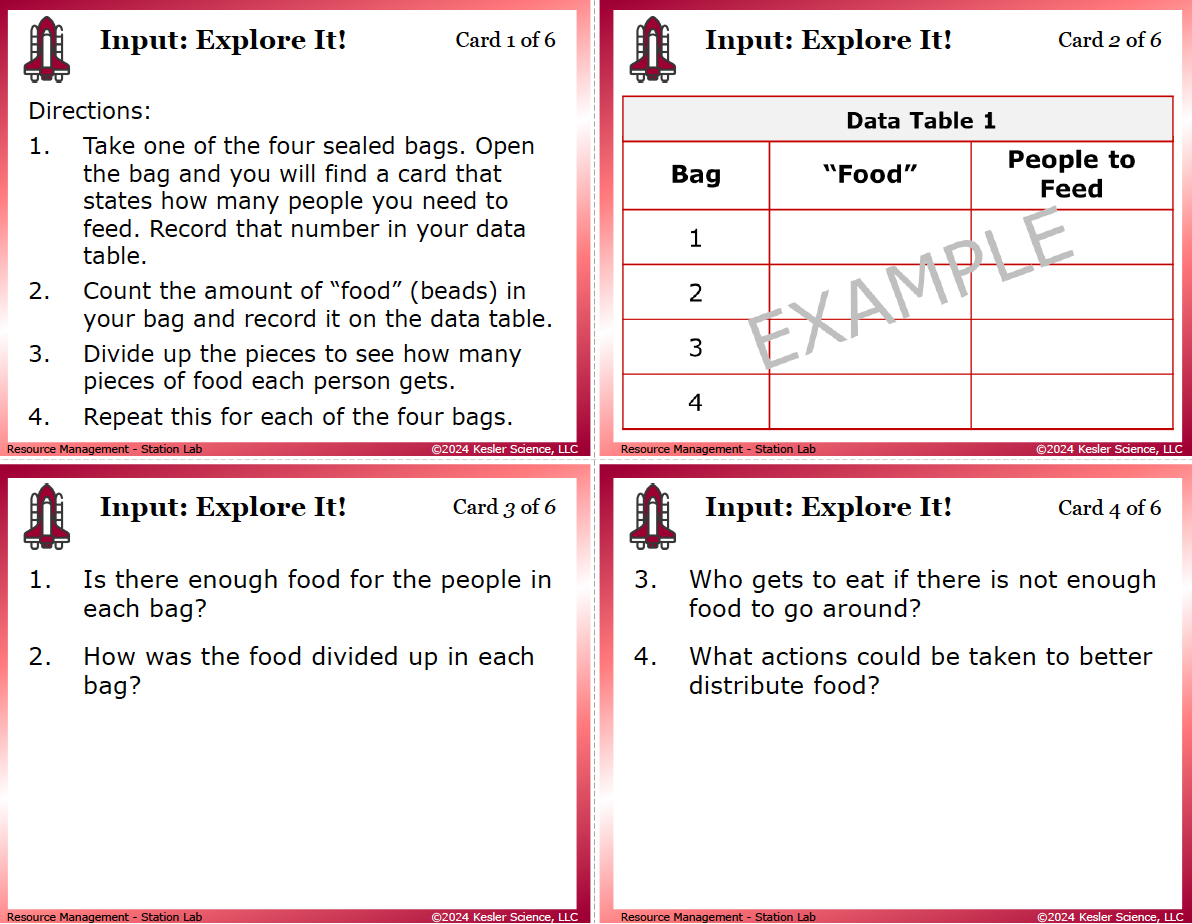
This is the heart of the lab. Students open four sealed bags. Each bag contains a card stating how many "people" need to feed and a count of "food" (beads). The bags are intentionally uneven: some have plenty for the people listed, others have far too little. Students record the numbers, divide the food, and find that some groups go hungry while others have surplus. Seven questions follow: where in the world might each bag represent, who eats when there isn't enough, and how could food be more equally distributed. The shared-bead-bag moment is when global resource inequality stops being abstract.
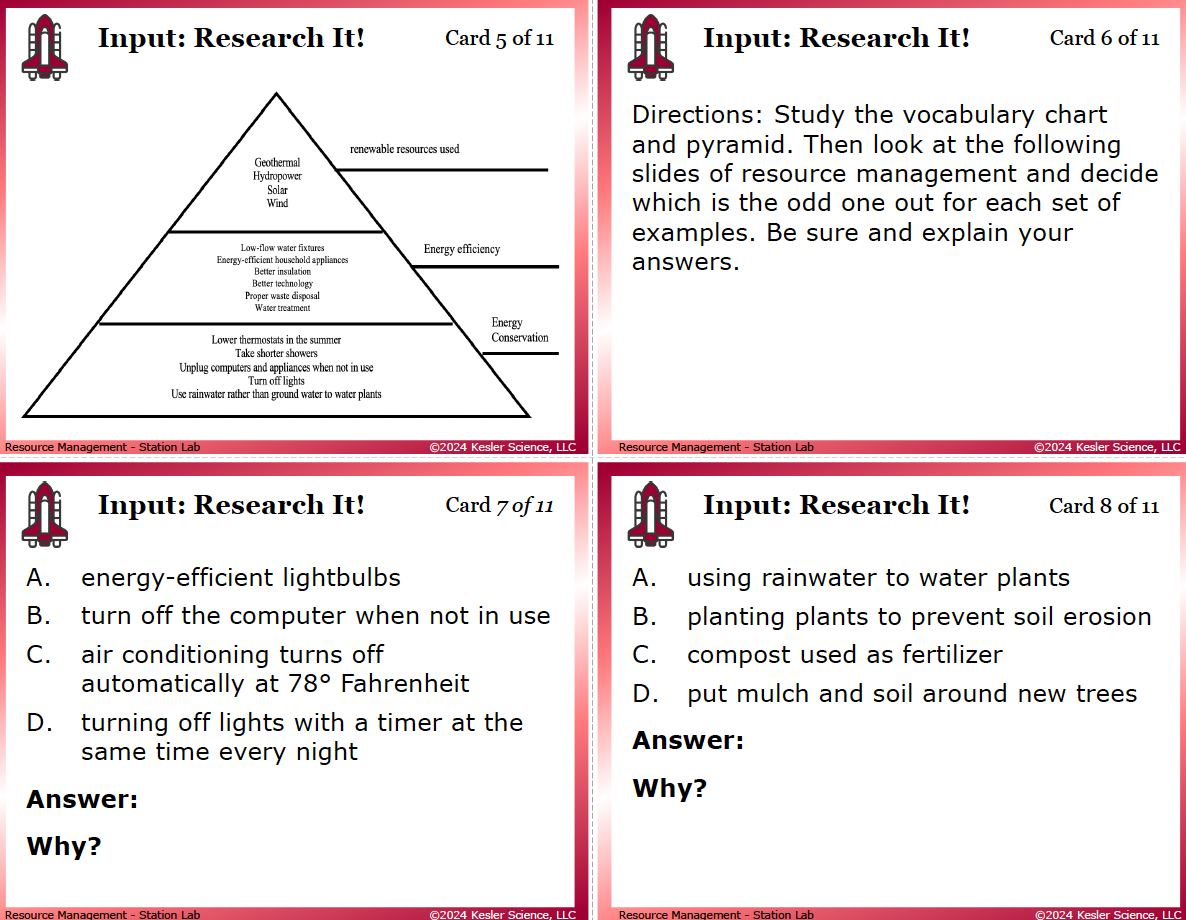
Students examine 11 reference cards covering vocabulary (conservation, efficiency, energy, recycling, resources, soil resources, technology, water resources) and a three-tier resource management pyramid: conservation actions at the base (lower thermostats, take shorter showers, unplug appliances), efficiency in the middle (low-flow fixtures, energy-efficient appliances, better insulation), and renewable resources at the top (geothermal, hydropower, solar, wind). Then five "odd one out" sets where they identify which item doesn't belong with the others (e.g., a list of energy conservation tips with one efficiency item that doesn't fit). Forces sorting and reasoning at once.
4 output stations: how students show what they learned
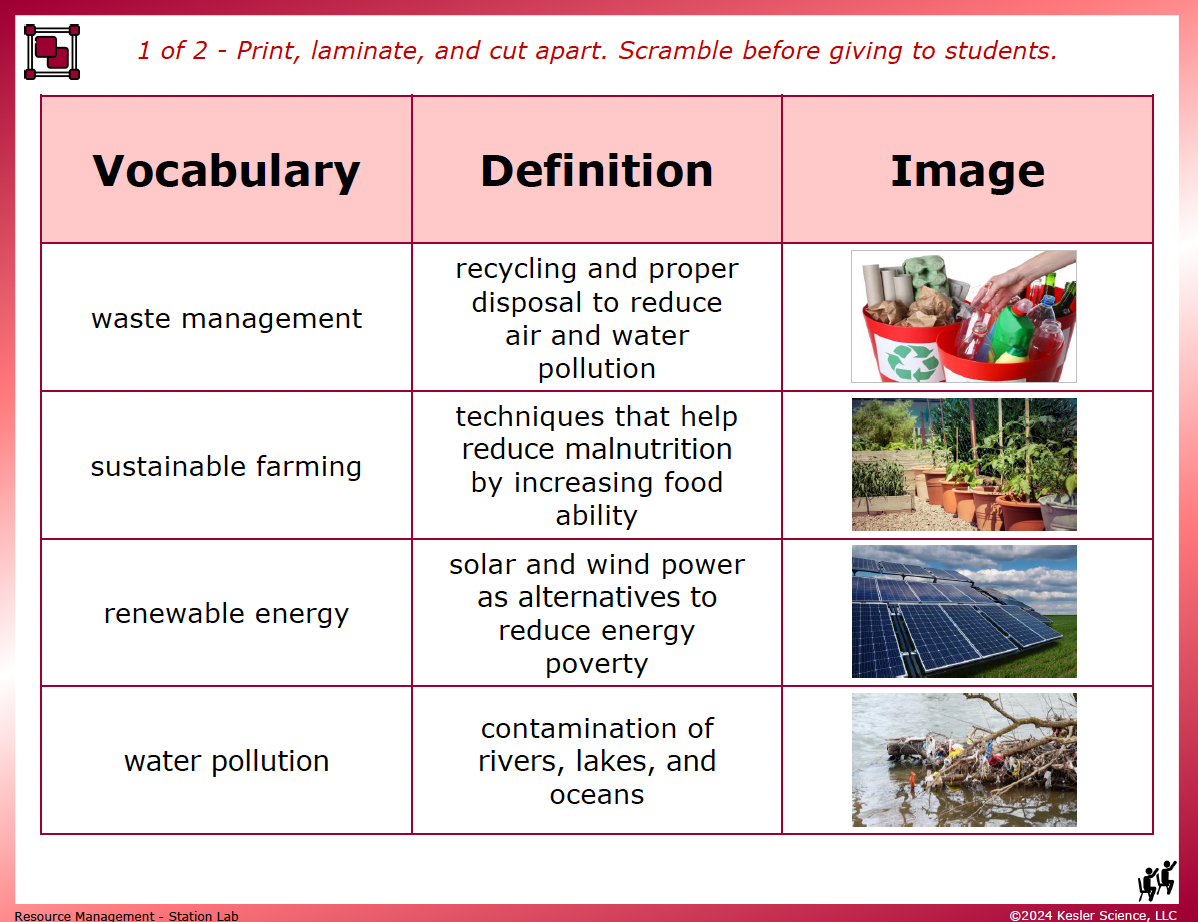
A vocabulary-definition-image card sort. Kids match eight terms (waste management, sustainable farming, renewable energy, water pollution, air pollution, malnutrition, global energy poverty, resource management) to their definitions and a representative photo. The image piece is what makes it click: kids see polluted rivers, garden vegetables, solar panels, and wood fires next to the words and lock the connections in. Easy to spot-check at a glance.
Students draw a side-by-side before-and-after scene. The left side shows a world with poor resource management: polluted air and water, scarce food, and people using old energy methods like wood fires. The right side shows a world with effective resource management: clean air, abundant food, solar panels, wind turbines. The contrast forces kids to think about every category at once. Different colors make the contrast pop.
Three open-ended questions: how does effective management of renewable energy resources help reduce global energy poverty, describe the connection between sustainable farming practices and the reduction of malnutrition, and what practices can decrease the amount of waste that you produce and why. The third question is personal and forces kids to apply what they've learned to their own lives.
Eight multiple-choice and fill-in-the-paragraph questions tied to TEKS 6.11A vocabulary (resource management, energy poverty, malnutrition, conserve, air pollution). Includes which actions belong on a poster about water conservation, how to manage resources to increase energy access (clean energy like solar and wind, NOT free energy or moving people to cities), what energy poverty actually means, and a fill-in paragraph that weaves all five vocab words together. If you're grading the lab, this is the easiest station to grade.
Bonus Challenge It! station for early finishers
Four optional extensions: design a comic strip illustrating energy poverty improving over time, build a concept map showing the relationships between resources, energy poverty, malnutrition, pollution, and renewable energy, design an infographic explaining why resource management matters, or write a research piece on why resource management is important globally. Requires teacher approval before they start.
How this fits into a complete resource management unit
This Station Lab is the Explore day of our full Resource Management Complete 5E Lesson for TEKS 6.11A. The complete two-week unit follows the 5E method of instruction and includes an Engage hook, the Resource Management Station Lab for Explore, PowerPoint slides and interactive notebook pages for Explain, student choice projects to Elaborate, and an Evaluate assessment.
Most teachers grab the full 5E because the Station Lab lands hardest with the days around it. But if you just need a strong hands-on day on resource management, the Station Lab on its own does the job.

Get this resource management activity

Or if you want the full two-week experience with the Engage hook, Explain day, Elaborate extension, and Evaluate assessment all included:
(Station Lab is included)
Frequently asked questions
What does TEKS 6.11A cover?
Texas TEKS 6.11A asks 6th grade students to identify and analyze advantages and disadvantages of various methods of conserving energy resources, water resources, and soil resources. Students should be able to define resource management, recognize problems like energy poverty and malnutrition, distinguish between conservation, efficiency, and renewable energy, and connect personal choices to global outcomes.
Is this kids' first time meeting energy poverty and malnutrition?
Yes for most 6th graders. They've heard "saving electricity" their whole lives, but the formal vocabulary (energy poverty, malnutrition, sustainable farming, renewable energy) and the connection to global problems is brand new. The Read It! passage introduces all five vocab words in bold, the Watch It! video shows real-world impacts, and the Explore It! food-distribution activity makes scarcity physical.
How long does this resource management activity take?
One to two class periods (45 to 110 minutes total). The Explore It! food-distribution and Research It! odd-one-out reasoning are the most time-intensive pieces, so plan for two periods the first time you run a station lab. Once your class has the rotation routine down, most groups can finish all 8 stations in one period.
Do I need a lot of supplies for this?
Almost nothing. Some bags, beads, and index cards. Total cost for a class of 30 if you're starting from nothing: under $10. The materials are reusable across class periods. The Watch It! station also needs a device with internet.
Can I use this in a 1:1 digital classroom?
Yes. The full digital version (PowerPoint or Google Slides) works in 1:1 classrooms and Google Classroom. Students drag digital cards in the Organize It! slide and complete the data table digitally. The Explore It! food-distribution activity is harder to digitize. You can substitute a digital simulation that distributes resources unevenly across virtual regions, but the physical bags are more memorable.