
8 hands-on stations for teaching matter and kinetic energy
A station lab is a student-led activity where small groups rotate through 8 stations (plus a 9th challenge station for early finishers) at their own pace during one to two class periods. You become a facilitator instead of a lecturer. You walk around, spot-check, and break misconceptions while kids work through the rotation.
The Matter and Kinetic Energy Station Lab has four input stations (where students take in new info on particles, states of matter, and kinetic energy) and four output stations (where they show what they learned). Here's what's at each one.
4 input stations: how students learn particles and kinetic energy
A short YouTube video where the narrator walks people through what really makes frozen water different from liquid water. Kids answer three questions: what makes ice different from water, the major difference between solids, liquids, and gases, and what "de-exciting" means in the context of cooling matter down. Visual learners hook in fast at this station because the video shows particle motion that's hard to picture from words alone.
A one-page passage called "States of Matter: The Classroom Chronicles" walks students through an analogy: sitting at desks is like a solid, walking the hallway between classes is like a liquid, riding their bike outside is like a gas. The vocabulary is bolded throughout (particles, structure, states of matter, molecule, kinetic energy). Three multiple-choice questions follow, plus the vocab notes section. Comes in two reading levels (Dependent and Modified) plus a Spanish version.
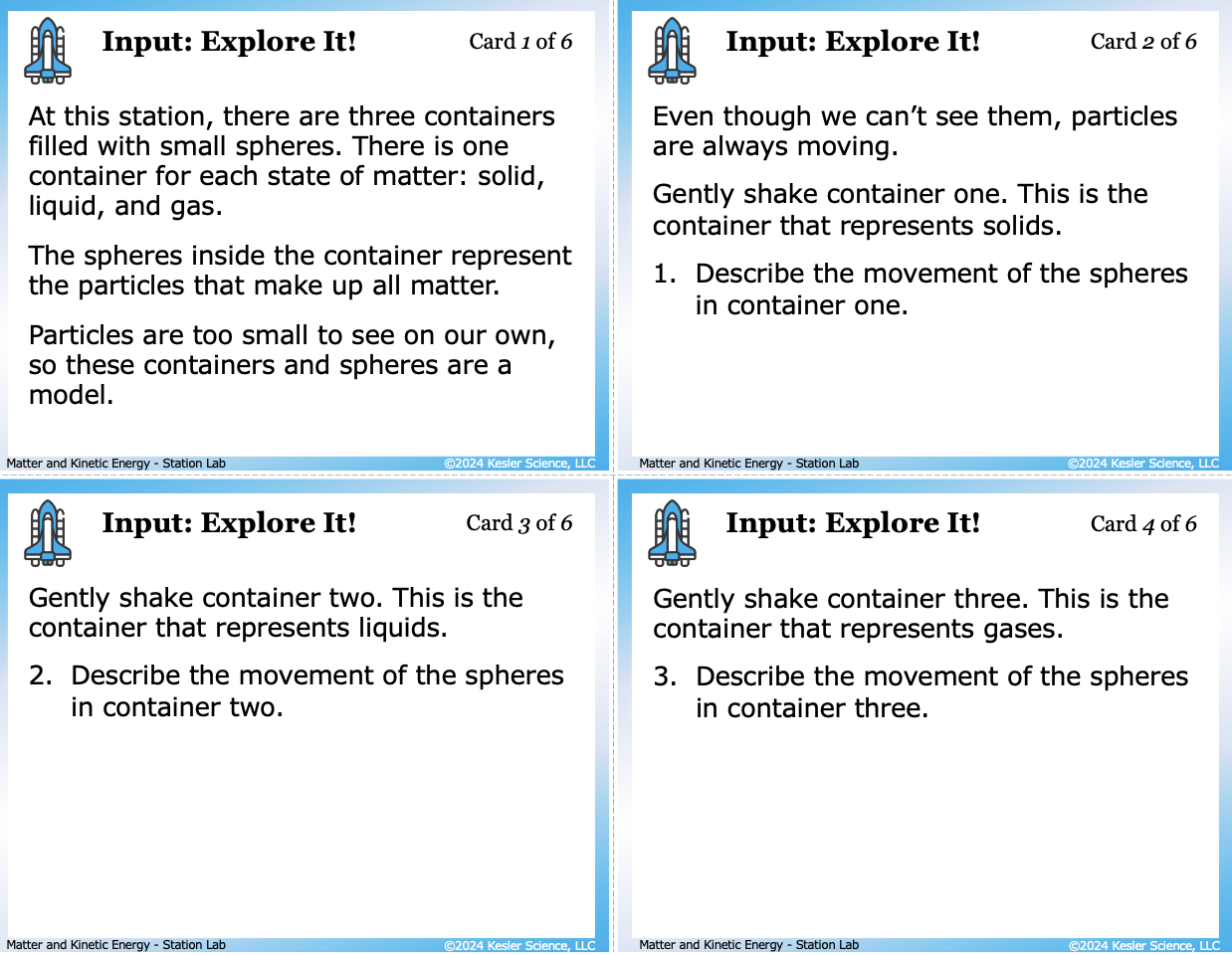
This is the heart of the lab. Three sealed containers, each filled with small spheres, sit at the station. One represents solids, one liquids, one gases. Kids gently shake each container and watch the difference. The solid spheres barely move. The liquid spheres slide around each other. The gas spheres bounce all over the place. Eight questions walk them through the observations and ask them to identify limits of the model. By the end, kids have physically seen the kinetic energy difference between the three states.
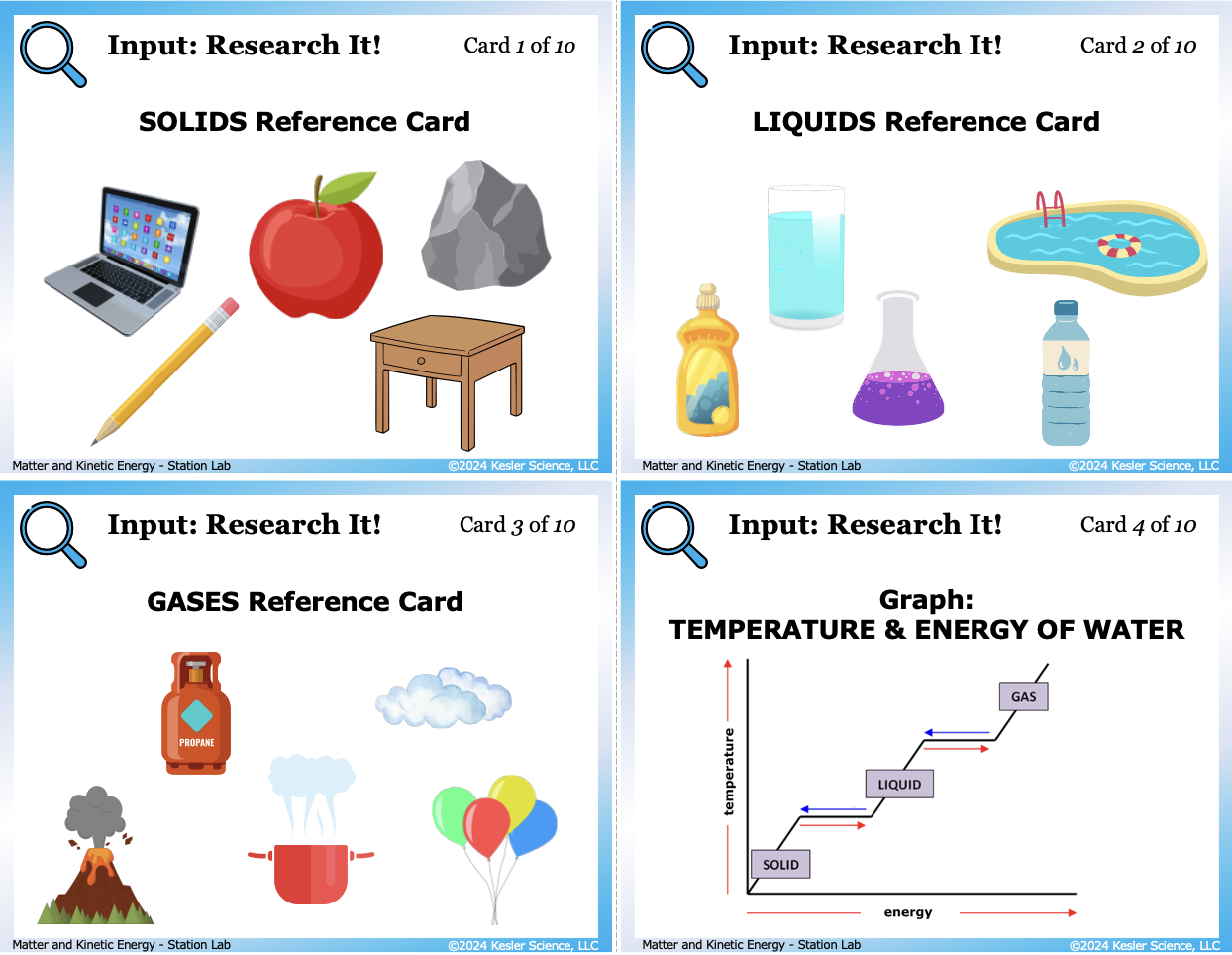
Students examine 10 reference cards: a SOLIDS card (computer, apple, pencil, rock, table), a LIQUIDS card (dish soap, water, beaker chemical, water bottle, pool), a GASES card (propane tank, cloud, steam from a pot, balloons, volcanic gas), and a temperature-vs-energy graph for water as it changes state. Eight questions walk students through the shapes of each state, what happens to volume when you change containers, and what the graph tells us about the relationship between temperature and kinetic energy.
4 output stations: how students show what they learned
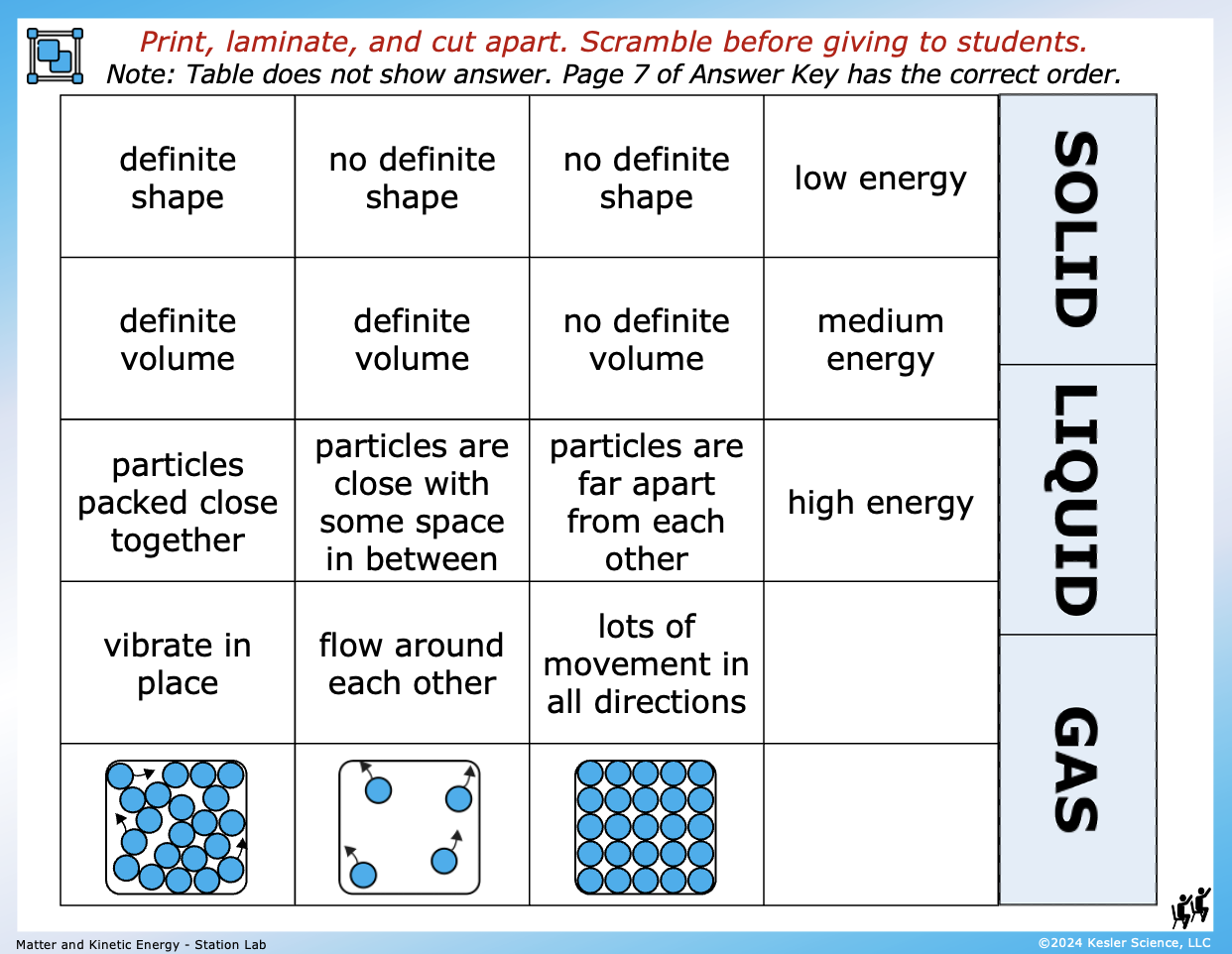
A card sort. Kids organize 12 property cards into three columns labeled SOLID, LIQUID, and GAS. The properties cover shape ("definite shape" vs "no definite shape"), volume ("definite volume" vs "no definite volume"), particle arrangement ("packed close together" vs "close with some space" vs "far apart"), particle movement ("vibrate in place" vs "flow around each other" vs "lots of movement in all directions"), and energy level (low, medium, high). Easy to spot-check at a glance.
Students draw three boxes side by side, one for a solid, one for a liquid, and one for a gas, with arrows showing energy increasing left to right. Inside each box they sketch what the particles look like and label the shape, structure, volume, and energy level. Even kids who say "I can't draw" surprise themselves here. The visual locks in the differences between the three states.
Three open-ended questions: what happens to the shape and volume of a liquid when you divide it into two containers, how the structure and energy of an ice cube's particles change when it's heated, and how the energy of particles affects their structure and the space they take up. This is the writing practice middle schoolers need and rarely get in science class.
Eight multiple-choice and fill-in-the-paragraph questions tied to TEKS 6.6A vocabulary (particles, structure, states of matter, molecule, kinetic energy). Includes the relationship between states of matter and kinetic energy, what happens when a liquid becomes a solid, and the movement of particles in a solid. The fill-in paragraph weaves all five vocabulary words together. If you're grading the lab, this is the easiest station to grade.
Bonus Challenge It! station for early finishers
Four optional extensions: write an acrostic poem using the phrase "Matter and Kinetic Energy," build a Venn diagram comparing solids, liquids, and gases, design a bookmark with the properties of all three states, or build a 10-word vocabulary crossword puzzle (paper or digital). Requires teacher approval before they start.
How this fits into a complete matter and kinetic energy unit
This Station Lab is the Explore day of our full Matter and Kinetic Energy Complete 5E Lesson for TEKS 6.6A. The complete two-week unit follows the 5E method of instruction and includes an Engage hook, the Matter and Kinetic Energy Station Lab for Explore, PowerPoint slides and interactive notebook pages for Explain, student choice projects to Elaborate, and an Evaluate assessment.
Most teachers grab the full 5E because the Station Lab lands hardest with the days around it. But if you just need a strong hands-on day on particles and kinetic energy, the Station Lab on its own does the job.

Get this matter and kinetic energy activity

Or if you want the full two-week experience with the Engage hook, Explain day, Elaborate extension, and Evaluate assessment all included:
(Station Lab is included)
Frequently asked questions
What does TEKS 6.6A cover?
Texas TEKS 6.6A asks 6th grade students to investigate and describe how particles in solids, liquids, and gases differ in their structure, shape, and motion. Students should understand that all matter is made of particles in motion (kinetic energy) and that the amount and type of motion is what distinguishes the three states. They should be able to look at an object and describe what its particles are doing.
Is this kids' first time meeting kinetic energy?
For most 6th graders, yes. They've heard "energy" before, but "kinetic energy" as a specific term tied to particle motion is brand new. The Read It! passage introduces the term in bold, the Research It! station ties it to the temperature-and-energy graph, and the Organize It! card sort makes them match the right energy level (low, medium, high) to the right state. By the end of the lab, kinetic energy stops being abstract and becomes "how much the particles are moving."
How long does this matter and kinetic energy activity take?
One to two class periods (45 to 110 minutes total). The Explore It! station's hands-on shaking activity is the highlight, so plan for two periods the first time you run a station lab. Once your class has the rotation routine down, most groups can finish all 8 stations in one period.
Do I need a lot of supplies for this?
Three small sealed containers with spheres for the Explore It! station, plus colored pencils. Total cost for a class of 30: under $10 if you're starting from nothing. Pill bottles, small mason jars, and pony beads from the craft store are all you need. The Watch It! station also needs a device with internet.
Can I use this in a 1:1 digital classroom?
Yes. The full digital version (PowerPoint or Google Slides) works in 1:1 classrooms and Google Classroom. Students drag the digital reference cards instead of physically modeling. The Explore It! shaking demo is harder to digitize, but you can replace it with a particle-motion simulation video or a PhET simulation if you don't have the supplies.