
8 hands-on stations for modeling Earth's tilt and seasons
A station lab is a student-led activity where small groups rotate through 8 stations (plus a 9th challenge station for early finishers) at their own pace during one to two class periods. You become a facilitator instead of a lecturer. You walk around, spot-check, and break misconceptions while kids work through the rotation.
The Model Earth's Tilt and Seasons Station Lab has four input stations (where students take in new info on tilt, orbit, solstices, and equinoxes) and four output stations (where they show what they learned). Here's what's at each one.
4 input stations: how students learn what causes seasons
A short YouTube video tackles the closer-to-the-Sun misconception head-on. Three questions follow: what the narrator says is wrong about typical Earth-Sun textbook diagrams, what two things cause hours of daylight to change over a year, and why the North Pole is not the hottest place on Earth during summer (it gets 24 hours of daylight in June but the rays hit at such a low angle that it stays cold). Visual learners come alive at this station because the video shows the same Earth from multiple angles to drive the tilt point home.
A one-page passage called "From Beach Parties to Equinoxes" frames the seasons around a June 21st beach party (the summer solstice). It walks students through Earth revolving on a 23.5-degree tilted axis, the difference between solstices and equinoxes, and direct vs. indirect sunlight. The vocabulary is bolded throughout (revolves, solstice, equinox, direct sunlight, indirect sunlight). Three multiple-choice questions follow, plus the vocab notes section. Comes in two reading levels (Dependent and Modified) plus a Spanish version.
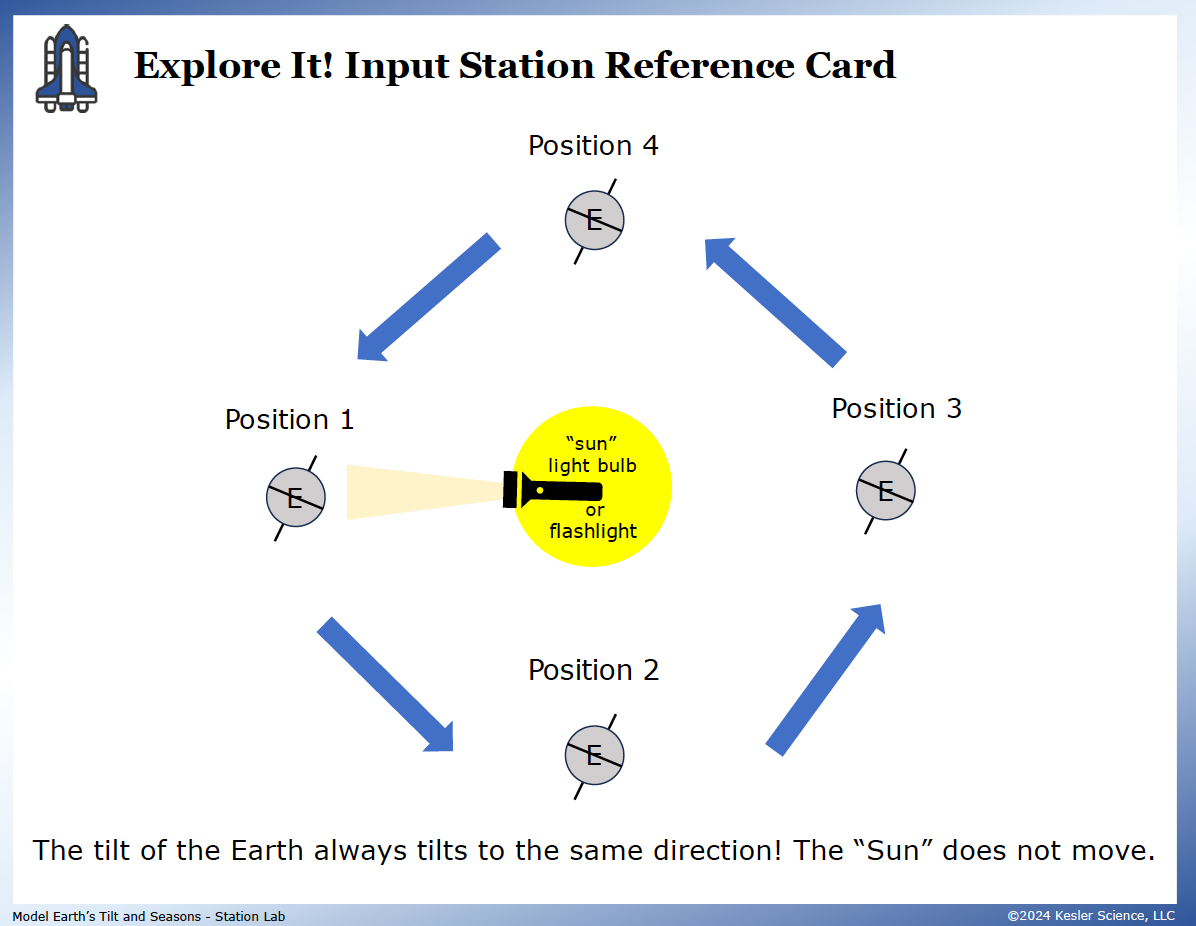
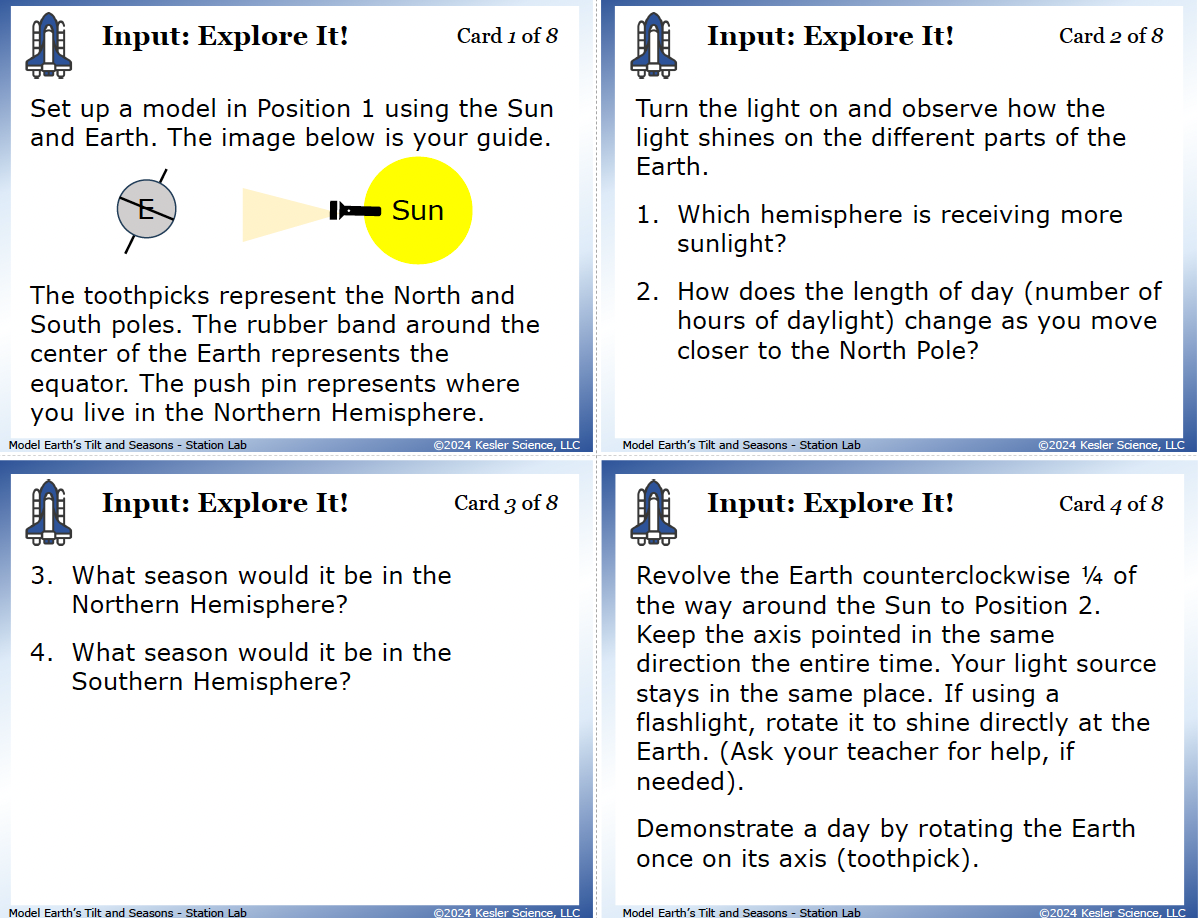
This is the heart of the lab. Students set up a foam-ball Earth on a toothpick axis with a rubber band equator and a push pin marking their location in the Northern Hemisphere. A flashlight or lamp serves as the Sun. They rotate the Earth around four positions on the table while keeping the axis pointed the same way the entire time. At each position they answer questions: which hemisphere gets more direct sunlight, how does daylight length change near the North Pole, what season is it in each hemisphere. Eleven questions across the four positions. The aha moment is when kids see the same tilted Earth produce summer in one position and winter in the position across the table without ever changing the tilt.
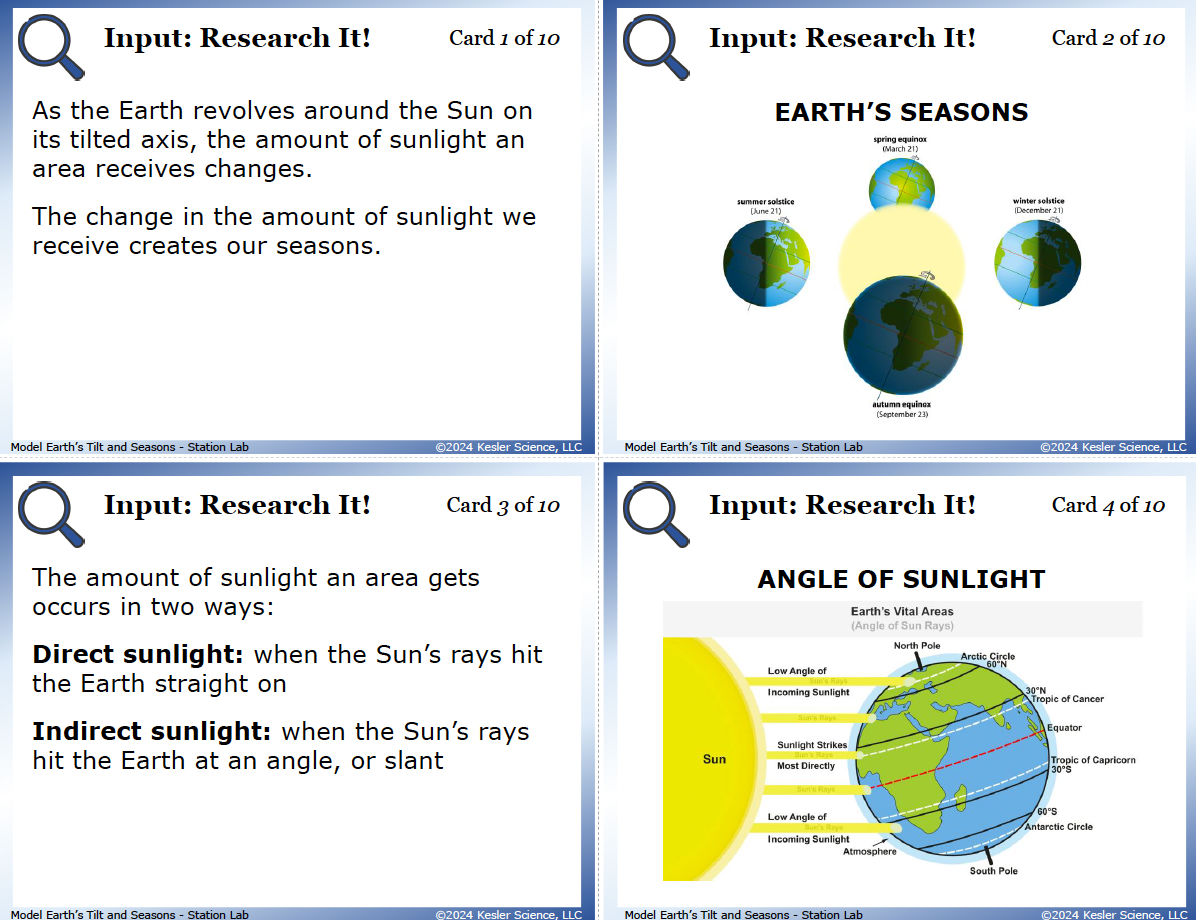
Students examine 10 reference cards covering Earth's seasons diagram, direct vs. indirect sunlight angles, length of day data tables, and average temperature charts at five latitudes (Equator, Tropic of Cancer, Tropic of Capricorn, Arctic Circle, Antarctic Circle). Four questions check whether they can compare daylight at different latitudes, identify where temperature stays steady year-round (and why), figure out which hemisphere is having summer during a winter solstice, and predict day-length changes from solstice to solstice based on patterns.
4 output stations: how students show what they learned
A two-column card sort. Kids match descriptions to either Solstice or Equinox. Examples: "June 21, when the Northern Hemisphere experiences the longest day of the year" goes under Solstice, "March 21, when both hemispheres enjoy nearly equal amounts of daylight and darkness" goes under Equinox, "Sun's rays are directly overhead at the equator at noon" goes under Equinox, "Sun's rays are directly overhead at the Tropic of Cancer or the Tropic of Capricorn" goes under Solstice. Easy to spot-check at a glance.
Students sketch the tilted Earth at four positions revolving around the Sun. They label the seasons in each hemisphere, mark the tilt of the axis on each Earth (always pointing the same direction), and add arrows showing the direction of revolution. Different colors for the Northern and Southern Hemisphere seasons make the contrast pop. The picture is essentially a static version of the Explore It! model, which is why this station works so well after kids have already done the physical activity.
Three open-ended questions: describe the Sun at the North Pole during the summer solstice (24 hours of daylight, sun never sets), explain the difference between direct and indirect sunlight in terms of temperature and intensity, and explain why summer in the Northern Hemisphere happens at the same time as winter in the Southern Hemisphere. This is the writing practice middle schoolers need and rarely get in science class.
Eight multiple-choice and fill-in-the-paragraph questions tied to TEKS 6.9A vocabulary (revolves, solstice, equinox, direct sunlight, indirect sunlight). Includes which event brings indirect sunlight to the Northern Hemisphere, what happens in the Southern Hemisphere when the Northern Hemisphere is at the summer solstice, and the likely cause if Earth suddenly stopped having seasons. The fill-in paragraph weaves all five vocab words together. If you're grading the lab, this is the easiest station to grade.
Bonus Challenge It! station for early finishers
Four optional extensions: build a 3D model of the Earth-Sun system showing all four seasons, create a five-page flipbook showing the positions of Earth and Sun for each season, write an interview with the Earth as it revolves around the Sun, or create a TikTok or Instagram Reel that models tilt and seasons using all the vocabulary. Requires teacher approval before they start.
How this fits into a complete tilt and seasons unit
This Station Lab is the Explore day of our full Model Earth's Tilt and Seasons Complete 5E Lesson for TEKS 6.9A. The complete two-week unit follows the 5E method of instruction and includes an Engage hook, the Model Earth's Tilt and Seasons Station Lab for Explore, PowerPoint slides and interactive notebook pages for Explain, student choice projects to Elaborate, and an Evaluate assessment.
Most teachers grab the full 5E because the Station Lab lands hardest with the days around it. But if you just need a strong hands-on day on tilt and seasons, the Station Lab on its own does the job.

Get this Earth's tilt and seasons activity

Or if you want the full two-week experience with the Engage hook, Explain day, Elaborate extension, and Evaluate assessment all included:
(Station Lab is included)
Frequently asked questions
What does TEKS 6.9A cover?
Texas TEKS 6.9A asks 6th grade students to model and illustrate the cause of seasons on Earth as a result of the tilt of Earth's axis as it orbits the Sun. Students should be able to explain that Earth's 23.5-degree tilt causes different parts of Earth to receive direct vs. indirect sunlight at different times of year, leading to seasons. They should distinguish between solstices and equinoxes and recognize why the Northern and Southern Hemispheres have opposite seasons.
Is this kids' first time meeting solstices and equinoxes?
Yes for most 6th graders. They've heard "summer" and "winter" all their lives but they've never connected those words to a specific tilt of an axis or a specific position in an orbit. The Read It! beach-party passage introduces solstice and equinox in bold, the Watch It! video provides the visual anchor, and the Explore It! foam-ball model makes the geometry physical.
How long does this Earth's tilt and seasons activity take?
One to two class periods (45 to 110 minutes total). The Explore It! station's four-position model is the longest piece, so plan for two periods the first time you run a station lab. Once your class has the rotation routine down, most groups can finish all 8 stations in one period.
Do I need a lot of supplies for this?
Foam balls, toothpicks, rubber bands, push pins, and flashlights. Total cost for a class of 30: under $25 if you're starting from nothing, less if you already have flashlights. Each Earth model is reusable, so the cost is essentially one-time. The Watch It! station also needs a device with internet.
Can I use this in a 1:1 digital classroom?
Yes. The full digital version (PowerPoint or Google Slides) works in 1:1 classrooms and Google Classroom. Students drag a digital tilted Earth around a digital Sun in the slides instead of physically modeling. The Explore It! foam-ball activity is harder to digitize. You can substitute a NASA tilt-and-seasons simulation if you don't have the supplies, but the physical model lands harder.