.png?width=375&height=100&name=WebPage%20logo%20with%20curves%202026%20(8).png)
For the first several years of my teaching career, my end-of-year send-off was pretty forgettable. We'd watch a movie, eat popcorn, sign yearbooks, and that was it. The kids walked out the door, and I went home feeling like I'd missed something. I'd just spent 180 days with these humans, and I sent them off with a Disney movie and a high five.
Then one summer, I sat down and made a list. I tried to write something specific I appreciated about every single student I'd taught that year. Not "good kid" or "tries hard." Something real. The girl who asked the best follow-up questions during labs. The boy who quietly helped his table partner without ever being asked. The student who turned every Bell Ringer into a debate, I didn't know I needed.
That list became the first version of an end-of-year awards ceremony. The kids loved it. Parents emailed me about it for weeks. And more than one student told me years later that their certificate was still hanging on their bedroom wall.
This is the last chance you get all year to make a positive impact on how your students feel about you, the school, and their own self-worth. By giving them a positive message at the end of the year, you're telling them they matter. You're planting the seed for their future teachers and bosses, too.
If you've ever wanted to send your students off with something they'll actually remember, this is the post for you. I'm going to walk you through why end-of-year science awards work, how I ran ceremony day in my classroom, which awards to give to which kids, and the three ready-made award sets I built so you don't have to design certificates from scratch. Don't worry. I've got you covered.
Let's get into it.
Why end-of-year science awards beat any other classroom send-off
Awards day is the one moment all year where every student gets called up by name and told, out loud, in front of their peers, something specific you noticed about them. That's a different kind of recognition than a grade on a paper. A grade tells a kid how they performed on a task. An award tells them who they are.
I'll be honest. I underestimated this for years. I thought the report card was the message. It isn't. The report card is the receipt. The award is the message.
There's a real science to this, too. Middle schoolers are in the middle of building their identity. The labels they collect during these years tend to stick with them. If the only labels they're getting are grades and behavior notes, they're missing the most important one: someone saw them. Someone who taught them science for an entire year noticed who they actually were as a person.
And here's the kicker. The quiet kids, the kids who never get nominated for anything, the kids whose parents have never gotten a positive phone call from school... those are the kids this matters most for. When you build it right, awards day is the day they finally get called up.
How I ran awards day in my science classroom
I want to walk you through exactly how I ran this, because the ceremony itself is half of why it works. The other half is the certificates, which I'll get to in a minute.
Step one: I set the tone before they walked in.
Right before awards day, I'd start the class by telling every student that for the next 45 minutes there will be nothing but positivity coming out of everyone's mouths. No sarcasm, no eye rolls, no inside jokes that leave somebody out. Setting that expectation up front is what fends off any unnecessary comments as awards are handed out. I never had a kid who couldn't do it. When you frame it that way, they rise to it.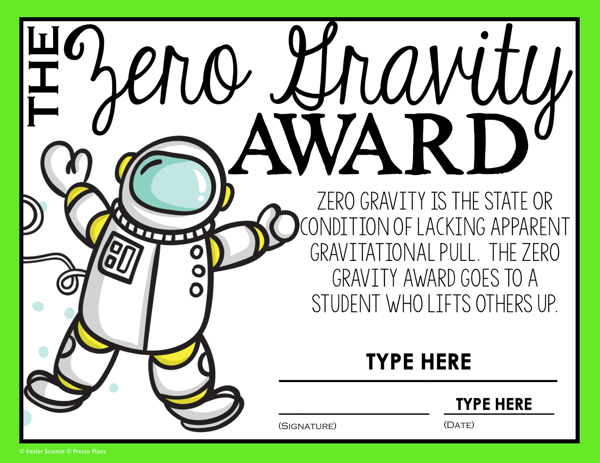
Step two: I put the certificate on the screen before I called the name.
I used the document camera and dropped each certificate under it, but covered the student's name with a sticky note. Then I'd read the description out loud. "This award goes to a student who bonds and interacts well with others." The class would start guessing who it was. By the time I peeled the sticky note off, half the room had already figured it out and the recipient was beaming.
This tiny detail is what turned the ceremony from a list of names into an event. The class was invested. They were rooting for each other.
Step three: I read the description, then I added my own line.
The certificate text gives you the science concept and the personality trait. But I'd add one specific thing. "The reason Maya is getting the magnetism award is because every single time we did group work, kids wanted to be at her table. She pulls people in." That one extra sentence is the thing the student remembers.
Step four: Photos and the wall.
I'd snap a photo of each student holding their award. Parents got a copy. I'd also let the students take pictures with their own phones, because this is exactly the kind of stuff we want them sharing on social media. Create a custom hashtag for the class (something like #keslerawards) and you'll see those posts roll in for weeks. Several parents printed the photos out and framed them.
Step five: We celebrated as a class.
After every name was called, I gave a short speech. Nothing dramatic. Just a "this is who you were as a science class this year" reflection. Then we did snacks. The ceremony took the full 45 minute period, which felt right.
That's it. No fancy speaker system, no auditorium, no parents in the room. Just the class, the certificates, and a teacher who took the time to notice. That's all it has to be.
The three end-of-year science award sets I built for you
I'll save you the time I spent the first few years staring at a blank Word document trying to design certificates. I built three different sets and you can grab whichever fits your classroom, or grab all three in a bundle for less.
Here's a breakdown of what's in each one and which kind of teacher should grab which.
The Scientists Awards (40 awards)
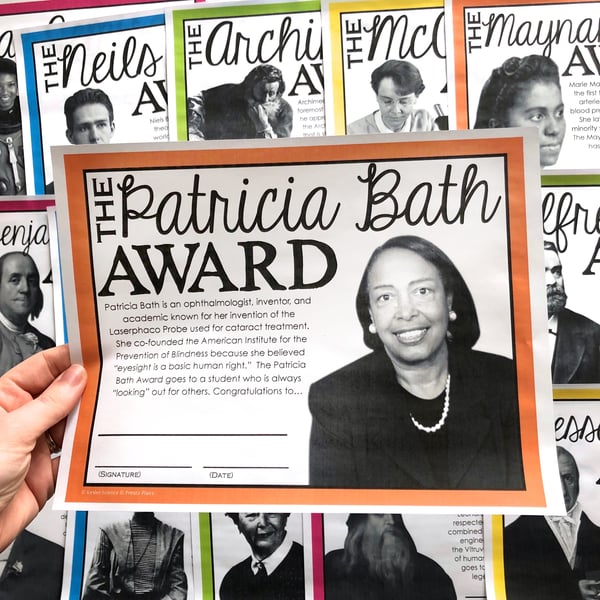
This set is built around 40 famous scientists, each one tied to a specific student personality trait or achievement. So instead of giving out "most improved" or "best participation," you're giving "The Marie Curie Award" or "The Mae Jemison Award." Each certificate includes brief biographical information about the scientist as well as an explanation for how it relates to the recipient.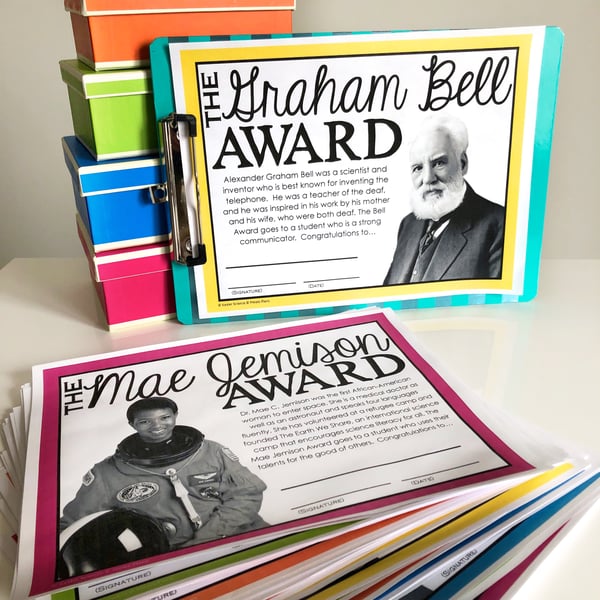
A few you'll find in the set:
- Isaac Newton for the student whose curiosity drives them to keep asking why
- Marie Curie for the student who refuses to give up on a hard problem
- Ada Lovelace for the student who connects ideas other people don't see as connected
- Mae Jemison for the student who leads with confidence and inspires others
- Patricia Bath for the student who comes up with creative solutions nobody else thought of
- George Washington Carver for the student who takes care of the world around them
- Garrett Morgan for the student whose ideas are always one step ahead
- Galileo Galilei for the student who questions assumptions and isn't afraid to push back
- Charles Darwin for the curious observer who notices things others miss
- Nikola Tesla for the student whose imagination runs ahead of everyone else
The full set has 40 scientists, with strong representation across gender, race, time period, and scientific field. That last part matters. Every kid in your room should be able to look at this lineup and see themselves in at least one of these scientists.
This set is for you if: you want your awards to do double duty as a final mini-lesson. Every certificate is a tiny biography. Kids walk out of your room knowing about scientists they may have never heard of, including ones who don't usually show up in the textbook.
The Science Concept Awards (60 awards)
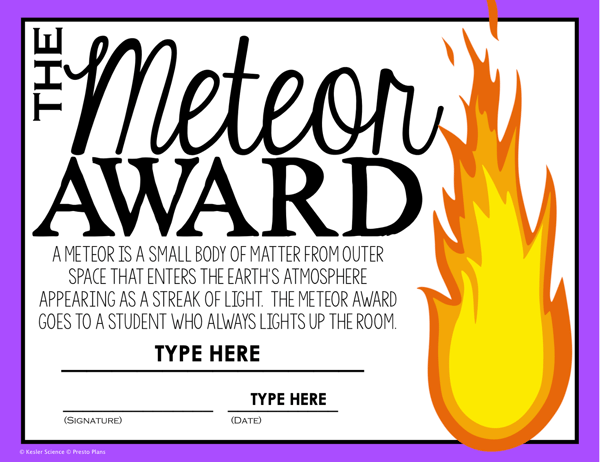
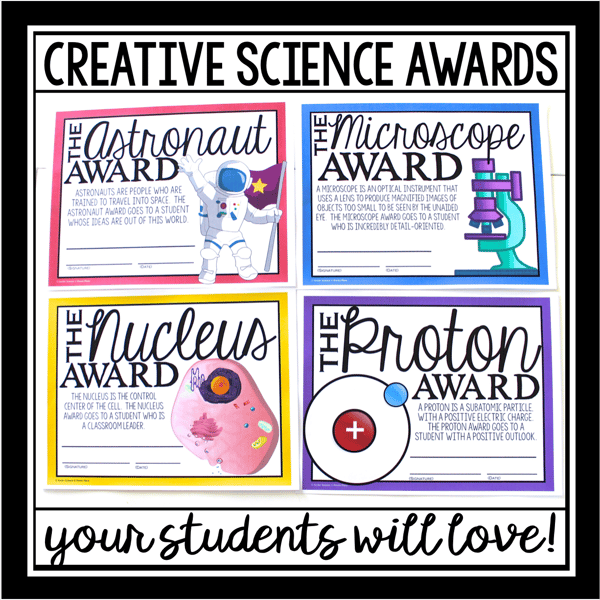
This is the most versatile set of the three, and probably the one I'd recommend if you can only grab one. It's 60 awards that each tie a real science concept to a personality trait. Each certificate includes a definition of the science concept as well as an explanation for how it relates to the recipient.
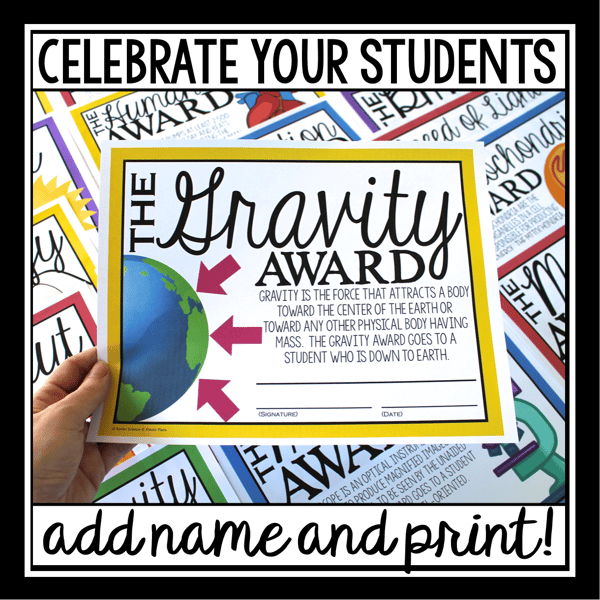
A few examples:
- The Nucleus Award for the classroom leader. The nucleus is the control center of the cell.
- The Mitochondria Award for the student who brings energy to the room. Mitochondria produce energy in the cell.
- The Magnetism Award for the student with a positive personality who attracts others.
- The Proton Award for the student with a positive outlook.
- The Photosynthesis Award for the student who turns whatever they're given into growth.
- The Audiology Award for the student who is a great listener.
- The Microscope Award for the student who notices the small details.
- The Periodic Table Award for the student who is naturally organized.
- The Speed of Light Award for the student who is always the first one done.
- The Thermometer Award for the student who reads the room and adjusts.
- The Ozone Layer Award for the student who looks out for everybody else.
- The Sirius A Award for the student who shines no matter what.
There are 60 in total, covering concepts from every major middle school science topic: cells, chemistry, space, weather, energy, Earth science, body systems, you name it. This means no matter what you taught this year, the awards reinforce content you actually covered.
This set is for you if: you teach a mix of science topics across the year and want awards that feel like a callback to what you actually learned together. The personality-to-concept link makes them memorable and gives you natural conversation starters when you read each one out loud.
Get the Science Concept Awards →
The Chemical Elements Awards (35 awards)
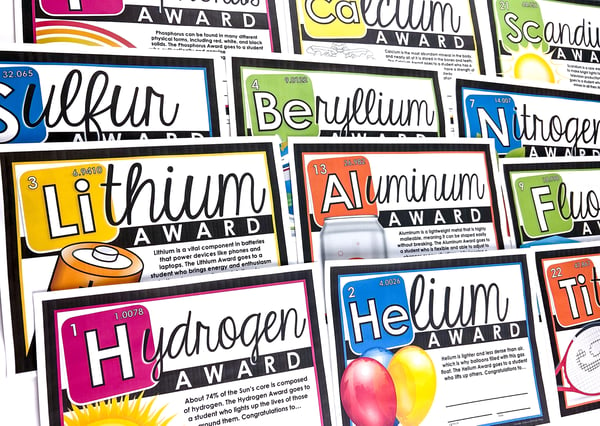
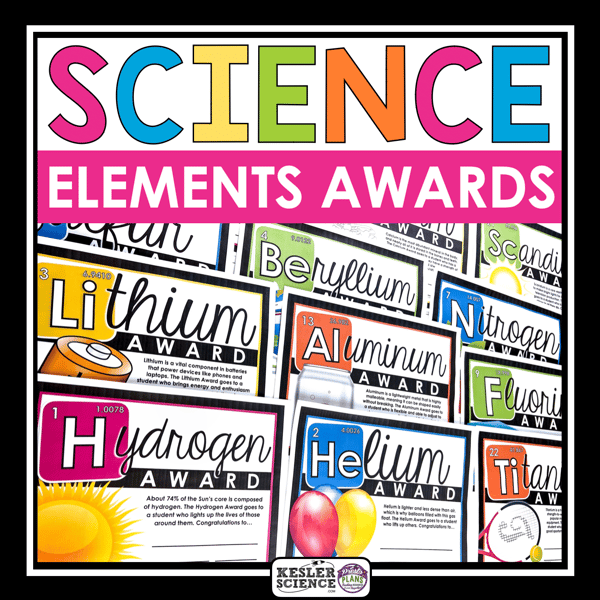
This is the specialty set, perfect for all the chemistry buffs in your classroom. Each award is a different element, and the certificate includes a fun fact about the element, its atomic mass and atomic number, and a specific student strength that ties back to the element's properties. If you teach chemistry or your year had a heavy chemistry unit, this set hits different. The kids will recognize every element on the certificate.
This set is for you if: you teach chemistry or have a class that did a lot of element and atomic structure work this year. It's also a great pick for high school teachers and for chemistry classrooms specifically, where you can hand out element awards that students actually understand and appreciate the meaning of.
Get the Chemical Elements Awards →
Or grab all three together: The End of Year Science Awards Bundle
If you teach more than one class, or if you teach a mix of topics, the bundle is the move. You get all 135 awards across the three sets at a discount versus buying them separately.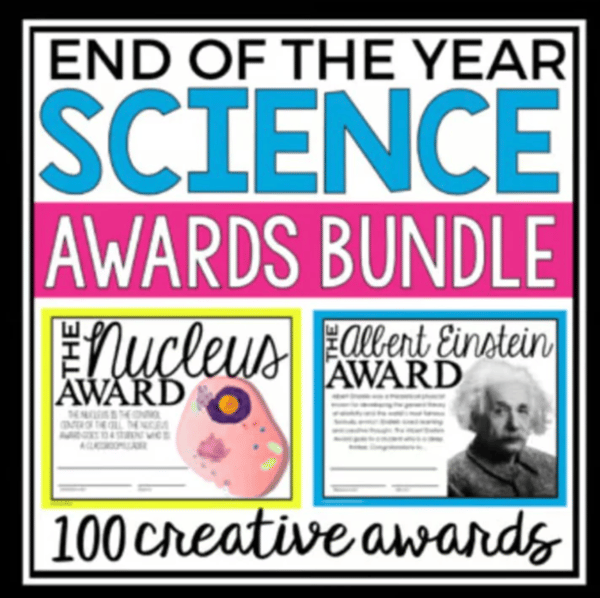
Honestly, the bundle is what most teachers end up grabbing. Here's why: with 135 different awards to choose from, you're never stuck handing out the same certificate twice. You can pick the exact award that fits each student, and you have enough variety to cover every class period you teach without repeating yourself.
That's the whole point. Every student deserves the award that's actually about them.
Get the Science Awards Bundle Here →
How to pick recipients without playing favorites
This is the part teachers ask about most. "How do I make sure I'm being fair?" "What if I miss somebody?" "What if a kid feels their award was a lesser one?"
Here's what worked for me.
Start with a class list, not the awards. Don't open the award files first. Open your roster. Write down one specific thing you genuinely appreciate about every single student. If you get stuck on a kid, that's a sign you need to spend a few minutes thinking about who that kid actually is. The award is the easy part. The noticing is the work.
Then match awards to students, not students to awards. Once you have your list of observations, scroll through the certificates and find the one that fits. You'll be surprised how natural the matches become. The boy who's always organizing his lab table? That's The Periodic Table Award. The girl whose questions always reframe the discussion? That's The Galileo Galilei Award.
Make sure every student gets something meaningful. This is the rule. No "participation" award, no "showed up" award, no recognition that feels like an afterthought. Every kid should get an award that, if you read it out loud at a family dinner, would land. If you can't think of something specific for a student, that's the work you need to do before awards day, not on awards day.
Don't rank. Don't do "first place" anything. Awards day isn't a podium. Every certificate is equal in weight. The student who gets The Mitochondria Award should feel just as recognized as the student who gets The Marie Curie Award. They're different, not better or worse.
For the quiet kids, dig deeper. The kids who never get noticed are the ones who matter most on this day. If you have a student you can't easily describe, ask yourself: what would I miss about them if they weren't in my class? That's your answer.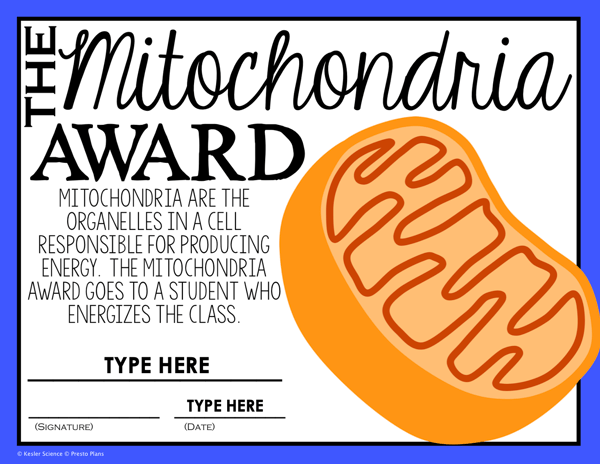
Tips for running your first awards ceremony
A few hard-won pieces of advice from running this for years.
Don't make speeches. Read the cards. I made this mistake the first year. I had a long intro speech, I made comments about every kid, the whole thing dragged. The kids checked out. The next year I let the certificates speak for themselves and just added one specific sentence per student. Much better.
Hold the ceremony before the last day. The last day of school is chaos. Permission slips, locker cleanouts, yearbooks. Run your ceremony two or three days before the last day so it has its own moment. The kids will remember it because it isn't getting drowned out.
Print on cardstock if you can. Regular paper is fine but cardstock makes the certificate feel like a thing. Parents are more likely to frame it, kids are more likely to keep it. Worth the extra few bucks.
Take the photos. I know teachers are sick of taking photos. Take these photos. Send them to the parents. The parents matter here too. A photo of their kid holding a certificate from their science teacher is the kind of thing that ends up on the fridge.
Let students nominate each other for a "class choice" bonus award. Some years I'd save one or two awards at the end for the class to vote on. It made the kids feel like they had a hand in the ceremony, and it always surfaced a kid I might have overlooked.
Get the science awards for your classroom
Here's the best part. You don't have to create the awards yourself. I've already done it for you with 135 unique science awards ready for your students. Whichever set you choose, all you have to do is print, sign and date, and you are done.
If you teach multiple classes or you want max flexibility, grab the bundle. If you teach one specific class or topic, pick the set that fits.
One last thing
If you take nothing else from this post, take this: your students will not remember the final grade you gave them. They will remember whether you saw them.
Awards day is your chance to tell every kid in your class, by name, in front of their peers, exactly who you saw them as for the past 180 days. The return on that investment is the kind of thing students remember for the rest of their lives.
Grab whichever award set fits your room. Print them. Run the ceremony. Send them off with something real.
That's how you close out a school year.