
Inside the Circulatory System Functions 5E Lesson
The 5E instructional model walks students through five phases: Engage, Explore, Explain, Elaborate, and Evaluate. It flips the traditional lecture-first sequence on its head. Students explore a concept hands-on before you ever explain it, which means by the time you do explain it, they have something to hook the vocabulary onto.
I switched to the 5E model years ago and stopped going back. Kids retain more, ask better questions, and stop staring at me waiting to be told the answer. The Circulatory System Functions 5E Lesson is built on this framework from start to finish. Here's how it plays out across the five phases.
🎯 Engage
Day one is a teacher-led hands-on exploration. Each small group gets a labeled diagram of the heart and body, a stack of "blood drop" tokens, and a path mat showing the lungs, the heart, and the body tissues. Following the teacher directions, they move a blood drop through the diagram, picking up and dropping off oxygen and carbon dioxide tokens at the right organs. The pulse activity (count your heart rate, do jumping jacks, count again) is built in as a warm-up.
By the end of the period, kids have the heart-and-body diagram annotated with oxygen-rich and oxygen-poor blood paths, a sketch of pulmonary vs. systemic circulation on their student sheet, and they can explain in their own words why the blood has to make two trips, not one. Nobody has heard a vocabulary lecture yet. That's the point. They walk into the rest of the unit with a working model of blood flow, not a memorized list of vessels.
What's included in the Engage:
- Teacher directions for the pulse-and-blood-path activity
- Printable student observation sheet
- Answer key for the discussion questions
- Four learning objective slides (standard verbatim, "Describe" verb highlighted, "I CAN...", and "WE WILL...")
- An illustrated Body Systems Word Wall in English and Spanish covering the full unit vocabulary
🔬 Explore
The Circulatory System Functions Station Lab is the heart of the Explore phase. Students rotate through 8 stations (plus a 9th challenge station for early finishers) over one class period. The Station Lab is split into four input stations (where kids take in new information) and four output stations (where they show what they learned).
The four input stations:
- 🎬 Watch It! — Students watch a short video on the structure and function of the circulatory system and answer guided questions about the heart, blood vessels, and blood components.
- 📖 Read It! — A one-page reading passage at two differentiated levels, with a Spanish version included.
- 🔬 Explore It! — Students build a working model of the four heart chambers using cups, straws, and red and blue water to show how blood moves through the right side (to the lungs) and the left side (to the body).
- 💻 Research It! — Reference cards on arteries vs. veins vs. capillaries, the four chambers of the heart, the four main components of blood, and pulmonary vs. systemic circulation.
The four output stations:
- 📋 Organize It! — A card sort where students place blood vessels (aorta, vena cava, pulmonary artery, pulmonary vein, capillaries) under "carries oxygen-rich blood" or "carries oxygen-poor blood" and justify their choice.
- 🎨 Illustrate It! — Students draw a labeled diagram of the heart showing all four chambers, both atria and both ventricles, and trace the path of a blood drop through pulmonary and systemic circulation.
- ✍️ Write It! — Three open-ended questions in complete sentences (this is where you see who really understands the two loops of circulation).
- 📝 Assess It! — A short formative check with multiple choice and a fill-in-the-blank vocabulary paragraph.
Print and digital versions are both included. If you want the full breakdown of what happens at every single station, what students produce, and how to set it up, that's in our dedicated Station Lab post.
→ Read the full Circulatory System Functions Station Lab walkthrough 8 stations, materials list, teacher tipsThe Station Lab is included in the full 5E lesson. You don't need to buy it separately if you're getting the whole unit.
📚 Explain
Here's the real payoff of doing the Engage and Explore before the Explain: by the time kids hit this phase, they've already traced blood through a heart model and felt their own pulse change with exercise. They have a working understanding before you ever start naming things. The discussions get deeper, the questions get sharper, and you spend less time defining and more time pushing their thinking.
The Circulatory System Functions Presentation walks 7th graders through the full scope of TEKS 7.13A for this system, one concept at a time. The deck opens with the big function of the circulatory system: it transports oxygen, nutrients, hormones, and waste throughout the body. Then students see that the circulatory system actually runs on two loops, not one. Pulmonary circulation carries blood from the heart to the lungs, where carbon dioxide is dropped off and oxygen is picked up, then back to the heart. Systemic circulation carries that freshly oxygenated blood from the heart out to every tissue in the body, then brings the oxygen-poor, waste-loaded blood back to the heart so the cycle can start again.
From there the deck zooms in on the heart. The heart is a muscular organ about the size of a fist, sitting just behind and slightly left of the breastbone. It has four chambers: two on top (the right atrium and left atrium) that receive blood, and two on the bottom (the right ventricle and left ventricle) that pump blood out. Between each chamber is a one-way valve that keeps blood moving in the right direction. The right side of the heart handles pulmonary circulation (blood to the lungs). The left side handles systemic circulation (blood to the body). The deck makes that point hard, because it's the most powerful idea in the unit: the heart is essentially two pumps in one organ, working at the same time.
Then the lesson tackles blood vessels, which is where the system actually does its delivery work. The deck walks through the three main types. Arteries carry blood away from the heart and have thick muscular walls because they have to handle the high-pressure pulse with every heartbeat. The aorta is the largest artery in the body. Veins carry blood back to the heart, have thinner walls, and contain one-way valves to keep blood from sliding backward. The superior vena cava brings blood from the upper body, the inferior vena cava brings it from the lower body. Capillaries are tiny vessels just one cell thick that connect arteries to veins. They're where the actual exchange happens: oxygen and nutrients move out to the cells, carbon dioxide and waste move in. The deck includes a built-in matching activity where students drag vessel types to the right job. Once kids see that arteries push, veins return, and capillaries trade, the system clicks.
The deck also breaks down what's actually in blood. Red blood cells carry oxygen using a protein called hemoglobin. White blood cells fight infection and work closely with the immune system. Platelets clump together to form clots and stop bleeding when you cut yourself. Plasma is the liquid part of blood (mostly water) that carries everything else along, including hormones from the endocrine system, nutrients from the digestive system, and waste headed to the urinary system. That last point is where the cross-system magic of TEKS 7.13A really shows up: the circulatory system interacts with almost every other system in the body.
What makes the Circulatory System Functions Presentation different from a typical body-systems slideshow is that kids are doing something on almost every slide. It's not a lecture deck. It's a participation deck. "Your answer:" prompts appear on most slides, Brain Breaks reset attention every few slides (one has kids hang upside down and predict whether blood still reaches the heart), and Quick Action INB tasks (vessel sorting, heart labeling, blood component matching) show up throughout. Think About It prompts push deeper into bigger ideas like how the circulatory system applies pushing and pulling forces and how it interacts with the respiratory system at the alveoli. The deck closes with a Check for Understanding tied back to the Essential Questions: What are the main functions of the circulatory system? and How does it interact with the other body systems?
The Explain materials in this product include:
- An editable Presentation at two differentiated levels (Dependent and Modified), works in PowerPoint or Google Slides
- A guided fill-in-the-blank student notes handout that mirrors the Presentation, with answer key
- A Paper Interactive Notebook (English and Spanish) students cut, fold, and glue into their notebooks
- A Digital Interactive Notebook at both levels with answer keys, for 1:1 classrooms or Google Classroom
The Explain runs across two class periods. The built-in Think About It prompts are where the real discussion happens, so let those breathe.
🛠️ Elaborate
The Elaborate phase is where students stretch what they learned about the circulatory system and put it into a project of their choosing. In this 7th grade life science lesson, that's a Student Choice Project board with six different project options plus a "design your own" pathway.
Students might build a 3-D model of the heart and show the path of blood through all four chambers, design an infographic comparing arteries, veins, and capillaries side by side, write a short story from the point of view of a red blood cell making one full lap through the body, or record a video walking through what happens to your circulatory system during a 100-meter sprint. There are options for kids who love to write, kids who love to draw, kids who love to build, and kids who love to perform. Whatever the project, the point is the same: students apply heart structure, blood vessels, blood components, and pulmonary vs. systemic circulation to a real-world artifact instead of a worksheet.
Choice is the whole point. By letting students pick how they show their thinking, you get more authentic work for TEKS 7.13A and you actually get to see what they understand about the circulatory system.
The rubric (the part teachers actually want)
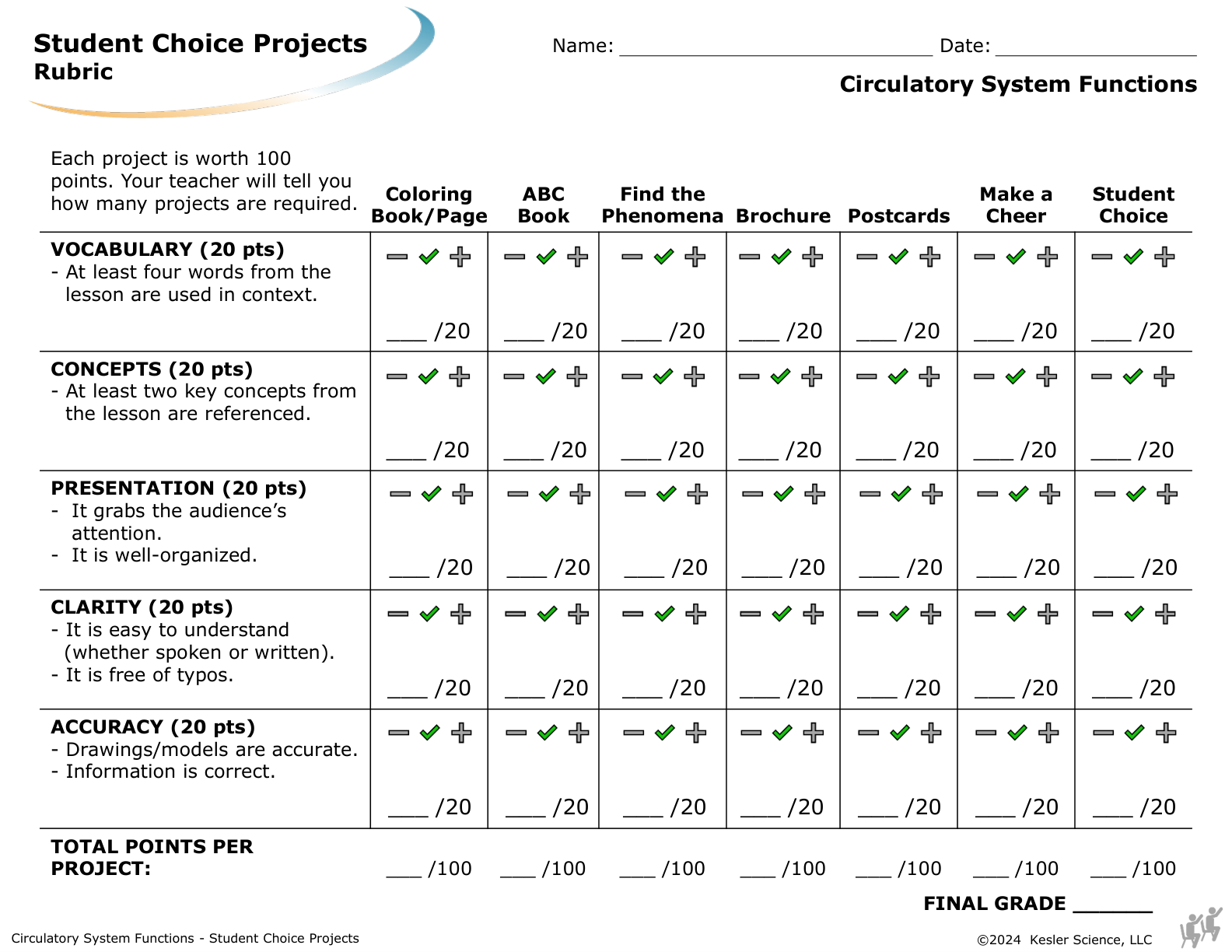
Every project, no matter which option a student picks, is graded on the same rubric. Five categories at 20 points each:
- Vocabulary (20 pts) — At least four words from the lesson are used in context.
- Concepts (20 pts) — At least two key concepts from the lesson are referenced.
- Presentation (20 pts) — The project grabs attention and is well-organized.
- Clarity (20 pts) — Easy to understand. Free of typos.
- Accuracy (20 pts) — Drawings and models are accurate. The science is right.
The rubric uses a minus / check / plus shorthand on every row so you can grade a stack of projects quickly without re-reading every criterion.
Two differentiated versions in one file
The standard version is for students ready for independent application of circulatory system ideas. The Reinforcement version is for students who need additional vocabulary or concept support. Three of the six options are swapped for projects with a tighter vocabulary tie-in, and "design your own" is replaced with "collaborate with the teacher" so kids aren't pitching cold.
✅ Evaluate
The Evaluate phase wraps the unit with a formal assessment. It's not all bubble-in. Several questions show students labeled diagrams of the heart and blood vessels and ask them to identify the chamber, the vessel, or the direction of blood flow.
The full assessment has 12 questions across five formats:
- Multiple choice (4 questions) covering the four chambers of the heart, the three types of blood vessels, the four components of blood, and pulmonary vs. systemic circulation
- Hotspot / visual (2 questions) where students click the left ventricle on a heart diagram and identify the type of vessel where gas exchange occurs
- Multiselect (2 questions) where students pick all of the vessels that carry oxygen-rich blood, and all of the structures involved in pulmonary circulation
- Short answer (2 questions) on how the heart's four chambers work together and on the difference between arteries, veins, and capillaries
- Multipart scenario (2 questions) with a real-world example (a student who just finished a sprint) where students explain the change in heart rate, the path of blood to the working muscles, and the role of the lungs in the process
A modified version is included for students who need additional support. Fewer multiple-choice distractors and sentence-starter scaffolds on the short-answer items.
If you've taught all five phases, this assessment shouldn't surprise anyone. It's a chance for kids to show you they get it.
How everything fits together
If you want the whole experience (Engage hook, the Station Lab as the Explore, the Explain day with Presentation and interactive notebook, the Student Choice Elaborate, and the Evaluate assessment all in one download), that's the Circulatory System Functions Complete 5E Science Lesson.
If you only need the one-day hands-on activity, the Station Lab works as a standalone. Most teachers buy the full 5E because the Station Lab works harder when it's bookended by a strong Engage and a follow-up Explain. But both are honest options.

Get the Circulatory System Functions 5E Lesson

Or if you only need the one-day hands-on Station Lab:
(The Station Lab is included in the full 5E Lesson)
Frequently asked questions
Does this cover all of TEKS 7.13A?
For the circulatory system, yes. The full standard asks students to describe the function and interactions of all 10 major body systems. This lesson covers the circulatory system in depth, including the heart, blood vessels, blood components, and how it interacts with the respiratory, digestive, endocrine, and immune systems. We have nine more 5E lessons for the other body systems under the same standard.
What do my students need to know before this lesson?
A basic understanding of cells, tissues, and organs from earlier grade-level standards. If your kids can describe what an organ is and the difference between a cell and a tissue, they're ready.
How long does it take to teach?
Done with fidelity, about 10 class periods of 45 minutes each: one day for the Engage, two days for the Station Lab, two days for the Presentation and Interactive Notebook, three days for the Student Choice Project, and one to two days for review and the assessment. A compressed sample plan is included in the file if you need to move faster.
Do I need special supplies?
Just clear plastic cups, flexible straws, and red and blue food coloring for the Explore It! heart-chamber model, plus printed cards for the Engage. Most teachers already have what they need.
Does this work for digital classrooms?
Yes. Every component has a digital version. The Station Lab is fully digital-ready (Google Slides), the Presentation works in Google Slides, and the Student Choice Projects can be submitted as videos, slide decks, or written work.
Is this 5E lesson aligned to NGSS too?
It aligns with MS-LS1-3 (using arguments supported by evidence for how the body is a system of interacting subsystems composed of groups of cells). Built TEKS-first, but the standards overlap.