
8 hands-on stations for teaching the carbon cycle
A station lab is a student-led activity where small groups rotate through 8 stations (plus a 9th challenge station for early finishers) at their own pace during one to two class periods. You become a facilitator instead of a lecturer. You walk around, spot-check, and break misconceptions while kids work through the rotation.
The Describing the Carbon Cycle Station Lab has four input stations (where students take in new info on photosynthesis, respiration, decomposition, fossil fuels, and carbon sinks) and four output stations (where they show what they learned). Here's what's at each one.
4 input stations: how students learn the carbon cycle
A short YouTube video covers the forms carbon takes, the basic steps of the cycle, and how human activity has impacted it. Students answer three questions on the answer sheet. This is the primer station that gets kids ready for the deeper carbon-tracking activities ahead.
A one-page passage called "Nature's Recycling System" walks students through carbon dioxide in the atmosphere, photosynthesis, animal respiration, decomposition, fossil fuels, combustion, and the balance the cycle keeps when it's working. Three multiple-choice questions and a vocabulary task follow. Comes in two reading levels (Dependent and Modified) plus a Spanish version.
This is the heart of the lab. Students play "Carbon's Journey Through the Carbon Cycle." They roll a die and string a colored bead onto a pipe cleaner: clear/white for atmosphere, blue for ocean, green for plants, red for living things, black for rocks. After 15 rolls they have a physical record of one carbon atom's path. Then they answer reflection questions: which sink did your carbon visit most, which sinks are short-term, which are long-term, did the carbon move in a pattern, and which carbon cycle pathways were left out of the game. This is the activity that locks in the idea that carbon moves but doesn't disappear.
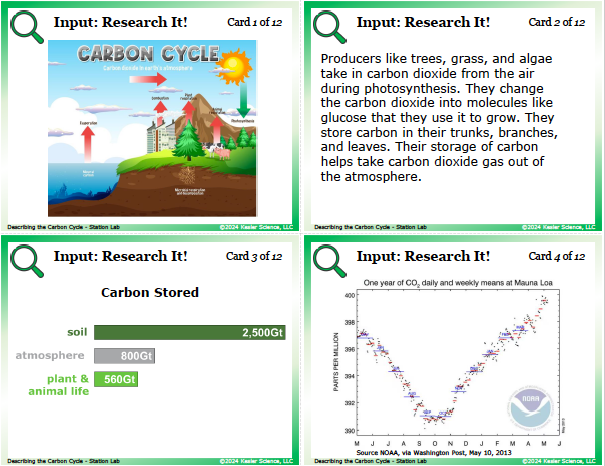
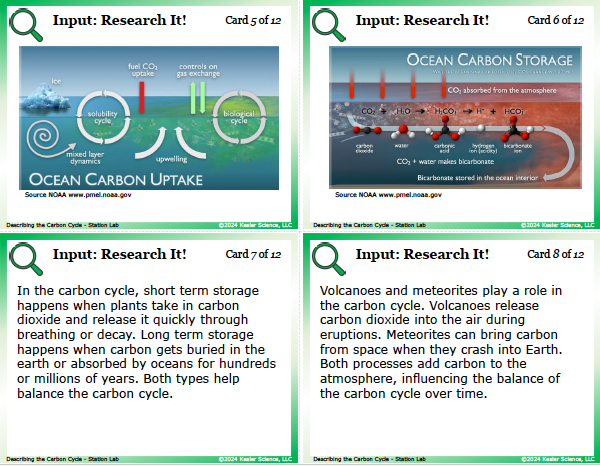
Students examine 12 reference cards: a labeled carbon cycle diagram, a passage on producers storing carbon, a Carbon Stored bar chart (soil 2,500 Gt, atmosphere 800 Gt, plant and animal life 560 Gt), a NOAA Mauna Loa CO2 graph showing the annual seasonal cycle, ocean carbon uptake diagrams, and short passages on short-term vs. long-term carbon storage and how volcanoes and meteorites add carbon. Five questions ask them to interpret the graphs, predict ocean uptake changes, and explain the role of plants, animals, volcanoes, and meteorites.
4 output stations: how students show what they learned
A 2-column card sort: Carbon Movement and Sink Description. Kids match six processes (photosynthesis, respiration, decomposition, burning fossil fuels, dissolving, sediment) with their accurate description of how that process moves carbon between reservoirs. Easy to spot-check at a glance.
Students draw a complete carbon cycle diagram. They have to include six labeled reservoirs (trees, ocean, atmosphere, rocks, fossil fuels, human activity), draw arrows showing the direction of carbon exchange, and label every important process. This catches kids who can describe the cycle in words but can't sketch it. Drawing it forces them to think about which way the carbon is moving and why.
Three open-ended questions: how the carbon cycle interacts with oceans, how decomposition contributes to the cycle, and why plants are considered a carbon sink. This is the writing practice middle schoolers need and rarely get in science class.
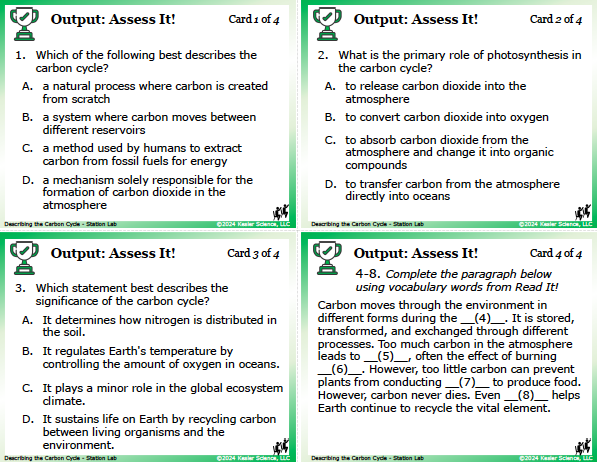
Eight multiple-choice and fill-in-the-paragraph questions tied to TEKS 8.11C vocabulary (carbon cycle, photosynthesis, decomposition, fossil fuels, global warming). Includes a "best describes the carbon cycle" question, a photosynthesis-role question, and a significance-of-the-cycle question. The fill-in paragraph weaves all five vocabulary words together. If you're grading the lab, this is the easiest station to grade.
Bonus Challenge It! station for early finishers
Four optional extensions: build a carbon cycle crossword, write a Carbon Atom Travel Adventures timeline with three stops, research the fast vs. slow carbon cycle and make a Venn diagram, or use the law of conservation of matter to explain why the cycle is continuous. Requires teacher approval before they start.
How this fits into a complete carbon cycle unit
This Station Lab is the Explore day of our full Describing the Carbon Cycle Complete 5E Lesson for TEKS 8.11C. The complete two-week unit follows the 5E method of instruction and includes an Engage hook, the Describing the Carbon Cycle Station Lab for Explore, PowerPoint slides and interactive notebook pages for Explain, student choice projects to Elaborate, and an Evaluate assessment.
Most teachers grab the full 5E because the Station Lab lands hardest with the days around it. But if you just need a strong hands-on day on describing the carbon cycle, the Station Lab on its own does the job.

Get this carbon cycle activity

Or if you want the full two-week experience with the Engage hook, Explain day, Elaborate extension, and Evaluate assessment all included:
(Station Lab is included)
Frequently asked questions
What does TEKS 8.11C cover?
Texas TEKS 8.11C asks 8th grade students to describe the carbon cycle. They should be able to identify the major reservoirs (atmosphere, oceans, biosphere, lithosphere), name the processes that move carbon between them (photosynthesis, respiration, decomposition, combustion, dissolving, sedimentation), and explain why the cycle keeps Earth's carbon balanced even though no carbon is created or destroyed.
How does this connect to TEKS 8.11A and 8.11B?
8.11A covers natural events that influence climate (volcanoes, ocean currents, the natural greenhouse effect). 8.11B covers human activities that influence climate (deforestation, urbanization, fossil fuels). 8.11C zooms in on the carbon cycle itself, which is the underlying system both standards depend on. Most teachers run them in this order: 8.11A, 8.11C, then 8.11B (because seeing the cycle in 11C makes 11B's human disruption story more concrete).
How long does this carbon cycle activity take?
One to two class periods (45 to 110 minutes total). The Explore It! bead game takes the longest because students roll 15+ times, so plan for two periods the first time. Once your class has the routine down, most groups can finish all 8 stations in one period.
Do I need to provide my own materials?
Pony beads in five colors, pipe cleaners, dice, and colored pencils. Total cost for a class of 30 (if you don't already have these): under $15 from Dollar Tree or Amazon. The Watch It! station also needs a device with internet.
Can I use this in a 1:1 digital classroom?
Yes. The full digital version (PowerPoint or Google Slides) works in 1:1 classrooms and Google Classroom. The Explore It! bead game can be replaced with a digital random-roll version where students drag colored carbon dots onto a digital journey log. The hands-on version is more memorable, but the digital version still gets kids tracking carbon through reservoirs.