
8 hands-on stations for teaching biotic and abiotic competition
A station lab is a student-led activity where small groups rotate through 8 stations (plus a 9th challenge station for early finishers) at their own pace during one to two class periods. You become a facilitator instead of a lecturer. You walk around, spot-check, and break misconceptions while kids work through the rotation.
The Biotic and Abiotic Competition Station Lab has four input stations (where students take in new info on biotic factors, abiotic factors, populations, and competition) and four output stations (where they show what they learned). Here's what's at each one.
4 input stations: how students learn biotic and abiotic competition
A short YouTube video introduces biotic factors, abiotic factors, and competition. Three task-card questions tie it back to specific biotic factors a species needs to survive, abiotic factors a living thing needs to stay alive, and what competition is with at least one example from the video. Visual learners come alive at this station because they see real ecosystems on screen before they read about them.
A one-page passage called "Competing for Resources" walks students through a hike in the woods and asks them to notice the biotic and abiotic factors around them. The vocabulary is bolded throughout (biotic factors, organism, population, abiotic factors, competition). The passage uses concrete examples kids can picture: trout populations in a river, oak vs. maple tree populations, and a rabbit competing with deer for food and other rabbits for living space. Three multiple-choice questions plus the vocabulary section follow. Comes in two reading levels (Dependent and Modified) plus a Spanish version.
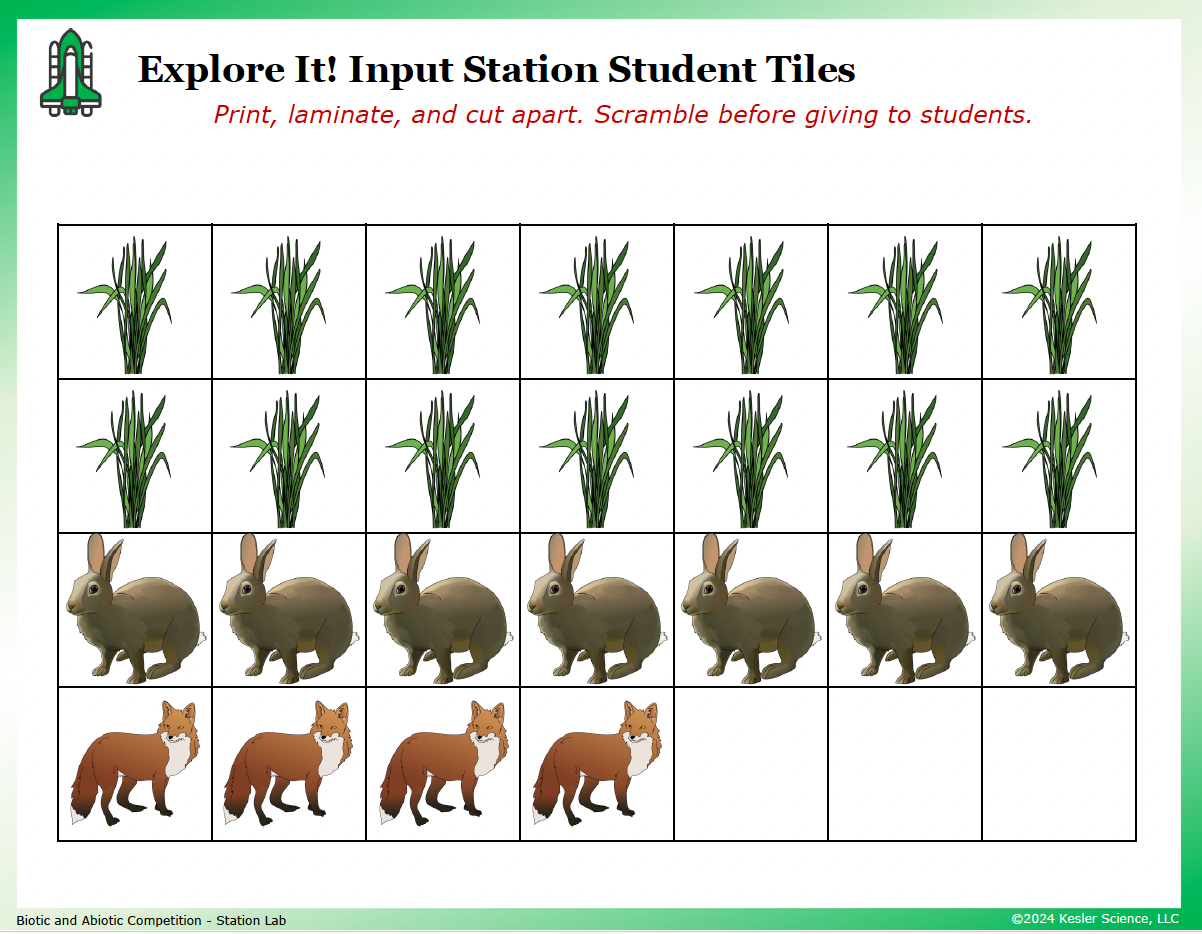
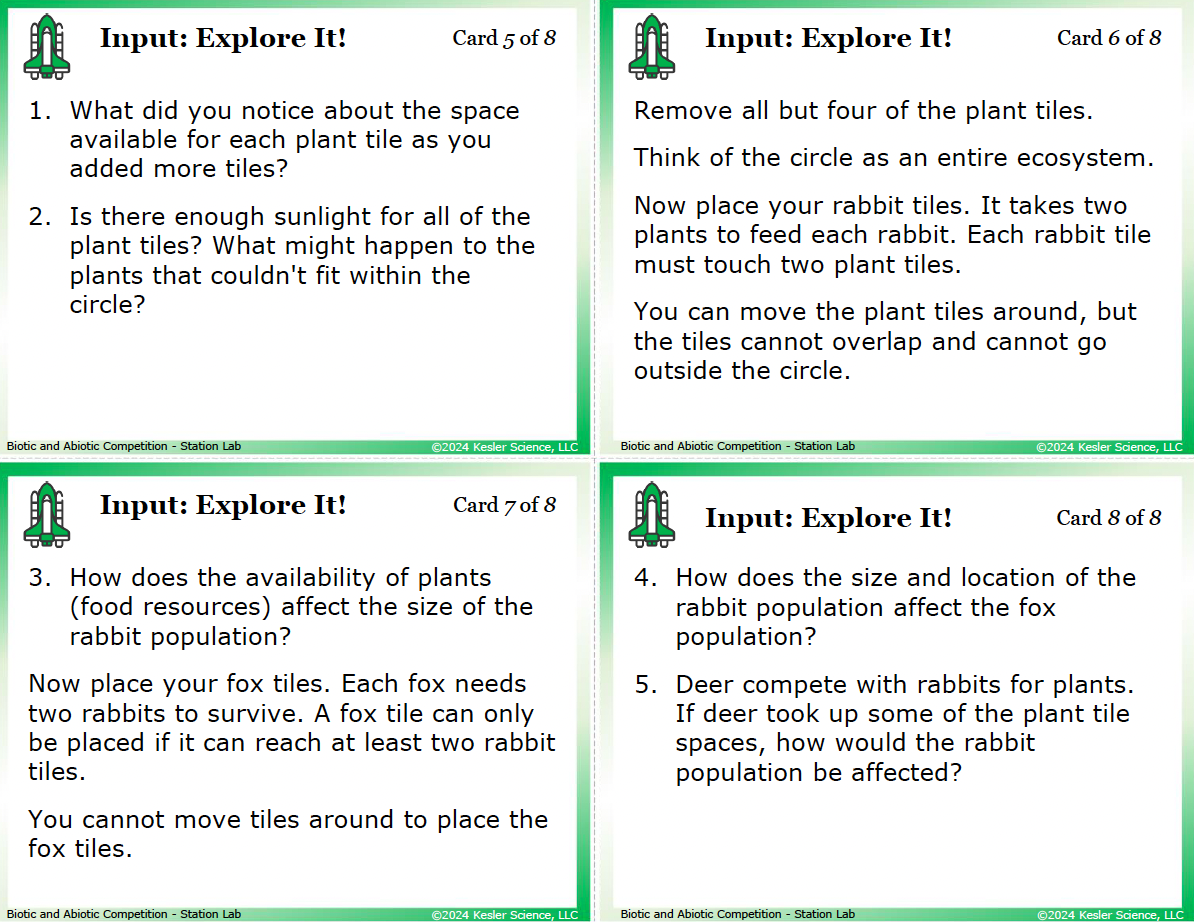
This is the heart of the lab. Students get a printed circle that represents sunlight and a set of paper tiles (14 plants, 7 rabbits, 4 foxes). Step 1: pack as many plant tiles as possible inside the circle without overlapping. Step 2: remove all but four plants and place rabbit tiles, knowing each rabbit needs to touch two plant tiles to survive. Step 3: place fox tiles, knowing each fox needs to reach two rabbits. Five questions push them past the data: what happens to the plants that did not fit, how plant availability shapes the rabbit population, and how a deer population would change everything. The tiles make competition physical instead of abstract.
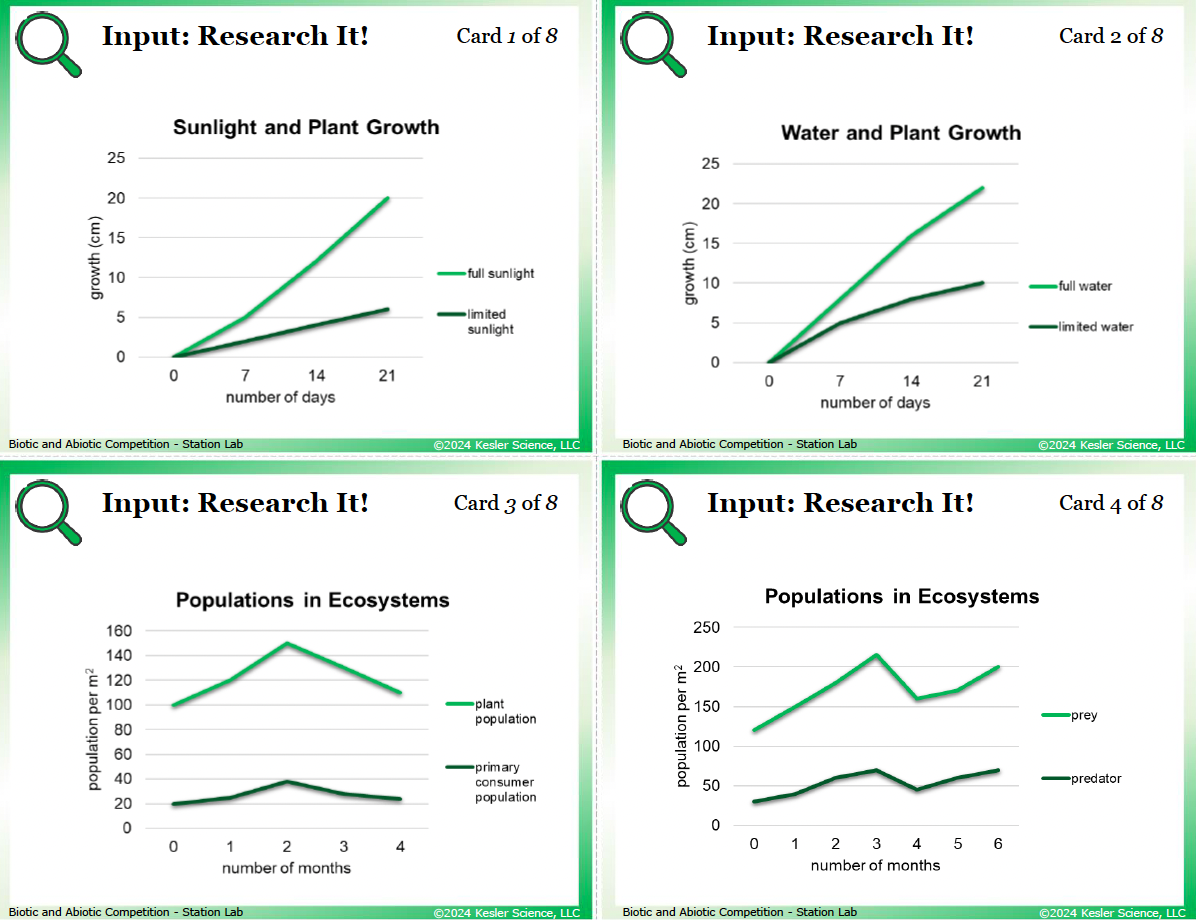
Students examine 8 reference cards built around Greenwood Forest, a fictional ecosystem researchers are studying. The cards include a Sunlight and Plant Growth graph (full sunlight vs. limited sunlight over 21 days), a Water and Plant Growth graph, a Populations in Ecosystems graph showing plant and primary consumer populations rising and falling together, and a separate Populations graph showing prey and predator populations with a sharp prey crash at month four. Five questions check whether they can read the graphs and explain why the relationships make sense.
4 output stations: how students show what they learned
A two-column card sort. Kids sort 12 ecosystem photo cards into Abiotic Factors and Biotic Factors. Abiotic photos include sunlight, rain, clouds, a rocky cliff, thermometers, soil, and a pH test strip. Biotic photos include a black bear, microorganisms (paramecium), a tree, fungal hyphae, bees on flowers, a mushroom, and a squirrel. Easy to spot-check at a glance and forces students to think about edge cases (soil contains microbes, but the soil itself is abiotic).
Students sketch a desert ecosystem on the answer sheet that includes sunlight, water, two cacti, two predators (rattlesnakes, lizards, or hawks), rocks, and one prey animal (mouse or small bird). They label every element as biotic or abiotic, draw a green arrow from each cactus to an abiotic factor they need (showing competition for sunlight or water), and draw a red line from the predators to the biotic factor they both need. The arrows are what reveal whether they understand competition: every arrow has to point to something both organisms want.
Three open-ended questions in complete sentences: how an increase in sunlight (an abiotic factor) impacts plants in a forest ecosystem, how a decrease in the prey population would impact the predator population, and how deer and rabbits competing for plants affects both populations. This is the writing practice middle schoolers need and rarely get in science class.
Eight multiple-choice and fill-in-the-paragraph questions tied to TEKS 6.12A vocabulary (biotic factor, organism, population, abiotic factor, competition). Includes which option is an example of an abiotic factor (dissolved oxygen in a river), which scenario shows a biotic factor impacting a population (a disease affects the grass that bison eat), and which statement does NOT describe competition (only animals compete). The fill-in paragraph weaves all five vocabulary words together. If you're grading the lab, this is the easiest station to grade.
Bonus Challenge It! station for early finishers
Four optional extensions: design a scavenger hunt of 10 abiotic and biotic factors students compete for in the school as an ecosystem, write a two-to-three-minute skit teaching the definition of competition, create an advertising flyer for a store selling abiotic and biotic factors with prices based on how valuable they are to the population, or research a local species and explain what biotic and abiotic factors it needs. Requires teacher approval before they start.
How this fits into a complete biotic and abiotic competition unit
This Station Lab is the Explore day of our full Biotic and Abiotic Competition Complete 5E Lesson for TEKS 6.12A. The complete two-week unit follows the 5E method of instruction and includes an Engage hook, the Biotic and Abiotic Competition Station Lab for Explore, PowerPoint slides and interactive notebook pages for Explain, student choice projects to Elaborate, and an Evaluate assessment.
Most teachers grab the full 5E because the Station Lab lands hardest with the days around it. But if you just need a strong hands-on day on biotic and abiotic competition, the Station Lab on its own does the job.

Get this biotic and abiotic competition activity

Or if you want the full two-week experience with the Engage hook, Explain day, Elaborate extension, and Evaluate assessment all included:
(Station Lab is included)
Frequently asked questions
What does TEKS 6.12A cover?
Texas TEKS 6.12A asks 6th grade students to investigate how organisms compete for biotic and abiotic factors in an ecosystem. Students should be able to define biotic factors (living things) and abiotic factors (nonliving things), give examples of each, and explain what happens when more than one organism needs the same resource (food, water, sunlight, living space, mates).
Is this kids' first time meeting biotic and abiotic?
For most 6th graders, yes. They have heard "living and nonliving" since elementary school, but the formal vocabulary (biotic, abiotic, population, organism, competition) is new this year. The Read It! passage introduces all five vocabulary words in bold. The Explore It! tile activity is the visual anchor, and the Organize It! photo card sort tests whether they can apply the vocabulary to 12 different real-world examples.
How long does this biotic and abiotic competition activity take?
One to two class periods (45 to 110 minutes total). The Explore It! tile activity is the longest piece because students have to physically arrange three rounds of tiles, so plan for two periods the first time you run a station lab. Once your class has the rotation routine down, most groups can finish all 8 stations in one period.
Do I need a lot of supplies for this?
No. Almost everything is in the download. You just need colored pencils or markers for the Illustrate It! desert ecosystem sketch and a device with internet for the Watch It! station. Total cost beyond the download is essentially zero if your classroom already has colored pencils.
Can I use this in a 1:1 digital classroom?
Yes. The full digital version (PowerPoint or Google Slides) works in 1:1 classrooms and Google Classroom. The Explore It! tile activity is digitized so students drag virtual plants, rabbits, and foxes into the sunlight circle on screen. The Organize It! photo card sort works especially well digitally because students drag photo cards into the correct column.