
8 hands-on stations for teaching adaptations and survival
A station lab is a student-led activity where small groups rotate through 8 stations (plus a 9th challenge station for early finishers) at their own pace during one to two class periods. You become a facilitator instead of a lecturer. You walk around, spot-check, and break misconceptions while kids work through the rotation.
The Adaptations for Survival Station Lab has four input stations (where students take in new info on variation, structural, behavioral, and physiological adaptations) and four output stations (where they show what they learned). Here's what's at each one.
4 input stations: how students learn adaptations
A short YouTube video introduces the three types of adaptations and the timescale they take. Students answer three questions: what are the three types of adaptations, how long do adaptations take, and in what ways has wild thyme adapted. The wild thyme example is a useful one (chemical defenses against herbivores) because it doesn't lean on the usual giraffe and polar bear examples.
A one-page passage called "Variations That Help Survival" walks students through how variations become adaptations using three vivid examples. Structural: giraffes with purple tongues that don't sunburn. Behavioral: hedgehogs that hibernate through winter. Physiological: ladybugs that release a stinky yellow substance from their knees when threatened. Three multiple-choice questions follow plus five vocabulary terms (variation, adaptation, structural adaptation, behavioral adaptation, physiological adaptation). Comes in two reading levels (Dependent and Modified) plus a Spanish version.
This is the heart of the lab. Students run a camouflage simulation. Place 80 pony beads (10 each of 4 colors) into a container lined with one specific color of paper or felt. Predators (the kids) have one minute to "collect" beads onto a knotted string. After the round, count the survivors of each color. The beads that survive then "reproduce" (add another of each surviving color) and a second round runs. The color matching the container survives best because predators can't see it. Four questions ask which color had the highest survival rate, which had the lowest, what about the environment caused the difference, and what would happen over more generations. This is the natural-selection bell ringer most teachers wish they had.
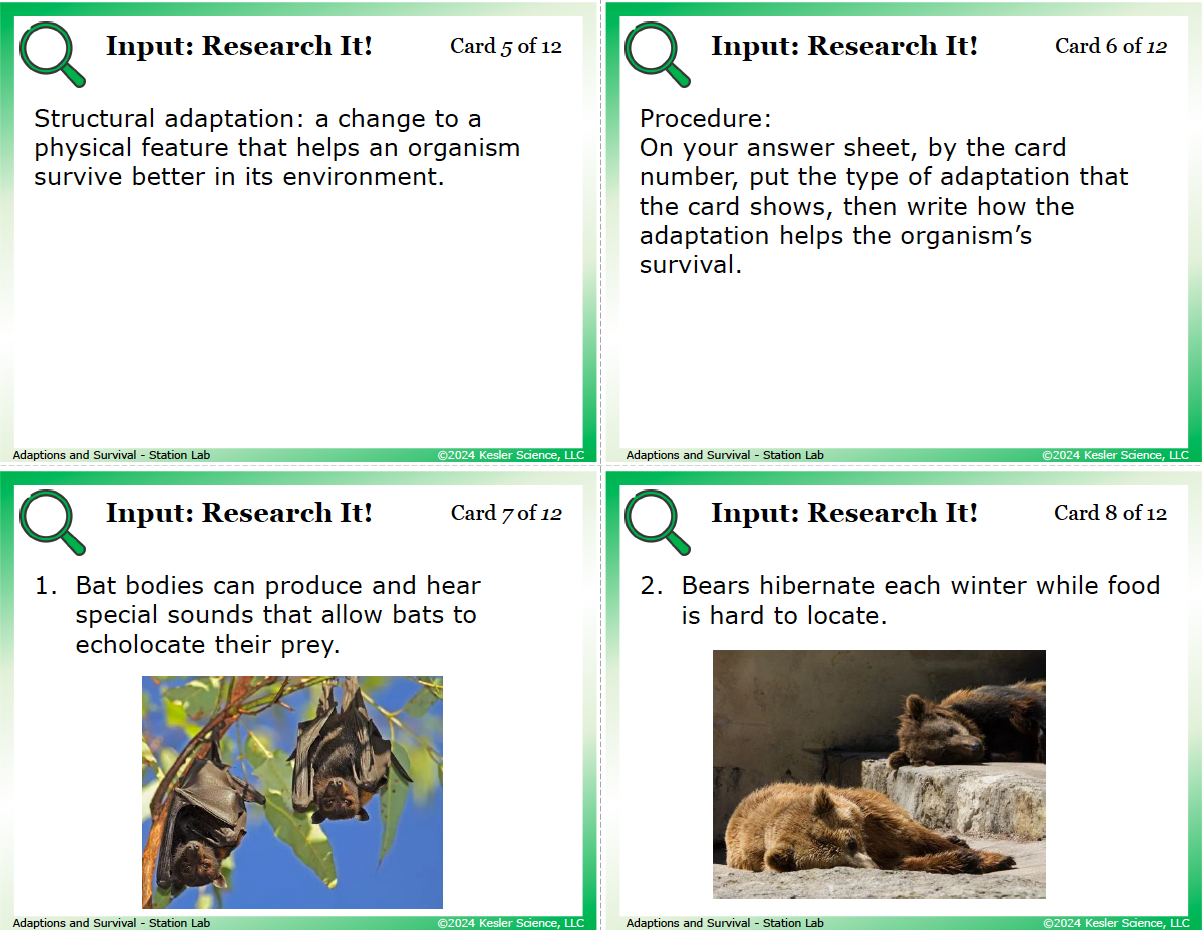
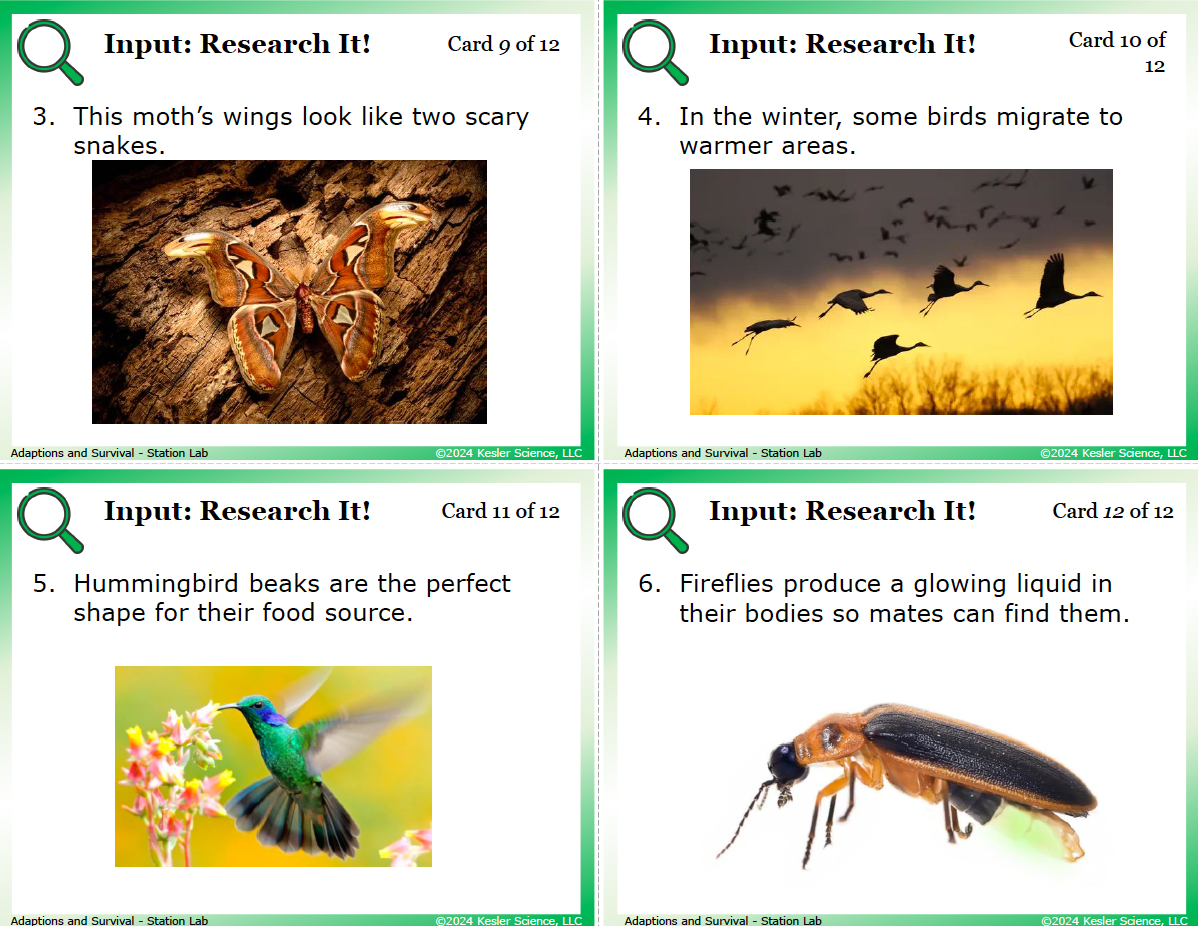
Students examine 12 reference cards: definitions of adaptation, structural, behavioral, and physiological adaptations, plus 6 organism cards. Bats use echolocation. Bears hibernate in winter. A moth has wings that look like two scary snakes. Birds migrate to warmer areas. Hummingbirds have beaks shaped for their food source. Fireflies produce a glowing liquid for mating. For each card, students write down the type of adaptation and how it helps the organism survive. Echolocation is physiological. Hibernation is behavioral. Mimicry wings are structural. Migration is behavioral. Hummingbird beaks are structural. Firefly bioluminescence is physiological.
4 output stations: how students show what they learned
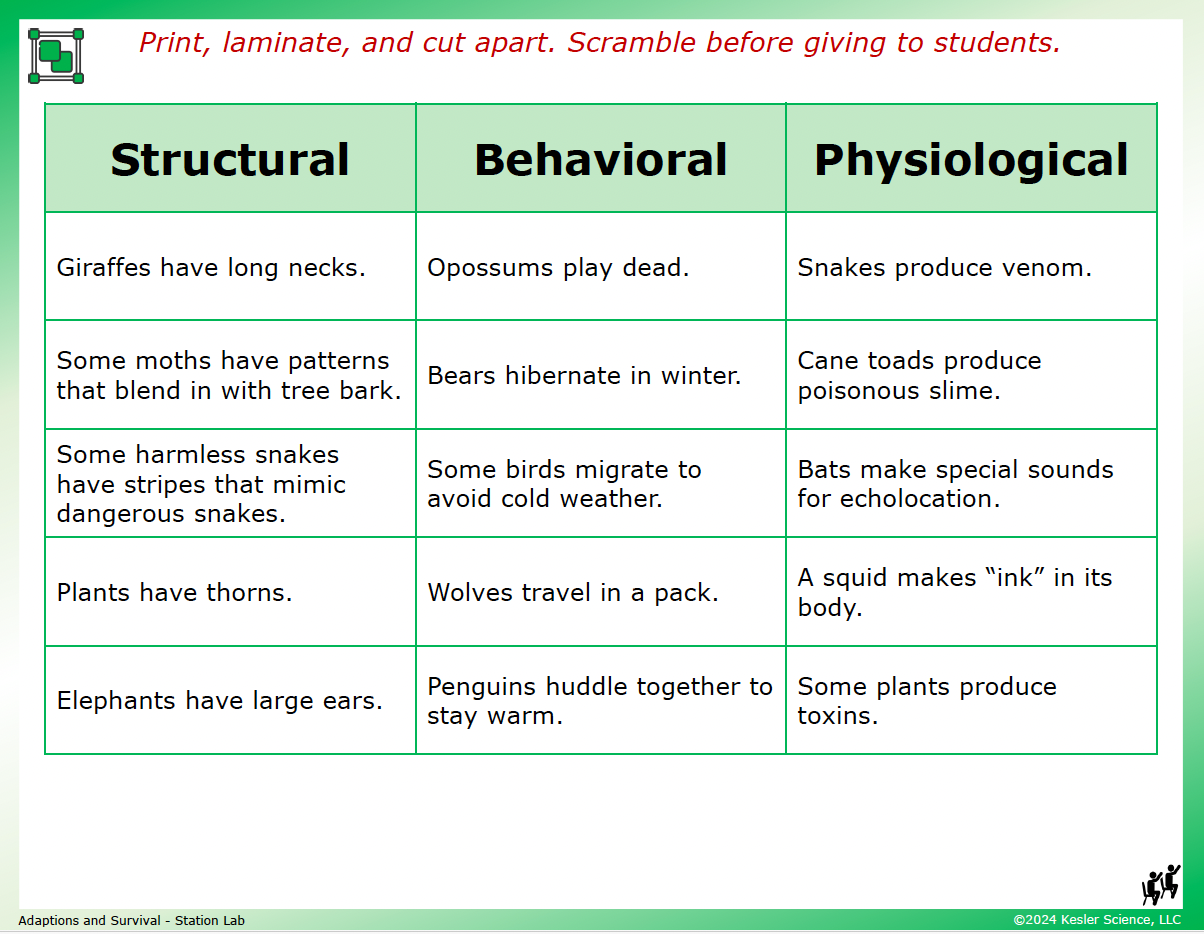
A three-column card sort with Structural, Behavioral, and Physiological. Kids match 15 examples with the right type. Structural: giraffe necks, moth tree-bark camouflage, mimic snake stripes, plant thorns, large elephant ears. Behavioral: opossums playing dead, bear hibernation, bird migration, wolf pack hunting, penguin huddling. Physiological: snake venom, cane toad slime, bat echolocation, squid ink, plant toxins. Some cards are tempting traps (squid ink looks structural but is a chemical produced by an internal process). Easy to spot-check at a glance.
Students invent their own imaginary animal based on a real organism and give it all three types of adaptations. They label each adaptation with its type (structural, behavioral, physiological) and explain how it helps the organism survive. This is the station where you'll get a tiger with venom-claws (physiological), a chameleon that hibernates (behavioral), and giant fluorescent ears (structural). The creativity sticks the three categories.
Three open-ended questions: how variations within a population become adaptations, how a behavioral adaptation like pack hunting influences survival over time, and what type of adaptation a new spider trait (silk shooting) would be and how it would impact the species. The third question is the application question that shows whether kids really get it. This is the writing practice middle schoolers need and rarely get in science class.
Eight multiple-choice and fill-in-the-paragraph questions tied to TEKS 8.13C vocabulary (variation, adaptation, structural, behavioral, physiological). Includes how structural adaptations help, which example is physiological (an animal producing venom, not a plant with thorns), and a behavioral adaptation example. The fill-in paragraph weaves all five vocabulary words into one passage about variation becoming adaptation. If you're grading the lab, this is the easiest station to grade.
Bonus Challenge It! station for early finishers
Four optional extensions: list as many organisms near your school as possible and describe each adaptation, write an acrostic poem with the word "ADAPTATION," build a four-panel comic strip of an organism describing its new adaptation, or interview an imaginary talking animal about its adaptations with four questions. Requires teacher approval before they start.
How this fits into a complete adaptations for survival unit
This Station Lab is the Explore day of our full Adaptations for Survival Complete 5E Lesson for TEKS 8.13C. The complete two-week unit follows the 5E method of instruction and includes an Engage hook, the Adaptations for Survival Station Lab for Explore, PowerPoint slides and interactive notebook pages for Explain, student choice projects to Elaborate, and an Evaluate assessment.
Most teachers grab the full 5E because the Station Lab lands hardest with the days around it. But if you just need a strong hands-on day on the three types of adaptations and how variation drives them, the Station Lab on its own does the job.

Get this adaptations for survival activity

Or if you want the full two-week experience with the Engage hook, Explain day, Elaborate extension, and Evaluate assessment all included:
(Station Lab is included)
Frequently asked questions
What does TEKS 8.13C cover?
Texas TEKS 8.13C asks 8th grade students to describe how variations of traits within a population lead to structural, behavioral, and physiological adaptations that influence the likelihood of survival and reproductive success of a species over generations. Students should be able to define the three types of adaptations, sort real-world examples into the right type, and explain how a population shifts toward better-adapted forms over generations.
What's the difference between structural, behavioral, and physiological adaptations?
Structural adaptations are physical features (long necks, sharp claws, camouflage colors, thick fur). Behavioral adaptations are ways an organism acts (hibernation, migration, pack hunting, huddling for warmth). Physiological adaptations are internal processes (venom production, bioluminescence, echolocation, antifreeze proteins). All three types are inherited and develop over generations, not within a single organism's lifetime.
How long does this adaptations activity take?
One to two class periods (45 to 110 minutes total). The Explore It! bead-and-camouflage simulation is the slowest because of the two-round structure, so plan for two periods the first time you run a station lab. Once your class has the routine down, most groups can finish all 8 stations in one period.
Do I need to provide my own materials?
You'll need pony beads (4 colors, 20 each), a small container or box, colored paper or felt for the bottom, pipe cleaners or string, a timer, colored pencils, and scissors. Total cost for a class of 30: under $10 if you don't already have these supplies. The Watch It! station also needs a device with internet.
Can I use this in a 1:1 digital classroom?
Yes. The full digital version (PowerPoint or Google Slides) works in 1:1 classrooms and Google Classroom. Students drag and drop adaptation examples into the right category instead of physically. The Explore It! simulation works best with real beads, but the digital version includes a comparable activity using on-screen colored shapes.