8 hands-on stations for teaching acids, bases, and pH
A station lab is a student-led activity where small groups rotate through 8 stations (plus a 9th challenge station for early finishers) at their own pace during one to two class periods. You become a facilitator instead of a lecturer. You're walking around, spot-checking, and breaking misconceptions while kids work through the rotation.
The Properties of Acids and Bases Station Lab has four input stations (where students take in new info on pH, indicators, and acid/base properties) and four output stations (where they show what they learned). Here's what's at each one.
4 input stations: how students learn properties of acids and bases
A short YouTube video walks students through the basic properties of acids and bases. They watch up to the 3-minute mark and answer three questions: properties of an acid (using lemon juice as the example), properties of a base (using bitter melon extract), and the pH of a neutral substance. Visual learners get instant traction at this station.
A one-page passage called "Everyday Acids and Bases" explains the pH scale (0 to 14), litmus paper, and the sensory properties of each (sour vs. bitter, stinging vs. slippery). Three multiple-choice questions follow. The passage comes in two reading levels (Dependent and Modified) plus a Spanish version, so you can differentiate without prepping anything extra.
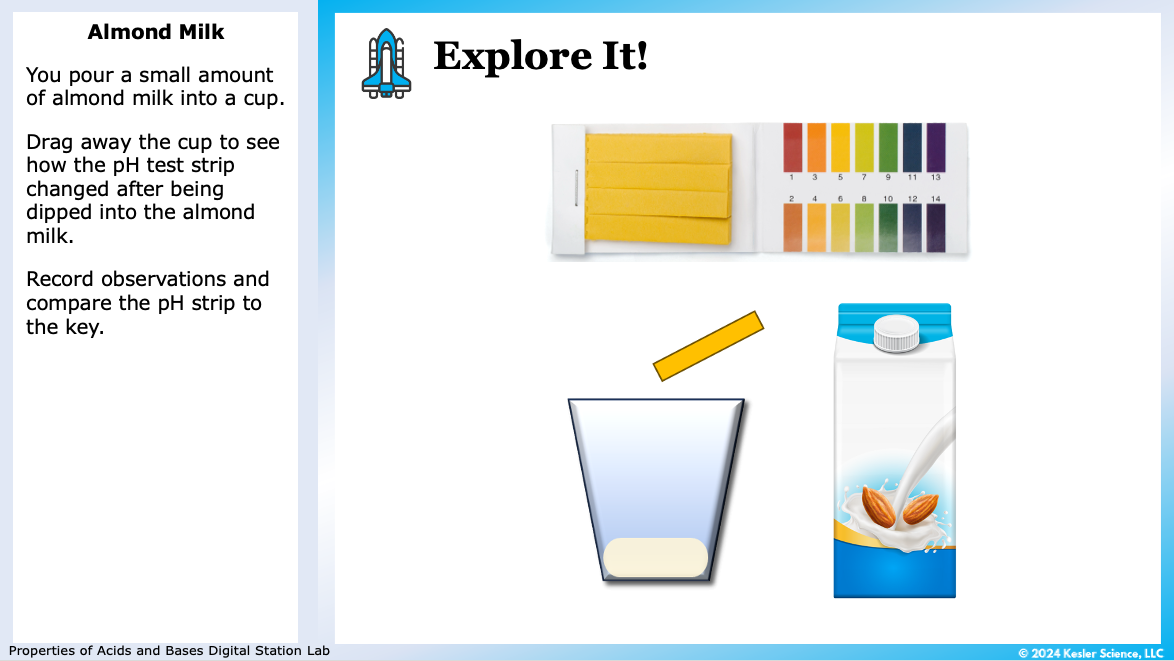
This is the heart of the lab. Students get five common household substances (dish soap, distilled water, lemon juice, almond milk, and vinegar), pour a small amount of each into labeled cups, and dip pH test strips into each one. They compare the colors to a key, write down the pH, and then sort everything into acids, bases, and neutral. By the time they're done, they've tested the standard with their hands. The neutral one (distilled water) is the moment most kids realize that water IS something on the pH scale, not just "the thing you drink."
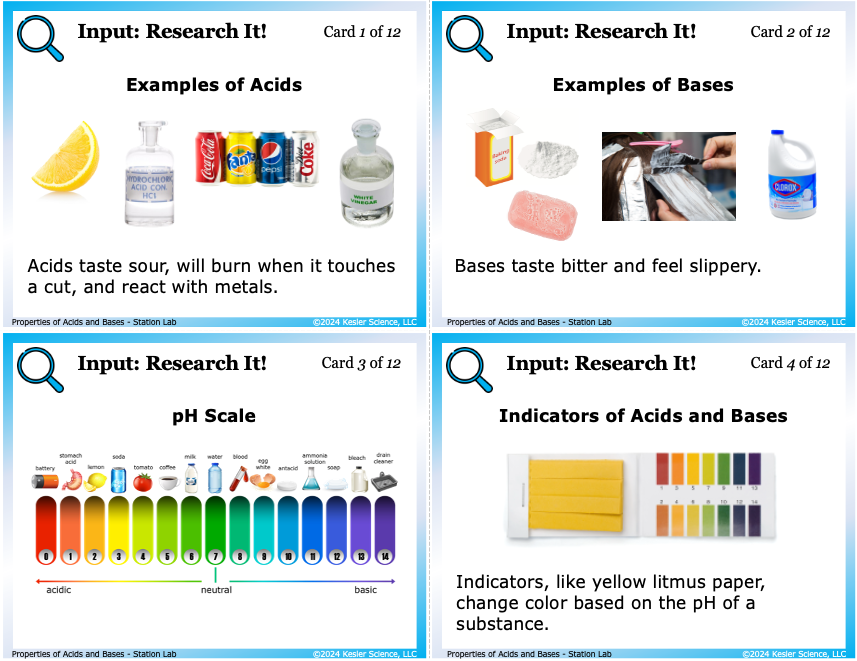
Students read 12 reference cards covering the pH scale (with images of stomach acid, lemons, milk, soap, bleach, and drain cleaner placed on the 0–14 scale), the role of indicators, examples of acids in industry (citric, sulfuric, hydrochloric), examples of bases (sodium hydroxide, ammonia, calcium hydroxide), and the neutralization reaction (acid + base → water + salt). Five questions check whether they can name properties of each, predict litmus color, and brainstorm everyday items they could test at home.
4 output stations: how students show what they learned
A card sort. Kids physically arrange property cards under two headers: Properties of Acids and Properties of Bases. Cards include "pH below 7", "pH above 7", "sour taste", "bitter taste", "feels slippery", "burns on a cut", "examples include lemons and vinegar", "examples include almond milk and soap". Easy to spot-check at a glance, and the fastest way to see who's actually internalized the differences vs. who's still guessing.
Students draw a color-coordinated pH scale (0 to 14) and place five real substances in their right spots: black coffee at pH 5, distilled water at pH 7, ammonia cleaner at pH 10, stomach acid at pH 1, and seawater at pH 8. They label the directions of acidic, neutral, and basic with arrows. This station catches one of the biggest misconceptions in the standard: that pH is a linear scale (it isn't, it's logarithmic, but that's a high school thing). What 8th graders need to walk away with is the relative spacing of common substances, and this drawing locks it in.
Three open-ended questions where students explain pH ranges in their own words, describe how indicators (especially litmus paper) work, and list ways to use senses to distinguish acids from bases (without actually tasting or touching, of course). This is the writing practice middle schoolers need and rarely get in science class.
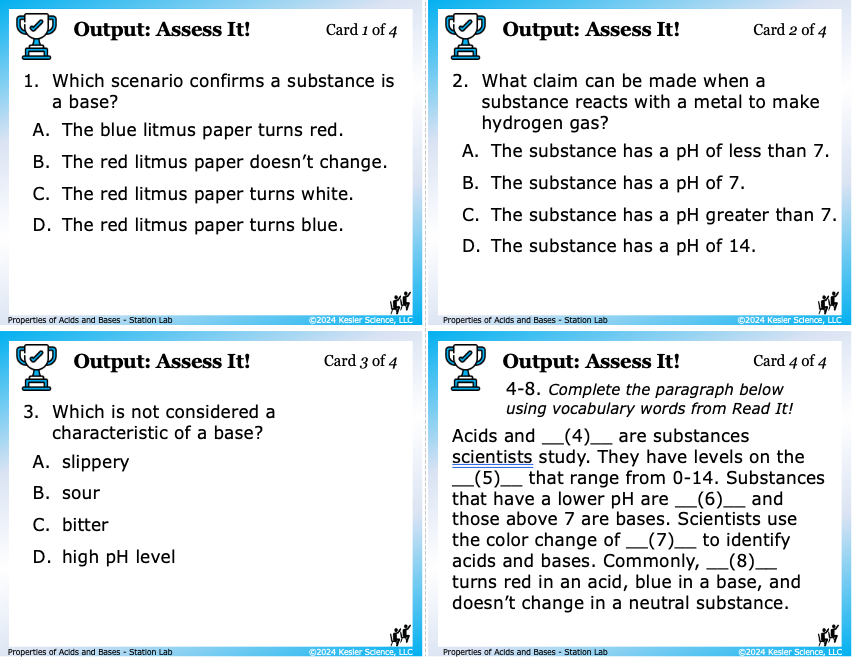
Eight multiple-choice and fill-in-the-paragraph questions tied to TEKS 8.6D vocabulary (acids, bases, indicator, litmus paper, pH scale). Includes scenarios with litmus paper color changes, the metal-plus-acid hydrogen-gas reaction, and "which is NOT a property of a base" type questions. If you're grading the lab, this is the easiest station to grade.
Bonus Challenge It! station for early finishers
Four optional extensions: a comic strip starring acids and bases, a social media post for a common acid or base, a doodle dictionary of vocabulary, and a research task on common indicators. Requires teacher approval before they start.
How this fits into a complete acids and bases unit
This Station Lab is the Explore day of our full Properties of Acids and Bases Complete 5E Lesson for TEKS 8.6D. The complete two-week unit follows the 5E method of instruction and includes an Engage hook, the Properties of Acids and Bases Station Lab for Explore, PowerPoint slides and interactive notebook pages for Explain, student choice projects to Elaborate, and an Evaluate assessment.
Most teachers grab the full 5E because the Station Lab lands hardest with the days around it. But if you just need a strong hands-on day on acids, bases, and pH, the Station Lab on its own does the job.

Get this acids and bases activity

Or if you want the full two-week experience with the Engage hook, Explain day, Elaborate extension, and Evaluate assessment all included:
(Station Lab is included)
Frequently asked questions
What does TEKS 8.6D cover?
Texas TEKS 8.6D asks 8th grade students to compare and contrast the properties of acids and bases, including pH relative to water. Students should be able to identify substances as acidic, basic, or neutral using the pH scale (0 to 14), recognize the sensory and chemical properties of each (sour vs. bitter, stinging vs. slippery, hydrogen gas reaction with metal), and use indicators like litmus paper to test unknown substances.
What is litmus paper and how does it work?
Litmus paper is paper coated with natural dyes that change color depending on the pH of a substance it touches. Red litmus turns blue in a base. Blue litmus turns red in an acid. Litmus paper that doesn't change color means the substance is neutral. It's a quick, low-cost way to identify acids and bases without specialized equipment.
How long does this acids and bases activity take?
One to two class periods (45 to 110 minutes total). The first time you run a station lab, plan for two periods so kids can learn the rotation and pacing without feeling rushed. Once your class has the routine down, most groups can finish all 8 stations in one period.
Do I need to provide my own materials?
Yes, but the materials are cheap and easy. You'll need pH test strips (about $7 for a pack of 100), small cups, dish soap, distilled water, lemon juice, almond milk, white vinegar, and colored pencils. Total cost for a class of 30: about $15. The Watch It! station also needs a device with internet.
Can I use this for 7th grade or in a 1:1 digital classroom?
Yes to both. The Modified version of every station works as a stretch lesson for advanced 7th graders. The full digital version (PowerPoint or Google Slides) works in 1:1 classrooms and Google Classroom. Students type into the slides and submit them back. The Explore It! station still needs the physical pH strips and substances for the full experience.