
Inside the Periodic Table & Reactions 5E Lesson
The 5E instructional model walks students through five phases: Engage, Explore, Explain, Elaborate, and Evaluate. It flips the traditional lecture-first sequence on its head. Students explore a concept hands-on before you ever explain it, which means by the time you do explain it, they have something to hook the vocabulary onto.
I switched to the 5E model years ago and stopped going back. Kids retain more, ask better questions, and stop staring at me waiting to be told the answer. The Periodic Table & Reactions 5E Lesson is built on this framework from start to finish. Here's how it plays out across the five phases.
🎯 Engage
Day one is a teacher-led atom hunt using a printed periodic table. I'd write a simple chemical reaction on the board (something like Fe + O2 going to rust, or 2H2 + O2 going to 2H2O) and hand every student a paper periodic table. Before talking about the reaction at all, every student had to circle each element symbol they could find in the equation on their own table and write the full element name next to it.
Sounds basic. But the first time you watch a class do this, kids are genuinely surprised that Fe means iron, not "fey," and that Na means sodium, not "en-ay." By the end of the period, students have made the connection that every letter in every chemical equation is a real element that lives somewhere on the table.
What's included in the Engage:
- Teacher directions for the atom hunt activity
- Printable student observation sheet with sample chemical equations
- Printable periodic table reference
- Answer key for the discussion questions
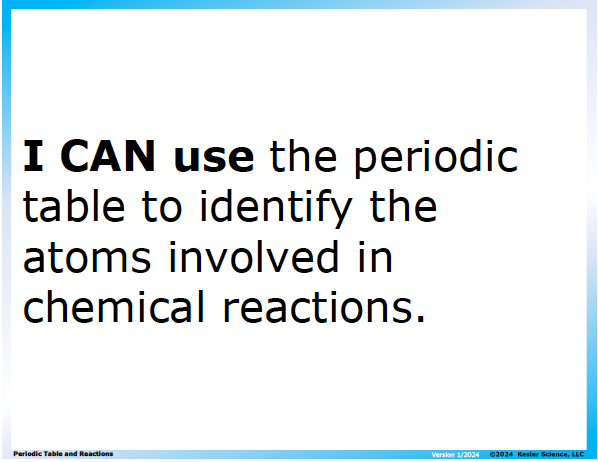
- Four learning objective slides (standard verbatim, the "use the periodic table" verb highlighted, "I CAN...", and "WE WILL...")
- An illustrated Chemistry Word Wall in English and Spanish covering the full unit vocabulary
🔬 Explore
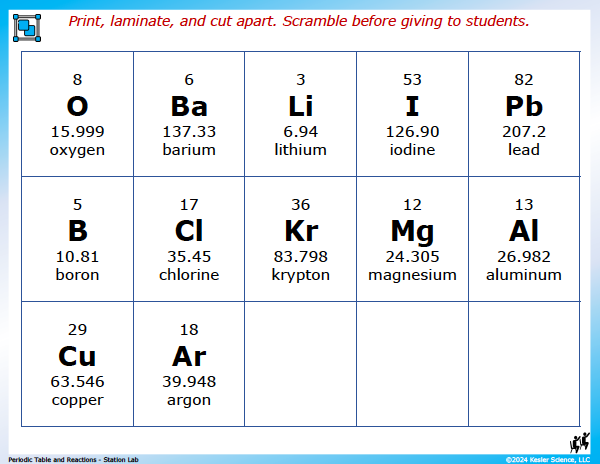
The Periodic Table & Reactions Station Lab is the heart of the Explore phase. Students rotate through 8 stations (plus a 9th challenge station for early finishers) over one class period. The Station Lab is split into four input stations (where kids take in new information) and four output stations (where they show what they learned).
The four input stations:
- 🎬 Watch It! — Students watch a short video on how to read the periodic table and identify elements in chemical reactions, then answer guided questions.
- 📖 Read It! — A one-page reading passage at two differentiated levels on the structure of the periodic table and how chemical symbols work, with a Spanish version included.
- 🔬 Explore It! — The hands-on activity (the heart of the Station Lab) where students decode chemical equations one element at a time using a printed periodic table.
- 💻 Research It! — Reference cards with the periodic table, common element symbols (including the tricky Latin ones like Na, Fe, Au, Pb, K), and how to count atoms using subscripts and coefficients.
The four output stations:
- 📋 Organize It! — A card sort where students match chemical symbols to element names and locate each on the periodic table.
- 🎨 Illustrate It! — Students draw a labeled periodic table tile and a sample chemical equation, identifying each element with its real name.
- ✍️ Write It! — Three open-ended questions in complete sentences about how the periodic table is used to read chemical equations.
- 📝 Assess It! — A short formative check with multiple choice and a fill-in-the-blank vocabulary paragraph.
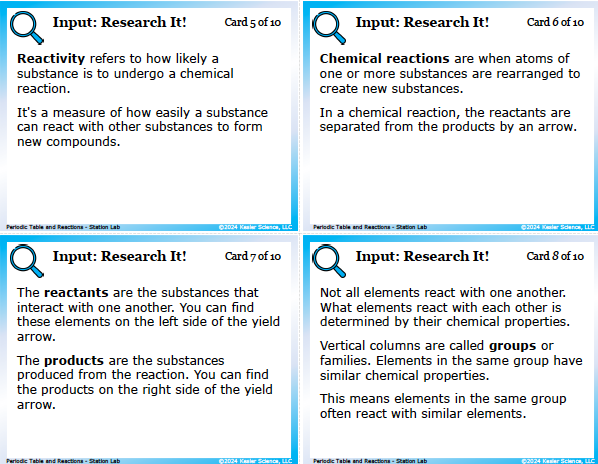
Print and digital versions are both included. If you want the full breakdown of what happens at every single station, what students produce, and how to set it up, that's in our dedicated Station Lab post.
→ Read the full Periodic Table & Reactions Station Lab walkthrough 8 stations, materials list, teacher tipsThe Station Lab is included in the full 5E lesson. You don't need to buy it separately if you're getting the whole unit.
📚 Explain
Here's the real payoff of doing the Engage and Explore before the Explain: by the time kids hit this phase, they've already located dozens of elements on a real periodic table with their own eyes. They have a working understanding of how chemical symbols and the table connect before you ever start defining things. The discussions get deeper, the questions get sharper, and you spend less time defining and more time pushing their thinking.
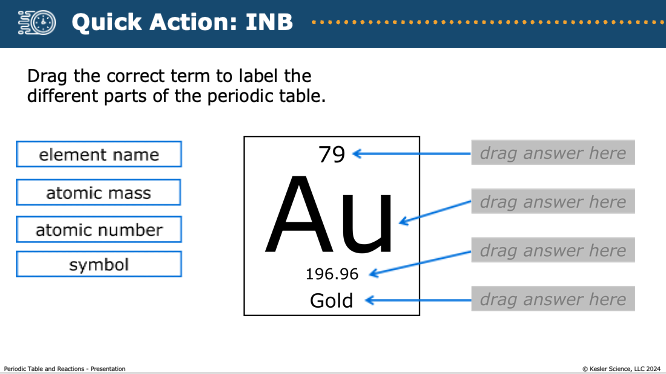
The Periodic Table & Reactions Presentation walks 8th graders through the full scope of TEKS 8.6B, one concept at a time, with periodic table visuals on nearly every slide. The deck opens by introducing the table itself: how all known elements are arranged in order of increasing atomic number (the number of protons), and how that order generally lines up with increasing atomic mass. From there it zooms in on a single tile and breaks down the four pieces of information on every element box: the atomic number, the chemical symbol, the atomic mass, and the element's name.
Students learn that the table is organized into periods (the rows numbered 1 through 7, where atomic number increases left to right) and groups or families (the columns numbered 1 through 18, where elements share similar chemical properties and reactivity). The deck then classifies every element into one of three big categories: metals (shiny, ductile, malleable, good conductors, high density, mostly on the left of the zigzag staircase), nonmetals (dull, brittle, poor conductors, low density, on the right), and metalloids (elements on the staircase itself with properties of both, like silicon used in microprocessors).
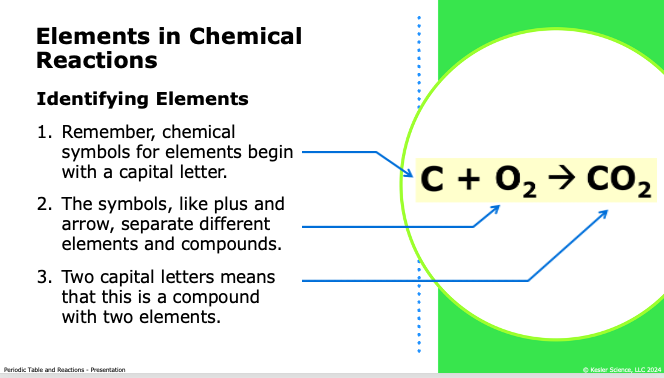
From there, the Presentation bridges the table directly into chemical equations. Students learn the rules that govern chemical symbols: every symbol starts with a capital letter, a following lowercase letter belongs to the same element (so Co is cobalt while CO is carbon plus oxygen), and the symbols on either side of a plus sign or arrow represent separate elements or compounds. The deck then practices the identification process on real reactions: the formation of carbon dioxide (C + O2 to CO2), the rusting of iron (Fe2O3), the formation of magnesium oxide (2Mg + O2 to 2MgO), and the neutralization reaction HCl + NaOH to H2O + NaCl. By the end, students are tracing every element in the equation for photosynthesis: 6CO2 + 6H2O to C6H12O6 + 6O2.
For every reaction, students see the same three-step process: locate the symbol on the table, name the element, classify it as a metal, nonmetal, or metalloid. That repetition (different reactions, same identification process) bakes the "use the periodic table to identify the atoms" verb of TEKS 8.6B into long-term memory.
What makes the Periodic Table & Reactions Presentation different from a typical chemistry slideshow is that kids are doing something on almost every single slide. It's not a lecture deck. It's a participation deck. "Your answer:" prompts appear on most slides, Brain Breaks reset attention every few slides (classifying real objects like a tumbler, pencil lead, and sulfur as metal, nonmetal, or metalloid), Quick Action INB tasks (drag the correct term to label parts of the periodic table, drag circle shapes to identify elements in equations) show up throughout, and Think About It prompts push deeper into bigger ideas like why a battery design team would choose lithium over lead or fluorine. The deck closes with a Check for Understanding tied back to the Essential Question: How can the periodic table be used to identify the atoms involved in chemical reactions?
The Explain materials in this product include:
- An editable 23-slide Presentation at two differentiated levels (Dependent and Modified), works in PowerPoint or Google Slides
- A guided fill-in-the-blank student notes handout that mirrors the Presentation, with answer key
- A Paper Interactive Notebook (English and Spanish) students cut, fold, and glue into their notebooks
- A Digital Interactive Notebook at both levels with answer keys, for 1:1 classrooms or Google Classroom
The Explain runs across two class periods. The built-in Think About It prompts are where the real discussion happens, so let those breathe.
🛠️ Elaborate
The Elaborate phase is where students stretch what they learned about the periodic table and chemical reactions and put it into a project of their choosing. In this 8th grade chemistry lesson, that's a Student Choice Project board with six different project options plus a "design your own" pathway.
Students might design a wanted poster for a missing element that lists its symbol, atomic number, and the reactions it's part of, or write and illustrate a children's book that follows a single atom through a chemical reaction, or build a 3D periodic table tile model for one of the trickier Latin-symbol elements (Na, Fe, Au, K, Pb) and explain where it shows up in everyday reactions. There are options for kids who love to write, kids who love to draw, kids who love to build, and kids who love to perform. Whatever the project, the point is the same: students apply the periodic table and chemical equations to a real-world artifact instead of a worksheet.
Choice is the whole point. By letting students pick how they show their thinking, you get more authentic work for TEKS 8.6B and you actually get to see what they understand about reading chemical reactions.
The rubric (the part teachers actually want)
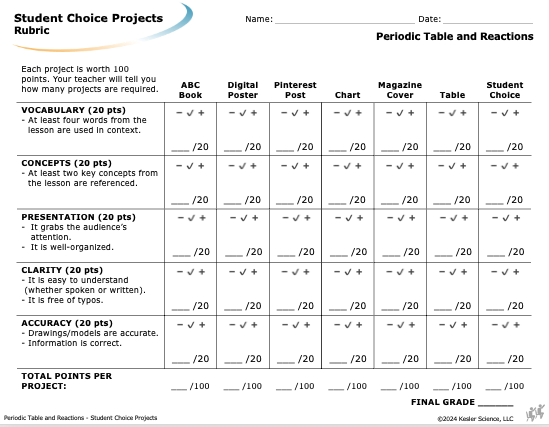
Every project, no matter which option a student picks, is graded on the same 100-point rubric. Five categories at 20 points each:
- Vocabulary (20 pts) — At least four words from the lesson are used in context.
- Concepts (20 pts) — At least two key concepts from the lesson are referenced.
- Presentation (20 pts) — The project grabs attention and is well-organized.
- Clarity (20 pts) — Easy to understand. Free of typos.
- Accuracy (20 pts) — Drawings and models are accurate. The science is right.
Two differentiated versions in one file
The standard version is for students ready for independent application. The Reinforcement version is for students who need additional vocabulary or concept support. Three of the six options are swapped for projects with a tighter vocabulary tie-in, and "design your own" is replaced with "collaborate with the teacher" so kids aren't pitching cold.
✅ Evaluate
The Evaluate phase wraps the unit with a formal assessment. It's not all bubble-in. Several questions hand students a chemical reaction and ask them to circle every element involved and name it using the periodic table.
The full assessment has 12 questions across five formats:
- Multiple choice (4 questions) covering element symbols, the structure of the periodic table, and counting atoms with subscripts and coefficients
- Hotspot / visual (2 questions) where students circle a target element on a periodic table and identify the atoms in a labeled chemical reaction
- Multiselect (2 questions) where students pick all elements present in a given chemical formula
- Short answer (2 questions) on why a chemical symbol like Na or Fe matters and how the periodic table is used to decode it
- Multipart scenario (2 questions) with a classroom discussion where kids identify which student's reasoning about a reaction is correct based on the periodic table
A modified version is included for students who need additional support, with fewer multiple-choice distractors and sentence-starter scaffolds on the short-answer items.
If you've taught all five phases, this assessment shouldn't surprise anyone. It's a chance for kids to show you they get it.
How everything fits together
If you want the whole experience (Engage hook, the Station Lab as the Explore, the Explain day with Presentation and interactive notebook, the Student Choice Elaborate, and the Evaluate assessment all in one download), that's the Periodic Table & Reactions Complete 5E Science Lesson.
If you only need the one-day hands-on activity, the Station Lab works as a standalone. Most teachers buy the full 5E because the Station Lab works harder when it's bookended by a strong Engage and a follow-up Explain. But both are honest options.

Get the Periodic Table & Reactions 5E Lesson

Or if you only need the one-day hands-on Station Lab:
(The Station Lab is included in the full 5E Lesson)
Frequently asked questions
Does this cover all of TEKS 8.6B?
Yes. The full standard is addressed across all five phases, with the "use the periodic table to identify the atoms" verb baked into the Engage atom hunt, the Station Lab Explore It!, and the Elaborate projects.
What do my students need to know before this lesson?
A basic understanding of atoms and elements from earlier grade-level standards (4th and 5th grade matter standards, plus TEKS 8.6A on classifying matter). If your kids know what an atom is and can name a few common elements, they're ready.
How long does it take to teach?
Done with fidelity, about 10 class periods of 45 minutes each: one day for the atom hunt Engage, two days for the Station Lab, two days for the Presentation and Interactive Notebook, three days for the Student Choice Project, and one to two days for review and the assessment. The product also ships with a compressed 8-day sample unit plan if you need to move faster.
Do I need special supplies?
Not really. Just printed periodic tables (the product includes one), highlighters or colored pencils, and the standard classroom stuff. No chemicals or lab equipment.
Does this work for digital classrooms?
Yes. Every component has a digital version. The Station Lab is fully digital-ready (Google Slides), the Presentation works in Google Slides, and the Student Choice Projects can be submitted as videos, slide decks, or written work.
Is this 5E lesson aligned to NGSS too?
It aligns most directly with MS-PS1-5 (developing and using a model to describe how the total number of atoms does not change in a chemical reaction) and supports MS-PS1-1 on atomic composition. Built TEKS-first, but the standards overlap heavily.