
8 hands-on stations for modeling the layers of Earth
A station lab is a student-led activity where small groups rotate through 8 stations (plus a 9th challenge station for early finishers) at their own pace during one to two class periods. You become a facilitator instead of a lecturer. You walk around, spot-check, and break misconceptions while kids work through the rotation.
The Modeling Layers of the Earth Station Lab has four input stations (where students take in new info on the crust, mantle, outer core, and inner core) and four output stations (where they show what they learned). Here's what's at each one.
4 input stations: how students learn the layers of Earth
A short YouTube video walks through Earth's four main layers and the conditions inside each one. Three questions follow: name the four main layers, explain why the inner core is solid while the outer core is liquid (extreme heat, but the inner core has even more pressure pressing it solid), and the deepest humans have ever drilled into the interior of Earth (12.2 km, the Kola Superdeep Borehole in Russia). Visual learners come alive at this station.
A one-page passage called "What Is Inside Our Earth?" walks students through each layer with thickness numbers in both kilometers and miles. The crust (8 km oceanic, 40 km continental). The mantle (2,900 km thick, hot and plastic-like). The outer core (2,200 km, mostly nickel and iron, liquid because temperatures hit 5,000°C). The inner core (1,200 km, also nickel and iron but solid because of extreme pressure). It also explains how seismic waves help scientists "see" inside Earth. The vocabulary is bolded throughout (crust, mantle, outer core, inner core, seismic waves). Three multiple-choice questions follow, plus the vocab notes section. Comes in two reading levels (Dependent and Modified) plus a Spanish version.
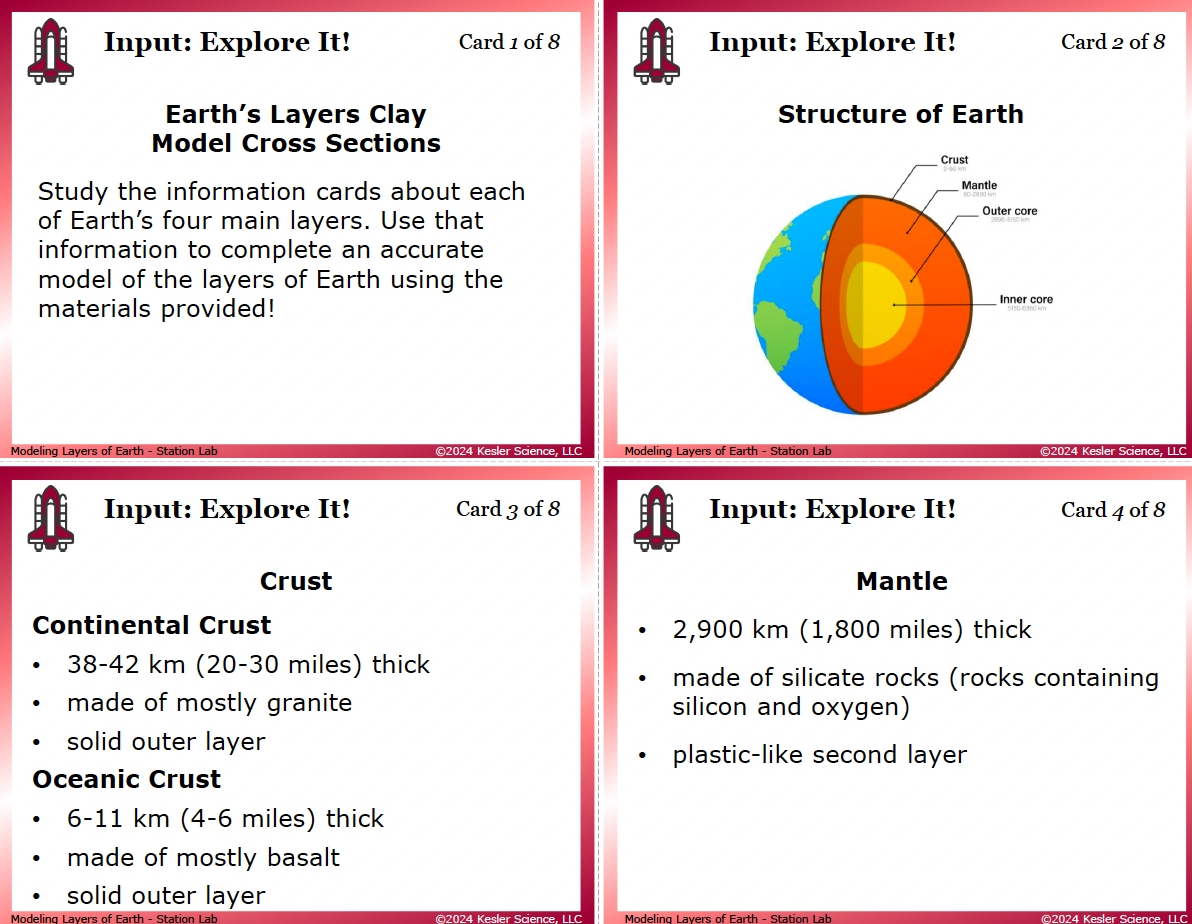
This is the heart of the lab. Students study four information cards (one for each layer with thickness, composition, and state of matter) and then build a clay cross-section model. Different color clay for each layer. Different colors for solid vs. liquid layers. The thicknesses have to be roughly accurate (the crust is a thin sliver, the mantle is by far the thickest layer). Three questions follow: how did you show solid vs. liquid in your model, what could you use besides clay, and why do scientists know so little about the inner layers. The final question is the hook for the Research It! station on seismic waves.
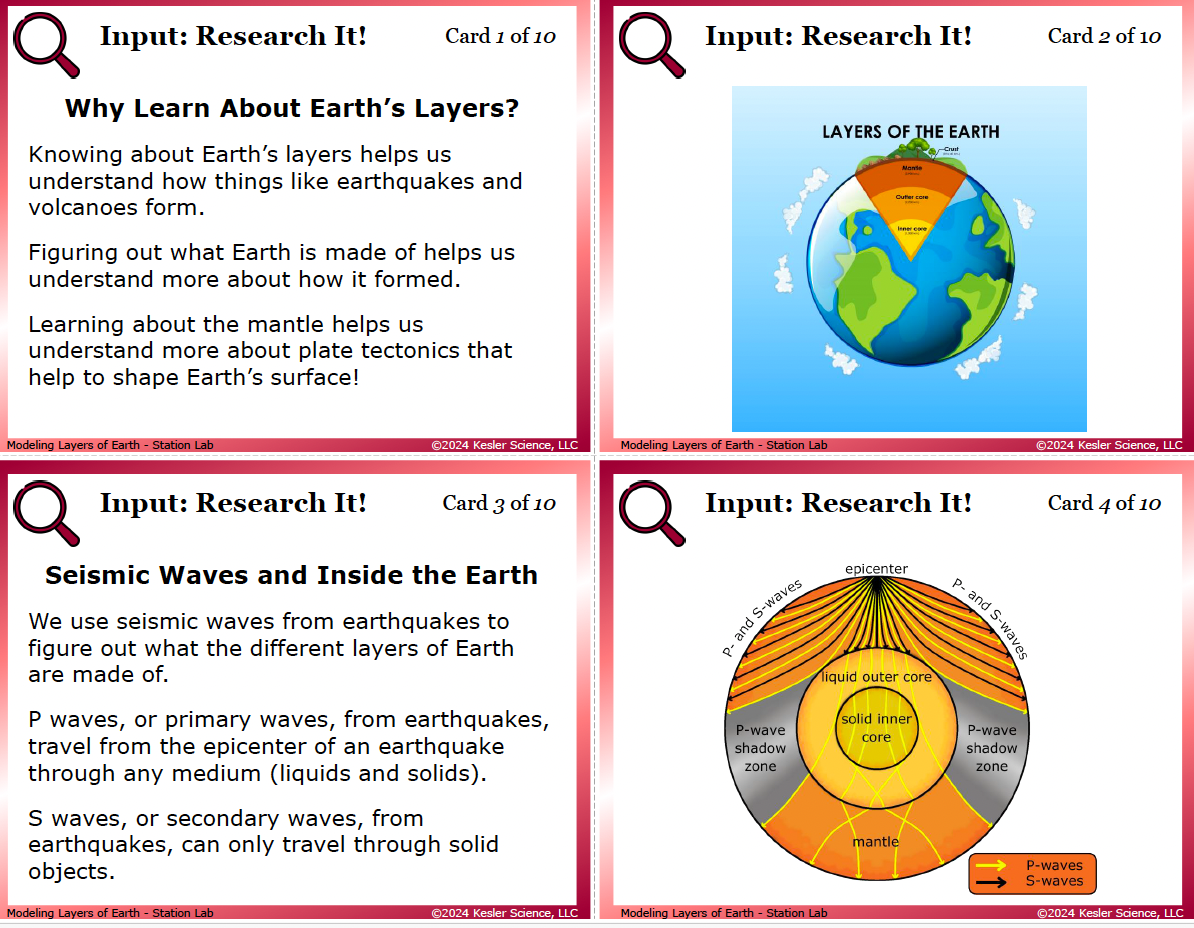
Students examine 10 reference cards. Why learning about Earth's layers matters (it explains earthquakes, volcanoes, and plate tectonics). How seismic waves work: P-waves travel through solids and liquids, but S-waves only travel through solids, which is how scientists figured out the outer core is liquid (it creates an S-wave shadow zone). The world's deepest mines (Mponeng Gold Mine in South Africa, 4 km) and the Kola Superdeep Borehole (12.2 km). Convection currents in the mantle that move tectonic plates. Six questions check understanding across all of these.
4 output stations: how students show what they learned
A four-column card sort. Kids match characteristics to crust, mantle, outer core, or inner core. State of matter (solid, plastic-like solid, liquid, solid). Composition (granite and basalt, silicate rocks, nickel and iron, nickel and iron). Thickness (8-40 km, 2,900 km, 2,200 km, 1,400 km). Plus a layer image card with arrows pointing to each. Easy to spot-check at a glance.
Students sketch an accurate diagram of Earth's four layers. Include all four layers, label thickness, composition (what each layer is made of), and state of matter. Different colors make the layers pop. The diagram is essentially the static version of the clay model from Explore It!, but the labels force kids to commit to specific numbers and materials.
Three open-ended questions: describe the different characteristics between the four layers (thickness, composition, location), describe Earth's crust and the differences between oceanic and continental crust (oceanic is thinner and made of basalt, continental is thicker and made of granite), and explain how seismic waves help scientists understand the interior of Earth without being able to get down there. This is the writing practice middle schoolers need and rarely get in science class.
Eight multiple-choice and fill-in-the-paragraph questions tied to TEKS 6.10B vocabulary (crust, mantle, outer core, inner core, seismic waves). Includes which layer has convection currents that move tectonic plates, the order of layers from inside to outside, what the inner and outer core are made of, and a fill-in paragraph that weaves all five vocab words together. If you're grading the lab, this is the easiest station to grade.
Bonus Challenge It! station for early finishers
Four optional extensions: design a travel brochure exploring Earth's layers, build a 10-word vocabulary crossword puzzle, build a 3D model of Earth showing all four layers with different materials, or write a creative story about a journey to the center of Earth. Requires teacher approval before they start.
How this fits into a complete layers of Earth unit
This Station Lab is the Explore day of our full Modeling Layers of the Earth Complete 5E Lesson for TEKS 6.10B. The complete two-week unit follows the 5E method of instruction and includes an Engage hook, the Modeling Layers of the Earth Station Lab for Explore, PowerPoint slides and interactive notebook pages for Explain, student choice projects to Elaborate, and an Evaluate assessment.
Most teachers grab the full 5E because the Station Lab lands hardest with the days around it. But if you just need a strong hands-on day on the layers of Earth, the Station Lab on its own does the job.

Get this layers of Earth activity

Or if you want the full two-week experience with the Engage hook, Explain day, Elaborate extension, and Evaluate assessment all included:
(Station Lab is included)
Frequently asked questions
What does TEKS 6.10B cover?
Texas TEKS 6.10B asks 6th grade students to model the layers of the Earth (crust, mantle, outer core, and inner core) and describe their relative composition, density, and thickness. Students should be able to identify each layer, name its primary materials, recognize whether it's solid or liquid, and understand why scientists use seismic waves to study the interior.
Is this kids' first time meeting the four layers of Earth?
Yes for most 6th graders. They might recognize the words "crust" or "core" from elementary read-alouds, but the formal four-layer model with thickness, composition, and state of matter is brand new. The Read It! passage introduces all four layers in bold, the Watch It! video shows the cross-section, and the Explore It! clay-model activity makes the structure physical.
How long does this layers of Earth activity take?
One to two class periods (45 to 110 minutes total). The Explore It! clay model is the longest piece, so plan for two periods the first time you run a station lab. Once your class has the rotation routine down, most groups can finish all 8 stations in one period.
Do I need a lot of supplies for this?
Modeling clay in four colors. That's pretty much it. Total cost for a class of 30: under $15 if you're starting from nothing. The clay is reusable across class periods and across school years. The Watch It! station also needs a device with internet.
Can I use this in a 1:1 digital classroom?
Yes. The full digital version (PowerPoint or Google Slides) works in 1:1 classrooms and Google Classroom. Students drag digital layer cards into a cross-section diagram instead of physically modeling. The Explore It! clay activity is harder to digitize. You can substitute a digital drawing tool or skip the clay and have students draw the cross-section on paper.