
8 Hands-On Stations for Teaching Matter Classification
A station lab is a student-led activity where small groups rotate through 8 stations (plus a 9th challenge station for early finishers) at their own pace during one to two class periods. You become a facilitator of the content rather than a lecturer. As kids are working, you're walking around, spot-checking, breaking misconceptions, and guiding students through the early phases of mastering the concept.
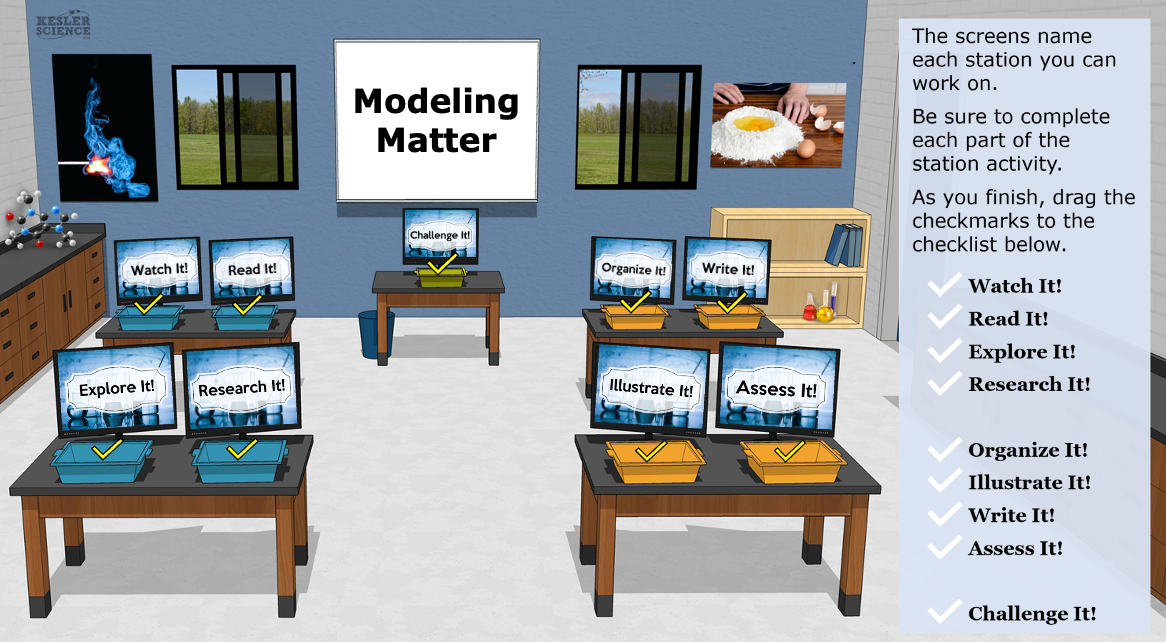
The Modeling Matter Station Lab has four input stations (where students take in new info on elements, compounds, and mixtures) and four output stations (where they show what they learned). Here's what's at each one.
4 Input Stations: How Students Learn Matter Classification
A short YouTube video shows someone using nuts, bolts, and washers to model elements, compounds, and mixtures. Students answer three questions and sort a list of substances (aluminum, water, salad dressing, air, etc.) into element / compound / mixture / homogeneous / heterogeneous. Visual learners come alive at this station.
A one-page reading passage explains the four classifications, with vocabulary work and three comprehension questions. Comes in two reading levels (dependent and modified) so you can differentiate without prepping anything extra. Spanish version included.
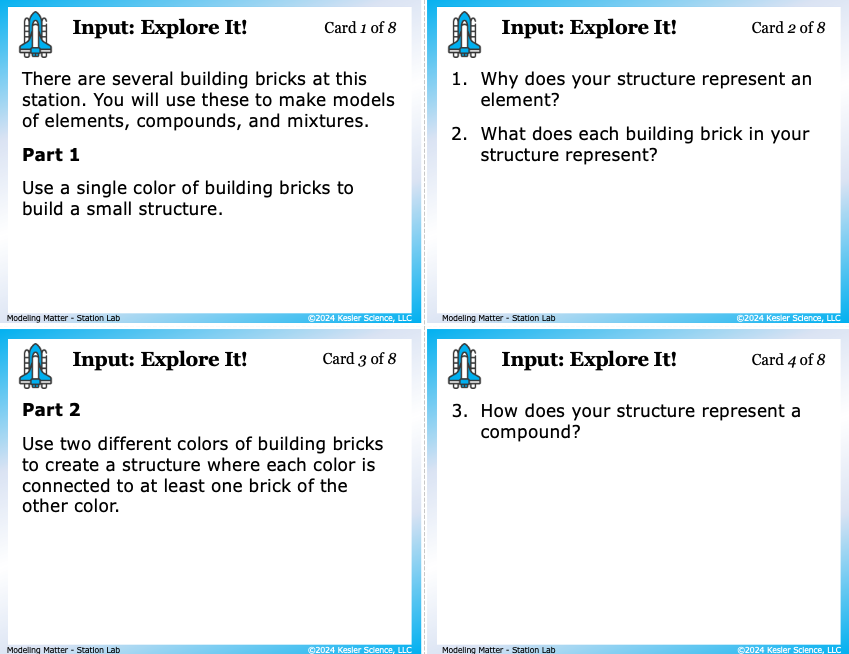
This is the heart of the lab. Students get a pile of colored building bricks (Lego, Mega Bloks, whatever you have) and build five different structures: an element (one color, one type of "atom"), a compound (two colors connected together), a homogeneous mixture (different colors evenly distributed), and a heterogeneous mixture (different colors clustered together). Then they explain why each model represents what it does. By the time they finish, they've taught themselves the whole standard.
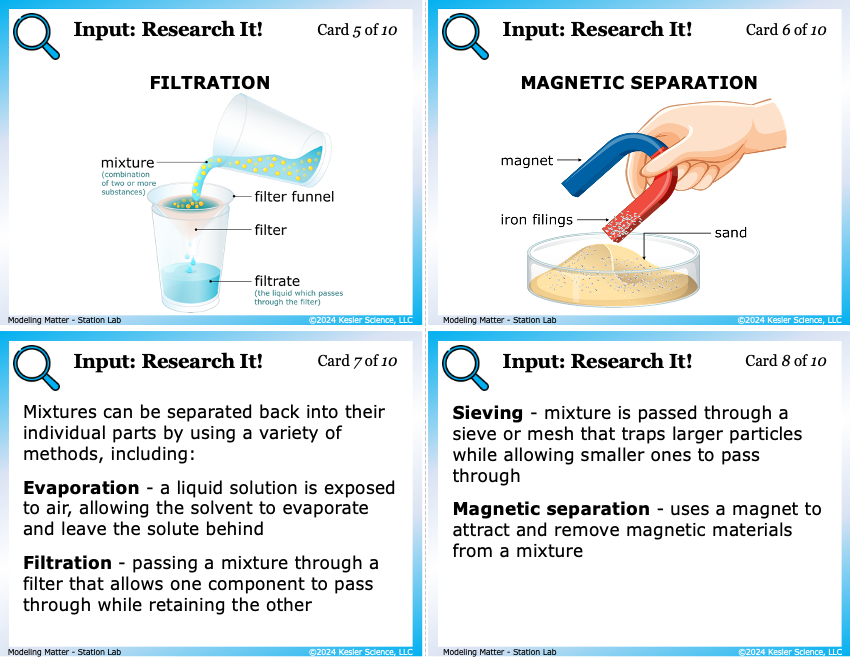
Students use reference cards (or the Genially in the digital version) to look up substances and classify them. They tackle harder questions like "if two elements from different groups combined, what would form?" and "how would you separate iron and sand?" This is where they connect the vocabulary to actual scientific thinking.
4 Output Stations: How Students Show What They Learned
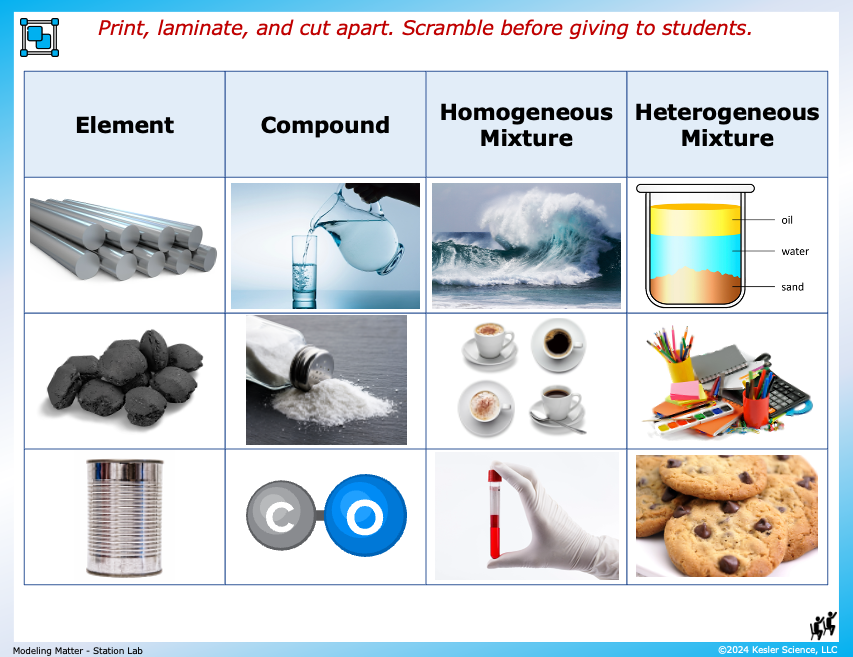
A card sort. Kids physically arrange substances under the four classification headers: element, compound, homogeneous mixture, heterogeneous mixture. Easy to spot-check at a glance. This is where I'd stand if I wanted to see who actually gets it.
Students draw a graphic organizer of the four matter categories with a picture and example for each. Even kids who say "I can't draw" surprise themselves here. The act of sketching it locks the categories in.
Three open-ended questions where students explain matter categories in their own words. ("If you found a brand new substance, walk me through how you'd figure out what category it belongs to.") This is the writing practice middle schoolers need and rarely get in science class.
Eight multiple-choice and vocabulary questions that double as a quick formative check. If you're grading the lab, this is the easiest one to grade.
Bonus Challenge It! Station for Early Finishers
Optional extension for early finishers. Requires teacher approval before they start (so it doesn't become a free-for-all).
How This Fits Into a Complete Elements, Compounds, and Mixtures Unit
At Kesler Science, most of our middle school resources are built around the 5E method of instruction (Engage, Explore, Explain, Elaborate, Evaluate). This Station Lab is from the Explore phase of the Modeling Matter 5E Lesson for TEKS 8.6A.
The full 5E Lesson also includes an Engage hook and activity, PowerPoint slides and interactive notebooks for Explain, student choice projects for Elaborate, and an Evaluate assessment. If you want the whole two-week unit, grab the 5E. If you just need the hands-on day, the Station Lab is plenty.
 Full 5E Lesson
$13.20
Full 5E Lesson
$13.20
 Just the Station Lab
$7.20
Just the Station Lab
$7.20
What You Get With This Matter Classification Activity
When you buy the Station Lab, you get a single download with everything you need:
- Print version at two reading levels (Dependent for on-grade learners, Modified for additional support) plus a Spanish Read It! passage
- Digital version as PowerPoint files (works in Google Slides too) at both levels — for 1:1 classrooms or Google Classroom
- Teacher Directions and Answer Key — both versions, all keys included
- Station task cards ready to print, laminate, and drop in envelopes at each station
- Student answer sheets for each level
Tips for Teaching Matter Classification in Your 8th Grade Classroom
Two things make this lab go smoother the first time:
1. Pre-sort your building bricks.
Put about 30 pieces in 4–5 colors at the Explore It! station. If you dump out a whole tub, kids will spend 20 minutes hunting for the right color and 5 minutes actually thinking about matter classification. Pre-sort and you flip the ratio.
2. Stand near Explore It! or Organize It! for the first rotation.
Those two stations show you the most about whether kids are actually getting the four-category distinction. If you're seeing wrong models or wrong sorts, you know to slow down at the Explain day. If you're seeing it click, you know they're ready to move on.
Get This Matter Classification Activity
Or if you want the full two-week experience with the Engage hook, Explain day, Elaborate extension, and Evaluate assessment all included:
(Station Lab is included)
Frequently Asked Questions
What does TEKS 8.6A cover?
Texas TEKS 8.6A asks 8th grade students to explain by modeling how matter is classified as elements, compounds, homogeneous mixtures, or heterogeneous mixtures. Students should be able to identify each category and explain the differences using concrete examples.
What's the difference between a homogeneous and heterogeneous mixture?
A homogeneous mixture has parts that are evenly distributed and look uniform throughout, like saltwater or air. A heterogeneous mixture has visibly distinct parts you can pick out, like a salad or sand mixed with iron filings.
How long does this matter classification activity take?
One to two class periods (45 to 110 minutes total). Most classes finish all 8 stations in one period the second time they run a station lab. The first time, plan for two periods so kids can learn the rotation and pacing without feeling rushed.
Do I need to provide my own materials?
Mostly no. Everything is in the download except colored building bricks (Lego, Mega Bloks, or any interlocking blocks) for the Explore It! station. A single $15 bag is plenty for a full class. The Watch It! station also needs a device with internet.
Can I use this for 7th grade or in a 1:1 digital classroom?
Yes to both. The Modified version of every station works as a stretch lesson for advanced 7th graders. The full digital version (PowerPoint or Google Slides) works in 1:1 classrooms and Google Classroom — students type into the slides and submit them back.