
Inside the Human Activity & Water 5E Lesson
The 5E instructional model walks students through five phases: Engage, Explore, Explain, Elaborate, and Evaluate. It flips the traditional lecture-first sequence on its head. Students explore a concept hands-on before you ever explain it, which means by the time you do explain it, they have something to hook the vocabulary onto.
I switched to the 5E model years ago and stopped going back. Kids retain more, ask better questions, and stop staring at me waiting to be told the answer. The Human Activity & Water 5E Lesson is built on this framework from start to finish. Here's how it plays out across the five phases.
🎯 Engage
Day one is a teacher-led watershed-model activity. Each small group gets a piece of butcher paper, washable markers in four colors, and a spray bottle of water. Following the step-by-step teacher directions, students crumple the paper into a watershed, draw a town, a farm, a factory, and a roadway, then spray and watch the colors bleed down into the lowest channel.
By the end of the period, kids have a sketch of how runoff carries pollutants from all over a watershed into a single body of water. Nobody has heard a vocabulary lecture yet. That's the point. They're walking into the rest of the unit with a working mental model of nonpoint source pollution, not a memorized definition.
What's included in the Engage:
- Teacher directions for the watershed-model activity
- Printable student observation sheet
- Answer key for the discussion questions
- Four learning objective slides (standard verbatim, "Analyze the influence" highlighted, "I CAN...", and "WE WILL...")
- An illustrated Earth Science Word Wall in English and Spanish covering the full unit vocabulary
🔬 Explore
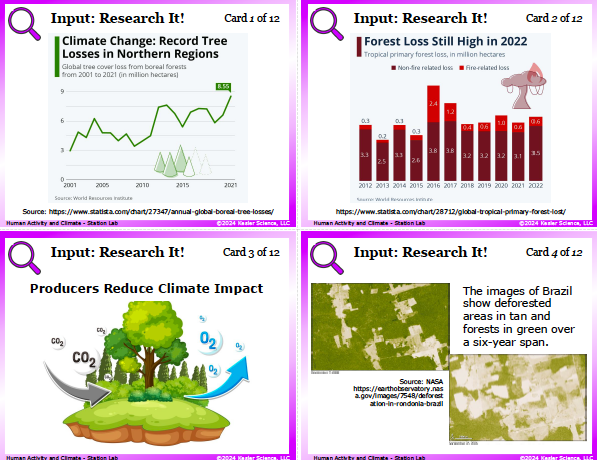
The Human Activity & Water Station Lab is the heart of the Explore phase. Students rotate through 8 stations (plus a 9th challenge station for early finishers) over one class period. The Station Lab is split into four input stations (where kids take in new information) and four output stations (where they show what they learned).
The four input stations:
- 🎬 Watch It! — Students watch a short video on watersheds, point source vs. nonpoint source pollution, and conservation, and answer guided questions.
- 📖 Read It! — A one-page reading passage at two differentiated levels, with a Spanish version included.
- 🔬 Explore It! — A filtration challenge where students try to clean "polluted" water using sand, gravel, and coffee filters and compare the results.
- 💻 Research It! — Reference cards on surface water vs. groundwater, watershed diagrams, eutrophication, and water treatment processes.
The four output stations:
- 📋 Organize It! — A card sort where students place pollution examples under point source or nonpoint source and label whether the impact is harmful or beneficial.
- 🎨 Illustrate It! — Students draw a labeled watershed diagram with sources of pollution and sources of conservation.
- ✍️ Write It! — Three open-ended questions in complete sentences (this is where you see who really gets it).
- 📝 Assess It! — A short formative check with multiple choice and a fill-in-the-blank vocabulary paragraph.
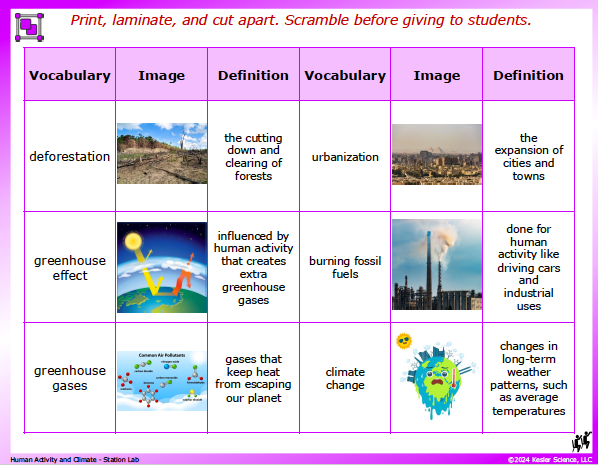
Print and digital versions are both included. If you want the full breakdown of what happens at every single station, what students produce, and how to set it up, that's in our dedicated Station Lab post.
→ Read the full Human Activity & Water Station Lab walkthrough 8 stations, materials list, teacher tipsThe Station Lab is included in the full 5E lesson. You don't need to buy it separately if you're getting the whole unit.
📚 Explain
Here's the real payoff of doing the Engage and Explore before the Explain: by the time kids hit this phase, they've already watched a watershed muddy itself and tried to filter dirty water with their hands. They have a working understanding before you ever start naming things. The discussions get deeper, the questions get sharper, and you spend less time defining and more time pushing their thinking.
The Human Activity & Water Presentation walks 7th graders through the full scope of TEKS 7.11A, one concept at a time, with maps, diagrams, and real-world photographs on nearly every slide. The deck opens with a quick reset on the water cycle and the surprising number that frames the whole unit: only about 1 percent of Earth's water is actually available freshwater. From there it builds out the framework: freshwater comes in two forms (surface water and groundwater), it moves through systems called watersheds, and human activity influences both quality and availability in ways that are sometimes beneficial and sometimes harmful.
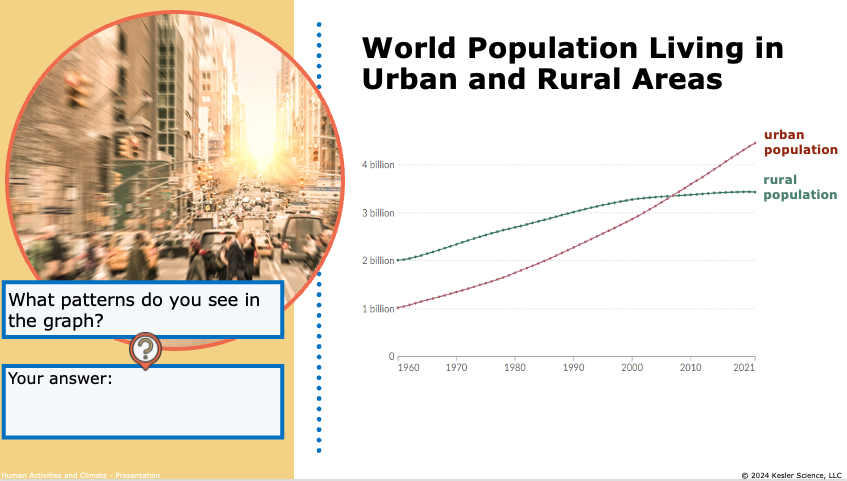
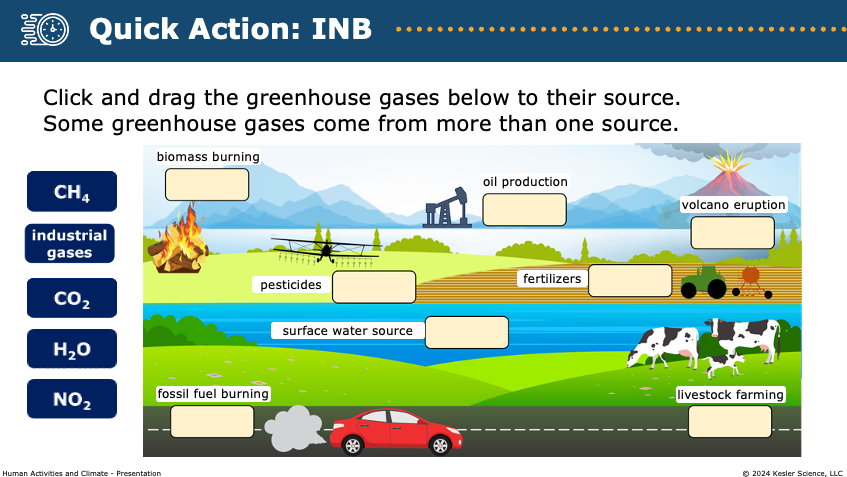
Students learn that groundwater is held in underground layers called aquifers, accessed by wells, and slow to refill once it's drained or contaminated. Surface water sits in rivers, lakes, streams, reservoirs, and wetlands and is much more prone to pollution because it's exposed. Both feed and are fed by watersheds, basin-like land formations that drain water (and anything mixed in with it) into a common outlet. A built-in Quick Action INB activity has students complete a watershed diagram by dragging features into their correct positions.
From there the deck turns to the two big ways human activity affects water: pollution and consumption. Students meet the difference between point source pollution (one identifiable source like a chemical pipe from a factory) and nonpoint source pollution (widespread sources like runoff from streets, lawns, and farms during a rainstorm). They unpack specific categories: surface water pollution, oil pollution, groundwater plumes, chemical pollution, agricultural runoff and the way excess fertilizer triggers eutrophication, and thermal pollution. The deck also covers water consumption, why agriculture is the largest user of freshwater in the United States, the difference between household and industrial use, and land subsidence caused by over-pumping aquifers. The beneficial side gets real time too: water treatment plants, conservation practices, and the technology humans use to clean water and protect watersheds.
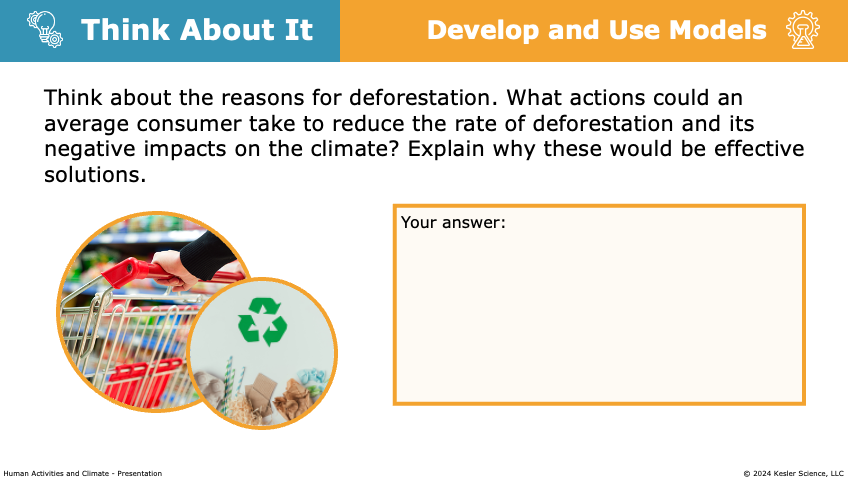
For every kind of pollution and conservation strategy, students see multiple representations: a diagram, a real-world map or photograph, and a sketch they make themselves. That layered repetition is what bakes the analyze the influence verb of TEKS 7.11A into long-term memory.
What makes this Presentation different from a typical Earth science slideshow is that kids are doing something on almost every single slide. It's not a lecture deck. It's a participation deck. "Your answer:" prompts appear on most slides, Brain Breaks reset attention every few slides, Quick Action INB tasks (the watershed diagram, the pollution-source sort, the conservation choices activity) show up throughout, and Think About It prompts push deeper into bigger ideas like cause and effect and model limitations. The deck closes with a Check for Understanding tied back to the Essential Questions: How can we analyze the influence of human activity on groundwater and surface water? How can human activity both benefit and harm groundwater and surface water in a watershed?
The Explain materials in this product include:
- An editable 35-slide Presentation at two differentiated levels (Dependent and Modified), works in PowerPoint or Google Slides
- A guided fill-in-the-blank student notes handout that mirrors the Presentation, with answer key
- A Paper Interactive Notebook (English and Spanish) students cut, fold, and glue into their notebooks
- A Digital Interactive Notebook at both levels with answer keys, for 1:1 classrooms or Google Classroom
The Explain runs across two class periods. The built-in Think About It prompts are where the real discussion happens, so let those breathe.
🛠️ Elaborate
The Elaborate phase is where students stretch what they learned about human activity and water systems and put it into a project of their choosing. In this 7th grade Earth science lesson, that's a Student Choice Project board with six different project options plus a "design your own" pathway.
Students might design a public service campaign for their own neighborhood explaining how lawn fertilizer ends up in the river, or build a 3-D model of a watershed with both pollution sources and conservation practices labeled. There are options for kids who love to write, kids who love to draw, kids who love to build, and kids who love to perform. Whatever the project, the point is the same: students apply point source pollution, nonpoint source pollution, watersheds, and conservation to a real-world artifact instead of a worksheet.
Choice is the whole point. By letting students pick how they show their thinking, you get more authentic work for TEKS 7.11A and you actually get to see what they understand about water systems.
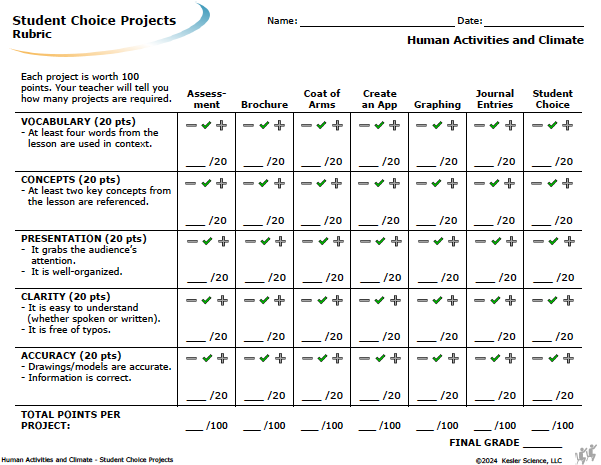
The rubric (the part teachers actually want)
Every project, no matter which option a student picks, is graded on a 100-point rubric. Five categories at 20 points each:
- Vocabulary (20 pts) — At least four words from the lesson are used in context.
- Concepts (20 pts) — At least two key concepts from the lesson are referenced.
- Presentation (20 pts) — The project grabs attention and is well-organized.
- Clarity (20 pts) — Easy to understand. Free of typos.
- Accuracy (20 pts) — Drawings and models are accurate. The science is right.
Two differentiated versions in one file
The standard version is for students ready for independent application of watershed analysis. The Reinforcement version is for students who need additional vocabulary or concept support. Three of the six options are swapped for projects with a tighter vocabulary tie-in, and "design your own" is replaced with "collaborate with the teacher" so kids aren't pitching cold.
✅ Evaluate
The Evaluate phase wraps the unit with a formal assessment. It's not all bubble-in. Several questions hand students watershed diagrams or pollution-source images and ask them to identify which type of pollution is shown and how it would impact the system.
The full assessment has 12 questions across five formats:
- Multiple choice (4 questions) covering surface water vs. groundwater, point vs. nonpoint source pollution, agricultural runoff, and water conservation
- Hotspot / visual (2 questions) where students click the pollution source in a watershed diagram and identify the location of an aquifer in a cross-section
- Multiselect (2 questions) where students pick all examples of nonpoint source pollution in a list of scenarios
- Short answer (2 questions) on how a homeowner's lawn-care choices can impact a river miles downstream
- Multipart scenario (2 questions) with a 3-student classroom debate where kids identify which reasoning about a polluted river is correct and which evidence supports it
A modified version is included for students who need additional support, with fewer multiple-choice distractors and sentence-starter scaffolds on the short-answer items.
If you've taught all five phases, this assessment shouldn't surprise anyone. It's a chance for kids to show you they get it.
How everything fits together
If you want the whole experience (Engage hook, the Station Lab as the Explore, the Explain day with Presentation and interactive notebook, the Student Choice Elaborate, and the Evaluate assessment all in one download), that's the Human Activity & Water Complete 5E Science Lesson.
If you only need the one-day hands-on activity, the Station Lab works as a standalone. Most teachers buy the full 5E because the Station Lab works harder when it's bookended by a strong Engage and a follow-up Explain. But both are honest options.

Get the Human Activity & Water 5E Lesson

Or if you only need the one-day hands-on Station Lab:
(The Station Lab is included in the full 5E Lesson)
Frequently asked questions
Does this cover all of TEKS 7.11A?
Yes. The full standard is addressed across all five phases, with the "analyze the influence" verb baked into the Explore, Explain, and Elaborate activities.
What do my students need to know before this lesson?
A basic understanding of the water cycle from earlier grade-level standards. If your kids can describe evaporation, condensation, and precipitation, they're ready.
How long does it take to teach?
Done with fidelity, about 10 class periods of 45 minutes each: one day for the watershed-model Engage, two days for the Station Lab, two days for the Presentation and Interactive Notebook, three days for the Student Choice Project, and one to two days for review and the assessment. The product also ships with a compressed 8-day sample unit plan if you need to move faster.
Do I need special supplies?
Just butcher paper, washable markers, and spray bottles for the Engage, plus sand, gravel, clear cups, and coffee filters for the Station Lab filtration challenge. Most teachers already have most of it and the rest is cheap at any grocery store.
Does this work for digital classrooms?
Yes. Every component has a digital version. The Station Lab is fully digital-ready (Google Slides), the Presentation works in Google Slides, and the Student Choice Projects can be submitted as videos, slide decks, or written work.
Is this 5E lesson aligned to NGSS too?
It aligns most directly with MS-ESS3-3 (applying scientific principles to design a method for monitoring and minimizing a human impact on the environment) and MS-ESS3-4 (constructing an argument supported by evidence for how increases in human population and per-capita consumption of natural resources impact Earth's systems). Built TEKS-first, but the standards overlap heavily.