
SEPs and Recurring Themes for 4th Grade Science
The 2024 science TEKS expect students to learn content through the scientific and engineering practices and the recurring themes and concepts. The real question is which ones fit which units, and how to teach them without rebuilding the curriculum you already have.
How the Practices, Themes, and Content Fit Together
In the 2024 science TEKS, you teach the content through the scientific and engineering practices and the recurring themes and concepts, all at the same time.
Scientific and Engineering Practices
The thinking and doing of science: asking questions, planning investigations, analyzing data, communicating evidence. The verbs students do.
Recurring Themes and Concepts
Big ideas that show up across every science domain: patterns; cause and effect; scale, proportion, and quantity; parts of a system; energy flows and matter cycles; structure and function; and stability and change.
Content
The science itself, in four strands: matter and energy; force, motion, and energy; Earth and space; and organisms and environments. The nouns of your year.
SEPsScientific and Engineering Practices
Four standards (4.1 to 4.4) broken into 16 student expectations. What students do as scientists, woven through every unit. Click any tile to jump to that student expectation.
Asking questions and conducting investigations
"The student asks questions, identifies problems, and plans and safely conducts classroom, laboratory, and field investigations to answer questions, explain phenomena, or design solutions using appropriate tools and models."
Ask Questions & Define Problems
Generate testable questions from observations and phenomena.
Plan & Conduct Investigations
Descriptive investigations, plus engineering design.
Lab Safety
Safe practices and safety equipment, in class and outdoors.
Use Scientific Tools
The right tool for the right measurement, used correctly.
Collect Observations & Measurements
Careful observations and measurements become evidence.
Tables, Graphs & Organizers
Tables, bar and line graphs, Venn diagrams, and flow charts.
Develop & Use Models
Build models and prototypes to explain and solve problems.
Ask questions and define problems
"Ask questions and define problems based on observations or information from text, phenomena, models, or investigations."
What this looks like in your classroom
Students start every unit by asking questions about something they saw or read, then sharpen them into questions they can actually test. When it's an engineering problem, they spell out what a good solution has to do.
- Generate questions from a phenomenon, demo, or reading
- Sort testable questions from ones they can't test
- Define an engineering problem with clear needs and constraints
- Turn a vague question into a specific one they can investigate
Pairs naturally with…
Sentence stems for kids
"I noticed… so I'm wondering…"
"The problem I want to solve is…"
"This question is testable because…"
Plan and conduct descriptive investigations
"Use scientific practices to plan and conduct descriptive investigations and use engineering practices to design solutions to problems."
What this looks like in your classroom
Students plan and run descriptive investigations. They observe, measure, and record what something is like or what happens, with no hypothesis to test and no setups to compare. When the goal is to solve a problem, they use engineering practices to design a solution.
- Plan what they'll observe, measure, and record before starting
- Describe what something is like or what happens, step by step
- Record observations and measurements as they go
- Use engineering design steps (define, design, test, improve)
Pairs naturally with…
Sentence stems for kids
"The question we're investigating is…"
"We will observe and measure…"
"We'll record our data in…"
Use safe practices and safety equipment
"Demonstrate safe practices and the use of safety equipment during classroom and field investigations as outlined in Texas Education Agency-approved safety standards."
What this looks like in your classroom
Students know which safety gear and rules apply before an investigation starts. Goggles, gloves, and careful handling aren't afterthoughts.
- Spot safety risks before the investigation starts
- Wear goggles and other safety equipment the right way
- Follow the class rules for heat, glass, and living things
- Know what to do if something goes wrong
Pairs naturally with…
Sentence stems for kids
"Before I start, the safety risks are…"
"The safety equipment I need is… because…"
"If something goes wrong, I will…"
Use scientific tools
"Use tools, including hand lenses; metric rulers; Celsius thermometers; calculators; laser pointers; mirrors; digital scales; balances; graduated cylinders; beakers; hot plates; meter sticks; magnets; notebooks; timing devices; sieves; materials for building circuits; materials to support observation of habitats of organisms such as terrariums, aquariums, and collecting nets; and materials to support digital data collection such as computers, tablets, and cameras, to observe, measure, test, and analyze information."
What this looks like in your classroom
Students know the right tool for each measurement and use it correctly. Wrong tool means wrong data.
- Match the tool to the measurement (mass to balance, volume to graduated cylinder, temperature to thermometer)
- Read tools carefully, to the smallest marked line, and record the unit
- Use hand lenses to see small details
- Keep a science notebook with the date, what they did, and what they saw
Pairs naturally with…
Sentence stems for kids
"I'm using a [tool] because I'm measuring…"
"The unit I'll record this in is…"
"My reading is… and the unit is…"
Collect observations and measurements
"Collect observations and measurements as evidence."
What this looks like in your classroom
Students collect both measurements and careful observations. Both count as evidence.
- Measure in metric units like centimeters, grams, milliliters, and degrees Celsius
- Record detailed observations (color, texture, shape, sound)
- Tell the difference between what they observed and what they think it means
- Use their data as evidence for a claim
Pairs naturally with…
Sentence stems for kids
"I measured…"
"I observed… so I think…"
"My evidence is…"
Construct graphic organizers
"Construct appropriate graphic organizers used to collect data, including tables, bar graphs, line graphs, tree maps, concept maps, Venn diagrams, flow charts or sequence maps, and input-output tables that show cause and effect."
What this looks like in your classroom
Students organize data so the patterns jump out. They pick the graphic organizer that fits the data.
- Set up a data table before the investigation starts
- Choose a bar graph or a line graph to fit the data
- Use Venn diagrams, flow charts, and input-output tables to organize ideas
- Label every axis with units; title every graph
Pairs naturally with…
Sentence stems for kids
"The best organizer for this is… because…"
"My graph shows…"
"When the input was…, the output was…"
Develop and use models
"Develop and use models to represent phenomena, objects, and processes or design a prototype for a solution to a problem."
What this looks like in your classroom
Students build models that show what they're trying to understand. Models can be drawings, diagrams, physical builds, or computer simulations. A prototype is a first try at a solution.
- Choose the model that fits what they're explaining
- Use the model to show how the parts work together
- Use the model to predict what happens when something changes
- Build and test a prototype for a solution
Pairs naturally with…
Sentence stems for kids
"My model represents… by…"
"This part of the model stands for…"
"If we changed [X] in the model, then [Y] would…"
Analyzing and interpreting data
"The student analyzes and interprets data to derive meaning, identify features and patterns, and discover relationships or correlations to develop evidence-based arguments or evaluate designs."
Limits of Models
Identify what models show well and what they leave out.
Patterns in Data
Find patterns and sources of error in data.
Mathematical Calculations
Use math to compare patterns and relationships.
Evaluate Designs
Judge a design or object against a list of criteria.
Identify advantages and limitations of models
"Identify advantages and limitations of models such as their size, scale, properties, and materials."
What this looks like in your classroom
Students treat every model as a helpful stand-in and ask two questions: what does this model show well, and what does it miss?
- List what the model shows well (the advantage)
- List what the model leaves out (the limitation)
- Spot when the model could fool someone
- Compare two different models of the same thing
Pairs naturally with…
Sentence stems for kids
"This model shows… but it doesn't show…"
"An advantage of this model is…"
"A limitation of this model is…"
Analyze data for features and patterns
"Analyze data by identifying any significant features, patterns, or sources of error."
What this looks like in your classroom
Students read their data and look for the story. What's the pattern, and what might have thrown it off?
- Find the highest, lowest, and most common values
- Spot patterns and trends in the data
- Recognize possible sources of error
- Repeat a measurement to check the results
Pairs naturally with…
Sentence stems for kids
"The pattern I see is…"
"A possible source of error here is…"
"This result looks different because…"
Use mathematical calculations
"Use mathematical calculations to compare patterns and relationships."
What this looks like in your classroom
Students do the math with their own data: adding, subtracting, and comparing. Math is how science answers "how much" and "how many more."
- Add and subtract measurements to find a change
- Use multiplication to compare, like "twice as far" or "three times as much"
- Compare two numbers to see which is bigger and by how much
- Show work with units throughout
Pairs naturally with…
Sentence stems for kids
"I subtracted… and got… [units]"
"The difference between… and… is…"
"The math shows that…"
Evaluate a design or object using criteria
"Evaluate a design or object using criteria."
What this looks like in your classroom
Students judge a design or an object against criteria, the list of things it has to do. Does it meet each one? What would make it better?
- List the criteria before judging anything
- Check a design or object against each criterion
- Suggest improvements based on the criteria it missed
- Compare two designs using the same criteria
Pairs naturally with…
Sentence stems for kids
"The criteria are…"
"This design meets the criterion… because…"
"It doesn't meet… yet, so we could…"
Developing evidence-based explanations and communicating findings
"The student develops evidence-based explanations and communicates findings, conclusions, and proposed solutions."
Develop Explanations
Explain with evidence from data and models.
Communicate Findings
Share findings in writing, talks, posters, and models.
Listen & Discuss
Listen for evidence and discuss ideas respectfully.
Develop explanations and propose solutions
"Develop explanations and propose solutions supported by data and models."
What this looks like in your classroom
Students explain WHY something happened and back it up with evidence from their data and models.
- Make a claim and back it up with evidence
- Use a model to help explain
- Propose solutions to problems based on data
- Tell the difference between an observation and an explanation
Pairs naturally with…
Sentence stems for kids
"My claim is…"
"My evidence is…"
"This evidence supports my claim because…"
Communicate explanations and solutions
"Communicate explanations and solutions individually and collaboratively in a variety of settings and formats."
What this looks like in your classroom
Students share their work in many ways. Science notebook, poster, talk, model, or slideshow. Pick the format that fits.
- Write clear explanations in their science notebooks
- Present findings out loud, alone and in groups
- Build posters, diagrams, or models to show what they learned
- Work respectfully with a team on a shared product
Pairs naturally with…
Sentence stems for kids
"Our findings are…"
"The most important thing we learned is…"
"We chose this format because…"
Listen actively and discuss respectfully
"Listen actively to others' explanations to identify relevant evidence and engage respectfully in scientific discussion."
What this looks like in your classroom
Students listen to each other's explanations, pick out the evidence, and respond respectfully, even when they disagree.
- Listen for the evidence in a classmate's explanation
- Ask questions about someone else's evidence
- Disagree respectfully and explain why
- Change their thinking when the evidence is strong
Pairs naturally with…
Sentence stems for kids
"I heard you say… and your evidence was…"
"I agree with… because…"
"I see it differently because…"
Contributions of scientists and the role of science in society
"The student knows the contributions of scientists and recognizes the importance of scientific research and innovation for society."
Discoveries & Society
How discoveries and inventions change science and daily life.
Explore STEM Careers
Investigate real STEM jobs through people and resources.
Explain how discoveries impact science and society
"Explain how scientific discoveries and innovative solutions to problems impact science and society."
What this looks like in your classroom
Science is a story told by many people. Students learn how discoveries and inventions changed what we know and how we live.
- Learn about scientists and inventors tied to each unit
- Explain how a discovery changed people's lives
- Connect an invention to the science behind it
- Recognize that science builds on earlier discoveries
Pairs naturally with…
Sentence stems for kids
"This discovery mattered because…"
"Before this invention, people…"
"This scientist's work helps us today by…"
Investigate STEM careers
"Research and explore resources such as museums, libraries, professional organizations, private companies, online platforms, and mentors employed in a science, technology, engineering, and mathematics (STEM) field to investigate STEM careers."
What this looks like in your classroom
Students start picturing themselves in STEM jobs. They explore what scientists, engineers, technicians, and mathematicians actually do.
- Research a STEM career tied to the current unit
- Read about working scientists and engineers
- Visit a museum or local STEM workplace (in person or virtually)
- Talk to a STEM professional or mentor
Pairs naturally with…
Sentence stems for kids
"A career that uses this kind of science is…"
"A [career] uses what we learned about… when they…"
"I'd want to learn more about [career] because…"
ThemesRecurring Themes and Concepts
One standard (4.5) with seven big ideas that show up everywhere. Point them out, name them, and students will start seeing them on their own.
Patterns
Repeating relationships in data and nature. Students notice them, then ask why.
Cause & Effect
One thing makes another happen. Students test it and predict what comes next.
Scale, Proportion & Quantity
Size, amounts, and time help describe, compare, and model systems.
Parts of a System
A system has parts that work together. Change one part and the rest can change too.
Energy Flows & Matter Cycles
Energy flows, matter cycles, and matter isn't lost when things are mixed.
Structure & Function
The way something is built shapes what it can do.
Stability & Change
Some things stay the same for a long time. Others change fast or slowly.
Patterns
"Identify and use patterns to explain scientific phenomena or to design solutions."
What this looks like in your classroom
Students start seeing repeating relationships across totally different topics. Once they spot a pattern, they ask why it happens.
- Spot patterns in data tables and graphs
- Predict what comes next based on what's come before
- Connect a pattern in one topic to a similar pattern in another
- Look for cycles that repeat over and over
Pairs naturally with…
Prompts and sentence stems
"I notice that every time…"
"I predict the next one will be… because…"
"This pattern looks like the one we saw in…"
Cause and Effect
"Identify and investigate cause-and-effect relationships to explain scientific phenomena or analyze problems."
What this looks like in your classroom
Students stop accepting "it just happens" and start asking what caused it, and what evidence supports that cause.
- Find the cause behind something they observed
- Tell the difference between two things happening together and one causing the other
- Predict an effect when a cause is changed
- Use evidence from an investigation to support a cause
Pairs naturally with…
Prompts and sentence stems
"The cause of this was…"
"If I change…, then… will happen because…"
"My evidence the cause is… is…"
Scale, Proportion & Quantity
"Use scale, proportion, and quantity to describe, compare, or model different systems."
What this looks like in your classroom
Students use size, amounts, and time to describe and compare things, and to build models of things too big, too small, or too slow to see.
- Describe things that are too small or too big to see directly
- Compare amounts using numbers and units
- Use a scale model to show something huge or tiny
- Think about how long a change takes (seconds or millions of years)
Pairs naturally with…
Prompts and sentence stems
"This is too [small / big / slow] to see, so we…"
"Compared to…, this is… times bigger"
"In real life, this would take…"
Parts of a System
"Examine and model the parts of a system and their interdependence in the function of the system."
What this looks like in your classroom
Students look at the whole system: what are the parts, and how do they depend on each other?
- Name the parts of a system and what each one does
- Build a model (drawing or physical) to show the system
- Predict what happens when one part changes or is removed
- Show what goes into and comes out of the system
Pairs naturally with…
Prompts and sentence stems
"What are the parts of this system?"
"What goes in? What comes out?"
"If we took away [X], what would happen to the rest?"
Energy Flows & Matter Cycles
"Investigate how energy flows and matter cycles through systems and how matter is conserved."
What this looks like in your classroom
Students track where things go. When something seems to disappear, they ask: where did the matter go? Where did the energy go?
- Trace matter through a cycle (the water cycle, or matter moving through a food web)
- Trace energy as it moves from one thing to another (a rolling ball, a water wave, a sound)
- Show that the total mass stays the same when things are mixed
- Use arrows in models to show the direction of flow
Pairs naturally with…
Prompts and sentence stems
"If matter looks like it disappeared, where did it actually go?"
"Where did the energy come from? Where did it go next?"
"Draw an arrow showing the flow."
Structure & Function
"Explain the relationship between the structure and function of objects, organisms, and systems."
What this looks like in your classroom
Students look at how something is built and ask why that shape matters for what it does.
- Connect the shape or parts of something to its job
- Predict how changing a structure would change what it does
- Compare structures in different organisms or objects
- Find the feature that makes something work
Pairs naturally with…
Prompts and sentence stems
"The structure of this is… and that lets it…"
"If we changed the structure to…, then…"
"Two things that look different do the same job because…"
Stability & Change
"Explain how factors or conditions impact stability and change in objects, organisms, and systems."
What this looks like in your classroom
Students notice that some systems stay about the same for a long time, while others change. They ask: what keeps it steady, and what would make it change?
- Notice what stays the same and what changes
- Predict what conditions would cause a change
- Tell slow changes from fast changes
- Find what caused a change
Pairs naturally with…
Prompts and sentence stems
"What keeps this the same?"
"What would have to change for this to change?"
"Is this change happening slowly or all at once?"
Where each practice and theme fits best
One row per unit, in no particular order. Teach your units in whatever order works for your campus. These are suggestions, not requirements. Just make sure every practice and theme shows up several times across the year.
| Unit | Practices to feature | Themes to feature |
|---|---|---|
| Matter & Mixtures 4.6A to 4.6C | 4.1CLab Safety 4.1DUse Scientific Tools 4.1ECollect Observations & Measurements 4.2CMathematical Calculations 4.2DEvaluate Designs 4.3CListen & Discuss | 4.5EEnergy Flows & Matter Cycles |
| Forces 4.7 | 4.1BPlan & Conduct Investigations 4.1ECollect Observations & Measurements 4.2BPatterns in Data 4.3CListen & Discuss | 4.5APatterns 4.5BCause & Effect |
| Energy, Conductors & Circuits 4.8A to 4.8C | 4.1AAsk Questions & Define Problems 4.1BPlan & Conduct Investigations 4.1CLab Safety 4.1FTables, Graphs & Organizers 4.2DEvaluate Designs 4.3ADevelop Explanations 4.4ADiscoveries & Society | 4.5APatterns 4.5DParts of a System 4.5EEnergy Flows & Matter Cycles 4.5FStructure & Function |
| Seasons & the Moon 4.9A to 4.9B | 4.1BPlan & Conduct Investigations 4.1ECollect Observations & Measurements 4.1FTables, Graphs & Organizers 4.1GDevelop & Use Models 4.2ALimits of Models 4.2BPatterns in Data 4.2CMathematical Calculations | 4.5APatterns 4.5CScale, Proportion & Quantity |
| Water Cycle, Weathering, Weather & Climate 4.10A to 4.10C | 4.1AAsk Questions & Define Problems 4.1CLab Safety 4.1ECollect Observations & Measurements 4.1FTables, Graphs & Organizers 4.1GDevelop & Use Models 4.2ALimits of Models 4.3BCommunicate Findings 4.3CListen & Discuss | 4.5BCause & Effect 4.5CScale, Proportion & Quantity 4.5DParts of a System 4.5GStability & Change |
| Natural Resources 4.11A to 4.11C | 4.1AAsk Questions & Define Problems 4.1DUse Scientific Tools 4.1GDevelop & Use Models 4.3BCommunicate Findings 4.4BExplore STEM Careers | 4.5BCause & Effect 4.5FStructure & Function |
| Producers, Food Webs & Fossils 4.12A to 4.12C | 4.1DUse Scientific Tools 4.1GDevelop & Use Models 4.2ALimits of Models 4.3ADevelop Explanations 4.4ADiscoveries & Society 4.4BExplore STEM Careers | 4.5CScale, Proportion & Quantity 4.5DParts of a System 4.5EEnergy Flows & Matter Cycles 4.5GStability & Change |
| Plants & Traits 4.13A to 4.13B | 4.1FTables, Graphs & Organizers 4.3BCommunicate Findings 4.3CListen & Discuss 4.4BExplore STEM Careers | 4.5BCause & Effect 4.5FStructure & Function |
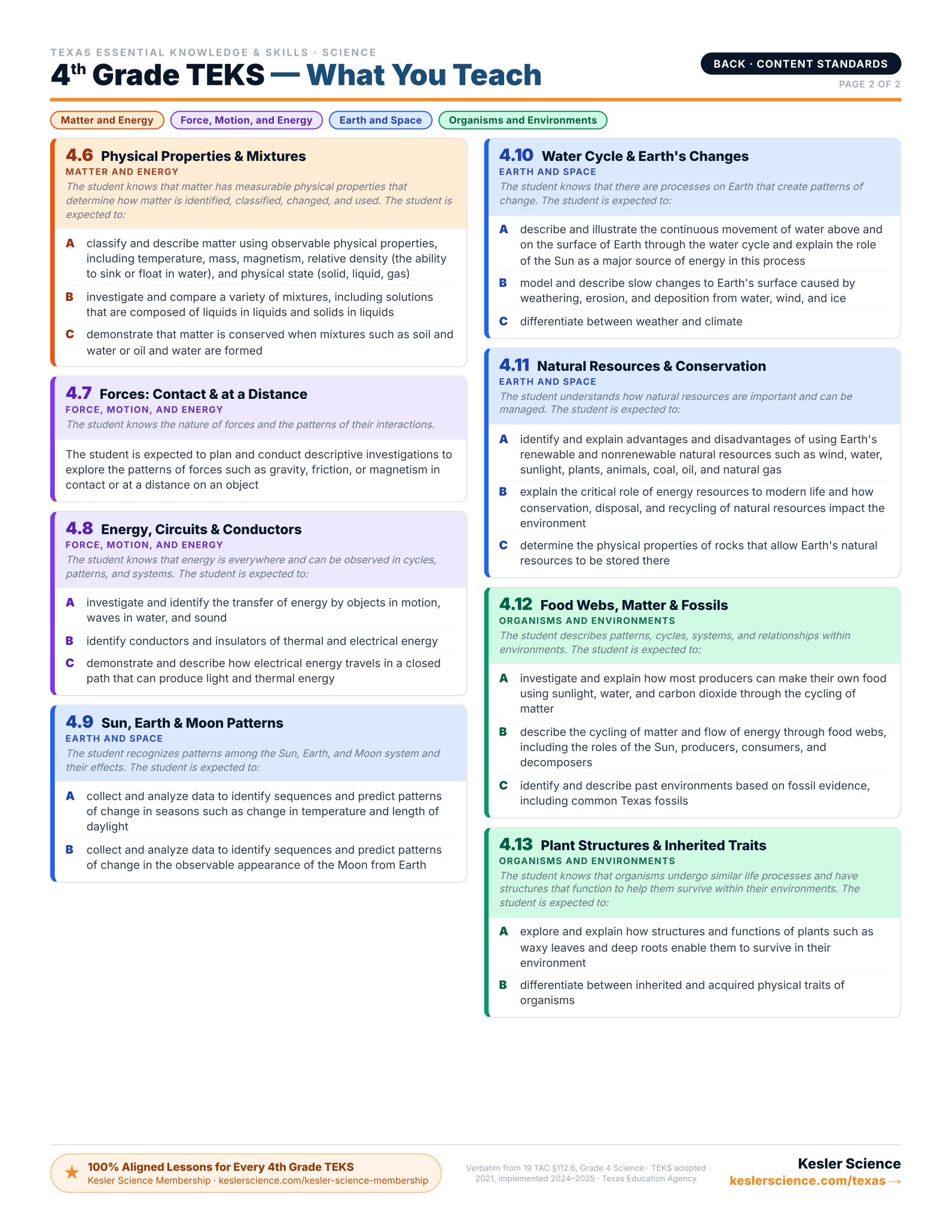
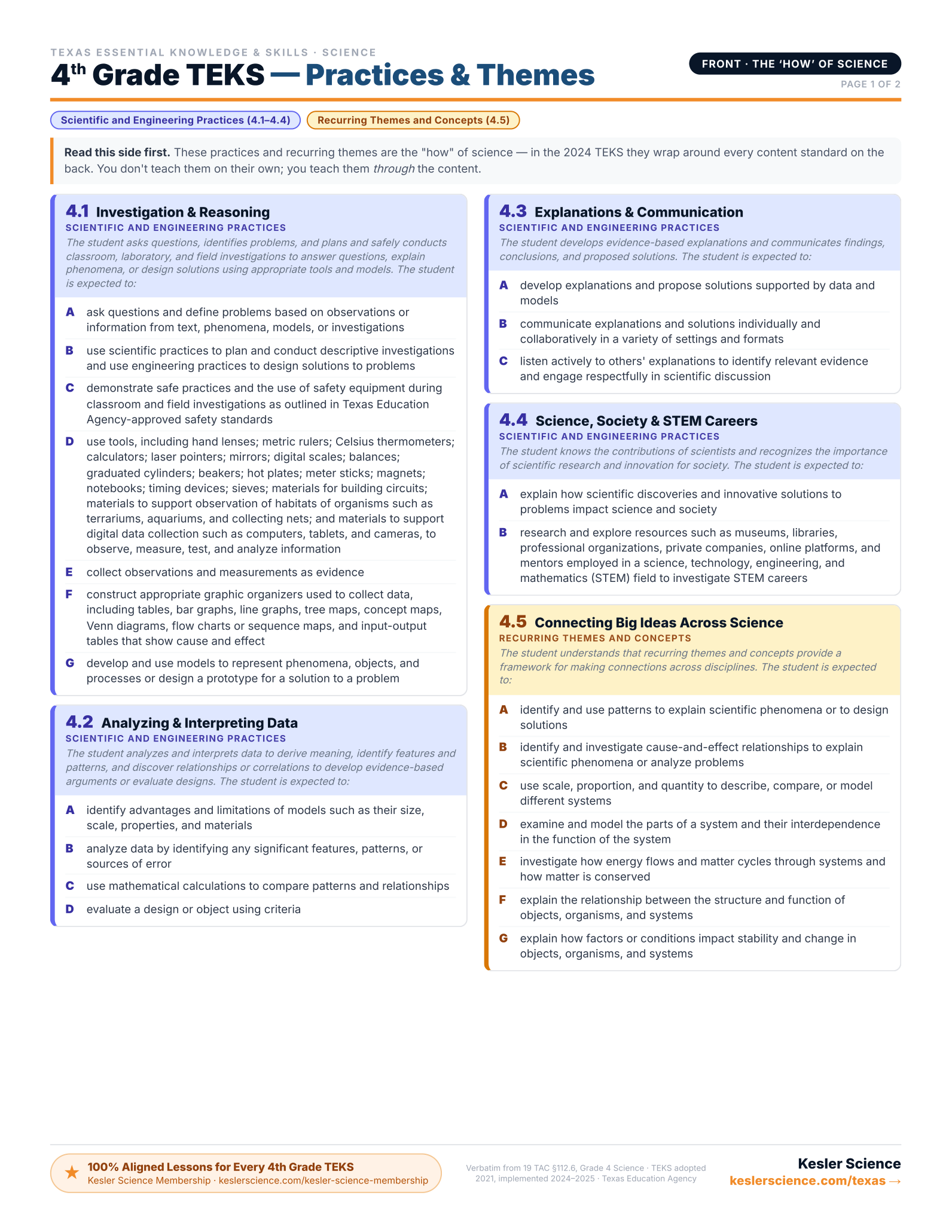
Every 4th-Grade Science TEKS on One Page
The color-coded, front-and-back cheat sheet I wish I'd had — every standard, organized by reporting category. Print it and reference it all year long. This will be your new favorite document!