.png?width=375&height=100&name=WebPage%20logo%20with%20curves%202026%20(8).png)
Every year my class built a periodic table wall, and every year we made it out of plain sheets of paper. It looked fine from across the room. Up close, the element symbols were all different sizes, and a few of them you just couldn't read.
Then I found a teacher on Pinterest whose class built theirs out of cereal boxes. Every symbol was the same size, every box had its own personality, and my paper wall suddenly looked pretty sad. (I wrote about that cereal box wall here.)
What bugged me later was that neither wall asked kids to actually use the periodic table. They copied an atomic number and a mass off a reference sheet, decorated a square, and moved on. That's a craft project. It looks great at open house, but it doesn't tell you much about what they learned.
TEKS 8.6B: Use the periodic table to identify the atoms involved in chemical reactions.
The word that matters in that standard is use. A good periodic table project has kids look at a chemical formula, figure out which elements are in it, and then go find those elements on the table and explain what the table tells them. If you want the full breakdown of the standard, it's on the TEKS 8.6B page of our Texas hub.
My one tip before you hand out the choice board
Put one reaction on the board that every student has to work into their project, no matter which project they pick. Baking soda and vinegar is a good one because they've all seen it fizz:
NaHCO3 + CH3COOH → CH3COONa + H2O + CO2
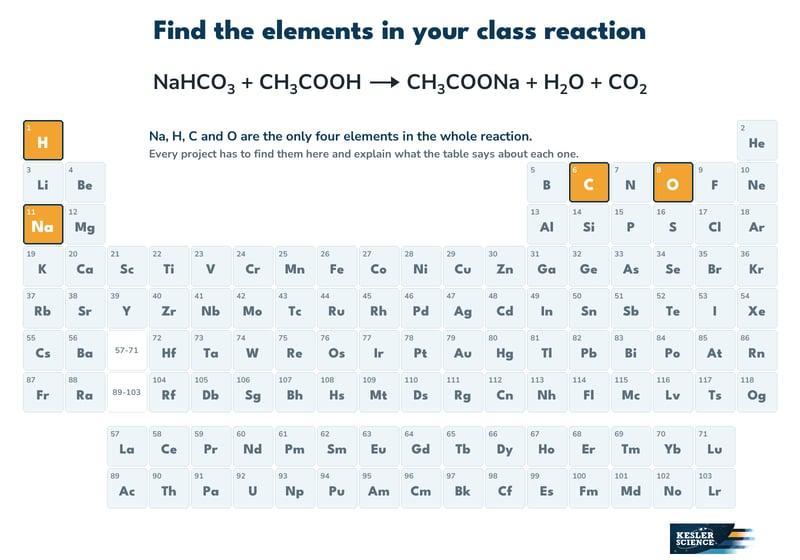
There are four elements in that reaction: sodium, hydrogen, carbon, and oxygen. Whether a kid makes a magazine cover or a video, they have to find those four on the periodic table and explain what they learned about each one. The projects all look different, but they're all proving the same thing, and that makes grading a whole lot easier.
4 periodic table project ideas I love
Any of these can work for 8.6B as long as the class reaction shows up in it.
1. ABC Book
A children's alphabet book about the periodic table. The fun part is watching kids wrestle with the hard letters. There's no element that starts with Q, so they'll have to get creative.
2. Magazine Cover
Kids love writing headlines. Something like "Why Sodium Can't Go Swimming" works because sodium reacts with water, and a headline like that sends them off to find out why.
3. Pinterest Post
Students pretend they're the teacher and design a pin for their own periodic table lesson. My students always loved getting to be the teacher, and to sell a lesson they have to understand it.
4. Cereal Box Periodic Table (whole class)
Each student gets an element and a cereal box. If you do this one, add a rule: every box has to name a real compound its element is part of and write out the formula. That one rule turns a craft project into an 8.6B project. The kids who draw helium or neon will come back and tell you they couldn't find one, and that opens up a great conversation about why noble gases barely react.
The part that usually kills student choice: grading
I know some of you are thinking, "Great, now I'm grading an ABC book, a magazine cover, and a video, and none of them look anything alike." That's the reason most of us give up on choice projects.
What makes it manageable is one rubric that works for every project, whatever the kid picked. If every project is graded on the same few things, a video and a poster are held to the same standard, and you're not writing a new rubric every time somebody gets creative.
You'll also want a way to support kids who aren't ready to run with a wide-open choice. A version of the choice board with fewer, more guided options lets them show what they know without getting lost.
Where it fits in the unit
I'd use it as the elaborate piece of the unit, after kids have already spent time with the table. The Periodic Table & Reactions Station Lab is a good lead-in, because students arrange color-coded shape cutouts and find the patterns for themselves before they ever start a project.
Not teaching in Texas? There's also a grades 6-8 version that leans into groups, periods, and reactivity trends.
I've done all the work for you
The Periodic Table & Reactions Student Choice Projects are ready to print:
- A choice board with nine project options plus a design-your-own option, all written for TEKS 8.6B
- A second, more guided choice board for students who need extra support
- One editable rubric that grades every project the same way
- Teacher directions
Get the Periodic Table Projects It's included in Kesler Science Plus
Give it a try this year. My bet is at least one kid turns in an ABC book you'll want to keep as your example for next year.